
BuddhistCatholicContemplativeEvangelicalGeneral ChristianHinduJewishLatter-day SaintMuslimNew VisionsProgressive Christian
Beliefs
- Buddhist
- Catholic
- Contemplative
- Evangelical
- General Christian
- Hindu
- Jewish
- Latter-day Saint
- More Voices
- Muslim
- New Visions
- Pagan
- Progressive Christian
Topics
- Religion News
- Food and Religion
- Sports and Religion
- Religious Art
- Religious Music and Entertainment
- Religious Events
- History and Religion
- Style and Religion
- Politics and Religion
- Women in Religion
- Recreation Outdoors and Religion
- Business Finance and Religion
- Careers Workplace and Religion
- Education and Religion
- Family Parenting and Religion
- Health Fitness and Religion
- Home and Religion
- Relationships and Religion
- Technology and Religion
- Travel and Religion
Columnists
- Buddhist Columnists
- Business Finance and Religion Columnists
- Careers Workplace and Religion Columnists
- Catholic Columnists
- Contemplative Columnists
- Education and Religion Columnists
- Evangelists Columnists
- Family Parenting and Religion Columnists
- General Christian Columnists
- Health Fitness and Religion Columnists
- Hindu Columnists
- History and Religion Columnists
- Home and Religion Columnists
- Jewish Columnists
- More Voices Columnists
- Latter Day Columnists
- Muslim Columnists
- New Visions Columnists
- Nonreligious Columnists
- Pagan Columnists
- Politics and Religion Columnists
- Progressive Columnists
- Recreation Outdoors and Religion Columnists
- Relationships and Religion Columnists
- Religion News Columnists
- Religious Art Columnists
- Religious Events Columnists
- Religious Music and Entertainment Columnists
- Sports and Religion Columnists
- Style and Religion Columnists
- Technology and Religion Columnists
- Travel and Religion Columnists
- Women in Religion Columnists
Resource Library
- 2026 Calendar
- Library of World Religions
- The 100 Most Holy Places on Earth
- Patheos Answers
- Podcasts
- Videos
- Faith Leaders Database
- Anglican Episcopalian
- Bahai
- Baptist
- Buddhism
- Christianity
- Confucianism
- Eastern Orthodoxy
- Hinduism
- Holiness and Pentecostal
- ISKCON
- Islam
- Judaism
- Lutheran
- Methodist
- The Church of Jesus Christ of Latter-day Saints
- New Age
- Paganism
- Presbytarian and Reformed
- Protestantism
- Religion Behind the Scenes
- Roman Catholic
- Scientology
- Shia Islam
- Sikhism
- Sufism
- Sunni Islam
- Taoism
- Zen
- See all religions
Research Tools
 Ad-Free & Subscriber Log-In Subscription Support
Ad-Free & Subscriber Log-In Subscription Support
Follow Patheos 

- Trending:
- Forgiveness
- |
- Marriage
- |
- Consciousness
- |
- Death Penalty
- |
- Election
- |
- Halloween

- Home
- Latter-day Saint
- Out with the old and in with the new
Out with the old and in with the new
Last updated on: December 28, 2022 at 11:49 pm by Dan Peterson
Out with the old and in with the new 2022-12-28T23:49:54-07:00 Dan Peterson
Patheos Explore the world's faith through different perspectives on religion and spirituality! Patheos has the views of the prevalent religions and spiritualities of the world.
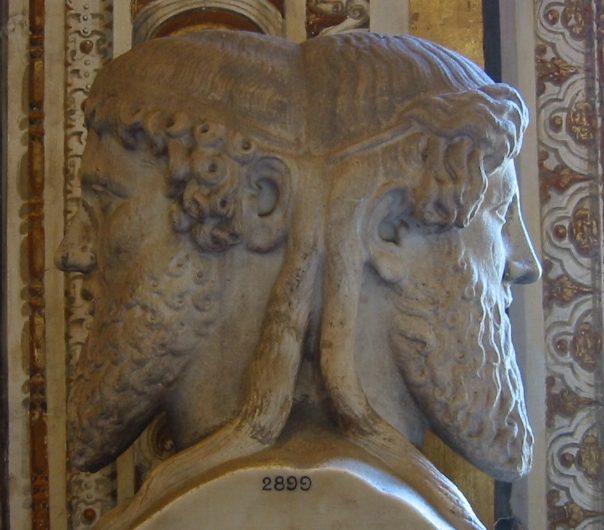
A statue of Janus in the Vatican Museum
(Wikimedia Commons pubic domain image)
I’ve just returned with two of my sons from watching Steven Spielberg’s semi-autobiographical film The Fabelmans. (My wife chose, instead, to spend the time with our visiting three-year-old granddaughter, who is, I readily admit, irresistibly adorable.) Although Indiana Jones doesn’t appear in the film and although it’s somewhat different from Jaws, Close Encounters of the Third Kind, E.T. the Extra-Terrestrial, and Jurassic Park, we enjoyed it quite a bit.
Earlier in the day, my wife and I drove up to the Salt Lake Valley to participate in the annual winter party of a reading group to which we’ve belonged for more than a couple of decades, and probably for the better part of thirty years. Its official title is the Gadianton Polysophical Marching and Chowder Society, and it began adjacent to the University of California at Santa Barbara, where its earliest members were either graduate students or on the faculty, many years before we were invited to join. We are very much on the younger end of the membership, and, alas, age is beginning to take its serious toll on our friends. We lost Davis Bitton, and Hal Moore and his wife, many years ago. George Bennion died in 2017; his widow, Joye, died this past June. John L. Sorenson passed away slightly more than a year ago; Todd Britsch died in late April. Jim Allen, who was recently widowed, was unable to come today. And the infirmities incident to age were very apparent today; we’ve been meeting mostly virtually over the past couple of years, and my wife and I have often been out of town for much of the past eight months or so, and I’m sorry to say that we noticed changes. It’s a great group, though. I had excellent conversations with, among others, Ben Bennion and his wife, and Tom Alexander, and the recently widowed Tom Rogers. Besides which, we had a fun “white elephant” exchange. And the food was really good.
***
Here’s a column that I wrote for the Deseret News back at the end of 2015. It’s directly relevant to the approaching New Year’s holiday:
January, the first month of the calendar year, most likely takes its name from the ancient Roman deity Janus, who was believed to be the gatekeeper of heaven. More generally, he was the god of doors, gateways (including city gates) and boundaries, and thus of beginnings and transitions, as well as a patron deity of traveling, trading and shipping.
Jan. 1 was New Year’s Day for the ancient Romans, who regarded beginnings as indicators or omens for whatever would follow. Accordingly, on the first day of January they would exchange good wishes as well as honey, dates, figs and coins.
Invoked at the beginning of each new year with burnt offerings of special cakes, Janus was peculiarly Roman; unlike most Roman deities, he had no Greek equivalent. He was typically represented with two faces, looking both to the past and toward the future.
Some ancient sources, however, say that Juno, the wife of the chief Roman god, Jupiter, was the goddess of the month, and even that January is named after her rather than Janus. For my purposes here, though, precisely how the month received its name is unimportant: Both Janus and Juno were connected with beginnings and transitions. Juno was the goddess of hearth and home, and was closely associated with conception and delivery. Juno and Janus presided together each month over the birth of the new moon.
Modern members of The Church of Jesus Christ of Latter-day Saints worship neither Janus nor Juno, but they should never forget that the God they do worship is, very emphatically, the Lord of new beginnings.
Repentance permits us, Janus-like, to look toward and reflect upon the past while turning with renewed purpose toward the future. The gift of the Atonement so clearly explained in the New Testament and, perhaps even more clearly, in the Book of Mormon, is already implicit in the Old Testament: “Come now, and let us reason together, saith the Lord: though your sins be as scarlet, they shall be as white as snow; though they be red like crimson, they shall be as wool” (Isaiah 1:18). “Return unto me, and I will return unto you, saith the Lord of hosts” (Malachi 3:7).
The hope of resurrection and the prospect of life even beyond the grave illustrate our limitless potential and the unending opportunity that has been given to us, however difficult our current circumstances may seem and however dejected we may sometimes feel. They declare that no defeat here in this world need be permanent, that no loss need be forever.
In baptism and in the weekly renewal of covenants associated with the sacrament, we have powerful symbols of new beginnings. We are buried in the water, as Jesus Christ was buried in the tomb. But, because of him and like him, we emerge born again to new life. The heavy rock that sealed him, seemingly forever, in his grave and that appeared to have permanently ended his mission in humiliating defeat was unable to prevent him from rising again in triumph.
John the Revelator saw him while exiled upon the small island of Patmos. “And he that sat upon the throne said, Behold, I make all things new” (Revelation 21:5).
The division between calendar years is only traditional and a human convention, much like the boundaries between states. But the practice of reflecting upon our past and of resolving to act better in the future is a good one at any time — on the first of January no less than at baptism and every week during worship services — and we should do it often.
It’s a pity that, all too frequently, many people begin the New Year with overindulgence and in a chemically induced haze. If the Romans were right, that the beginning of a year is an indicator or omen for what will follow, such practices are ill-considered, and perhaps even (literally) ominous.
This season is a time for fun, of course, and for family and friends. But it should also be an occasion for serious reflection, for taking stock and for determining to move forward during the coming year.
The marvelous English writer G. K. Chesterton made an excellent point when he suggested that, “The object of a New Year is not that we should have a new year. It is that we should have a new soul.”
Through repentance, resolution, renewed covenants and the help of the Spirit, a “new soul” is actually possible for each and every one of us. Hallelujah!
Gadianton Polysophical Marching and Chowder Society
Previous Post

December 27, 2022
Religiosity, Depression, and Life Expectancy
Next Post
December 29, 2022 Cosmological 1
Browse Our Archives
Select a Category Uncategorized
Select a Month October 2026 September 2026 August 2026 July 2026 June 2026 May 2026 April 2026 March 2026 February 2026 January 2026 December 2025 November 2025 October 2025 September 2025 August 2025 July 2025 June 2025 May 2025 April 2025 March 2025 February 2025 January 2025 December 2024 November 2024 October 2024 September 2024 August 2024 July 2024 June 2024 May 2024 April 2024 March 2024 February 2024 January 2024 December 2023 November 2023 October 2023 September 2023 August 2023 July 2023 June 2023 May 2023 April 2023 March 2023 February 2023 January 2023 December 2022 November 2022 October 2022 September 2022 August 2022 July 2022 June 2022 May 2022 April 2022 March 2022 February 2022 January 2022 December 2021 November 2021 October 2021 September 2021 August 2021 July 2021 June 2021 May 2021 April 2021 March 2021 February 2021 January 2021 December 2020 November 2020 October 2020 September 2020 August 2020 July 2020 June 2020 May 2020 April 2020 March 2020 February 2020 January 2020 December 2019 November 2019 October 2019 September 2019 August 2019 July 2019 June 2019 May 2019 April 2019 March 2019 February 2019 January 2019 December 2018 November 2018 October 2018 September 2018 August 2018 July 2018 June 2018 May 2018 April 2018 March 2018 February 2018 January 2018 December 2017 November 2017 October 2017 September 2017 August 2017 July 2017 June 2017 May 2017 April 2017 March 2017 February 2017 January 2017 December 2016 November 2016 October 2016 September 2016 August 2016 July 2016 June 2016 May 2016 April 2016 March 2016 February 2016 January 2016 December 2015 November 2015 October 2015 September 2015 August 2015 July 2015 June 2015 May 2015 April 2015 March 2015 February 2015 January 2015 December 2014 November 2014 March 2014 August 2013 February 2012
Follow Us!
TAKE THE
Religious Wisdom Quiz
What Christian tradition is associated with the seven sacraments?
Select your answer to see how you score.
Quakerism Roman Catholicism Protestantism Seventh-day Adventism
Related posts from Sic et Non

The Latest in Mahonri Moriancumr Studies

TRENDING AT PATHEOS Latter-day Saint

The Sermon on the Mount, Part I: Matthew...
The Sermon on the Mount, Part I (Matthew 4:12-5:12) St. Matthew moves...

What's up from Crossway: Reviewing some of their latest A few weeks...

Janie Learns the Way of the Cross: A...
Teaching children about Jesus' Passion can be challenging. Many parents and educators...

Looking For Good Catholic Writing - October 2026
He alone extends the heavens, and he walks upon the waves of...

In "Irreplaceable," our book on vocation and technology, Trevor Sutton and I...

I was strolling through the top floor of the brand new Parthenon...
view all Latter-day Saint blogs
Ad-Free & Subscriber Log-In Subscription Support
- About Us
- 2026 Calendar
- Videos
- Podcasts
- Library of World Religions
- Faith In Media Tracker
- Advertise With Us
- Write for Us
- Privacy Policy
- Terms of Service
- Do Not Sell My Data
- Contact Us
- Radiant Digital
- Manage Newsletter Subscriptions
- Unsubscribe From Notifications
- Sitemap
Copyright 2008-2026, Patheos. All rights reserved.
Subscription Support Ad-Free & Subscriber Log-In
Follow Patheos