
BuddhistCatholicContemplativeEvangelicalGeneral ChristianHinduJewishLatter-day SaintMuslimNew VisionsProgressive Christian
Beliefs
- Buddhist
- Catholic
- Contemplative
- Evangelical
- General Christian
- Hindu
- Jewish
- Latter-day Saint
- More Voices
- Muslim
- New Visions
- Pagan
- Progressive Christian
Topics
- Religion News
- Food and Religion
- Sports and Religion
- Religious Art
- Religious Music and Entertainment
- Religious Events
- History and Religion
- Style and Religion
- Politics and Religion
- Women in Religion
- Recreation Outdoors and Religion
- Business Finance and Religion
- Careers Workplace and Religion
- Education and Religion
- Family Parenting and Religion
- Health Fitness and Religion
- Home and Religion
- Relationships and Religion
- Technology and Religion
- Travel and Religion
Columnists
- Buddhist Columnists
- Business Finance and Religion Columnists
- Careers Workplace and Religion Columnists
- Catholic Columnists
- Contemplative Columnists
- Education and Religion Columnists
- Evangelists Columnists
- Family Parenting and Religion Columnists
- General Christian Columnists
- Health Fitness and Religion Columnists
- Hindu Columnists
- History and Religion Columnists
- Home and Religion Columnists
- Jewish Columnists
- More Voices Columnists
- Latter Day Columnists
- Muslim Columnists
- New Visions Columnists
- Nonreligious Columnists
- Pagan Columnists
- Politics and Religion Columnists
- Progressive Columnists
- Recreation Outdoors and Religion Columnists
- Relationships and Religion Columnists
- Religion News Columnists
- Religious Art Columnists
- Religious Events Columnists
- Religious Music and Entertainment Columnists
- Sports and Religion Columnists
- Style and Religion Columnists
- Technology and Religion Columnists
- Travel and Religion Columnists
- Women in Religion Columnists
Resource Library
- 2026 Calendar
- Library of World Religions
- The 100 Most Holy Places on Earth
- Patheos Answers
- Podcasts
- Videos
- Faith Leaders Database
- Anglican Episcopalian
- Bahai
- Baptist
- Buddhism
- Christianity
- Confucianism
- Eastern Orthodoxy
- Hinduism
- Holiness and Pentecostal
- ISKCON
- Islam
- Judaism
- Lutheran
- Methodist
- The Church of Jesus Christ of Latter-day Saints
- New Age
- Paganism
- Presbytarian and Reformed
- Protestantism
- Religion Behind the Scenes
- Roman Catholic
- Scientology
- Shia Islam
- Sikhism
- Sufism
- Sunni Islam
- Taoism
- Zen
- See all religions
Research Tools
 Ad-Free & Subscriber Log-In Subscription Support
Ad-Free & Subscriber Log-In Subscription Support
Follow Patheos 

- Trending:
- Forgiveness
- |
- Marriage
- |
- Consciousness
- |
- Death Penalty
- |
- Election
- |
- Halloween

- Home
- Latter-day Saint
- Are logic and mathematics purely rational? (1)
Are logic and mathematics purely rational? (1)
Last updated on: December 16, 2022 at 8:30 pm by Dan Peterson
Are logic and mathematics purely rational? (1) 2022-12-16T20:30:57-07:00 Dan Peterson
Patheos Explore the world's faith through different perspectives on religion and spirituality! Patheos has the views of the prevalent religions and spiritualities of the world.
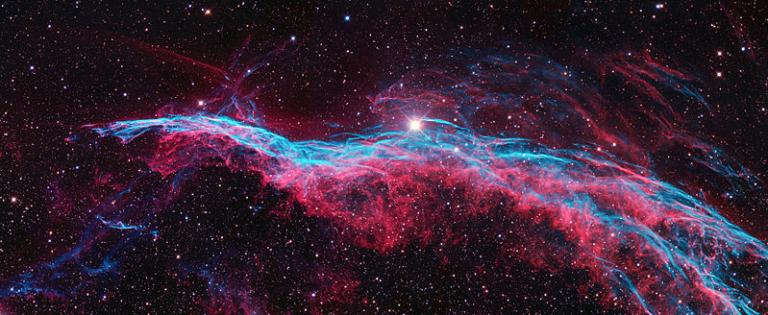
NGC6960, the Veil Nebula (Wikimedia Commons public domain image)
The following went up today on the website of the Interpreter Foundation:
Conference Talks: “The Scale of Creation in Space and Time,” given by John S. Lewis
In this presentation, which was given at the 9 November 2013 Interpreter Symposium on Science and Mormonism: Cosmos, Earth, and Man, the distinguished planetary scientist John S. Lewis, an adult convert to the Church of Jesus Christ of Latter-day Saints, discusses several aspects of the creation stories in scripture for the purpose of distinguishing anachronistic modern reinterpretations from the content of the original vision.
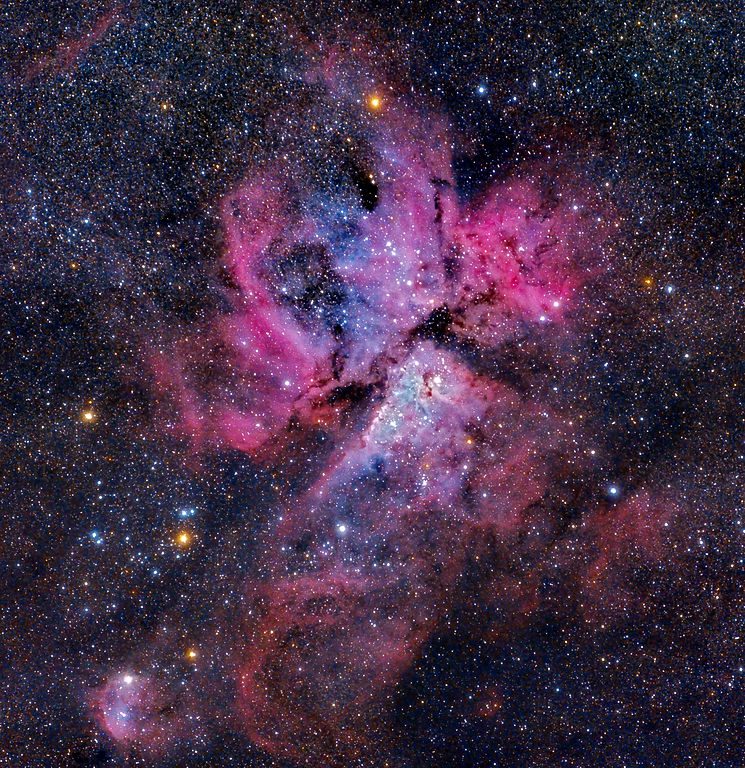
The Carina Nebula, NGC 3372 (Wikimedia Commons public domain image)
Still more or less on the science front: Recently, a friend not only recommended but generously gave me a copy of Michael Guillen’s Believing is Seeing: A Physicist Explains How Science Shattered His Atheism and Revealed the Necessity of Faith (Carol Stream, IL: Tyndale Refresh, 2021). Dr. Guillen, who grew up in East Los Angeles (not too terribly far from where I myself was raised, although he’s a few years younger) before studying mathematics, physics, and astronomy at UCLA and Cornell, taught physics for eight years at Harvard University before becoming the chief science editor for ABC News.
Herewith, I share some notes inspired by and/or based upon Believing is Seeing. For me, they constitute a hasty and unpolished first pass on this topic:
For many if not most people, about the closest that we can come to certainty in this life is mathematics. I doubt that I’m the only one around who spent a lot of time on such things as geometric proofs. But mathematics appears not to be as certain as we have imagined.
Take the ancient mathematician Euclid (fl. ca. BC 300), for example, and his famous book known as the Elements (Στοιχεῖα), one of the greatest classics in the entire history of mathematical thought.
His treatise, which was not only intensely studied but remained enormously influential for many centuries, rests on the assumption of fully thirty-three axioms — propositions that he cannot prove. Twenty-three of them are definitions. Five each are postulates and “common notions.”
The “common notions” are pretty easily illustrated with simple processes of counting. And they’re quite trivial. But the other axioms, the postulates, are neither trivial nor easily illustrated, although they must be accepted in order to proceed with the development of Euclid’s extraordinary intellectual structure.
Consider, for example, the geometric concept of a “point.” It has no width, no depth, and no length. It’s something, and yet, simultaneously, it’s nothing. Just try to picture it — without length, depth, or breadth.
Or consider logic, surely the most logical of all disciplines! Friedrich Ludwig Gottlob Frege (1848-1925) was a very great German logician, who hoped to derive all of arithmetic from the smallest possible set of axioms. In the first volume of his planned three-volume Grundgesetze der Arithmetik (“The Basic Laws of Arithmetic”), which was published in 1893, he built upon just six axioms. Nine years later, when he was just about to submit the finished manuscript of his second volume, he received a letter, dated 16 June 1902, from a young British mathematician named Bertrand Russell. The letter had identified an error in the first volume. Not a typo, but a fundamental and devastating flaw in Frege’s fifth axiom.
It had to do with “sets.” Guillen offers the example of an entire village of clean-shaven men, including the village barber, who, he says, shaves all and only men who don’t shave themselves. What can we say about the set of all men who shave themselves? Does it include the barber? Is the barber a man who shaves himself? If you answer “Yes, the barber shaves himself,” you have a problem because you’ve just contradicted his claim that he shaves all and only men who don’t shave themselves. If you say “No, the barber doesn’t shave himself,” you have another problem: You’re contradicting the barber’s claim that he shaves all men who don’t shave themselves.
It’s a matter of self-reference. Consider the proposition This statement is false. If it’s true, it’s false. If it’s false, it’s true.
“[L]ogic spins out of control,” comments Guillen, “sucking us into a maelstrom of circular reasoning from which there is no escape.” (110)
“Your discovery of the contradiction has surprised me beyond words,” Frege wrote back to Russell. “And, I should almost like to say, left me thunderstruck, because it has rocked the ground on which I meant to build arithmetic.” (110)
In 1903, Frege proceeded with publication of his second volume, including this mournful comment: “Hardly anything more unfortunate can befall a scientific writer than to have one of the foundations of his edifice shaken after the work is finished. This was the position I was placed in by a letter of Mr. Bertrand Russell, just when the printing of this volume was nearing its completion.” (110)
Frege never published the third volume of his flawed masterpiece, and he died on 26 July 1925. (He is still, however, considered by many the greatest logician after Aristotle.) That same year, David Hilbert, perhaps the greatest of twentieth-century mathematicians, commented that “the present state of affairs where we run up against the paradoxes is intolerable. Just think, the definitions and deductive methods which everyone learns, teaches, and uses in mathematics, the paragon of truth and certitude, lead to absurdities! If mathematical thinking is defective, where are we to find truth and certitude?” (110-111)
Hilbert thought that, with more work, logicians and mathematicians could get beyond the foundational problem of Frege’s fifth axiom. They just needed to be much more careful.
Among those responding to the challenge were Bertrand Russell himself, and his brilliant senior colleague Alfred North Whitehead. In 1910, they published the first volume of a projected three-volume work entitled Principia Mathematica, which was going to put mathematics back on a solid logical footing that was free of contradictions and paradoxes.
It was very well received. Until Kurt Gödel spotting a fundamental and inescapable glitch, not merely in the Principia but in logic itself. A problem that can never be fixed. In essence, Gödel’s theorems said that,
Given any formal system of logic powerful enough to describe all the truths in arithmetic, it will be either incomplete (there will be truths it cannot prove) or inconsistent (it will be infected with paradoxes and therefore totally unreliable). (111)
(Based upon pp. 105-112 of Believing is Seeing; to be continued)
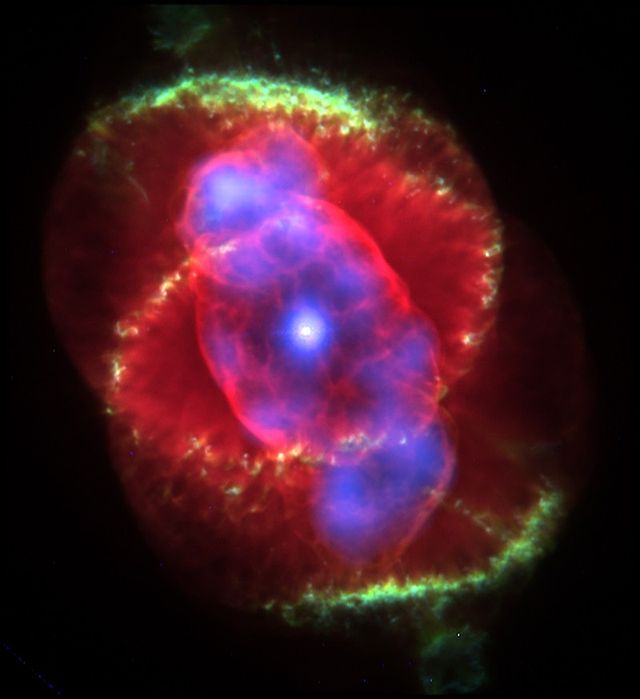
Composite photograph of the Cat’s Eye Nebula
(Wikimedia Commons public domain image)
Here are some interesting links from the world of religion news:
“Escaping that ‘comfort zone’: Press keeps missing obvious religion news at ’22 World Cup”
“NPR comes to hills of Tennessee and sees exactly the religion trends that you would expect”
Have you been hearing about this story out of Nicaragua? “Ortega’s Brutal Catholic Crackdown – Where’s the Outrage?”
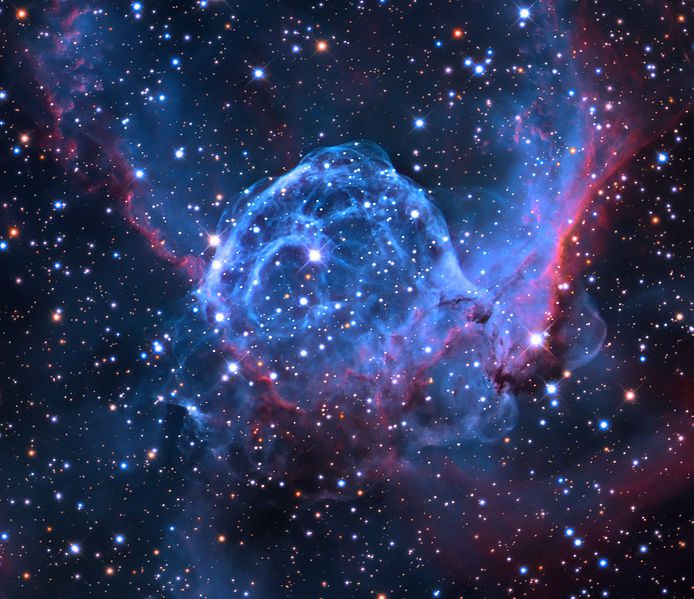
NGC 2359, “Thor’s Helmet”
Photo by JSchulman (Wikimedia CC public domain image)
But not everything is so very pleasant:
If this horror, plucked while still juicy and fresh from the Christopher Hitchens Memorial “How Religion Poisons Everything” File©, doesn’t turn you vivid red with righteousness indignation, it’s really difficult to imagine what might: “Colombian Red Cross acknowledges partnership with Church in 5-year humanitarian-aid project: Sister Renlund, Sister Zeballos represent the Church at recognition event — and help distribute aid to several dozen families in need”
Christopher Hitchens Memorial "How Religion Poisons Everything" File
Previous Post

December 13, 2022
"More protective than any pill, than any therapy, than any program."
Next Post
December 15, 2022 Are logic and mathematics purely rational? (2)
Browse Our Archives
Select a Category Uncategorized
Select a Month October 2026 September 2026 August 2026 July 2026 June 2026 May 2026 April 2026 March 2026 February 2026 January 2026 December 2025 November 2025 October 2025 September 2025 August 2025 July 2025 June 2025 May 2025 April 2025 March 2025 February 2025 January 2025 December 2024 November 2024 October 2024 September 2024 August 2024 July 2024 June 2024 May 2024 April 2024 March 2024 February 2024 January 2024 December 2023 November 2023 October 2023 September 2023 August 2023 July 2023 June 2023 May 2023 April 2023 March 2023 February 2023 January 2023 December 2022 November 2022 October 2022 September 2022 August 2022 July 2022 June 2022 May 2022 April 2022 March 2022 February 2022 January 2022 December 2021 November 2021 October 2021 September 2021 August 2021 July 2021 June 2021 May 2021 April 2021 March 2021 February 2021 January 2021 December 2020 November 2020 October 2020 September 2020 August 2020 July 2020 June 2020 May 2020 April 2020 March 2020 February 2020 January 2020 December 2019 November 2019 October 2019 September 2019 August 2019 July 2019 June 2019 May 2019 April 2019 March 2019 February 2019 January 2019 December 2018 November 2018 October 2018 September 2018 August 2018 July 2018 June 2018 May 2018 April 2018 March 2018 February 2018 January 2018 December 2017 November 2017 October 2017 September 2017 August 2017 July 2017 June 2017 May 2017 April 2017 March 2017 February 2017 January 2017 December 2016 November 2016 October 2016 September 2016 August 2016 July 2016 June 2016 May 2016 April 2016 March 2016 February 2016 January 2016 December 2015 November 2015 October 2015 September 2015 August 2015 July 2015 June 2015 May 2015 April 2015 March 2015 February 2015 January 2015 December 2014 November 2014 March 2014 August 2013 February 2012
Follow Us!
TAKE THE
Religious Wisdom Quiz
I am a goat released into the wilderness, carrying away the sins of the people. What am I?
Select your answer to see how you score.
An atonement goat A sin offering The scapegoat A sacrifice
Related posts from Sic et Non

A case of twin near-death experiences?

Toward a "Post-Materialist Science"?


Once more unto the breach, dear friends, once...
TRENDING AT PATHEOS Latter-day Saint

Swimfan: Forgotten Aughts Pleasures
This is a recovery effort. In 2002, My Big Fat Greek Wedding...

Top Three Anti-Catholic Lies About Catholicism
This is my initial transcript for the video, "THE 3 WORST...

Pope Leo Celebrates Mass for Nurses & Docs...
I don't have any idea how he did it, but Pope Leo...

The Sermon on the Mount, Part I: Matthew...
The Sermon on the Mount, Part I (Matthew 4:12-5:12) St. Matthew moves...

What's up from Crossway: Reviewing some of their latest A few weeks...

Janie Learns the Way of the Cross: A...
Teaching children about Jesus' Passion can be challenging. Many parents and educators...
view all Latter-day Saint blogs
Ad-Free & Subscriber Log-In Subscription Support
- About Us
- 2026 Calendar
- Videos
- Podcasts
- Library of World Religions
- Faith In Media Tracker
- Advertise With Us
- Write for Us
- Privacy Policy
- Terms of Service
- Do Not Sell My Data
- Contact Us
- Radiant Digital
- Manage Newsletter Subscriptions
- Unsubscribe From Notifications
- Sitemap
Copyright 2008-2026, Patheos. All rights reserved.
Subscription Support Ad-Free & Subscriber Log-In
Follow Patheos