
BuddhistCatholicContemplativeEvangelicalGeneral ChristianHinduJewishLatter-day SaintMuslimNew VisionsProgressive Christian
Beliefs
- Buddhist
- Catholic
- Contemplative
- Evangelical
- General Christian
- Hindu
- Jewish
- Latter-day Saint
- More Voices
- Muslim
- New Visions
- Pagan
- Progressive Christian
Topics
- Religion News
- Food and Religion
- Sports and Religion
- Religious Art
- Religious Music and Entertainment
- Religious Events
- History and Religion
- Style and Religion
- Politics and Religion
- Women in Religion
- Recreation Outdoors and Religion
- Business Finance and Religion
- Careers Workplace and Religion
- Education and Religion
- Family Parenting and Religion
- Health Fitness and Religion
- Home and Religion
- Relationships and Religion
- Technology and Religion
- Travel and Religion
Columnists
- Buddhist Columnists
- Business Finance and Religion Columnists
- Careers Workplace and Religion Columnists
- Catholic Columnists
- Contemplative Columnists
- Education and Religion Columnists
- Evangelists Columnists
- Family Parenting and Religion Columnists
- General Christian Columnists
- Health Fitness and Religion Columnists
- Hindu Columnists
- History and Religion Columnists
- Home and Religion Columnists
- Jewish Columnists
- More Voices Columnists
- Latter Day Columnists
- Muslim Columnists
- New Visions Columnists
- Nonreligious Columnists
- Pagan Columnists
- Politics and Religion Columnists
- Progressive Columnists
- Recreation Outdoors and Religion Columnists
- Relationships and Religion Columnists
- Religion News Columnists
- Religious Art Columnists
- Religious Events Columnists
- Religious Music and Entertainment Columnists
- Sports and Religion Columnists
- Style and Religion Columnists
- Technology and Religion Columnists
- Travel and Religion Columnists
- Women in Religion Columnists
Resource Library
- 2026 Calendar
- Library of World Religions
- The 100 Most Holy Places on Earth
- Patheos Answers
- Podcasts
- Videos
- Faith Leaders Database
- Anglican Episcopalian
- Bahai
- Baptist
- Buddhism
- Christianity
- Confucianism
- Eastern Orthodoxy
- Hinduism
- Holiness and Pentecostal
- ISKCON
- Islam
- Judaism
- Lutheran
- Methodist
- The Church of Jesus Christ of Latter-day Saints
- New Age
- Paganism
- Presbytarian and Reformed
- Protestantism
- Religion Behind the Scenes
- Roman Catholic
- Scientology
- Shia Islam
- Sikhism
- Sufism
- Sunni Islam
- Taoism
- Zen
- See all religions
Research Tools
 Ad-Free & Subscriber Log-In Subscription Support
Ad-Free & Subscriber Log-In Subscription Support
Follow Patheos 

- Trending:
- Forgiveness
- |
- Marriage
- |
- Consciousness
- |
- Death Penalty
- |
- Election
- |
- Halloween

- Home
- Latter-day Saint
- Very sad news, and a belated note from the River Nile
Very sad news, and a belated note from the River Nile
Last updated on: November 11, 2022 at 12:28 am by Dan Peterson
Very sad news, and a belated note from the River Nile 2022-11-11T00:28:34-07:00 Dan Peterson
Patheos Explore the world's faith through different perspectives on religion and spirituality! Patheos has the views of the prevalent religions and spiritualities of the world.
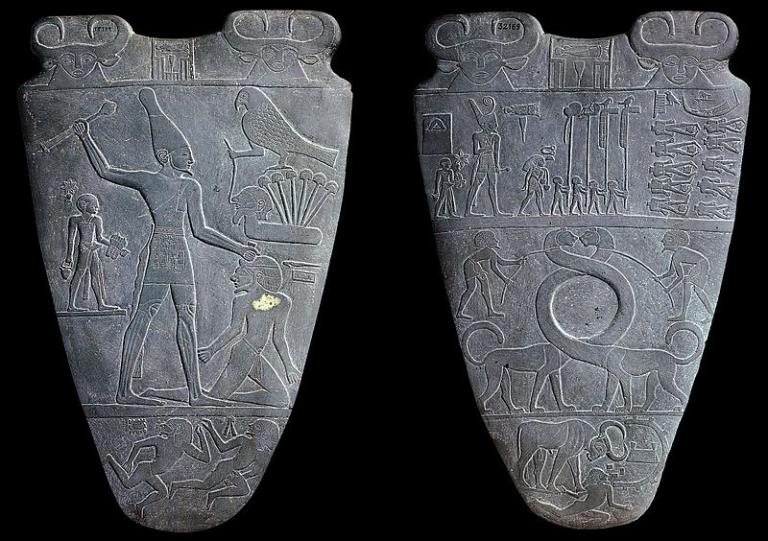
In the Narmer Palette, which dates to roughly the 31st century BC, King Narmer, who unified Upper Egypt and Lower Egypt, is depicted in the process of using some of his business techniques in the area of Mergers and Acquisitions. (Wikimedia Commons public domain image). We always take our groups to the Egyptian Museum in Cairo, and this is the first thing that we show them. It is displayed just inside the main entrance. Next time, though — in sha‘a Allah! — the NEW museum will finally be finished and open.
I’m deeply saddened to pass on the news, which I received only just now, that Kent Budge, a Caltech-trained computational physicist who worked at Los Alamos National Laboratory in New Mexico and who (in recent years as dCyl) commented here from time to time — very helpfully and sanely, I might add — has passed away. As I understand it, his death (on Wednesday night, I think) came as a result of complications from injuries sustained several months ago in a very serious automobile accident. We’ve lost a very good mind and a devoted Latter-day Saint.

A felucca on the River Nile at sunset. (Wikimedia Commons public domain photograph by Ian Pudsley.). We took many such rides on the Nile — it was, for example, a Cairo Branch tradition to load every member onto one or two large boats for Easter sunrise gatherings — and we still love to include such an evening cruise for guests on our tours to Egypt. (Not this time. though, for various reasons.)
As I’ve noted, the WiFi aboard our Nile cruise boat, usually terrible to non-functioning, was completely absent this time around. So here’s something that I put together on Tuesday, 8 November 2022, but was unable to actually post until now:
Today was a relatively relaxing day. Because some of its passengers needed to return from a trip down to the magnificent temples of Abu Simbel, our boat got a late start. Yesterday, by contrast, we were obliged to be on the bus by two o’clock in the morning in order to catch our flight down to Aswan, the southernmost city of Egypt.
As I write, we’re cruising northward on the Nile—which is to say, downstream—between Aswan and the temple city of Kom Ombo. It’s peaceful. The water is broad, blue, and smooth. The sun is beginning to set, and the banks of the river, with their sharp contrast of green vegetation and golden desert, are especially lovely.
One of the more counterintuitive facts about Egypt, something that often takes people a little bit of time to wrap their minds around, is that Upper Egypt is in the south and that Lower Egypt is in the north. (These were the two separate regions that were united by Narmer or Menes in the most ancient Egyptian past — somewhere during the interval between 3300 BC and perhaps a little after 3000 BC, thus well before the building of the pyramids. But Egyptians were always aware of the distinction between Upper and Lower Egypt—they still are very aware of it—and even the familiar “double crown” of the pharaohs reflected the remembered division.) That’s opposite to what people would typically assume. The reason, of course, is that the Nile flows from south to north, meaning that the southern part of Egypt is (rather slightly) more elevated than is the northern part.
As I mentioned here yesterday, Jewish military colonies served as mercenary garrisons during the fifth century before Christ at various locations in Persian-occupied Egypt. The most famous of them was located on Elephantine Island, directly opposite the ancient city of Syene (modern Aswan), where it guarded Egypt’s southern border. (The name “Elephantine” reflects the importance of Egypt’s ancient ivory trade with inner Africa.) Most scholars believe that the colony at Elephantine was originally founded around 600 BC, by Jews fleeing the military expansion of the Babylonian Empire—just as their contemporary, the Book of Mormon’s Lehi, did.
Surprisingly, as I’ve noted, the Aramaic-speaking Jews of Elephantine eventually built their own temple outside of Jerusalem, just as the Nephites had. It was dedicated to “Yahu” or “Yaho,” a variant form of the name “Yahweh” (“Jehovah”). But two other Aramaic-speaking communities also lived in the area, religiously foreign but fairly close culturally: A group from Syria had a temple for Bethel and the “Queen of Heaven” in Syene and, nearby, a group of Babylonians had built temples for Nabu and Banit.
Papyrus Amherst 63 was discovered along the Egyptian Nile at Luxor (ancient Thebes) in the late 19th century, roughly five hundred miles south of the Mediterranean. For multiple reasons, although its title isn’t particularly gripping, Papyrus Amherst 63 is one of the more interesting documentary finds from the ancient Middle East. Certainly it is so from a Latter-day Saint perspective.
The papyrus is made up of about thirty-five literary texts in the Aramaic language (a near-cousin of Hebrew). They appear in four sections, followed by an appendix in the form of a “court novella” about the Assyrian king Assurbanipal and his brother. The first three sections contain ritual texts from the Babylonians, the Syrians, and the Jews, in that order. The fourth section is surprisingly ecumenical, often equating one god with another (e.g., Yahweh with Bethel), as if the three communities were trying to create common religious ground. (Compare the apostle Paul’s use of a pagan poem about Zeus in Acts 17, as if that poem referred to the biblical God; see “God’s sheep recognize his voice” https://www.deseretnews.com/article/705387043/Gods-sheep-recognize-his-voice.html.)
All five of the gods who had temples at Elephantine and Syene appear in Papyrus Amherst 63; for that reason, I think it reasonable to conclude that the text was almost certainly compiled in that region by people belonging to those communities.
It contains three Israelite psalms, only one of which– a variant form of the biblical Psalm 20:2-6—corresponds to anything in the Bible. (A Latter-day Saint will think immediately of the teaching of the Book of Mormon that elements of the biblical text would be lost in transmission.) “The three psalms clearly belong together,” says the Dutch scholar Karel van der Toorn. Among other things, they seem to have been originally composed in Hebrew and they all celebrate “Yaho” as the king of the gods. They “go back,” says van der Toorn, “to Hebrew hymns that must have been written in the eighth century at the latest.”
Curiously, though, the scribes who recorded them in Papyrus Amherst 63, most likely (according to handwriting experts) in the fourth century B.C., did so in Demotic—a cursive and relatively late Egyptian script—rather than in the customary Aramaic or Hebrew script. This delayed their decipherment for more than 120 years; although the script was clear enough, it seemed to be meaningless gibberish to the Egyptologists who studied it until they realized that the language of the underlying text wasn’t Egyptian at all.
Many Latter-day Saint scholars believe the Book of Mormon to have been written in Hebrew or something very like it, but in an Egyptian script, and they have have long pointed to Papyrus Amherst 63 as evidence of an ancient biblical text that was recorded in precisely that way. (See, for example, William J. Hamblin, “Reformed Egyptian” (https://publications.mi.byu.edu/fullscreen/?pub=1461&index=6).)
Professor van der Toorn says of the three Amherst psalms that “These were songs the Israelites chanted before their religion turned monotheistic.” Thus, rather like biblical Psalm 82:1, Yaho is described not as a solitary figure but as the highest of the Gods, the head of a “council of heaven.”
Karel van der Toorn, “Egyptian Papyrus Sheds New Light on Jewish History,” Biblical Archaeology Review (July/August 2018): 32-39, 66-68, prompted this blog entry, which draws substantially from it. On Yahweh as the head of a “heavenly council” rather than as the isolated deity of later monotheism, see Daniel C. Peterson, “Ye Are Gods: Psalm 82 and John 10 as Witnesses to the Divine Nature of Humankind” (https://publications.mi.byu.edu/fullscreen/?pub=1091&index=17).
On the River Nile, in Upper Egypt
Posted from Paris, France
Previous Post

November 10, 2022
A belated note from Aswan
Next Post
November 12, 2022 Live from Orem, it's Saturday Night!
Browse Our Archives
Select a Category Uncategorized
Select a Month October 2026 September 2026 August 2026 July 2026 June 2026 May 2026 April 2026 March 2026 February 2026 January 2026 December 2025 November 2025 October 2025 September 2025 August 2025 July 2025 June 2025 May 2025 April 2025 March 2025 February 2025 January 2025 December 2024 November 2024 October 2024 September 2024 August 2024 July 2024 June 2024 May 2024 April 2024 March 2024 February 2024 January 2024 December 2023 November 2023 October 2023 September 2023 August 2023 July 2023 June 2023 May 2023 April 2023 March 2023 February 2023 January 2023 December 2022 November 2022 October 2022 September 2022 August 2022 July 2022 June 2022 May 2022 April 2022 March 2022 February 2022 January 2022 December 2021 November 2021 October 2021 September 2021 August 2021 July 2021 June 2021 May 2021 April 2021 March 2021 February 2021 January 2021 December 2020 November 2020 October 2020 September 2020 August 2020 July 2020 June 2020 May 2020 April 2020 March 2020 February 2020 January 2020 December 2019 November 2019 October 2019 September 2019 August 2019 July 2019 June 2019 May 2019 April 2019 March 2019 February 2019 January 2019 December 2018 November 2018 October 2018 September 2018 August 2018 July 2018 June 2018 May 2018 April 2018 March 2018 February 2018 January 2018 December 2017 November 2017 October 2017 September 2017 August 2017 July 2017 June 2017 May 2017 April 2017 March 2017 February 2017 January 2017 December 2016 November 2016 October 2016 September 2016 August 2016 July 2016 June 2016 May 2016 April 2016 March 2016 February 2016 January 2016 December 2015 November 2015 October 2015 September 2015 August 2015 July 2015 June 2015 May 2015 April 2015 March 2015 February 2015 January 2015 December 2014 November 2014 March 2014 August 2013 February 2012
Follow Us!
TAKE THE
Religious Wisdom Quiz
In 1 Peter 1, what does Peter say is more valuable than gold?
Select your answer to see how you score.
Faith Charity Righteousness Wisdom
Related posts from Sic et Non

Looking at the Largest Orthodox Cathedral on Earth

The Iron Gates and the Lion of the...


Learning more about a region of which I've...
TRENDING AT PATHEOS Latter-day Saint

The Problem with False Prophets
Miller’s Station UMC| 10/18/26| Anchor Verse: Jeremiah 23: 1, 9-23 I...

Emotion in Early Christianity by Andrew Crislip
Andrew Crislip’s Emotion in Early Christianity examines an often overlooked dimension of...

16 Spiritual Touchstones for a More Grounded Life
After decades of spiritual study, here are 16 principles I try...

Catholic Evangelization: Sharing Your Faith Every Day
Welcome back to the Graceful Awakening mini-series called, “From Faith to Mission.” ...

The Pillar of the Boatmen: the Ancient Monument...
The Pillar of the Boatmen is a Romano-Gaulish sculpture that dates from...

In one sense walking into Westminster Abbey is like walking down the...
view all Latter-day Saint blogs
Ad-Free & Subscriber Log-In Subscription Support
- About Us
- 2026 Calendar
- Videos
- Podcasts
- Library of World Religions
- Faith In Media Tracker
- Advertise With Us
- Write for Us
- Privacy Policy
- Terms of Service
- Do Not Sell My Data
- Contact Us
- Radiant Digital
- Manage Newsletter Subscriptions
- Unsubscribe From Notifications
- Sitemap
Copyright 2008-2026, Patheos. All rights reserved.
Subscription Support Ad-Free & Subscriber Log-In
Follow Patheos