
BuddhistCatholicContemplativeEvangelicalGeneral ChristianHinduJewishLatter-day SaintMuslimNew VisionsProgressive Christian
Beliefs
- Buddhist
- Catholic
- Contemplative
- Evangelical
- General Christian
- Hindu
- Jewish
- Latter-day Saint
- More Voices
- Muslim
- New Visions
- Pagan
- Progressive Christian
Topics
- Religion News
- Food and Religion
- Sports and Religion
- Religious Art
- Religious Music and Entertainment
- Religious Events
- History and Religion
- Style and Religion
- Politics and Religion
- Women in Religion
- Recreation Outdoors and Religion
- Business Finance and Religion
- Careers Workplace and Religion
- Education and Religion
- Family Parenting and Religion
- Health Fitness and Religion
- Home and Religion
- Relationships and Religion
- Technology and Religion
- Travel and Religion
Columnists
- Buddhist Columnists
- Business Finance and Religion Columnists
- Careers Workplace and Religion Columnists
- Catholic Columnists
- Contemplative Columnists
- Education and Religion Columnists
- Evangelists Columnists
- Family Parenting and Religion Columnists
- General Christian Columnists
- Health Fitness and Religion Columnists
- Hindu Columnists
- History and Religion Columnists
- Home and Religion Columnists
- Jewish Columnists
- More Voices Columnists
- Latter Day Columnists
- Muslim Columnists
- New Visions Columnists
- Nonreligious Columnists
- Pagan Columnists
- Politics and Religion Columnists
- Progressive Columnists
- Recreation Outdoors and Religion Columnists
- Relationships and Religion Columnists
- Religion News Columnists
- Religious Art Columnists
- Religious Events Columnists
- Religious Music and Entertainment Columnists
- Sports and Religion Columnists
- Style and Religion Columnists
- Technology and Religion Columnists
- Travel and Religion Columnists
- Women in Religion Columnists
Resource Library
- 2026 Calendar
- Library of World Religions
- The 100 Most Holy Places on Earth
- Patheos Answers
- Podcasts
- Videos
- Faith Leaders Database
- Anglican Episcopalian
- Bahai
- Baptist
- Buddhism
- Christianity
- Confucianism
- Eastern Orthodoxy
- Hinduism
- Holiness and Pentecostal
- ISKCON
- Islam
- Judaism
- Lutheran
- Methodist
- The Church of Jesus Christ of Latter-day Saints
- New Age
- Paganism
- Presbytarian and Reformed
- Protestantism
- Religion Behind the Scenes
- Roman Catholic
- Scientology
- Shia Islam
- Sikhism
- Sufism
- Sunni Islam
- Taoism
- Zen
- See all religions
Research Tools
 Ad-Free & Subscriber Log-In Subscription Support
Ad-Free & Subscriber Log-In Subscription Support
Follow Patheos 

- Trending:
- Forgiveness
- |
- Marriage
- |
- Consciousness
- |
- Death Penalty
- |
- Election
- |
- Halloween

- Home
- Latter-day Saint
- Two final thoughts on Thanksgiving
Two final thoughts on Thanksgiving
Last updated on: November 25, 2022 at 8:51 pm by Dan Peterson
Two final thoughts on Thanksgiving 2022-11-25T20:51:35-07:00 Dan Peterson
Patheos Explore the world's faith through different perspectives on religion and spirituality! Patheos has the views of the prevalent religions and spiritualities of the world.
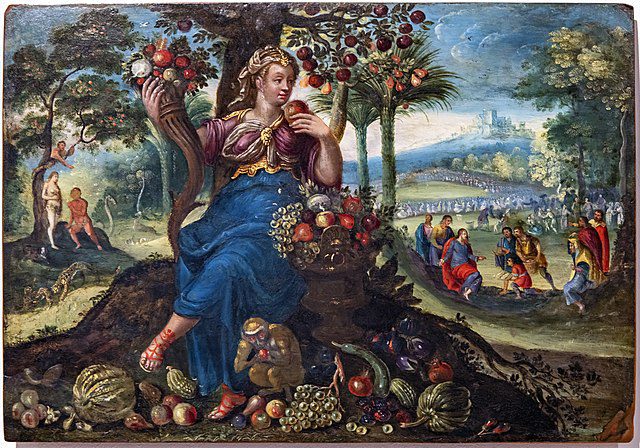
Musée Ingres-Bourdelle – L’Allégorie du goût – WIERIX Jérôme (graveur) , VOS Martin de (d’après) – Joconde06070000290
I wrote these two columns in 2016 and 2017:
It’s not insignificant that the verbs “to think” and “to thank” (compare German “denken” and “danken”) share the same linguistic root. The scriptures are replete with exhortations to “remember,” to reflect, to thank:
“O give thanks unto the Lord,” says the psalmist (105:1-5), “call upon his name: make known his deeds among the people. Sing unto him, sing psalms unto him: talk ye of all his wondrous works. Glory ye in his holy name: let the heart of them rejoice that seek the Lord. . . . Remember his marvellous works that he hath done; his wonders, and the judgments of his mouth.”
Even secular-minded people should pause occasionally to consider the blessings that we enjoy. We live in a universe, for example, that’s seemingly fine-tuned for our arrival, on a privileged planet where the conditions are primed for life.
But those conditions have existed throughout history. Today, though, most Americans live in unprecedented luxury of which even kings couldn’t have dreamed a few generations ago. Royal castles were drafty and cold then, and lacked plumbing. For us, by contrast, if the weather is too hot, we turn the air conditioning on. If it’s too cold, we have central heating.
We can, if we choose, enjoy an unimaginably rich cuisine—American one day, Chinese the next. Mexican, Thai, Indian, Japanese, French, Italian. We eat a variety of fruits and vegetables, without regard to season. The diet of a Renaissance prince was poor and monotonous compared to the offerings of a typical American supermarket.
For most of us, hunger and starvation aren’t the issue; our problem is actually having too much. (Of course, that’s not true of everybody, and now our challenge is to share with those most in need and, ideally, to bring them and others up to a better standard of living.) If anything, the traditional Thanksgiving feast has lost a bit of its “specialness” because many of us eat pretty well all the time. (One of my students tells me, though, that she’s looking eagerly forward to what she calls “non-ramen Thursday.”)
Our technology, our labor-saving devices, would astonish our ancestors. We travel at unimaginable speeds in unthinkable comfort; we’re upset if our flight is delayed for thirty minutes, and irritated when we’re handed pretzels rather than peanuts or obliged to sit in a middle seat.
We listen to the Berlin Philharmonic or to the latest rock or country tunes wherever and whenever we want. We communicate cheaply and instantaneously at great distances. The world’s knowledge is available to us with a few clicks. We watch movies on demand, whenever we choose. In our own homes. Whereas earlier generations were obliged to work from sunrise to sunset in order to survive, we worry about whether we’re getting enough exercise.
Many of the diseases that once carried us off can be cured with simple medicines; other ailments can be fixed with routine procedures. Death still takes us eventually but, on the whole, we live pretty well until it does. When our hearing falters, we have hearing aids. We keep our teeth, or else we replace them—along with our hips and our knees. Have you ever thought to be grateful for your glasses or contact lenses? Perhaps you should. What would your life be like without them?
Latter-day Saints, though, have specific reasons to be thankful, reasons that go far beyond material comforts and technological marvels.
The restoration of the gospel in the early nineteenth century provides modern corroboration of the biblical stories. It testifies of Christ’s atoning sacrifice and of his resurrection from the dead, gracious gifts from a loving Father and his selfless Son. Because Christ rose, we too will rise, and the ordinances of the gospel link generations together for all eternity. Life wins. Love wins. The restored gospel tells us of the plan of salvation, a plan of happiness that suffuses our lives with rich and deep meaning. It teaches us of a Heavenly Father who wants us to inherit everything that he has.
“O give thanks unto the Lord,” sings the Psalmist, “for he is good: for his mercy endureth for ever” (Psalm 107:1)
Moreover, the restored gospel teaches us that—like God, who seeks to share everything he has with his children—we should share our abundance with our brothers and sisters. At this season, as at all others. “Be ye therefore perfect, even as your Father which is in heaven is perfect” (Matthew 5:48).
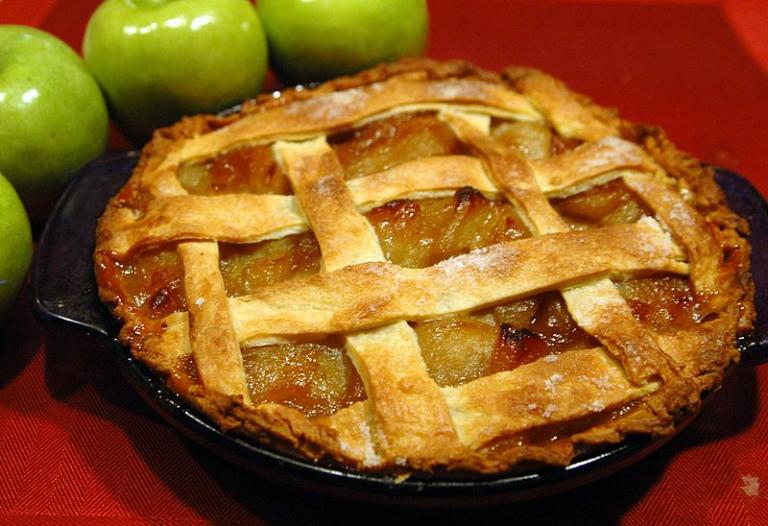
Even something as simple as apple pie is incredibly complex, and draws on a rich and varied history, geological, biological, and cultural. (Wikimedia Commons public domain image)
“If you wish to make an apple pie from scratch,” the late American astronomer and science popularizer Carl Sagan once quipped, “you must first invent the universe.”
As Americans enjoy their Thanksgiving dinners today, many of those dinners will include apple pie. But any other food would serve to make Sagan’s important point.
Unless we ourselves grew the apples and grains and other ingredients vital to our apple pie, we can’t really claim to have made it from scratch. After all, those components came to us via complex and varied trade networks, from widely scattered farms.
Moreover, the hardworking farmers who grew our apples and the grains for our piecrusts didn’t create them out of nothing. They came from pre-existing seeds.
Lest this column rapidly grow far too complicated, though, we’ll concentrate only on the apples:
Rev. William Blaxton planted the first apple orchard in North America in Boston, in 1625. But apples had already been grown in Asia and Europe for millennia. In fact, the apple tree, which originated in Central Asia, may have been the earliest tree ever cultivated.
Where do apple trees come from, ultimately? The origin of life on Earth as a whole remains a mystery; science doesn’t know how or whence it arose. But apples are very far from simple or primitive organisms. The apple genome, its genetic material, may contain more genes than any other plant genome yet analyzed, and perhaps even more than the human genome does. But even a single gene is a remarkable thing. Unlike the machines that humans create, DNA—the hereditary material in cells—has the capacity to reproduce itself. Planting a Porsche or a hammer doesn’t yield new craftsman’s tools or sports cars. Apple trees, though, produce seeds that, in their turn, yield new apple trees.
This would all be irrelevant, of course, had chemical and biological processes not created soil in which to plant apple seeds. Moreover, according to some current science, that soil wouldn’t have contained key ingredients for the chemistry of life—elements such as hydrogen, oxygen, nitrogen, phosphorus and sulfur—if they weren’t regularly replenished by the constant movements of the tectonic plates that cover Earth’s surface. (In other words, you may owe your apple pie to the same forces that cause earthquakes.)
There would be no soil, though, no tectonic plates and neither apples nor apple pie if there were no Earth. Where did it come from? Our solar system formed roughly 4.6 billion years ago and, shortly thereafter, the Earth began to coalesce.
Ultimately, of course, the genesis of apples is to be found in the Big Bang, which occurred (for reasons that may lie forever beyond the reach of science) about 13.7 billion years ago.
But the path from the Big Bang to the appearance of life (and apple pies) on Earth is paved with remarkable facts. Somehow, only a fraction of a second after that unimaginable explosion, nature’s fundamental forces were established—in ways that make life possible. If, for example, gravity differed even slightly—making you weigh a billionth of a gram more or less than you do—or if the universe’s expansion rate were even slightly slower or faster, or if the overall density of the cosmos varied by as little as 0.0000000000001%—roughly the same precision required for a blindfolded man to choose a single predesignated coin from a pile of pennies sufficient to pay off the national debt of the United States—either a “Big Crunch” would shortly have followed the Big Bang or, alternatively, atoms would have scattered so widely that neither galaxies, stars, planets nor apples could have formed.
Sir Fred Hoyle (d. 2001), an illustrious astronomer and a vocal atheist, conducted path-breaking research into the indispensable role that stars played in the synthesis of all the chemical elements heavier than helium—including carbon—without which life (and apple pie) would be impossible. What he found shocked him deeply:
“A commonsense interpretation of the facts,” he commented, “suggests that a super-intellect has monkeyed with physics, as well as with chemistry and biology, and that there are no blind forces worth speaking about in nature. The numbers one calculates from the facts seem to me so overwhelming as to put this conclusion almost beyond question.”
Making apple pie absolutely from scratch is plainly more difficult than most of us have imagined. Downright mysterious, in fact. Praise God, from whom all blessings flow.
Posted from Bountiful, Utah
Church of Jesus Christ of Latter-day Saints
Previous Post

November 24, 2022
For Thanksgiving Day
Next Post
November 25, 2022 "Rethinking the Encounter between Jacob and Sherem"
Browse Our Archives
Select a Category Uncategorized
Select a Month October 2026 September 2026 August 2026 July 2026 June 2026 May 2026 April 2026 March 2026 February 2026 January 2026 December 2025 November 2025 October 2025 September 2025 August 2025 July 2025 June 2025 May 2025 April 2025 March 2025 February 2025 January 2025 December 2024 November 2024 October 2024 September 2024 August 2024 July 2024 June 2024 May 2024 April 2024 March 2024 February 2024 January 2024 December 2023 November 2023 October 2023 September 2023 August 2023 July 2023 June 2023 May 2023 April 2023 March 2023 February 2023 January 2023 December 2022 November 2022 October 2022 September 2022 August 2022 July 2022 June 2022 May 2022 April 2022 March 2022 February 2022 January 2022 December 2021 November 2021 October 2021 September 2021 August 2021 July 2021 June 2021 May 2021 April 2021 March 2021 February 2021 January 2021 December 2020 November 2020 October 2020 September 2020 August 2020 July 2020 June 2020 May 2020 April 2020 March 2020 February 2020 January 2020 December 2019 November 2019 October 2019 September 2019 August 2019 July 2019 June 2019 May 2019 April 2019 March 2019 February 2019 January 2019 December 2018 November 2018 October 2018 September 2018 August 2018 July 2018 June 2018 May 2018 April 2018 March 2018 February 2018 January 2018 December 2017 November 2017 October 2017 September 2017 August 2017 July 2017 June 2017 May 2017 April 2017 March 2017 February 2017 January 2017 December 2016 November 2016 October 2016 September 2016 August 2016 July 2016 June 2016 May 2016 April 2016 March 2016 February 2016 January 2016 December 2015 November 2015 October 2015 September 2015 August 2015 July 2015 June 2015 May 2015 April 2015 March 2015 February 2015 January 2015 December 2014 November 2014 March 2014 August 2013 February 2012
Follow Us!
TAKE THE
Religious Wisdom Quiz
Who was the Amalekite king spared by Saul, contrary to God's command?
Select your answer to see how you score.
Abner Agag Goliath Ish-bosheth
Related posts from Sic et Non


Notes on Women, Priesthood, and General Conference

"The Book of Moses as a Temple Text"

TRENDING AT PATHEOS Latter-day Saint

In "Irreplaceable," our book on vocation and technology, Trevor Sutton and I...

I was strolling through the top floor of the brand new Parthenon...

What Does Gêvâh Mean For Kimberley Guifoyle &...
This week, a lot of the news is focused on Kimberly Guilfoyle....

INNER CIRCLE: Profound Mystery (Of Christ In All...
Ephesians 5:31-32 “For this reason, a man will leave his father and...

Do Not Rejoice When Your Enemy Falls: The...
Turning an execution into a public spectacle is a disturbing expression of...

'The Chosen' S6 Trailer: The Passion Gets Very...
Not many watching 'The Chosen' worry about spoilers, but just because they...
view all Latter-day Saint blogs
Ad-Free & Subscriber Log-In Subscription Support
- About Us
- 2026 Calendar
- Videos
- Podcasts
- Library of World Religions
- Faith In Media Tracker
- Advertise With Us
- Write for Us
- Privacy Policy
- Terms of Service
- Do Not Sell My Data
- Contact Us
- Radiant Digital
- Manage Newsletter Subscriptions
- Unsubscribe From Notifications
- Sitemap
Copyright 2008-2026, Patheos. All rights reserved.
Subscription Support Ad-Free & Subscriber Log-In
Follow Patheos