
BuddhistCatholicContemplativeEvangelicalGeneral ChristianHinduJewishLatter-day SaintMuslimNew VisionsProgressive Christian
Beliefs
- Buddhist
- Catholic
- Contemplative
- Evangelical
- General Christian
- Hindu
- Jewish
- Latter-day Saint
- More Voices
- Muslim
- New Visions
- Pagan
- Progressive Christian
Topics
- Religion News
- Food and Religion
- Sports and Religion
- Religious Art
- Religious Music and Entertainment
- Religious Events
- History and Religion
- Style and Religion
- Politics and Religion
- Women in Religion
- Recreation Outdoors and Religion
- Business Finance and Religion
- Careers Workplace and Religion
- Education and Religion
- Family Parenting and Religion
- Health Fitness and Religion
- Home and Religion
- Relationships and Religion
- Technology and Religion
- Travel and Religion
Columnists
- Buddhist Columnists
- Business Finance and Religion Columnists
- Careers Workplace and Religion Columnists
- Catholic Columnists
- Contemplative Columnists
- Education and Religion Columnists
- Evangelists Columnists
- Family Parenting and Religion Columnists
- General Christian Columnists
- Health Fitness and Religion Columnists
- Hindu Columnists
- History and Religion Columnists
- Home and Religion Columnists
- Jewish Columnists
- More Voices Columnists
- Latter Day Columnists
- Muslim Columnists
- New Visions Columnists
- Nonreligious Columnists
- Pagan Columnists
- Politics and Religion Columnists
- Progressive Columnists
- Recreation Outdoors and Religion Columnists
- Relationships and Religion Columnists
- Religion News Columnists
- Religious Art Columnists
- Religious Events Columnists
- Religious Music and Entertainment Columnists
- Sports and Religion Columnists
- Style and Religion Columnists
- Technology and Religion Columnists
- Travel and Religion Columnists
- Women in Religion Columnists
Resource Library
- 2026 Calendar
- Library of World Religions
- The 100 Most Holy Places on Earth
- Patheos Answers
- Podcasts
- Videos
- Faith Leaders Database
- Anglican Episcopalian
- Bahai
- Baptist
- Buddhism
- Christianity
- Confucianism
- Eastern Orthodoxy
- Hinduism
- Holiness and Pentecostal
- ISKCON
- Islam
- Judaism
- Lutheran
- Methodist
- The Church of Jesus Christ of Latter-day Saints
- New Age
- Paganism
- Presbytarian and Reformed
- Protestantism
- Religion Behind the Scenes
- Roman Catholic
- Scientology
- Shia Islam
- Sikhism
- Sufism
- Sunni Islam
- Taoism
- Zen
- See all religions
Research Tools
 Ad-Free & Subscriber Log-In Subscription Support
Ad-Free & Subscriber Log-In Subscription Support
Follow Patheos 

- Trending:
- Forgiveness
- |
- Marriage
- |
- Consciousness
- |
- Death Penalty
- |
- Election
- |
- Halloween

- Home
- Latter-day Saint
- Religion News
- A bit more on attempts to weaponize the atrocity in Colorado Springs
A bit more on attempts to weaponize the atrocity in Colorado Springs
Last updated on: November 23, 2022 at 5:37 pm by Dan Peterson
A bit more on attempts to weaponize the atrocity in Colorado Springs 2022-11-23T17:37:26-07:00 Dan Peterson
Patheos Explore the world's faith through different perspectives on religion and spirituality! Patheos has the views of the prevalent religions and spiritualities of the world.

Aspen growing from lava rock in southern Utah — irrelevant, but striking
(Wikimedia Commons)
I reported yesterday on the efforts of a small handful of zealous critics of the Church to blame the recent mass murders in Colorado Springs on the Church of Jesus Christ of Latter-day Saints and, specifically, on President Dallin H. Oaks, Elder Jeffrey R. Holland, and the late Elder Neal A. Maxwell. I suggested that Mx. Aldrich may actually not have been motivated by pious study of relatively inaccessible remarks from the General Authorities, and now, as we learn still more about them (that is, Mx. Aldrich), my suggestion seems even more plausible than when I first posted it:
“Colorado Gay Bar Shooting Suspect Identifies as ‘Nonbinary,’ Lawyers Say”
But such efforts to exploit Ms. Aldrich’s murderous actions for partisan advantage, for socio-cultural and political gain, have been remarkably energetic:
“Politicizing the Colorado Springs Massacre”
And what of that small handful of critics on whose speculations I commented yesterday? Well, it seems that President Oaks and Elder Holland are somehow still to blame for Mx. Aldrich’s lethal rampage. Moreover, and very damnably, my brief comment dehumanized and minimized the Colorado Springs attack, failed to mention the victims, neglected to celebrate the heroic actions of one or two patrons of Club Q that probably saved many lives, and sought to make Church leaders the real victims of the tragedy. Of course, one might be forgiven for thinking that, since I was responding only to one very specific peripheral issue that had been grafted onto the massacre in Colorado Springs, expressing my, umm, disapproval of the murder of five innocent people and the wounding of many others would have been unnecessary. Surely only a monster would fail to disapprove of such horrors. Surely only a depraved monster would not endorse life-saving heroism. But some folks affect, at least, to believe that I am just such a monster. And there’s probably nothing that I’ll ever be able to do about it.

An upward path into the mountains. (Wikimedia Commons public domain image)
On a very different note, here’s a Thanksgiving column that I published in 2011:
Autumn harvest festivals were and are common across Europe, and, as every American schoolchild once learned, our modern Thanksgiving celebrations descend from a meal shared between Massachusetts Pilgrims and Native Americans in 1621.
It was not until 3 October 1863, however, that a uniform national holiday was established by presidential proclamation. Writing well into the Civil War, Abraham Lincoln declared that
“The year that is drawing towards its close, has been filled with the blessings of fruitful fields and healthful skies. To these bounties, which are so constantly enjoyed that we are prone to forget the source from which they come, others have been added, which are of so extraordinary a nature, that they cannot fail to penetrate and soften even the heart which is habitually insensible to the ever watchful providence of Almighty God.”
After enumerating a substantial and very specific list of material blessings, Lincoln continued.
“No human counsel hath devised nor hath any mortal hand worked out these great things. They are the gracious gifts of the Most High God, who, while dealing with us in anger for our sins, hath nevertheless remembered mercy. It has seemed to me fit and proper that they should be solemnly, reverently and gratefully acknowledged as with one heart and one voice by the whole American People. I do therefore invite my fellow citizens in every part of the United States, and also those who are at sea and those who are sojourning in foreign lands, to set apart and observe the last Thursday of November next, as a day of Thanksgiving and Praise to our beneficent Father who dwelleth in the Heavens. And I recommend to them that while offering up the ascriptions justly due to Him for such singular deliverances and blessings, they do also, with humble penitence for our national perverseness and disobedience, commend to His tender care all those who have become widows, orphans, mourners or sufferers in the lamentable civil strife in which we are unavoidably engaged, and fervently implore the interposition of the Almighty Hand to heal the wounds of the nation and to restore it as soon as may be consistent with the Divine purposes to the full enjoyment of peace, harmony, tranquility and Union.”
It is a remarkable document—and not only for Abraham Lincoln’s characteristic eloquence.
One is struck, for example, by Lincoln’s sense of gratitude even amidst horrible death, destruction, and tragedy. The great battle at Gettysburg had concluded precisely three months before, and Lincoln himself would fall as one of the Civil War’s last victims only eighteen months later. Yet he calls for national thanksgiving to God.
It’s also impossible to miss the overt religiousness of the statement, and difficult to imagine a similar document emerging from any recent White House. Lincoln writes without embarrassment of God’s grace and paternal care, and, perhaps even more notably today, of our sins and “perverseness and disobedience,” recognizing an authority far higher than his own that rules all human affairs and overrules all human power.
And this authority, Lincoln plainly understands, is a Person. Lincoln doesn’t merely advise his fellow citizens to be satisfied that their fields are productive and to be happy at good weather. He counsels them to recognize a living, willing, conscious Being behind those “gifts,” and to thank that Being for them.
To recognize a divine Person behind nature and human history, to perceive an ultimate and inconceivably powerful Will beneath and beyond the shifting phenomena of our lives and the world, is a characteristic mark of the religious attitude—and submission to that Will, and gratitude to that Person, are among the virtues advocated by all religions of the Abrahamic tradition and most religions worldwide.
Anybody can be happy with his or her material state, satisfied that things are going well, relieved that they’re not going as badly as they could have gone. And everybody should, if possible, devote Thanksgiving Day to strengthening relationships with family and friends. (Most of us, nowadays, eat so very well throughout the year that the Thanksgiving meal in itself is, relatively speaking, unimportant. This isn’t just “Turkey Day”; Lincoln’s proclamation says nothing about food.)
But thanks can only meaningfully be given to persons. Thus, if Thanksgiving is to be practiced as the sixteenth president of the United States—perhaps our greatest—advised, it must expressly involve gratitude to God.
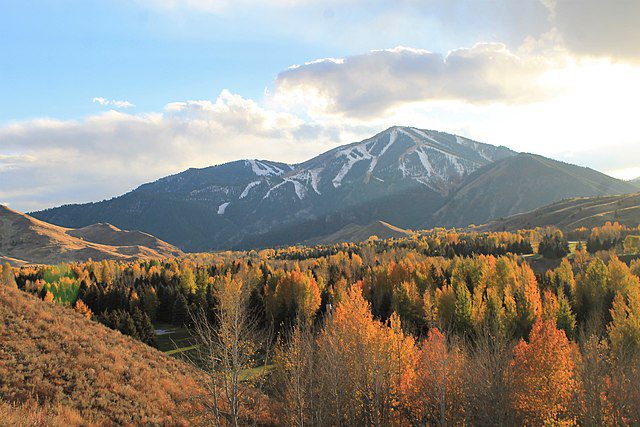
Bald Mountain, as seen from Sun Valley, Idaho
(Photo taken by rickmouser45, Wikimedia Commons image)
And here’s one from 2012:
William Ernest Henley’s famous Victorian-era poem “Invictus” provided the title and the theme for Clint Eastwood’s inspiring 2009 film about Nelson Mandela. It also provided the memorable claim “I am the master of my fate: I am the captain of my soul.”
It’s a stirring assertion, and, in a very real sense, true. A great proportion of what we are and do rests upon our own decisions.
But not everything, and perhaps not the most important things. Henley’s claim is also false and misleading.
As I write, a friend and neighbor is recuperating from a catastrophic fall that lacerated his face, took out most of his teeth, broke major bones everywhere in his body, and very nearly killed him. As he plunged groundwards, he certainly wasn’t the master of his fate, and he’s scarcely more so as he lies in a hospital bed. Those who’ve surveyed the spot where he landed, closely bordered by objects that could instantly have ended his life, regard his survival as a miracle, and he himself, speaking with difficulty, testifies to it.
“I thank whatever gods may be,” says Henley, “for my unconquerable soul.”
Thirty years ago, my wife and I traveled with our infant son from southern California to her parents’ house in Denver, Colorado, where the whole extended family were gathering for a Christmas trip to Florida. We participated in a “Messiah” sing-along and then went home to prepare for our flight to Orlando the next morning.
But then came what’s been called “the Christmas Eve blizzard of 1982.” Stapleton International Airport closed at 9:30 AM on 24 December, remained closed for fully thirty-three hours, and then, for several days thereafter, was open only for severely limited operations. Ten-foot-high snowdrifts were left throughout greater Denver, highways into and out of the city were shut down, power outages darkened large portions of the metropolitan area, roofs collapsed, supermarkets closed because their employees couldn’t get to work, hospitals were reduced to minimal staff on emergency power, and snowmobiles dominated suburban streets.
It was astounding to me, and revealing, to realize how easily simple snowfall could shut down a major modern city quite accustomed to seeing it.
We’re plainly not entirely the masters of our fates, the captains of our souls. Rather, as Elder Orson F. Whitney (d. 1931) of the Quorum of the Twelve Apostles put it in “The Soul’s Captain,” his response to “Invictus,” “Men are as bubbles on the wave, as leaves upon the tree.”
We’re fragile creatures. A few days without food, even fewer without water, a few minutes without oxygen, and we’re gone. If our hearts miss just a few beats, none of our plans, ambitions, schemes, or careful investments will mean a thing. And, in the end, no matter how we fight it, we’ll die.
Our comfort and survival in the meantime depend upon cycles of evaporation and precipitation that few of us really understand, and we rely upon complex networks of exchange and transportation that very few of us could begin to explain.
The ground on which most of us live and where our food is grown was cleared of rocks, trees, and stumps by millions of hardworking people whose names we’ve forgotten. Our cities—big and small—feature large buildings erected by generations of construction workers to whom we’ve probably never given the slightest thought.
We owe a debt of gratitude that we can never repay. “For behold, are we not all beggars? Do we not all depend upon . . . God, for all the substance which we have, for both food and raiment, and for gold, and for silver, and for all the riches which we have of every kind?” (Mosiah 4:19). The Book of Mormon’s Amulek wisely counsels us that we should “humble ourselves even to the dust, and worship God, in whatsoever place we may be in, in spirit and in truth; and that we live in thanksgiving daily, for the many mercies and blessings which he doth bestow upon us” (paraphrased slightly from Alma 34:38).
In the United States of America, where many of us are gathering together as families and friends for the Thanksgiving holiday, this is an exceptionally appropriate day for us to remember the debt that we owe to those who’ve preceded us and to God, “in whom we live, and move, and have our being” (Acts 17:28).
Religion News
Church of Jesus Christ of Latter-day Saints
Previous Post

November 22, 2022
The Colorado Springs Shooter and the Church
Next Post
November 23, 2022 "Latter-day Houses of the Lord"
Browse Our Archives
Select a Category Uncategorized
Select a Month October 2026 September 2026 August 2026 July 2026 June 2026 May 2026 April 2026 March 2026 February 2026 January 2026 December 2025 November 2025 October 2025 September 2025 August 2025 July 2025 June 2025 May 2025 April 2025 March 2025 February 2025 January 2025 December 2024 November 2024 October 2024 September 2024 August 2024 July 2024 June 2024 May 2024 April 2024 March 2024 February 2024 January 2024 December 2023 November 2023 October 2023 September 2023 August 2023 July 2023 June 2023 May 2023 April 2023 March 2023 February 2023 January 2023 December 2022 November 2022 October 2022 September 2022 August 2022 July 2022 June 2022 May 2022 April 2022 March 2022 February 2022 January 2022 December 2021 November 2021 October 2021 September 2021 August 2021 July 2021 June 2021 May 2021 April 2021 March 2021 February 2021 January 2021 December 2020 November 2020 October 2020 September 2020 August 2020 July 2020 June 2020 May 2020 April 2020 March 2020 February 2020 January 2020 December 2019 November 2019 October 2019 September 2019 August 2019 July 2019 June 2019 May 2019 April 2019 March 2019 February 2019 January 2019 December 2018 November 2018 October 2018 September 2018 August 2018 July 2018 June 2018 May 2018 April 2018 March 2018 February 2018 January 2018 December 2017 November 2017 October 2017 September 2017 August 2017 July 2017 June 2017 May 2017 April 2017 March 2017 February 2017 January 2017 December 2016 November 2016 October 2016 September 2016 August 2016 July 2016 June 2016 May 2016 April 2016 March 2016 February 2016 January 2016 December 2015 November 2015 October 2015 September 2015 August 2015 July 2015 June 2015 May 2015 April 2015 March 2015 February 2015 January 2015 December 2014 November 2014 March 2014 August 2013 February 2012
Follow Us!
TAKE THE
Religious Wisdom Quiz
What did Moses do after breaking the tablets?
Select your answer to see how you score.
Left the camp Fasted for 30 days Returned to Sinai for new tablets Destroyed the calf
Related posts from Sic et Non


Notes on Women, Priesthood, and General Conference

"The Book of Moses as a Temple Text"

TRENDING AT PATHEOS Latter-day Saint

How to Make a Decision When You Can't...
Main point: It’s much more valuable to stay close to God so...

Archdiocese Hosts Military Marriage Retreat in Germany
RASTATT, Germany — The transient military lifestyle, with its frequent deployments and...

Nearly every morning, I make the drive to Detroit with my high-school-age...

The Real AI Story Is Adoption Without Trust
Artificial intelligence has crossed a political threshold. It is no longer a...

A new article, written by Jeff Lindsay and Gale L. Pooley,...

Swimfan: Forgotten Aughts Pleasures
This is a recovery effort. In 2002, My Big Fat Greek Wedding...
view all Latter-day Saint blogs
Ad-Free & Subscriber Log-In Subscription Support
- About Us
- 2026 Calendar
- Videos
- Podcasts
- Library of World Religions
- Faith In Media Tracker
- Advertise With Us
- Write for Us
- Privacy Policy
- Terms of Service
- Do Not Sell My Data
- Contact Us
- Radiant Digital
- Manage Newsletter Subscriptions
- Unsubscribe From Notifications
- Sitemap
Copyright 2008-2026, Patheos. All rights reserved.
Subscription Support Ad-Free & Subscriber Log-In
Follow Patheos