
BuddhistCatholicContemplativeEvangelicalGeneral ChristianHinduJewishLatter-day SaintMuslimNew VisionsProgressive Christian
Beliefs
- Buddhist
- Catholic
- Contemplative
- Evangelical
- General Christian
- Hindu
- Jewish
- Latter-day Saint
- More Voices
- Muslim
- New Visions
- Pagan
- Progressive Christian
Topics
- Religion News
- Food and Religion
- Sports and Religion
- Religious Art
- Religious Music and Entertainment
- Religious Events
- History and Religion
- Style and Religion
- Politics and Religion
- Women in Religion
- Recreation Outdoors and Religion
- Business Finance and Religion
- Careers Workplace and Religion
- Education and Religion
- Family Parenting and Religion
- Health Fitness and Religion
- Home and Religion
- Relationships and Religion
- Technology and Religion
- Travel and Religion
Columnists
- Buddhist Columnists
- Business Finance and Religion Columnists
- Careers Workplace and Religion Columnists
- Catholic Columnists
- Contemplative Columnists
- Education and Religion Columnists
- Evangelists Columnists
- Family Parenting and Religion Columnists
- General Christian Columnists
- Health Fitness and Religion Columnists
- Hindu Columnists
- History and Religion Columnists
- Home and Religion Columnists
- Jewish Columnists
- More Voices Columnists
- Latter Day Columnists
- Muslim Columnists
- New Visions Columnists
- Nonreligious Columnists
- Pagan Columnists
- Politics and Religion Columnists
- Progressive Columnists
- Recreation Outdoors and Religion Columnists
- Relationships and Religion Columnists
- Religion News Columnists
- Religious Art Columnists
- Religious Events Columnists
- Religious Music and Entertainment Columnists
- Sports and Religion Columnists
- Style and Religion Columnists
- Technology and Religion Columnists
- Travel and Religion Columnists
- Women in Religion Columnists
Resource Library
- 2026 Calendar
- Library of World Religions
- The 100 Most Holy Places on Earth
- Patheos Answers
- Podcasts
- Videos
- Faith Leaders Database
- Anglican Episcopalian
- Bahai
- Baptist
- Buddhism
- Christianity
- Confucianism
- Eastern Orthodoxy
- Hinduism
- Holiness and Pentecostal
- ISKCON
- Islam
- Judaism
- Lutheran
- Methodist
- The Church of Jesus Christ of Latter-day Saints
- New Age
- Paganism
- Presbytarian and Reformed
- Protestantism
- Religion Behind the Scenes
- Roman Catholic
- Scientology
- Shia Islam
- Sikhism
- Sufism
- Sunni Islam
- Taoism
- Zen
- See all religions
Research Tools
 Ad-Free & Subscriber Log-In Subscription Support
Ad-Free & Subscriber Log-In Subscription Support
Follow Patheos 

- Trending:
- Forgiveness
- |
- Marriage
- |
- Consciousness
- |
- Death Penalty
- |
- Election
- |
- Halloween

- Home
- Latter-day Saint
- A belated note from Aswan
A belated note from Aswan
Last updated on: November 10, 2022 at 3:24 pm by Dan Peterson
A belated note from Aswan 2022-11-10T15:24:49-07:00 Dan Peterson
Patheos Explore the world's faith through different perspectives on religion and spirituality! Patheos has the views of the prevalent religions and spiritualities of the world.

A view of the River Nile at Aswan (Wikimedia Commons public domain image)
WiFi on the Nile cruise boats has always been frustratingly bad. This time, it was altogether nonexistent. Here, though, is something that I put together in Aswan on Monday, 7 November and then was unable to post.
I love the scenery around Aswan. As we always do when we’re here with a group, we took our people on a small boat from where our cruise ship is docked to a small Nubian village several miles to the south. Located on the western bank of the Nile, it’s a literally colorful place, authentic but clearly oriented to tourists. Our folks visit a Nubian home, have their pictures taken holding a baby crocodile (with his jaws bound firmly shut), and bargain with the locals for spices and small figurines and scarves and the like.
But my favorite part of the Nubian visit has always been the boat ride itself, to and from the village. The Nile is clean and blue here, and the contrast between the river and its green banks, on the one hand, and, on the other, the sand dunes on the west and on the east, is clear and, to my mind, strikingly beautiful. I don’t often think of Egypt as beautiful but, here in Aswan, it is very much so.
Aswan is also deeply interesting. There are the two historic dams, of course – the older Aswan Dam and the famous twentieth-century High Dam. They’re well worth a visit. But between them is the gorgeous Temple of Isis on the island of Philae (to which the Ptolemaic temple was moved when it was threatened by the building of the High Dam and where it was meticulously reconstructed). And then there is Elephantine Island, which I can see right now from the deck of our cruise ship.
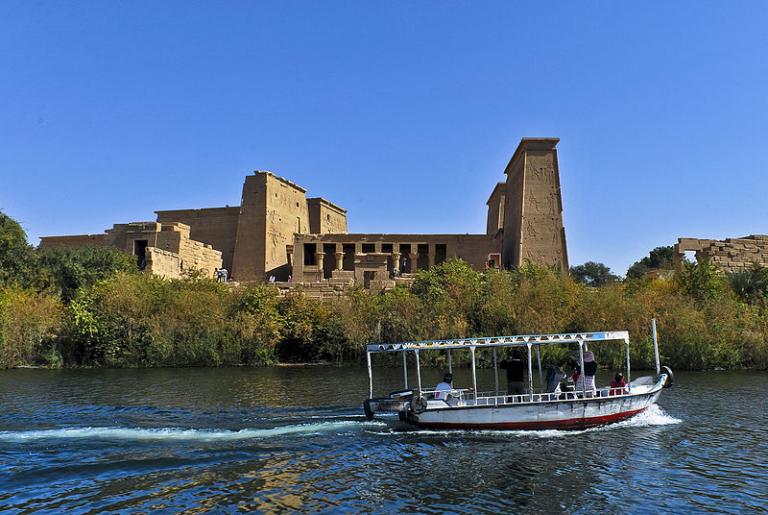
There are more beautiful photographs of the Temple of Isis at Philae, near Aswan, but this one was available.
(Wikimedia Commons public domain image)
Many years ago, I was accompanying a a different group of Latter-day Saint tourists in Egypt. It was my first time to accompany a group to Aswan. At one point, our local guide took us to a restaurant on an island in the Nile River. Suddenly, I realized where we were. I pointed excitedly to some ruins at the southern end of an adjacent island, exclaiming to my puzzled companions that it was one of the most important of all Book of Mormon archaeological sites. Then I explained why:
According to the Book of Mormon (see, for example, 1 Nephi 2:5), around the beginning of the sixth century before Christ there lived a woman in or near Jerusalem by the name of “Sariah.” However, no woman appears in the Bible bearing that name. “Sarai,” Abraham’s wife, comes the closest. Her name probably means “my princess” or “my lady.” Later, she’s called “Sarah” (“princess.”) But “Sariah” is quite distinct.
So did Joseph Smith simply invent the name? Definitely not.
In unvowelled Hebrew, “Sariah*”* would almost certainly be spelled “sryh,” and it would be pronounced something like “Saryah.” Although “sryh” is not found in the Bible as a female name, it is well documented as an ancient Israelite masculine name. In fact, it’s attached to eleven different men in the Hebrew Bible, appearing a total of nineteen times. In the King James Bible, it’s spelled “Seraiah,” which is presumably a shortened form of “sryhw” or “Saryahu,” where the element “Yahu” derives from the divine name “Yahuweh” or “Jehovah.” (That longer form actually does appear in the Hebrew of Jeremiah 36:26, as well as in several Iron Age seals and clay bullae.)
So perhaps Joseph Smith took the name “Seraiah” from the Old Testament but misspelled it and misapplied it to a woman? Again, apparently not.
As Jeffrey Chadwick pointed out in a 1993 article, the Hebrew name “Sariah,” spelled “sryh,” has been reconstructed by non-Latter-day Saint scholars and identified as the Hebrew name of a Jewish woman who lived at Elephantine in Upper Egypt during the fifth century B.C. To be precise, she lived on that small island that so excited me. It was known to the ancient Egyptians as “3bw” (“Elephant” or “Ivory”) and to the Greeks as “Elephantine,” which reflects the importance of Aswan, in the far south of Egypt, to the ivory trade with inner Africa.
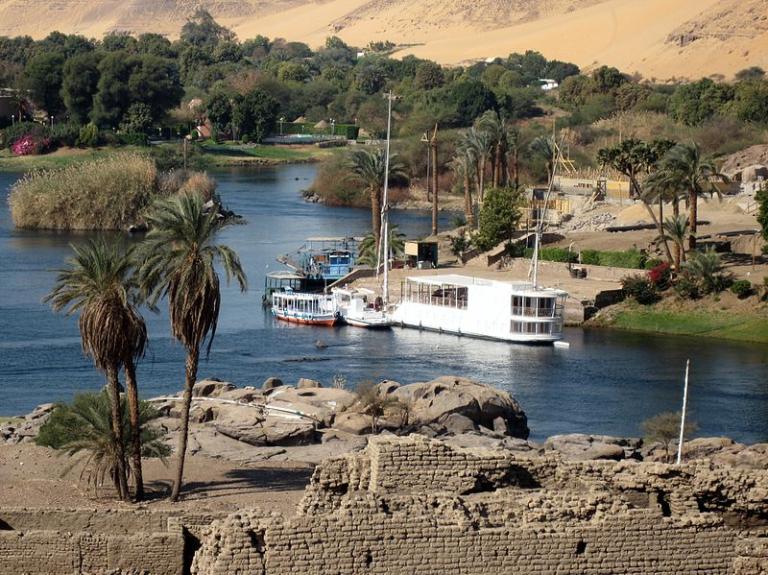
At the south end of Elephantine Island in the Nile River, near Aswan, Egypt
(Wikimedia Commons public domain image)
The reference to Sariah of Elephantine is found in line 4 of Aramaic Papyrus #22 (also called Cowley #22 or C-22), where she is described as “Seraiah, daughter of Hoshea son of Harman.” Her name may mean either “Yah (or Yahuweh) has struggled” or “Yah (or Yahuweh) is prince.” And “Sariah” may be the better spelling.
In other words, “Sariah” seems to be an authentically ancient Hebrew feminine name. Yet the Elephantine Papyri were discovered around the beginning of the twentieth century, far too late for Joseph Smith to have studied them.
But there’s more.
Why is this Sariah mentioned in Papyrus C-22? Because she had donated two shekels of silver to “Yahu Elaha,” “the Lord God.” Arthur Cowley, after whom the papyrus was named, believed that her donation, which he dates to the year 419 BC, went to the expenses of the Jewish temple that we know to have been constructed on Elephantine Island.
An Israelite temple outside of Jerusalem? Yes, indeed. Directly parallel to the temple “like unto the temple of Solomon” that Nephi had constructed in the Americas somewhat more than a century before (2 Nephi 5:16), it was built by a colony of Jewish soldiers that had probably been established there sometime in the seventh century—i.e., during Lehi’s early years—when Judah was subservient to Egypt.
“For Latter-day Saint students today,” summarizes Chadwick, “the historical parallels between Sariah of Elephantine and Sariah the wife of Lehi are interesting, even if coincidental. Aside from sharing the same Hebrew name and the same Judahite-Israelite background, both women lived a great distance from Jerusalem. One’s location would indicate that she probably used Egyptian as a language in addition to Aramaic, whereas the other’s husband and at least one son were schooled in ‘the language of the Egyptians’ as well as their native Hebrew tongue (1 Nephi 1:2). Both women reverenced ‘the Lord God’ (Aramaic ‘Yahu Elaha’; compare 2 Nephi 5:30). Both women lived among Judahite-Israelite colonies that built their own temples outside the sphere of the temple at Jerusalem.”
See Jeffrey R. Chadwick, “Notes and Communications: Sariah in the Elephantine Papyri,” Journal of Book of Mormon Studies 2/2 (1993) (https://publications.mi.byu.edu/fullscreen/?pub=1379&index=13).
Aswan, Egypt
Posted from Cairo, Egypt
Previous Post

November 6, 2022
"Why and Why Not?"
Next Post
November 11, 2022 Very sad news, and a belated note from the River Nile
Browse Our Archives
Select a Category Uncategorized
Select a Month October 2026 September 2026 August 2026 July 2026 June 2026 May 2026 April 2026 March 2026 February 2026 January 2026 December 2025 November 2025 October 2025 September 2025 August 2025 July 2025 June 2025 May 2025 April 2025 March 2025 February 2025 January 2025 December 2024 November 2024 October 2024 September 2024 August 2024 July 2024 June 2024 May 2024 April 2024 March 2024 February 2024 January 2024 December 2023 November 2023 October 2023 September 2023 August 2023 July 2023 June 2023 May 2023 April 2023 March 2023 February 2023 January 2023 December 2022 November 2022 October 2022 September 2022 August 2022 July 2022 June 2022 May 2022 April 2022 March 2022 February 2022 January 2022 December 2021 November 2021 October 2021 September 2021 August 2021 July 2021 June 2021 May 2021 April 2021 March 2021 February 2021 January 2021 December 2020 November 2020 October 2020 September 2020 August 2020 July 2020 June 2020 May 2020 April 2020 March 2020 February 2020 January 2020 December 2019 November 2019 October 2019 September 2019 August 2019 July 2019 June 2019 May 2019 April 2019 March 2019 February 2019 January 2019 December 2018 November 2018 October 2018 September 2018 August 2018 July 2018 June 2018 May 2018 April 2018 March 2018 February 2018 January 2018 December 2017 November 2017 October 2017 September 2017 August 2017 July 2017 June 2017 May 2017 April 2017 March 2017 February 2017 January 2017 December 2016 November 2016 October 2016 September 2016 August 2016 July 2016 June 2016 May 2016 April 2016 March 2016 February 2016 January 2016 December 2015 November 2015 October 2015 September 2015 August 2015 July 2015 June 2015 May 2015 April 2015 March 2015 February 2015 January 2015 December 2014 November 2014 March 2014 August 2013 February 2012
Follow Us!
TAKE THE
Religious Wisdom Quiz
What was Jesus' first miracle?
Select your answer to see how you score.
Feeding the 5,000 Turning water into wine Healing a blind man Walking on water
Related posts from Sic et Non

Looking at the Largest Orthodox Cathedral on Earth

The Iron Gates and the Lion of the...


Learning more about a region of which I've...
TRENDING AT PATHEOS Latter-day Saint

Looking at the Largest Orthodox Cathedral on Earth
There is often a considerable amount of anger and, shall we...

The Problem with False Prophets
Miller’s Station UMC| 10/18/26| Anchor Verse: Jeremiah 23: 1, 9-23 I...

Emotion in Early Christianity by Andrew Crislip
Andrew Crislip’s Emotion in Early Christianity examines an often overlooked dimension of...

16 Spiritual Touchstones for a More Grounded Life
After decades of spiritual study, here are 16 principles I try...

Catholic Evangelization: Sharing Your Faith Every Day
Welcome back to the Graceful Awakening mini-series called, “From Faith to Mission.” ...

The Pillar of the Boatmen: the Ancient Monument...
The Pillar of the Boatmen is a Romano-Gaulish sculpture that dates from...
view all Latter-day Saint blogs
Ad-Free & Subscriber Log-In Subscription Support
- About Us
- 2026 Calendar
- Videos
- Podcasts
- Library of World Religions
- Faith In Media Tracker
- Advertise With Us
- Write for Us
- Privacy Policy
- Terms of Service
- Do Not Sell My Data
- Contact Us
- Radiant Digital
- Manage Newsletter Subscriptions
- Unsubscribe From Notifications
- Sitemap
Copyright 2008-2026, Patheos. All rights reserved.
Subscription Support Ad-Free & Subscriber Log-In
Follow Patheos