
BuddhistCatholicContemplativeEvangelicalGeneral ChristianHinduJewishLatter-day SaintMuslimNew VisionsProgressive Christian
Beliefs
- Buddhist
- Catholic
- Contemplative
- Evangelical
- General Christian
- Hindu
- Jewish
- Latter-day Saint
- More Voices
- Muslim
- New Visions
- Pagan
- Progressive Christian
Topics
- Religion News
- Food and Religion
- Sports and Religion
- Religious Art
- Religious Music and Entertainment
- Religious Events
- History and Religion
- Style and Religion
- Politics and Religion
- Women in Religion
- Recreation Outdoors and Religion
- Business Finance and Religion
- Careers Workplace and Religion
- Education and Religion
- Family Parenting and Religion
- Health Fitness and Religion
- Home and Religion
- Relationships and Religion
- Technology and Religion
- Travel and Religion
Columnists
- Buddhist Columnists
- Business Finance and Religion Columnists
- Careers Workplace and Religion Columnists
- Catholic Columnists
- Contemplative Columnists
- Education and Religion Columnists
- Evangelists Columnists
- Family Parenting and Religion Columnists
- General Christian Columnists
- Health Fitness and Religion Columnists
- Hindu Columnists
- History and Religion Columnists
- Home and Religion Columnists
- Jewish Columnists
- More Voices Columnists
- Latter Day Columnists
- Muslim Columnists
- New Visions Columnists
- Nonreligious Columnists
- Pagan Columnists
- Politics and Religion Columnists
- Progressive Columnists
- Recreation Outdoors and Religion Columnists
- Relationships and Religion Columnists
- Religion News Columnists
- Religious Art Columnists
- Religious Events Columnists
- Religious Music and Entertainment Columnists
- Sports and Religion Columnists
- Style and Religion Columnists
- Technology and Religion Columnists
- Travel and Religion Columnists
- Women in Religion Columnists
Resource Library
- 2026 Calendar
- Library of World Religions
- The 100 Most Holy Places on Earth
- Patheos Answers
- Podcasts
- Videos
- Faith Leaders Database
- Anglican Episcopalian
- Bahai
- Baptist
- Buddhism
- Christianity
- Confucianism
- Eastern Orthodoxy
- Hinduism
- Holiness and Pentecostal
- ISKCON
- Islam
- Judaism
- Lutheran
- Methodist
- The Church of Jesus Christ of Latter-day Saints
- New Age
- Paganism
- Presbytarian and Reformed
- Protestantism
- Religion Behind the Scenes
- Roman Catholic
- Scientology
- Shia Islam
- Sikhism
- Sufism
- Sunni Islam
- Taoism
- Zen
- See all religions
Research Tools
 Ad-Free & Subscriber Log-In Subscription Support
Ad-Free & Subscriber Log-In Subscription Support
Follow Patheos 

- Trending:
- Forgiveness
- |
- Marriage
- |
- Consciousness
- |
- Death Penalty
- |
- Election
- |
- Halloween

- Home
- Latter-day Saint
- History and Religion
- For Thanksgiving Day
For Thanksgiving Day
Last updated on: November 29, 2022 at 6:15 am by Dan Peterson
For Thanksgiving Day 2022-11-29T06:15:38-07:00 Dan Peterson
Patheos Explore the world's faith through different perspectives on religion and spirituality! Patheos has the views of the prevalent religions and spiritualities of the world.
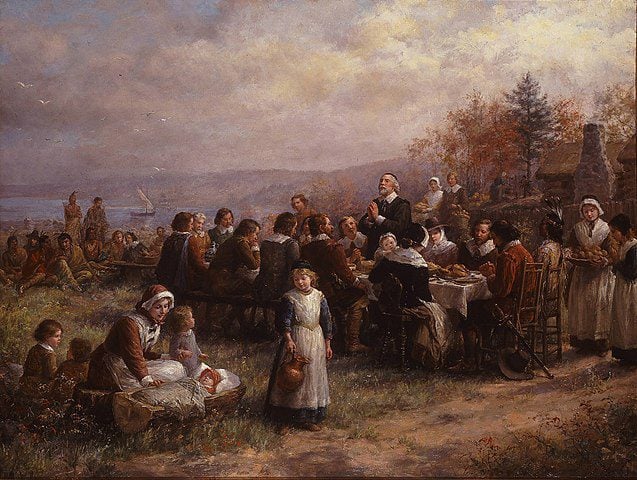
“Thanksgiving at Plymouth,” by Jennie Augusta Brownscombe (1925)
Wikimedia Commons public domain image
Happy Thanksgiving!
I hesitated just a bit before deciding to call your attention to a new piece that has appeared on the blog of the Interpreter Foundation, where it will remain for the next several weeks. Today is an important holiday here in the United States, and I don’t want to mar or distract from the spirit of the day, which I hope will be a wonderful one for all who observe it. But this item has been the subject of pre-publication controversy in some circles, so that I’ve decided to go ahead with mentioning it:
Review of Cheryl L. Bruno, Joe Steve Swick, III, and Nicholas S. Literski. Method Infinite: Freemasonry and the Mormon Restoration. Salt Lake City, UT: Greg Kofford Books, 2022, 509pp. with index. Price: $44.95 (hardback); $34.95 (softcover).
[Editor’s Note: This is a pre-publication copy of a review that will, after source checking, copy editing, and typesetting, appear in the pages of Interpreter: A Journal of Latter-day Saint Faith and Scholarship. At that time, this version will be removed and this page will redirect to the version published in the Journal. As the publication of the book reviewed here, Method Infinite: Freemasonry and the Mormon Restoration, closely coincided with the publication of Dr. Bradshaw’s book, Freemasonry and the Origins of Latter-day Saint Temple Ordinances, a fair amount of discussion has recently resulted. It was, therefore, felt that interested parties might benefit from this early version of the review being posted on the blog, followed in a few weeks by the final version appearing in the Journal.]
But, now, back to Thanksgiving. Over the past two or three days, I’ve been sharing columns that I wrote for the holiday, starting in 2010. Here are two columns that I wrote in, respectively, 2014 and 2015:
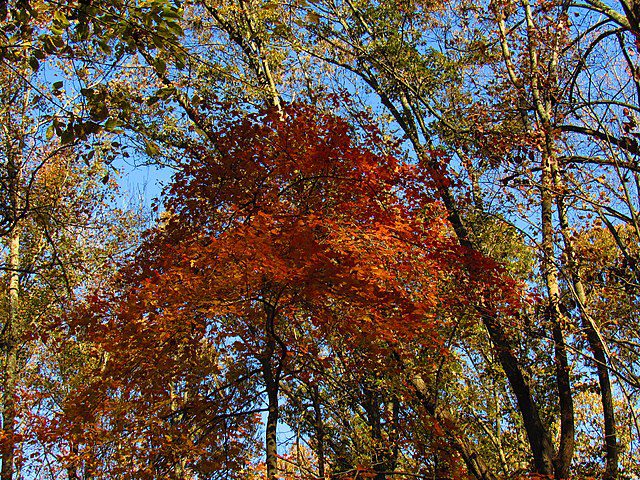
There is still color left in some places, as in this Wikimedia Commons public domain photo from Caledon State Park in Virginia
Many years ago, a friend (now deceased) told me about a very high-ranking Church leader (also now deceased) who had been asked to address a group of local senior service missionaries and their wives at their annual Christmas dinner.
As the program proceeded, various stories were related to illustrate the great things that this group of devoted volunteers had accomplished during the year then nearing its end. Unfortunately, the Church leader, still waiting to offer his concluding remarks, was growing concerned at what struck him as the evening’s self-congratulatory tone.
Finally, his turn came to speak. He had been allotted roughly half an hour, but he jettisoned his prepared text. Instead, he simply opened his scriptures to Mosiah 2:20-21, and read it to his audience:
“I say unto you, my brethren, that if you should render all the thanks and praise which your whole soul has power to possess, to that God who has created you, and has kept and preserved you, and has caused that ye should rejoice, and has granted that ye should live in peace one with another—
“I say unto you that if ye should serve him who has created you from the beginning, and is preserving you from day to day, by lending you breath, that ye may live and move and do according to your own will, and even supporting you from one moment to another—I say, if ye should serve him with all your whole souls yet ye would be unprofitable servants.”
He then bore a brief testimony of Christ and sat down. The rebuke was quiet but unmistakable, and my friend had remembered it for years by the time he told me about it.
Today is a day for giving thanks—uniquely and officially so in America, but appropriately so everywhere—for the remarkable blessings that we enjoy. We have far more to be grateful for than we can begin to recognize or enumerate, and it should leave us deeply humble.
We enjoy food, nourished by soil and weather we didn’t create, that we neither planted nor harvested. It’s brought to us via roads and rails and ships constructed by people whose names we don’t know, and we prepare it with fuels and implements that we didn’t produce.
We communicate worldwide virtually for free. Films, computers, television, and radio put almost unlimited information at our fingertips, including remarkable ways of researching family history.
We benefit from a level of nutrition, health, and comfort that would have been unimaginable to our ancestors, many of whom suffered throughout their lives from rotten teeth and incurable ailments. Only a few generations ago, even the simplest diseases stymied the best physicians. Dentists and surgeons did their work without sterilization or anesthesia. But, until fairly recently, there were no hip replacements or arthroscopic knee surgeries anyway, and, not very long before that, there were no aspirin tablets and no corrective lenses. If you had a headache, you simply endured it until it went away. If your eyes or knees went bad, you lived with it until you died.
Prior to a couple of centuries ago, all transportation was on foot, or on or behind an animal, or blown by the wind. Ramses II, Augustus Caesar, Queen Elizabeth I of England, and George Washington all traveled roughly the same way. Today, by contrast, we cruise along comfortably in climate-controlled bubbles at speeds they never knew, listening to the Beatles (including John Lennon and George Harrison, who’ve been dead for years) or to the Vienna Philharmonic.
We typically take this all for granted. We even complain about it. Several years ago, I found myself wedged between two strangers on a flight from Chicago to Salt Lake City. The flight attendant gave me only pretzels, and the flight dragged on for more than four hours! Suddenly though, I thought of the handcart pioneers. Only 150 years before, they had followed essentially the same route, thousands of feet below me, over rivers, through brush and rocks, under rain and sometimes snow, requiring several months to complete their journey. My whining might not have impressed them favorably.
And the Gospel is on earth again. In other words, to put it flippantly, we’ve won the cosmic lottery.
Praise God, from whom all blessings flow;
Praise him, all creatures here below;
Praise him above, ye heavenly host;
Praise Father, Son, and Holy Ghost. Amen.
A very happy Thanksgiving to everyone.
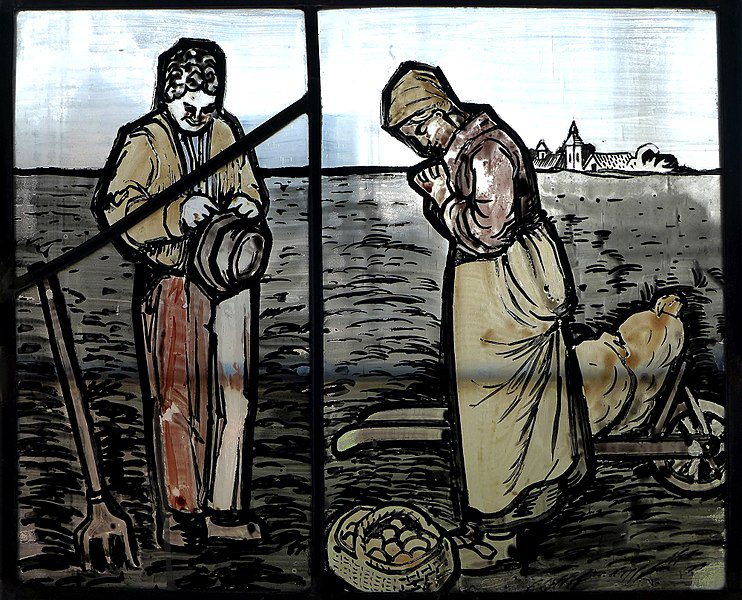
“Kartoffelernte und Erntedank in der Hippolit-Kirche zu Amelinghausen.”
(Oxfordian Kissuth, licensed under the Creative Commons Attribution-Share Alike 3.0 Unported license)
[Potato Harvest and Harvest Festival in the Church of St. Hippolytus in Amelinghausen]
Although American Thanksgiving Day began as a harvest festival, it’s not about eating. Most of us eat quite well—often too well—every day, so meals aren’t special. It’s not even really about family. As its name implies, it’s about giving thanks.
And we have much for which to be thankful.
Why is there a universe in the first place? Why is it so precisely fine-tuned as to produce us? The great twentieth-century atheistic astrophysicist Sir Fred Hoyle concluded, rather grumpily, that the whole thing is “a put-up job,” that “a superintellect has monkeyed with physics, as well as with chemistry and biology.” “As we look out into the universe,” wrote the Anglo-American mathematical physicist Freeman Dyson, of Princeton’s Institute for Advanced Study, “and identify the many accidents of physics and astronomy that have worked together to our benefit, it almost seems as if the universe must in some sense have known that we were coming.”
Ours, says the British physicist Paul Davies, is “a Goldilocks Universe.” It’s “just right.” And so is the globe on which we live, as demonstrated in recent books bearing such titles as “Privileged Planet” and “Rare Earth.”
Our bodies are phenomenally complicated; our brains, some scientists say, are the most physically complex objects in the known universe. Stars and galaxies are simple in comparison.
Most readers of this column enjoy the privilege of American citizenship, or of something rather like it. There are, today, a number of free countries that respect human rights. But many are unfree and oppressive. There are many prosperous nations, too—but also many that are very poor. We should be mindful of those less fortunate than ourselves, but also grateful for the blessings that we enjoy and not complacent about them.
Although most of us are isolated or insulated from the production of food and take it for granted, we have easy access to diets of a richness and variety that would have been unimaginable even to our relatively recent ancestors and to many in the world still today.
Gutenberg’s printing press and, now, ebooks and the Web and powerful search engines, grant us easy access to vast treasuries of knowledge. Cell phones and cheap and instant Internet communications keep us in contact, wherever we are. As we hurtle along in climate-controlled automobiles or jet aircraft, we listen, if the mood strikes us, to concerts by U2, or Taylor Swift, or the Berlin Philharmonic. And we lament journeys of several hours that, not so long ago, would have required uncomfortable days if not miserable and dangerous weeks. GPS systems guide us at every step, taking us from driveway to driveway, thousands of miles away.
Of course, no technical marvel changes life’s fundamentals. We still love family and friends. We still lose them. We become sick and, despite superb healthcare (including antibiotics and surgical procedures unknown to our grandparents), we die. We suffer from the human evils of oppression, crime, cruelty, and war. We endure mental and emotional illnesses, and virtually all of us know someone whose life has been damaged or even ruined by the scourge of drugs.
So, more than for anything else, we who’ve been privileged to learn of the Gospel of Christ should be thankful for his atonement and resurrection, which can mend all broken things and make all good things eternal. The power is not ours, but his. I close with powerful words from two hymns, the first from Rudyard Kipling and the second a Latin text derived from Psalm 115:1 and most recently set to memorable music by the great film composer Patrick Doyle:
God of our fathers, known of old,
Lord of our far-flung battle-line,
Beneath whose awful Hand we hold
Dominion over palm and pine—
Lord God of Hosts, be with us yet,
Lest we forget—lest we forget!
The tumult and the shouting dies;
The Captains and the Kings depart:
Still stands Thine ancient sacrifice,
An humble and a contrite heart.
Lord God of Hosts, be with us yet,
Lest we forget—lest we forget!
Far-called, our navies melt away;
On dune and headland sinks the fire:
Lo, all our pomp of yesterday
Is one with Nineveh and Tyre!
Judge of the Nations, spare us yet,
Lest we forget—lest we forget!
“Non nobis, Domine, non nobis, sed nomini tuo da gloriam.” “Not unto us, O Lord, not unto us, but to thy name give the glory.”
Thanks be to God.
History and Religion
Church of Jesus Christ of Latter-day Saints
Freemasonry and the Mormon Restoration
Previous Post

November 23, 2022
An Atmosphere of Gratitude and Grounds for Appreciation
Next Post
November 24, 2022 Two final thoughts on Thanksgiving
Browse Our Archives
Select a Category Uncategorized
Select a Month October 2026 September 2026 August 2026 July 2026 June 2026 May 2026 April 2026 March 2026 February 2026 January 2026 December 2025 November 2025 October 2025 September 2025 August 2025 July 2025 June 2025 May 2025 April 2025 March 2025 February 2025 January 2025 December 2024 November 2024 October 2024 September 2024 August 2024 July 2024 June 2024 May 2024 April 2024 March 2024 February 2024 January 2024 December 2023 November 2023 October 2023 September 2023 August 2023 July 2023 June 2023 May 2023 April 2023 March 2023 February 2023 January 2023 December 2022 November 2022 October 2022 September 2022 August 2022 July 2022 June 2022 May 2022 April 2022 March 2022 February 2022 January 2022 December 2021 November 2021 October 2021 September 2021 August 2021 July 2021 June 2021 May 2021 April 2021 March 2021 February 2021 January 2021 December 2020 November 2020 October 2020 September 2020 August 2020 July 2020 June 2020 May 2020 April 2020 March 2020 February 2020 January 2020 December 2019 November 2019 October 2019 September 2019 August 2019 July 2019 June 2019 May 2019 April 2019 March 2019 February 2019 January 2019 December 2018 November 2018 October 2018 September 2018 August 2018 July 2018 June 2018 May 2018 April 2018 March 2018 February 2018 January 2018 December 2017 November 2017 October 2017 September 2017 August 2017 July 2017 June 2017 May 2017 April 2017 March 2017 February 2017 January 2017 December 2016 November 2016 October 2016 September 2016 August 2016 July 2016 June 2016 May 2016 April 2016 March 2016 February 2016 January 2016 December 2015 November 2015 October 2015 September 2015 August 2015 July 2015 June 2015 May 2015 April 2015 March 2015 February 2015 January 2015 December 2014 November 2014 March 2014 August 2013 February 2012
Follow Us!
TAKE THE
Religious Wisdom Quiz
What is the Christian teaching about humility?
Select your answer to see how you score.
Value others above yourself Be proud always Demand honor Boast often
Related posts from Sic et Non


Notes on Women, Priesthood, and General Conference

"The Book of Moses as a Temple Text"

TRENDING AT PATHEOS Latter-day Saint

I was strolling through the top floor of the brand new Parthenon...

What Does Gêvâh Mean For Kimberley Guifoyle &...
This week, a lot of the news is focused on Kimberly Guilfoyle....

INNER CIRCLE: Profound Mystery (Of Christ In All...
Ephesians 5:31-32 “For this reason, a man will leave his father and...

Do Not Rejoice When Your Enemy Falls: The...
Turning an execution into a public spectacle is a disturbing expression of...

'The Chosen' S6 Trailer: The Passion Gets Very...
Not many watching 'The Chosen' worry about spoilers, but just because they...

The purpose-driven labor priest
A labor activist reads Rick Warren and it gets me wondering about...
view all Latter-day Saint blogs
Ad-Free & Subscriber Log-In Subscription Support
- About Us
- 2026 Calendar
- Videos
- Podcasts
- Library of World Religions
- Faith In Media Tracker
- Advertise With Us
- Write for Us
- Privacy Policy
- Terms of Service
- Do Not Sell My Data
- Contact Us
- Radiant Digital
- Manage Newsletter Subscriptions
- Unsubscribe From Notifications
- Sitemap
Copyright 2008-2026, Patheos. All rights reserved.
Subscription Support Ad-Free & Subscriber Log-In
Follow Patheos