
BuddhistCatholicContemplativeEvangelicalGeneral ChristianHinduJewishLatter-day SaintMuslimNew VisionsProgressive Christian
Beliefs
- Buddhist
- Catholic
- Contemplative
- Evangelical
- General Christian
- Hindu
- Jewish
- Latter-day Saint
- More Voices
- Muslim
- New Visions
- Pagan
- Progressive Christian
Topics
- Religion News
- Food and Religion
- Sports and Religion
- Religious Art
- Religious Music and Entertainment
- Religious Events
- History and Religion
- Style and Religion
- Politics and Religion
- Women in Religion
- Recreation Outdoors and Religion
- Business Finance and Religion
- Careers Workplace and Religion
- Education and Religion
- Family Parenting and Religion
- Health Fitness and Religion
- Home and Religion
- Relationships and Religion
- Technology and Religion
- Travel and Religion
Columnists
- Buddhist Columnists
- Business Finance and Religion Columnists
- Careers Workplace and Religion Columnists
- Catholic Columnists
- Contemplative Columnists
- Education and Religion Columnists
- Evangelists Columnists
- Family Parenting and Religion Columnists
- General Christian Columnists
- Health Fitness and Religion Columnists
- Hindu Columnists
- History and Religion Columnists
- Home and Religion Columnists
- Jewish Columnists
- More Voices Columnists
- Latter Day Columnists
- Muslim Columnists
- New Visions Columnists
- Nonreligious Columnists
- Pagan Columnists
- Politics and Religion Columnists
- Progressive Columnists
- Recreation Outdoors and Religion Columnists
- Relationships and Religion Columnists
- Religion News Columnists
- Religious Art Columnists
- Religious Events Columnists
- Religious Music and Entertainment Columnists
- Sports and Religion Columnists
- Style and Religion Columnists
- Technology and Religion Columnists
- Travel and Religion Columnists
- Women in Religion Columnists
Resource Library
- 2026 Calendar
- Library of World Religions
- The 100 Most Holy Places on Earth
- Patheos Answers
- Podcasts
- Videos
- Faith Leaders Database
- Anglican Episcopalian
- Bahai
- Baptist
- Buddhism
- Christianity
- Confucianism
- Eastern Orthodoxy
- Hinduism
- Holiness and Pentecostal
- ISKCON
- Islam
- Judaism
- Lutheran
- Methodist
- The Church of Jesus Christ of Latter-day Saints
- New Age
- Paganism
- Presbytarian and Reformed
- Protestantism
- Religion Behind the Scenes
- Roman Catholic
- Scientology
- Shia Islam
- Sikhism
- Sufism
- Sunni Islam
- Taoism
- Zen
- See all religions
Research Tools
 Ad-Free & Subscriber Log-In Subscription Support
Ad-Free & Subscriber Log-In Subscription Support
Follow Patheos 

- Trending:
- Forgiveness
- |
- Marriage
- |
- Consciousness
- |
- Death Penalty
- |
- Election
- |
- Halloween

- Home
- Latter-day Saint
- The, Umm, Creative Life
The, Umm, Creative Life
Last updated on: October 16, 2022 at 9:38 pm by Dan Peterson
The, Umm, Creative Life 2022-10-16T21:38:30-06:00 Dan Peterson
Patheos Explore the world's faith through different perspectives on religion and spirituality! Patheos has the views of the prevalent religions and spiritualities of the world.
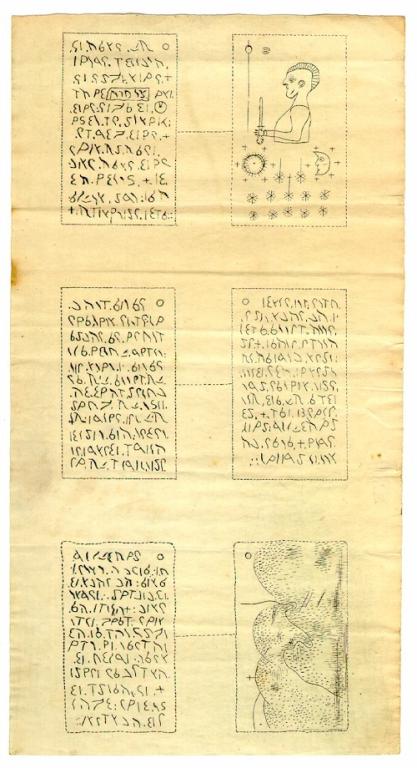
An 1845 broadside depicting “The Record of Rajah Manchou of Vorito,” commonly known as the “Voree Plates,” which were allegedly discovered by James J. Strang and used to promote his leadership of the Latter Day Saint movement.
(Wikimedia Commons public domain image)
Newly available from the Interpreter Foundation:
Witnesses of the Book of Mormon — Insights Episode 26: James Strang’s Witnesses
James Strang was a recent convert to the church who claimed to be the successor of Joseph after the martyrdom. Strang also claimed to have discovered ancient metal plates, What do we know about this man and his claims?
This is the twenty-sixth in a series compiled from the many interviews conducted during the course of the Witnesses film project. This series of mini-films is being released each Saturday at 7pm MDT. These additional resources are hosted by Camrey Bagley Fox, who played Emma Smith in Witnesses, as she introduces and visits with a variety of experts. These individuals answer questions or address accusations against the witnesses, also helping viewers understand the context of the times in which the witnesses lived. This week we feature Daniel C. Peterson, President of the Interpreter Foundation and Executive Producer of Witnesses. For more information, go to https://witnessesofthebookofmormon.org/ or watch the documentary movie Undaunted.
Short clips from this episode are also available on TikTok and Instagram.
Be sure to subscribe to our YouTube channel at https://youtube.interpreterfoundation.org/ and our other social media channels on Facebook, Twitter, Instagram, and TikTok.
***
Morning was spent in the swimming pool. Early afternoon was spent at a showing of Lyle, Lyle, Crocodile. It was a bit loud and, at points, apparently a bit too scary. With the help of popcorn and a firmly-clutched stuffed corgi, though, we managed to see the movie through to the end. It also helps, I think, to have a grandma and an uncle and a more or less adequately functional grandpa on full-time duty. But the absent parental units, it seems, were completely unmissed. And, on demand, outdoor-grilled Bratwurst for dinner! (After pizza last night.)
***
I’ve already mentioned in prior blog entries that I’ve been reading Stephen King, On Writing: A Memoir of the Craft (New York: Scribner’s, 2000). In view of the fact (also already mentioned) that I’ve never been a fan of Stephen King — nor, for that matter, an un-fan; I simply haven’t paid much attention — I’m a little bit surprised myself at how much I’ve enjoyed the book.
He was, apparently, a serious alcoholic and drug addict for a number of the years when he was cementing his stature as a prolifically best-selling writer, and he speaks with frankness and considerable authority on the matter of addiction to drugs and alcohol and its relationship to the writing life.
Alcoholics build defenses like the Dutch build dikes. I spent the first twelve years or so of my married life assuring myself that I “just liked to drink.” I also employed the world-famous Hemingway Defense. Although never clearly articulated (it would not be manly to do so), the Hemingway Defense goes something like this: as a writer, I am a very sensitive fellow, but I am also a man, and real men don’t give in to their sensitivities. Only sissy-men do that. Therefore I drink. How else can I face the existential horror of it all and continue to work? Besides, come on, I can handle it. A real man always can. . . .
By 1985 I had added drug addition to my alcohol problems, yet I continued to function, as a good many substance abusers do, on a marginally competent level. (94, 96)
He even acknowledges that he scarcely remembers writing his novel Cujo, which he regrets because he rather likes the novel and says that he probably enjoyed or, anyway, would have enjoyed writing it.
A major intervention was finally required from wife, family, and friends in order to save him from going over the brink. So I was pleased to see this very strong statement from him, which I hope that nobody reading this blog of mine really needs:
The idea that creative endeavor and mind-altering substances are entwined is one of the great pop-intellectual myths of our time. The four twentieth-century writers whose work is most responsible for it are probably Hemingway, Fitzgerald, Sherwood Anderson, and the poet Dylan Thomas. They are the writers who largely formed our vision of an existential English-speaking wasteland where people have been cut off from one another and live in an atmosphere of emotional strangulation and despair. These concepts are very familiar to most alcoholics, the common reaction to them is amusement. Substance-abusing writers are just substance abusers — common garden-variety drunks and druggies, in other words. Any claims that the drugs and alcohol are necessary to dull a finer sensibility are just the usual self-serving [coarse two-syllable term omitted]. I’ve heard alcoholic snowplow drivers make the same claim, that they drink to still the demons. It doesn’t matter if you’re James Jones, John Cheever, or a stewbum snoozing in Penn Station; for an addict, the right to the drink or drug of choice must be preserved at all costs. Hemingway and Fitzgerald didn’t drink because they were creative, alienated, or morally weak. They drank because it’s what alkies are wired up to do. Creative people probably do run a greater risk of alcoholism and addiction than those in some other jobs, but so what? We all look pretty much the same when we’re puking in the gutter. (98-99)
I’ve been told more than once that drugs and booze help with The Creative Process. But I’ve never believed it. I’ve wondered what people like Charlie Parker, Tennessee Williams, Miles Davis, Samuel Taylor Coleridge, Sonny Rollins, William Faulkner, John Coltrane, Whitney Houston, Edgar Allen Poe, and Billie Holiday might have achieved without their addictions. Of course, we’ll never know.
I also like this passage from Stephen King:
When I’m asked for “the secret of my success” (an absurd idea, that, but impossible to get away from), I sometimes say there are two: I stayed physically healthy (at least until a van knocked me down by the side of the road in the summer of 1999), and I stayed married. It’s a good answer because it makes the question go away, and because there is an element of truth in it. The combination of a healthy body and a stable relationship with a self-reliant woman who takes zero [coarse monosyllabic term, related to the two-syllable term above, omitted] from me or anyone else has made the continuity of my working life possible. And I believe the converse is also true: that my writing and the pleasure I take in it has contributed to the stability of my health and my home life. (154-155)
My debt to my wonderful, steady, reliable, self-reliant wife for whatever inconsequential achievements I may have to my name is absolutely incalculable, as anybody who knows the two of us will readily recognize.
Posted from Miami, Florida
On Writing: A Memoir of the Craft
Previous Post

October 14, 2022
Jonathan Neville's "Response to Recent Reviews"
Next Post
October 16, 2022 "Life Together"
Browse Our Archives
Select a Category Uncategorized
Select a Month October 2026 September 2026 August 2026 July 2026 June 2026 May 2026 April 2026 March 2026 February 2026 January 2026 December 2025 November 2025 October 2025 September 2025 August 2025 July 2025 June 2025 May 2025 April 2025 March 2025 February 2025 January 2025 December 2024 November 2024 October 2024 September 2024 August 2024 July 2024 June 2024 May 2024 April 2024 March 2024 February 2024 January 2024 December 2023 November 2023 October 2023 September 2023 August 2023 July 2023 June 2023 May 2023 April 2023 March 2023 February 2023 January 2023 December 2022 November 2022 October 2022 September 2022 August 2022 July 2022 June 2022 May 2022 April 2022 March 2022 February 2022 January 2022 December 2021 November 2021 October 2021 September 2021 August 2021 July 2021 June 2021 May 2021 April 2021 March 2021 February 2021 January 2021 December 2020 November 2020 October 2020 September 2020 August 2020 July 2020 June 2020 May 2020 April 2020 March 2020 February 2020 January 2020 December 2019 November 2019 October 2019 September 2019 August 2019 July 2019 June 2019 May 2019 April 2019 March 2019 February 2019 January 2019 December 2018 November 2018 October 2018 September 2018 August 2018 July 2018 June 2018 May 2018 April 2018 March 2018 February 2018 January 2018 December 2017 November 2017 October 2017 September 2017 August 2017 July 2017 June 2017 May 2017 April 2017 March 2017 February 2017 January 2017 December 2016 November 2016 October 2016 September 2016 August 2016 July 2016 June 2016 May 2016 April 2016 March 2016 February 2016 January 2016 December 2015 November 2015 October 2015 September 2015 August 2015 July 2015 June 2015 May 2015 April 2015 March 2015 February 2015 January 2015 December 2014 November 2014 March 2014 August 2013 February 2012
Follow Us!
TAKE THE
Religious Wisdom Quiz
What was the name of the Jewish ruling council in Jesus’ time?
Select your answer to see how you score.
Essenes Sanhedrin Sadducees Pharisees
Related posts from Sic et Non

Where will YOU be in mid-August?


Is Our Faith Rooted in "Fear"?

TRENDING AT PATHEOS Latter-day Saint

How to Make a Decision When You Can't...
Main point: It’s much more valuable to stay close to God so...

Archdiocese Hosts Military Marriage Retreat in Germany
RASTATT, Germany — The transient military lifestyle, with its frequent deployments and...

Nearly every morning, I make the drive to Detroit with my high-school-age...

The Real AI Story Is Adoption Without Trust
Artificial intelligence has crossed a political threshold. It is no longer a...

A new article, written by Jeff Lindsay and Gale L. Pooley,...

Swimfan: Forgotten Aughts Pleasures
This is a recovery effort. In 2002, My Big Fat Greek Wedding...
view all Latter-day Saint blogs
Ad-Free & Subscriber Log-In Subscription Support
- About Us
- 2026 Calendar
- Videos
- Podcasts
- Library of World Religions
- Faith In Media Tracker
- Advertise With Us
- Write for Us
- Privacy Policy
- Terms of Service
- Do Not Sell My Data
- Contact Us
- Radiant Digital
- Manage Newsletter Subscriptions
- Unsubscribe From Notifications
- Sitemap
Copyright 2008-2026, Patheos. All rights reserved.
Subscription Support Ad-Free & Subscriber Log-In
Follow Patheos