
BuddhistCatholicContemplativeEvangelicalGeneral ChristianHinduJewishLatter-day SaintMuslimNew VisionsProgressive Christian
Beliefs
- Buddhist
- Catholic
- Contemplative
- Evangelical
- General Christian
- Hindu
- Jewish
- Latter-day Saint
- More Voices
- Muslim
- New Visions
- Pagan
- Progressive Christian
Topics
- Religion News
- Food and Religion
- Sports and Religion
- Religious Art
- Religious Music and Entertainment
- Religious Events
- History and Religion
- Style and Religion
- Politics and Religion
- Women in Religion
- Recreation Outdoors and Religion
- Business Finance and Religion
- Careers Workplace and Religion
- Education and Religion
- Family Parenting and Religion
- Health Fitness and Religion
- Home and Religion
- Relationships and Religion
- Technology and Religion
- Travel and Religion
Columnists
- Buddhist Columnists
- Business Finance and Religion Columnists
- Careers Workplace and Religion Columnists
- Catholic Columnists
- Contemplative Columnists
- Education and Religion Columnists
- Evangelists Columnists
- Family Parenting and Religion Columnists
- General Christian Columnists
- Health Fitness and Religion Columnists
- Hindu Columnists
- History and Religion Columnists
- Home and Religion Columnists
- Jewish Columnists
- More Voices Columnists
- Latter Day Columnists
- Muslim Columnists
- New Visions Columnists
- Nonreligious Columnists
- Pagan Columnists
- Politics and Religion Columnists
- Progressive Columnists
- Recreation Outdoors and Religion Columnists
- Relationships and Religion Columnists
- Religion News Columnists
- Religious Art Columnists
- Religious Events Columnists
- Religious Music and Entertainment Columnists
- Sports and Religion Columnists
- Style and Religion Columnists
- Technology and Religion Columnists
- Travel and Religion Columnists
- Women in Religion Columnists
Resource Library
- 2026 Calendar
- Library of World Religions
- The 100 Most Holy Places on Earth
- Patheos Answers
- Podcasts
- Videos
- Faith Leaders Database
- Anglican Episcopalian
- Bahai
- Baptist
- Buddhism
- Christianity
- Confucianism
- Eastern Orthodoxy
- Hinduism
- Holiness and Pentecostal
- ISKCON
- Islam
- Judaism
- Lutheran
- Methodist
- The Church of Jesus Christ of Latter-day Saints
- New Age
- Paganism
- Presbytarian and Reformed
- Protestantism
- Religion Behind the Scenes
- Roman Catholic
- Scientology
- Shia Islam
- Sikhism
- Sufism
- Sunni Islam
- Taoism
- Zen
- See all religions
Research Tools
 Ad-Free & Subscriber Log-In Subscription Support
Ad-Free & Subscriber Log-In Subscription Support
Follow Patheos 

- Trending:
- Forgiveness
- |
- Marriage
- |
- Consciousness
- |
- Death Penalty
- |
- Election
- |
- Halloween

- Home
- Latter-day Saint
- An idea for a conference on science and religion: Any interest out there?
An idea for a conference on science and religion: Any interest out there?
Last updated on: October 18, 2022 at 9:23 pm by Dan Peterson
An idea for a conference on science and religion: Any interest out there? 2022-10-18T21:23:18-06:00 Dan Peterson
Patheos Explore the world's faith through different perspectives on religion and spirituality! Patheos has the views of the prevalent religions and spiritualities of the world.
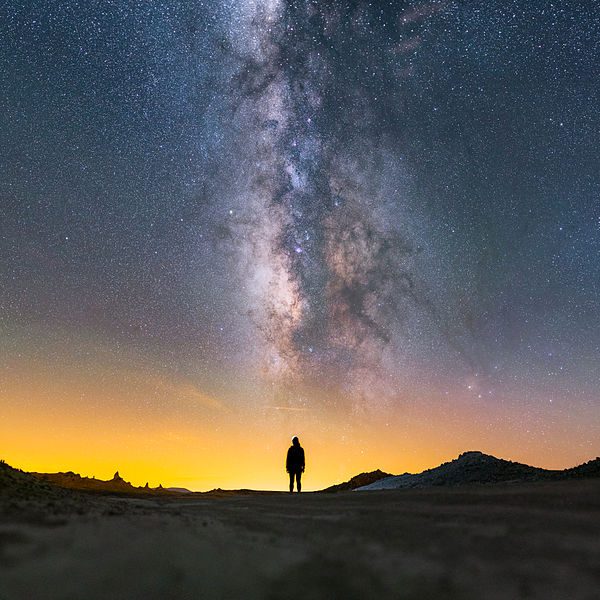
The Milky Way above California’s Mojave Desert (Wikimedia Commons public domain image)
First, though: I failed to note here that an article of mine was published by Meridian Magazine several days ago. Some of you might perhaps find it interesting, and, in order to make up for lost time, my most obsessive critics will want to get down to the task of maliciously misreading, grossly misunderstanding, and flagrantly misrepresenting it as soon as they possibly can:
“Sacrifice, Morality, and the Halifax Explosion”
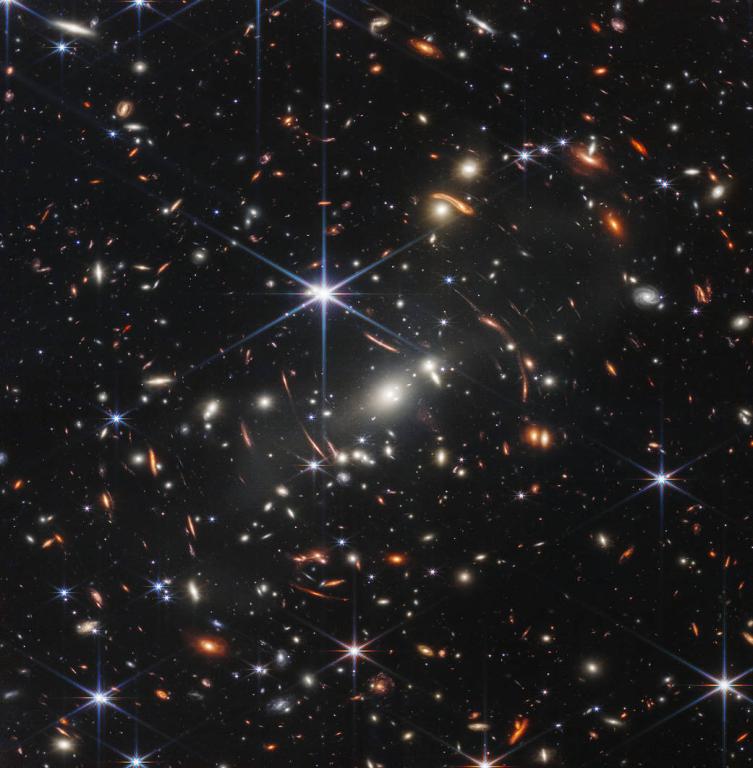
President Joe Biden unveiled this image of galaxy cluster SMACS 0723, known as Webb’s First Deep Field, during a White House event on Monday, 11 July 2022.
The Webb image covers a patch of sky approximately the size of a grain of sand held at arm’s length by someone on the ground — and reveals thousands of galaxies in a tiny sliver of an inconceivably vast universe
(Public domain image from the National Aeronautics and Space Administration)
One more thing: The parental units still appear to be quite blissfully unmissed. Of course, it’s fairly distracting, I would think, to stay not at your own home but at a Marriott resort and then, among other things, to zip across the Everglades in an airboat, pause to observe waterbirds, watch an alligator slowly swim toward and around your boat, attend an actual “alligator show,” try to keep your toes out of the mouth of a large, curious, slowly but constantly moving African tortoise, and hold various exotic reptiles including an Albino boa constrictor named “Julius Squeezer.”
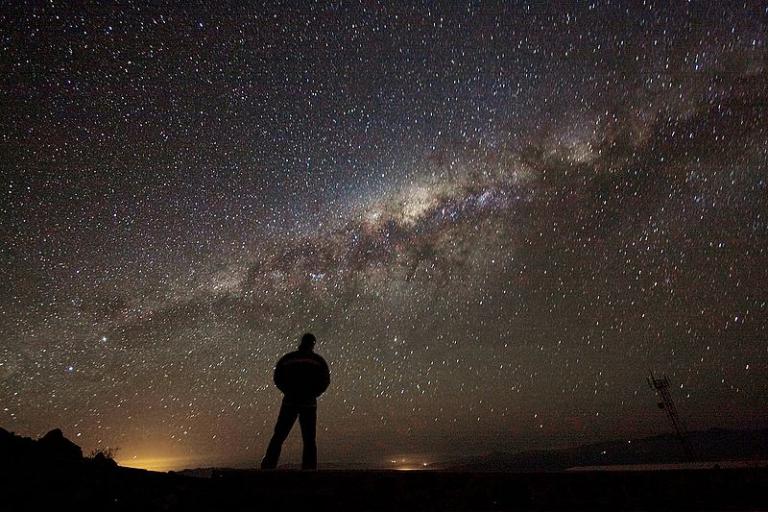
Astronomer Alan Fitzsimmons takes a break between sessions at the La Silla Observatory in Chile to admire the Milky Way.
(Wikimedia Commons)
Joseph Smith’s 1832 account of his First Vision, in his own handwriting, offers a very simple stab in the direction of a basic natural theology:
I looked upon the sun the glorious luminary of the earth and also the moon rolling in their magesty through the heavens and also the stars shining in their courses and the earth also upon which I stood and the beast of the field and the fowls of heaven and the fish of the waters and also man walking forth upon the face of the earth in magesty and in the strength of beauty whose power and intiligence in governing the things which are so exceding great and marvilous even in the likeness of him who created them and when I considired upon these things my heart exclaimed well hath the wise man said it is a fool that saith in his heart there is no God my heart exclaimed all all these bear testimony and bespeak an omnipotant and omnipresant power a being who makith Laws and decreeeth and bindeth all things in their bounds who filleth Eternity who was and is and will be from all Eternity to Eternity.
Such appeals to the physical cosmos, the visible natural world around us, as evidence for the existence of God and, to some degree at least, for his nature and character, are scattered throughout the scriptures. Here, for example, is a famous passage (Psalm 19:1-2) ascribed to the ancient Israelite king David, as rendered in the English Standard Bible (ESV):
The heavens declare the glory of God,
and the sky above proclaims his handiwork.
Day to day pours out speech,
and night to night reveals knowledge.
And here is the apostle Paul, taking aim at pagan idolatry and immorality in his letter to the Saints at Rome, also represented here in the ESV translation:
For the wrath of God is revealed from heaven against all ungodliness and unrighteousness of men, who by their unrighteousness suppress the truth. For what can be known about God is plain to them, because God has shown it to them. For his invisible attributes, namely, his eternal power and divine nature, have been clearly perceived, ever since the creation of the world, in the things that have been made. So they are without excuse. For although they knew God, they did not honor him as God or give thanks to him, but they became futile in their thinking, and their foolish hearts were darkened. Claiming to be wise, they became fools, and exchanged the glory of the immortal God for images resembling mortal man and birds and animals and creeping things. (Romans 1:18-23)
Consider, too, this part of the exchange between Alma, the Nephite chief priest, and the anti-Christ Korihor in the Book of Mormon:
And now Korihor said unto Alma: If thou wilt show me a sign, that I may be convinced that there is a God, yea, show unto me that he hath power, and then will I be convinced of the truth of thy words.
But Alma said unto him: Thou hast had signs enough; will ye tempt your God? Will ye say, Show unto me a sign, when ye have the testimony of all these thy brethren, and also all the holy prophets? The scriptures are laid before thee, yea, and all things denote there is a God; yea, even the earth, and all things that are upon the face of it, yea, and its motion, yea, and also all the planets which move in their regular form do witness that there is a Supreme Creator. (Alma 30:43-44)
Many of us, and perhaps even most of us, will have had the experience at least once or twice of contemplating a grand landscape or watching a beautiful sunset and having the sense wash over us, perhaps not very articulately, that there is something divine behind it. But I’ll let a quartet of famous English poets speak for the less eloquent rest of us. First, William Wordsworth, who was — especially in his earlier life — a great Romantic poet of nature, wrote of
that blessed mood,
In which the burthen of the mystery,
In which the heavy and the weary weight
Of all this unintelligible world,
Is lightened:—that serene and blessed mood,
In which the affections gently lead us on,—
Until, the breath of this corporeal frame
And even the motion of our human blood
Almost suspended, we are laid asleep
In body, and become a living soul:
While with an eye made quiet by the power
Of harmony, and the deep power of joy,
We see into the life of things.
Gerard Manley Hopkins believed that “The world is charged with the grandeur of God.” Elizabeth Barrett Browning wrote that
Earth’s crammed with heaven,
And every common bush afire with God,
But only he who sees takes off his shoes;
The rest sit round and pluck blackberries.
William Blake exhorted us
To see a World in a Grain of Sand
And a Heaven in a Wild Flower.
However, aren’t such perceptions merely the sentimental, vague, and, in the end, rather irrational things that we can expect from, well, poets? After all, nobody is going to confuse Walt Whitman or Emily Dickinson with Isaac Newton or James Clerk Maxwell. Intuition isn’t the same thing as a reasoned argument.
But at least some scientists have evidently had the same sense.
For instance, the great seventeenth-century German astronomer and mathematician Johann Kepler reported of his revolutionary scientific insights that
I was merely thinking God’s thoughts after Him. Since we astronomers are priests of the highest God in regard to the book of nature, it benefits us to be thoughtful, not of the glory of our minds, but rather, above all else, of the glory of God.
And the late Allan Sandage, one of the foremost astronomers of the latter half of the twentieth century — and, although I didn’t realize it until too late, for many years a near neighbor of mine in San Gabriel, California, where I grew up — came to serious Christianity relatively late in his life on the basis of a similar sense:
It was my science that drove me to the conclusion that the world is much more complicated than can be explained by science. It is only through the supernatural that I can understand the mystery of existence. . . .
I find it quite improbable that such order came out of chaos. There has to be some organizing principle. God to me is a mystery, but is the explanation for the miracle of existence, why there is something instead of nothing. . . .
The world is too complicated in all parts and interconnections to be due to chance alone. I am convinced that the existence of life with all its order in each of its organisms is simply too well put together. Each part of a living thing depends on all its other parts to function. How does each part know? How is each part specified at conception? The more one learns of biochemistry the more unbelievable it becomes unless there is some type of organizing principle — an architect.
Albert Einstein wasn’t by any stretch of the imagination an orthodox Jew, let alone a Christian. He didn’t believe in a personal God, and he rejected the idea of personal immortality. But he also energetically rejected attempts to portray him as an atheist, and he was, in his way — and in a way relevant to this particular little mini-essay — profoundly religious.
A knowledge of the existence of something we cannot penetrate, of the manifestations of the profoundest reason and the most radiant beauty — it is this knowledge and this emotion that constitute the truly religious attitude; in this sense, and in this alone, I am a deeply religious man. . . .
If something is in me which can be called religious then it is the unbounded admiration for the structure of the world so far as our science can reveal it.
I believe in Spinoza’s God who reveals himself in the orderly harmony of what exists. . . .
The most beautiful and most profound experience is the sensation of the mystical. It is the sower of all true science. He to whom this emotion is a stranger, who can no longer wonder and stand rapt in awe, is as good as dead. To know that what is impenetrable to us really exists, manifesting itself as the highest wisdom and the most radiant beauty which our dull faculties can comprehend only in their primitive forms — this knowledge, this feeling is at the center of true religiousness.
Even Charles Darwin, at one point, evidently published an ode on the folly of atheism, with the biblical motto “I am fearfully and wonderfully made,” drawn from Psalm 139:14. The poem’s first verse reads as follows:
Dull atheist, could a giddy dance
Of atoms lawless hurl’d
Construct so wonderful, so wise,
So harmonised a world?
He may, it seems, later have lost that apparently confident faith — although, if he did, the loss doesn’t appear to have come from his science. (See my 29 May 2019 newspaper column entitled “A reflection on the tragedy of Charles Darwin.”)
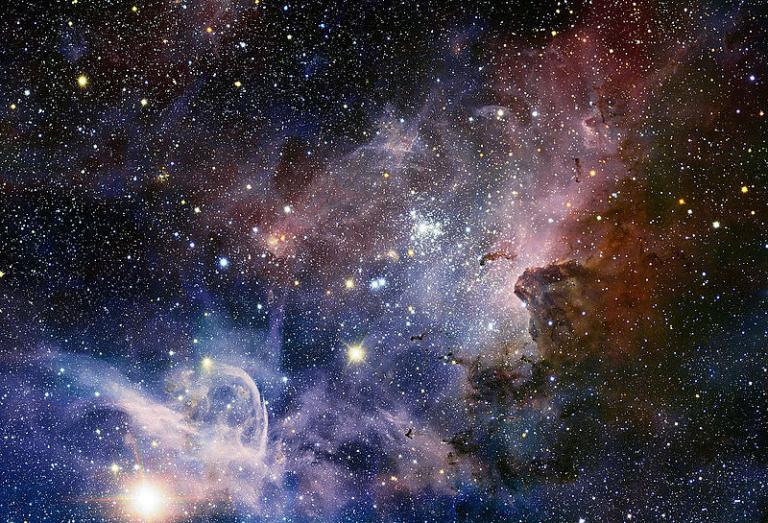
The Carina Nebula, visible from the southern hemisphere (Wikimedia Commons public domain image)
Once or twice here, I’ve mentioned my hope of convening a conference (and of subsequently publishing a collection of the conference papers) in which believing Latter-day Saint scientists can write on how their science and their faith not only co-exist but mutually nourish each other. I’ve spoken with enough of them to know that, for many, the intricacy and the order that they observe on the microcosmic level of atoms and molecules and cells, in the terrestrial phenomena of geology and biology, and on the macrocosmic level of planets, stars, galaxies, and the cosmos itself moves them religiously and inspires them. I’m not looking for the familiar effort to reconcile science and theology, valuable though that is. Rather, I’m hoping for expressions of how science itself can be a kind of religious experience, even a religious vocation — “thinking God’s thoughts after him,” as Kepler said.
Such a conference or volume (preferably both) would, I think, not only help faithful Latter-day Saint non-scientists. It might make science seem less suspect and threatening to non-scientist believers. It might even interest a few able young Latter-day Saints in considering vocations in science — not least and not only by illustrating the fact that science is not intrinsically hostile or contrary to faith and spirituality but might even be an avenue for spiritual experiences.
Within the past month or so, I’ve been specifically encouraged to think about such a conference yet again. Over the past few years, several people have written to me, expressing their interest in participating in the project. Unfortunately, I’ve mislaid the file containing their names. So I’m asking anybody who might still be interested to contact me. Perhaps — I’m embarrassed to say — again. The game is afoot. Or, at least, it may be.
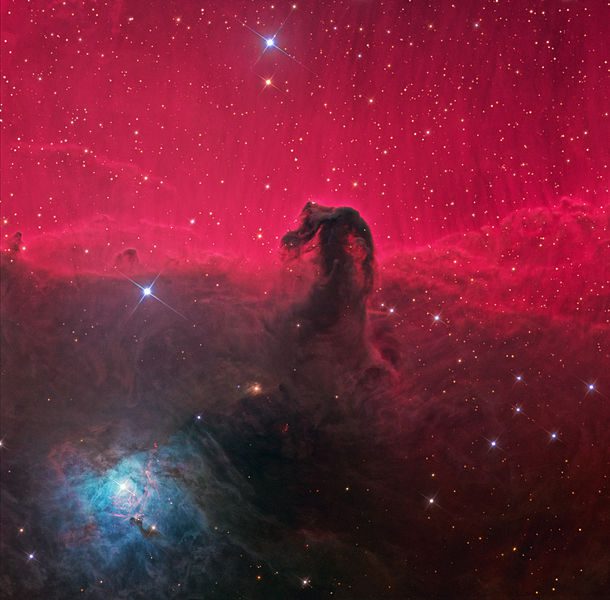
The Horsehead Nebula (Barnard 33), in the Constellation of Orion
(Wikimedia Commons public domain image. Author: Ken Crawford)
And now, last but most assuredly not least, I share with you a deliciously terrible item from the Christopher Hitchens Memorial “How Religion Poisons Everything” File©:
“The Church Works With Save the Children To Help Migrant Children and Families in Mexico”
Posted from Miami, Florida
Previous Post

October 16, 2022
"Life Together"
Next Post
October 18, 2022 Yes to Apologetics
Browse Our Archives
Select a Category Uncategorized
Select a Month October 2026 September 2026 August 2026 July 2026 June 2026 May 2026 April 2026 March 2026 February 2026 January 2026 December 2025 November 2025 October 2025 September 2025 August 2025 July 2025 June 2025 May 2025 April 2025 March 2025 February 2025 January 2025 December 2024 November 2024 October 2024 September 2024 August 2024 July 2024 June 2024 May 2024 April 2024 March 2024 February 2024 January 2024 December 2023 November 2023 October 2023 September 2023 August 2023 July 2023 June 2023 May 2023 April 2023 March 2023 February 2023 January 2023 December 2022 November 2022 October 2022 September 2022 August 2022 July 2022 June 2022 May 2022 April 2022 March 2022 February 2022 January 2022 December 2021 November 2021 October 2021 September 2021 August 2021 July 2021 June 2021 May 2021 April 2021 March 2021 February 2021 January 2021 December 2020 November 2020 October 2020 September 2020 August 2020 July 2020 June 2020 May 2020 April 2020 March 2020 February 2020 January 2020 December 2019 November 2019 October 2019 September 2019 August 2019 July 2019 June 2019 May 2019 April 2019 March 2019 February 2019 January 2019 December 2018 November 2018 October 2018 September 2018 August 2018 July 2018 June 2018 May 2018 April 2018 March 2018 February 2018 January 2018 December 2017 November 2017 October 2017 September 2017 August 2017 July 2017 June 2017 May 2017 April 2017 March 2017 February 2017 January 2017 December 2016 November 2016 October 2016 September 2016 August 2016 July 2016 June 2016 May 2016 April 2016 March 2016 February 2016 January 2016 December 2015 November 2015 October 2015 September 2015 August 2015 July 2015 June 2015 May 2015 April 2015 March 2015 February 2015 January 2015 December 2014 November 2014 March 2014 August 2013 February 2012
Follow Us!
TAKE THE
Religious Wisdom Quiz
What kind of bird did Noah send out second from the ark?
Select your answer to see how you score.
Owl Eagle Dove Pidgeon
Related posts from Sic et Non

A case of twin near-death experiences?

Toward a "Post-Materialist Science"?

We've been at it for fourteen years now

This Wednesday, Thursday, Friday, and Saturday
TRENDING AT PATHEOS Latter-day Saint

The Sermon on the Mount, Part I: Matthew...
The Sermon on the Mount, Part I (Matthew 4:12-5:12) St. Matthew moves...

What's up from Crossway: Reviewing some of their latest A few weeks...

Janie Learns the Way of the Cross: A...
Teaching children about Jesus' Passion can be challenging. Many parents and educators...

Looking For Good Catholic Writing - October 2026
He alone extends the heavens, and he walks upon the waves of...

In "Irreplaceable," our book on vocation and technology, Trevor Sutton and I...

I was strolling through the top floor of the brand new Parthenon...
view all Latter-day Saint blogs
Ad-Free & Subscriber Log-In Subscription Support
- About Us
- 2026 Calendar
- Videos
- Podcasts
- Library of World Religions
- Faith In Media Tracker
- Advertise With Us
- Write for Us
- Privacy Policy
- Terms of Service
- Do Not Sell My Data
- Contact Us
- Radiant Digital
- Manage Newsletter Subscriptions
- Unsubscribe From Notifications
- Sitemap
Copyright 2008-2026, Patheos. All rights reserved.
Subscription Support Ad-Free & Subscriber Log-In
Follow Patheos