
BuddhistCatholicContemplativeEvangelicalGeneral ChristianHinduJewishLatter-day SaintMuslimNew VisionsProgressive Christian
Beliefs
- Buddhist
- Catholic
- Contemplative
- Evangelical
- General Christian
- Hindu
- Jewish
- Latter-day Saint
- More Voices
- Muslim
- New Visions
- Pagan
- Progressive Christian
Topics
- Religion News
- Food and Religion
- Sports and Religion
- Religious Art
- Religious Music and Entertainment
- Religious Events
- History and Religion
- Style and Religion
- Politics and Religion
- Women in Religion
- Recreation Outdoors and Religion
- Business Finance and Religion
- Careers Workplace and Religion
- Education and Religion
- Family Parenting and Religion
- Health Fitness and Religion
- Home and Religion
- Relationships and Religion
- Technology and Religion
- Travel and Religion
Columnists
- Buddhist Columnists
- Business Finance and Religion Columnists
- Careers Workplace and Religion Columnists
- Catholic Columnists
- Contemplative Columnists
- Education and Religion Columnists
- Evangelists Columnists
- Family Parenting and Religion Columnists
- General Christian Columnists
- Health Fitness and Religion Columnists
- Hindu Columnists
- History and Religion Columnists
- Home and Religion Columnists
- Jewish Columnists
- More Voices Columnists
- Latter Day Columnists
- Muslim Columnists
- New Visions Columnists
- Nonreligious Columnists
- Pagan Columnists
- Politics and Religion Columnists
- Progressive Columnists
- Recreation Outdoors and Religion Columnists
- Relationships and Religion Columnists
- Religion News Columnists
- Religious Art Columnists
- Religious Events Columnists
- Religious Music and Entertainment Columnists
- Sports and Religion Columnists
- Style and Religion Columnists
- Technology and Religion Columnists
- Travel and Religion Columnists
- Women in Religion Columnists
Resource Library
- 2026 Calendar
- Library of World Religions
- The 100 Most Holy Places on Earth
- Patheos Answers
- Podcasts
- Videos
- Faith Leaders Database
- Anglican Episcopalian
- Bahai
- Baptist
- Buddhism
- Christianity
- Confucianism
- Eastern Orthodoxy
- Hinduism
- Holiness and Pentecostal
- ISKCON
- Islam
- Judaism
- Lutheran
- Methodist
- The Church of Jesus Christ of Latter-day Saints
- New Age
- Paganism
- Presbytarian and Reformed
- Protestantism
- Religion Behind the Scenes
- Roman Catholic
- Scientology
- Shia Islam
- Sikhism
- Sufism
- Sunni Islam
- Taoism
- Zen
- See all religions
Research Tools
 Ad-Free & Subscriber Log-In Subscription Support
Ad-Free & Subscriber Log-In Subscription Support
Follow Patheos 

- Trending:
- Forgiveness
- |
- Marriage
- |
- Consciousness
- |
- Death Penalty
- |
- Election
- |
- Halloween

- Home
- Latter-day Saint
- The Halifax Explosion
The Halifax Explosion
Last updated on: October 9, 2022 at 10:37 pm by Dan Peterson
The Halifax Explosion 2022-10-09T22:37:00-06:00 Dan Peterson
Patheos Explore the world's faith through different perspectives on religion and spirituality! Patheos has the views of the prevalent religions and spiritualities of the world.
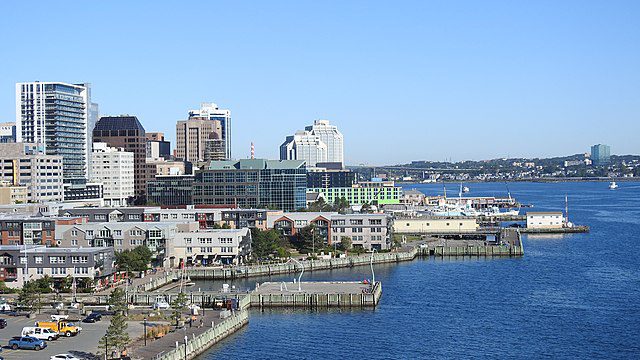
A 2019 Wikimedia Commons public domain photograph of Halifax, Nova Scotia
Halifax, Nova Scotia, is sadly well acquainted with tragedy. In a blog entry that I posted yesterday, I mentioned the city’s connection with the sinking of the Titanic, which occurred seven hundred nautical miles away, and with some of the victims of that terrible event. About five and a half years thereafter, though, an even more horrible catastrophe occurred far closer to home: On 6 December 1917, the Norwegian ship Imo, a neutral relief vessel contracted to carry supplies and materiel for the civilians of Belgium who were suffering because of the First World War, collided with the French ship Mont Blanc, which was carrying high-explosive munitions for the war effort, in the area of Halifax Harbour called “The Narrows.” Within thirty-five minutes — but not before other boats had pulled up close to help fight the fire that had broken out owing to the friction caused by two colliding metal ships — the Mont Blanc exploded. That explosion sent flames into the sky accompanied by a cloud of smoke that very soon extended approximately three miles above the city.
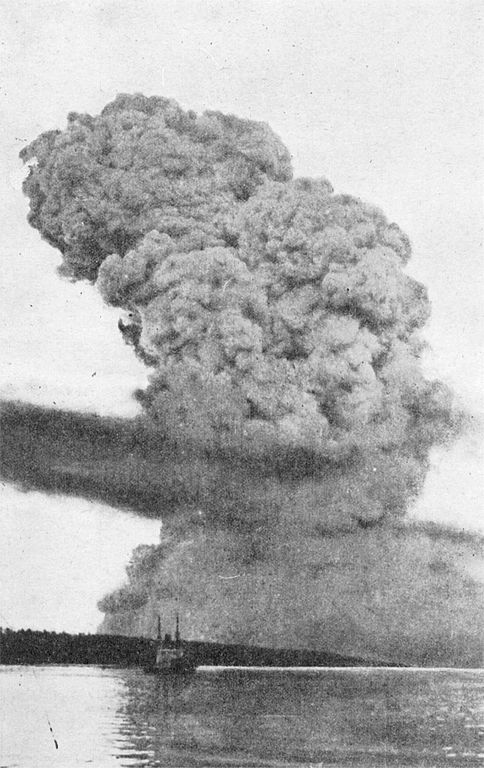
Halifax, Nova Scotia on 6 December 1917
(Wikimedia Commons public domain image)
For a brief instant, the sea floor of the harbor was even exposed to view. Tsunamis passed through portions of the city repeatedly, then also repeatedly receded, pulling rubble and people with them back into the water. The entire residential district known as Richmond was obliterated. Rocks from the seabed were hurled into the air, landing long distances away. The forward gun of the Mont Blanc, its barrel melted, landed in Albro Lake, more than a mile from the harbor. The shank of one of the freighter’s anchors fell, almost intact and weighing half a ton, into a forest approximately two miles from the explosion. The Mont Blanc itself was essentially vaporized. The sound of the blast was heard by people scores of miles away. When the shock wave from the explosion passed through the water beneath him, at least one ship captain out on the North Atlantic many miles away feared that his vessel had just hit a mine. Some who survived the blast assumed, at first, that they were under German attack.
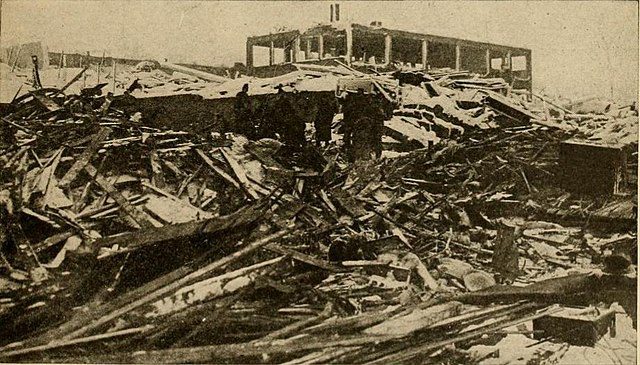
An area of Halifax after the 6 December 1917 explosion
(Wikimedia Commons public domain image)
Some of the sources claim that this was the largest man-made explosion ever known, prior to the detonation of the atomic bomb over Hiroshima, Japan, in 1945. The official report puts the death toll at 1,963, the number of wounded at roughly 9,000, and the number of those who survived but were permanently blinded at 199. Many, though, think that the official report grossly underestimates the number of fatalities. One of the rescuers, for example — a man who went on, decades later, to become the Halifax fire chief — recalled that he was directed in the days following the disaster to provide 3,200 markers for the dead. And other critics of the report argue that it ignored the untold numbers of victims who perished on the boats and ships that had been in the harbor itself, as well as the residents and visitors who simply vanished without a trace.
The hands on the north clock face in the Halifax City Hall tower are permanently fixed at 9:04:35, the exact moment of the blast aboard the Mont Blanc on the morning of 6 December 1917. The clock face is a replica of the City Hall clock that was stopped by the force of the explosion.
I’m perfectly astonished that, until I was Googling some information on Halifax during the evening before we landed there, I had never, to the best of my knowledge, heard of what is now known as the “Halifax Explosion.” It’s an arresting story that, among many other things, would make a very dramatic and affecting film. And here’s a story that I would put right at the heart of the plot:
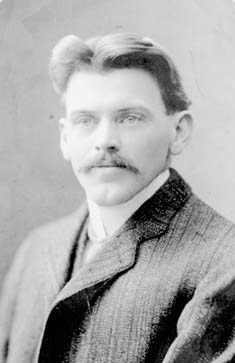
Vincent Coleman (1872-1917)
Wikimedia Commons public domain image
Chief clerk William Lovett and train dispatcher Vincent Coleman were in their telegraph office at Richmond Station and the freight yards of the Canadian Government Railway when the Imo and the Mont Blanc collided. Within minutes, another man ran past their door, shouting to them that they should run for their lives. The Mont Blanc, he yelled, was loaded with explosives and was certainly about to blow up. They jumped up and ran. But then, as they were crossing the tracks, Coleman, the train dispatcher, stopped. There were, he explained, trains coming toward Halifax bearing hundreds of people. He had to go back to stop them from coming. Hundreds of lives were at stake.
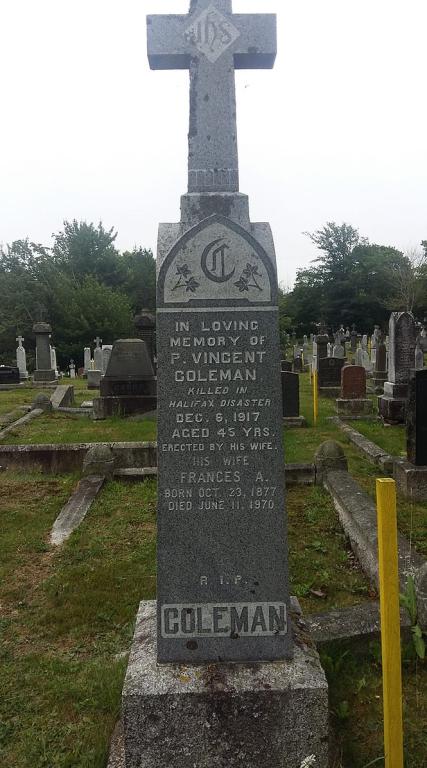
The grave marker, in Halifax’s Mount Olivet Catholic Cemetery, of Vincent Coleman and his widow, Frances, who, despite being injured in the 1917 Halifax Explosion herself, lived on until 1970.
(Wikimedia Commons public domain image)
Vincent Coleman was killed instantly by the blast. However, the last Morse code message that he sent read as follows: “Hold up the train. Ammunition ship afire in harbour making for Pier 6 and will explode. Guess this will be my last message. Good-bye, boys.” Apparently, several trains did stop, and hundreds of lives were saved.
“Greater love hath no man than this, that a man lay down his life for his friends.” (John 15:13)
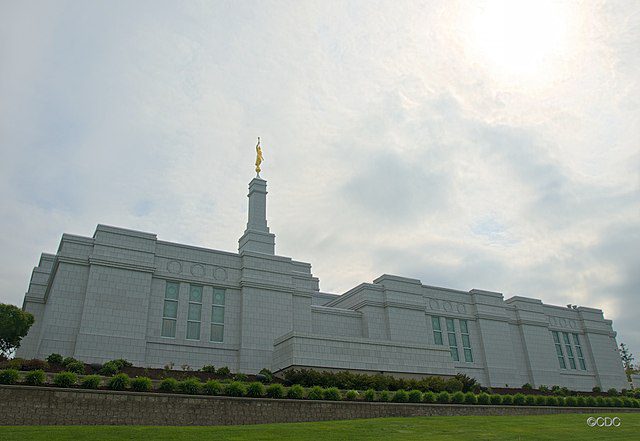
The small Halifax Nova Scotia Temple was dedicated on 14 November 1999, by President Gordon B. Hinckley. (Wikimedia Commons public domain photo by Halifaxfman)
In conclusion, though, I offer for your torment and indignation yet another appalling horror from the ever-flowing Christopher Hitchens Memorial “How Religion Poisons Everything” File©:
Abstract
The aim of the current study was to explore the link between religiosity and psychological well-being in a model of Pakistani Muslims. Earlier research has acknowledged a positive relationship between the two factors. The sample (65 men and 85 women) with an age range from 18 to 60 years was chosen. Religiosity was operationalized as religious gatherings attendance, belief salience and frequency of prayer. Anxiety, loneliness and life fulfillment were chosen as dependent variables because they are important facets of psychological well-being. Reliable with previous research, correlation statistics suggested that a strong, negative relationship does indeed exist between religiosity and loneliness (r = -0.852) and between religiosity and anxiety (r = -0.511). A strong positive relationship was also found between religiosity and life satisfaction (r =0.76) Thus, the results of this study supported the hypothesized relationship between religiosity and different facets of psychological well-being.
Posted from the North Atlantic
Christopher Hitchens Memorial "How Religion Poisons Everything" File
Previous Post

October 7, 2022
Funny, Touching, Titanic
Next Post
October 8, 2022 "Did Lucy Harris Support the Book of Mormon?"
Browse Our Archives
Select a Category Uncategorized
Select a Month October 2026 September 2026 August 2026 July 2026 June 2026 May 2026 April 2026 March 2026 February 2026 January 2026 December 2025 November 2025 October 2025 September 2025 August 2025 July 2025 June 2025 May 2025 April 2025 March 2025 February 2025 January 2025 December 2024 November 2024 October 2024 September 2024 August 2024 July 2024 June 2024 May 2024 April 2024 March 2024 February 2024 January 2024 December 2023 November 2023 October 2023 September 2023 August 2023 July 2023 June 2023 May 2023 April 2023 March 2023 February 2023 January 2023 December 2022 November 2022 October 2022 September 2022 August 2022 July 2022 June 2022 May 2022 April 2022 March 2022 February 2022 January 2022 December 2021 November 2021 October 2021 September 2021 August 2021 July 2021 June 2021 May 2021 April 2021 March 2021 February 2021 January 2021 December 2020 November 2020 October 2020 September 2020 August 2020 July 2020 June 2020 May 2020 April 2020 March 2020 February 2020 January 2020 December 2019 November 2019 October 2019 September 2019 August 2019 July 2019 June 2019 May 2019 April 2019 March 2019 February 2019 January 2019 December 2018 November 2018 October 2018 September 2018 August 2018 July 2018 June 2018 May 2018 April 2018 March 2018 February 2018 January 2018 December 2017 November 2017 October 2017 September 2017 August 2017 July 2017 June 2017 May 2017 April 2017 March 2017 February 2017 January 2017 December 2016 November 2016 October 2016 September 2016 August 2016 July 2016 June 2016 May 2016 April 2016 March 2016 February 2016 January 2016 December 2015 November 2015 October 2015 September 2015 August 2015 July 2015 June 2015 May 2015 April 2015 March 2015 February 2015 January 2015 December 2014 November 2014 March 2014 August 2013 February 2012
Follow Us!
TAKE THE
Religious Wisdom Quiz
What is the book of songs and prayers in the Bible called?
Select your answer to see how you score.
Psalms Matthew Proverbs Genesis
Related posts from Sic et Non

Once more unto the breach, dear friends, once...

"Was Joseph a Sexual Predator?" and other fun...


TRENDING AT PATHEOS Latter-day Saint

The Sermon on the Mount, Part I: Matthew...
The Sermon on the Mount, Part I (Matthew 4:12-5:12) St. Matthew moves...

What's up from Crossway: Reviewing some of their latest A few weeks...

Janie Learns the Way of the Cross: A...
Teaching children about Jesus' Passion can be challenging. Many parents and educators...

Looking For Good Catholic Writing - October 2026
He alone extends the heavens, and he walks upon the waves of...

In "Irreplaceable," our book on vocation and technology, Trevor Sutton and I...

I was strolling through the top floor of the brand new Parthenon...
view all Latter-day Saint blogs
Ad-Free & Subscriber Log-In Subscription Support
- About Us
- 2026 Calendar
- Videos
- Podcasts
- Library of World Religions
- Faith In Media Tracker
- Advertise With Us
- Write for Us
- Privacy Policy
- Terms of Service
- Do Not Sell My Data
- Contact Us
- Radiant Digital
- Manage Newsletter Subscriptions
- Unsubscribe From Notifications
- Sitemap
Copyright 2008-2026, Patheos. All rights reserved.
Subscription Support Ad-Free & Subscriber Log-In
Follow Patheos