
BuddhistCatholicContemplativeEvangelicalGeneral ChristianHinduJewishLatter-day SaintMuslimNew VisionsProgressive Christian
Beliefs
- Buddhist
- Catholic
- Contemplative
- Evangelical
- General Christian
- Hindu
- Jewish
- Latter-day Saint
- More Voices
- Muslim
- New Visions
- Pagan
- Progressive Christian
Topics
- Religion News
- Food and Religion
- Sports and Religion
- Religious Art
- Religious Music and Entertainment
- Religious Events
- History and Religion
- Style and Religion
- Politics and Religion
- Women in Religion
- Recreation Outdoors and Religion
- Business Finance and Religion
- Careers Workplace and Religion
- Education and Religion
- Family Parenting and Religion
- Health Fitness and Religion
- Home and Religion
- Relationships and Religion
- Technology and Religion
- Travel and Religion
Columnists
- Buddhist Columnists
- Business Finance and Religion Columnists
- Careers Workplace and Religion Columnists
- Catholic Columnists
- Contemplative Columnists
- Education and Religion Columnists
- Evangelists Columnists
- Family Parenting and Religion Columnists
- General Christian Columnists
- Health Fitness and Religion Columnists
- Hindu Columnists
- History and Religion Columnists
- Home and Religion Columnists
- Jewish Columnists
- More Voices Columnists
- Latter Day Columnists
- Muslim Columnists
- New Visions Columnists
- Nonreligious Columnists
- Pagan Columnists
- Politics and Religion Columnists
- Progressive Columnists
- Recreation Outdoors and Religion Columnists
- Relationships and Religion Columnists
- Religion News Columnists
- Religious Art Columnists
- Religious Events Columnists
- Religious Music and Entertainment Columnists
- Sports and Religion Columnists
- Style and Religion Columnists
- Technology and Religion Columnists
- Travel and Religion Columnists
- Women in Religion Columnists
Resource Library
- 2026 Calendar
- Library of World Religions
- The 100 Most Holy Places on Earth
- Patheos Answers
- Podcasts
- Videos
- Faith Leaders Database
- Anglican Episcopalian
- Bahai
- Baptist
- Buddhism
- Christianity
- Confucianism
- Eastern Orthodoxy
- Hinduism
- Holiness and Pentecostal
- ISKCON
- Islam
- Judaism
- Lutheran
- Methodist
- The Church of Jesus Christ of Latter-day Saints
- New Age
- Paganism
- Presbytarian and Reformed
- Protestantism
- Religion Behind the Scenes
- Roman Catholic
- Scientology
- Shia Islam
- Sikhism
- Sufism
- Sunni Islam
- Taoism
- Zen
- See all religions
Research Tools
 Ad-Free & Subscriber Log-In Subscription Support
Ad-Free & Subscriber Log-In Subscription Support
Follow Patheos 

- Trending:
- Forgiveness
- |
- Marriage
- |
- Consciousness
- |
- Death Penalty
- |
- Election
- |
- Halloween

- Home
- Latter-day Saint
- “Who Felt or Saw the Plates?”
“Who Felt or Saw the Plates?”
Last updated on: September 10, 2022 at 7:05 pm by Dan Peterson
“Who Felt or Saw the Plates?” 2022-09-10T19:05:18-06:00 Dan Peterson
Patheos Explore the world's faith through different perspectives on religion and spirituality! Patheos has the views of the prevalent religions and spiritualities of the world.
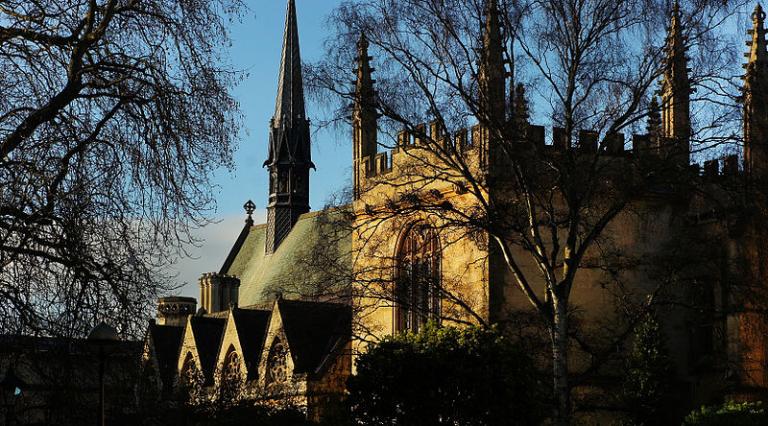
Evening at the University of Oxford (Wikimedia Commons public domain image)
Something new has just been posted on the website of the Interpreter Foundation:
Witnesses of the Book of Mormon — Insights Episode 21: Who Felt or Saw the Plates?
Critics have long claimed that the various witnesses—both official and unofficial—never interacted with the plates in a physical way. First hand accounts indicate otherwise. What are we to make of such criticism?
This is the twenty-first in a series compiled from from the many interviews conducted during the course of the Witnesses film project. This series of mini-films is being released each Saturday at 7pm MDT. These additional resources are hosted by Camrey Bagley Fox, who played Emma Smith in Witnesses, as she introduces and visits with a variety of experts. These individuals answer questions or address accusations against the witnesses, also helping viewers understand the context of the times in which the witnesses lived. This week we feature Daniel C. Peterson, President of the Interpreter Foundation and Executive Producer of Witnesses. For more information, go to https://witnessesofthebookofmormon.org/ or watch the documentary movie Undaunted.
Short clips from this episode are also available on TikTok and Instagram.
Be sure to subscribe to our YouTube channel at https://youtube.interpreterfoundation.org/ and our other social media channels on Facebook, Twitter, Instagram, and TikTok.
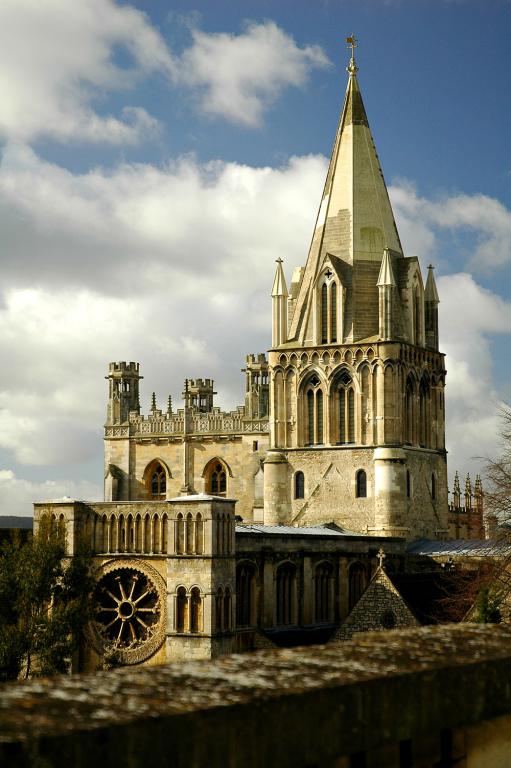
Christ Church Cathedral, Oxford
(Wikimedia Commons public domain image)
Isaac Schorr, of National Review, has been paying pretty close attention to the story about alleged racist insults at a recent women’s volleyball game in Provo between Brigham Young University and Duke University, which has now attracted the exceedingly weird attention of the University of South Carolina. (Amid all of the controversy, by the way, the results of the match have tended to be overlooked. So, just for the record: BYU won.)
“BYU Investigation Finds No Evidence That Fans Hurled Racial Slur at Duke Volleyball Player”
“BYU Investigation Exposes Media’s Credulous Coverage of Volleyball Player’s Racial-Slur Allegation”
And here, for whatever it may be worth, is an oddly parallel story from back in 2018:
Washington Post: “South Carolina women’s basketball coach denies fans used n-word, spat at Missouri players”
Here’s a little parable or analogy to make the matter between BYU and Duke and South Carolina still clearer than it already is, if that’s even remotely possible:
Plaintiff: “I saw Jones steal my car.”
Judge: “I sentence him to be hanged tomorrow at dawn. Members of the jury, have you reached a verdict?”
Jury Foreman: “We have, your honor. We find the defendant not guilty. Most especially since the plaintiff’s car doesn’t appear to have been stolen in the first place.”
Judge: “I stand by my decision. The defendant will be hanged tomorrow morning at dawn.”
Meanwhile, in other but not wholly unrelated news:
“Oberlin Finally Agrees to Pay $36.59 Million to Bakery over False Racism Accusations”
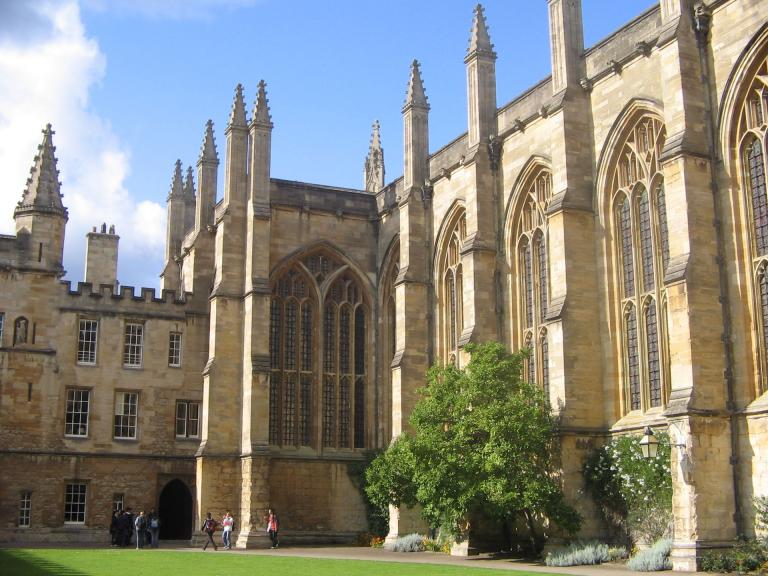
The chapel of New College, Oxford (Wikimedia Commons public domain image)
As, I suppose, some of you yourselves have done, I’ve been paying attention to the coverage of the death of Queen Elizabeth II and to the ascension of King Charles III. (How very strange it seems to me to say or type that latter name and title!) There is, though, a dimension of the late queen’s reign that, I agree, the American news media seem to have largely left on the cutting room floor:
Deseret News: “Queen Elizabeth II’s religious legacy: For Queen Elizabeth II, who died Thursday, faith was both personal and professional”
GetReligion: “Elizabeth the Great: Why do many journalists choose to edit faith out of her Christmas talks?”

Queen’s College, Oxford. (Wikimedia Commons public domain photograph)
Many years ago, I read an article in which, as I recall it, the late, great conservative writer William F. Buckley Jr. explained why he had decided to step down from a position (on their board of advisors, or something of that sort) with the organization known as Amnesty International. Amnesty had been established to publicize and champion the cases of “prisoners of conscience,” essentially political prisoners, around the world. (I myself was a member of the group for several years.) In recent times, though, Amnesty had broadened its mission to include opposition to capital punishment, and Buckley chose, for that reason, to end his involvement. Not so much, I think, because he was a strong supporter of the death penalty (I’m not sure that he was one, as I am not) but because, in his judgment, broadening the mission of Amnesty International from its laser-like concentration on prisoners of conscience, which every decent person could endorse, to campaigning against the death penalty even in unambiguous cases of undoubted serial killers, where decent people might legitimately disagree, seemed to him to dilute the authority of a previously clear focus.
I thought of that case during my recent Saturday spent at the annual meeting of the International Association for Near-Death Studies (IANDS) in Salt Lake City. I understand that a conviction of the validity of near-death studies might open one’s mind to the possibility of the truth of still other “paranormal” ideas. That is, in fact, somewhat the position in which I find myself: My mind isn’t wholly closed to such things as clairvoyance and extra-sensory perception, though my broader worldview neither demands them nor deems them particularly significant even if they’re true. In fact, within the past decade or a bit more — so tepid is my interest that I need to reach back at least that far to find them — I’ve read a couple of books, both of which were written by reputable psychologists with tenured faculty appointments at top-tier universities, that have surprised me with their presentation of seemingly genuine evidence for the existence of ESP and remote viewing. (I’ll probably write something up, eventually, on those two books.) I’ve also had an entirely astonishing personal experience with water-divining, which I didn’t expect and for which I cannot account: On this, see my previous blog entries “Thoughts on a few controversial topics related to science” and “My career as a water witcher, armed with a divining rod.”
With those admissions on public record, I was nonetheless concerned at IANDS, and have been concerned for quite a while when I’ve seen it elsewhere, to see a mingling of what I regard as pretty solid material with other things that seem to me rather dubious at best — e.g., crystal-gazing, drum circles, mediums, past-life regressions, and various kinds of New Age spirituality that have been cherry-picked and decontextualized from world religious traditions and Third World indigenous practices. (I know from speaking with him that at least one of the officers of IANDS himself shares my concern, that association with a whole host of such fringy and undisciplined things detracts from the credibility of what we both see as credible claims of out-of body experiences [OBEs] and near-death experiences [NDEs]. And they are already dismissed by quite a few people without serious consideration.)
A case in point: I bought a book at IANDS by one Mark Anthony, who bills himself as “the Psychic Lawyer©.” It’s entitled Evidence of Eternity: Communicating with Spirits for Proof of the Afterlife (Woodbury, MN: Llewellyn Publications, 2022). I bought it because of its title, and because it carried back-jacket endorsements by two people whose books I have respected. I’m almost done reading it, and, well, I’m not positively impressed. For one thing, I don’t, umm, resonate to vague talk about spirit vibrations and spirit frequencies. I could probably just pass that off as matter of style. But it’s deeper than that: His claims may be true, but I can’t grant them any authority or real credibility. Partly because there’s too much self-promotion in the book, and too little real content. Partly, too, because, while it doesn’t prove him fraudulent, I’m bothered by the fact that he charges for his “psychic readings.” And I can find very little about him other than sites that puff him as a psychic and puff his psychic-related books. His repeated claim to be “an Oxford-educated attorney” makes no sense to me, since he seems to have no Oxford degree and since he has been admitted to practice, if he really does practice, not in the United Kingdom but in Florida, Washington DC, and, so he says, before the United States Supreme Court. I’ve made only a cursory search, but I could find nothing confirming his status as an attorney in those venues. Has he really he really lectured “at universities including Harvard, Brown, Columbia, and Yale”? If so, I’ve found no evidence for it via Google. I did, however, find this:
And everything in his book rests on his personal credibility. The evidentiary value of the experiences he relates depends entirely upon whether he himself is reliable. They’re all stories that he tells. Now, I also freely confess that I’ve devoted only about five minutes to my searches regarding Mr. Anthony. Maybe I’m being too hasty. But I’m skeptical.
International Association for Near-Death Studies
Previous Post

September 9, 2022
A Transcendent Light
Next Post
September 11, 2022 "That's me!"
Browse Our Archives
Select a Category Uncategorized
Select a Month October 2026 September 2026 August 2026 July 2026 June 2026 May 2026 April 2026 March 2026 February 2026 January 2026 December 2025 November 2025 October 2025 September 2025 August 2025 July 2025 June 2025 May 2025 April 2025 March 2025 February 2025 January 2025 December 2024 November 2024 October 2024 September 2024 August 2024 July 2024 June 2024 May 2024 April 2024 March 2024 February 2024 January 2024 December 2023 November 2023 October 2023 September 2023 August 2023 July 2023 June 2023 May 2023 April 2023 March 2023 February 2023 January 2023 December 2022 November 2022 October 2022 September 2022 August 2022 July 2022 June 2022 May 2022 April 2022 March 2022 February 2022 January 2022 December 2021 November 2021 October 2021 September 2021 August 2021 July 2021 June 2021 May 2021 April 2021 March 2021 February 2021 January 2021 December 2020 November 2020 October 2020 September 2020 August 2020 July 2020 June 2020 May 2020 April 2020 March 2020 February 2020 January 2020 December 2019 November 2019 October 2019 September 2019 August 2019 July 2019 June 2019 May 2019 April 2019 March 2019 February 2019 January 2019 December 2018 November 2018 October 2018 September 2018 August 2018 July 2018 June 2018 May 2018 April 2018 March 2018 February 2018 January 2018 December 2017 November 2017 October 2017 September 2017 August 2017 July 2017 June 2017 May 2017 April 2017 March 2017 February 2017 January 2017 December 2016 November 2016 October 2016 September 2016 August 2016 July 2016 June 2016 May 2016 April 2016 March 2016 February 2016 January 2016 December 2015 November 2015 October 2015 September 2015 August 2015 July 2015 June 2015 May 2015 April 2015 March 2015 February 2015 January 2015 December 2014 November 2014 March 2014 August 2013 February 2012
Follow Us!
TAKE THE
Religious Wisdom Quiz
In Philemon, what does Paul call Onesimus?
Select your answer to see how you score.
My friend My helper My very heart My brother
Related posts from Sic et Non

A Follow-Up on How I Met President Jeffrey...
A monument to the transience of power (and...
"Protecting the Symbols of Christ’s Church"
TRENDING AT PATHEOS Latter-day Saint

57th Dove Awards Honor Dolly Parton, Crown New...
On gospel music’s biggest night, the 57th annual GMA Dove Awards honored...

The First Eucharistic Controversy: Christ’s Real Presence
For Catholics, the Eucharist is the source and summit of the Christian...

What a Stop Sign Can Teach Us About...
How to Make a Decision When You Can't Hear God Main point:...

Archdiocese Hosts Military Marriage Retreat in Germany
RASTATT, Germany — The transient military lifestyle, with its frequent deployments and...

Nearly every morning, I make the drive to Detroit with my high-school-age...

The Real AI Story Is Adoption Without Trust
Artificial intelligence has crossed a political threshold. It is no longer a...
view all Latter-day Saint blogs
Ad-Free & Subscriber Log-In Subscription Support
- About Us
- 2026 Calendar
- Videos
- Podcasts
- Library of World Religions
- Faith In Media Tracker
- Advertise With Us
- Write for Us
- Privacy Policy
- Terms of Service
- Do Not Sell My Data
- Contact Us
- Radiant Digital
- Manage Newsletter Subscriptions
- Unsubscribe From Notifications
- Sitemap
Copyright 2008-2026, Patheos. All rights reserved.
Subscription Support Ad-Free & Subscriber Log-In
Follow Patheos