
BuddhistCatholicContemplativeEvangelicalGeneral ChristianHinduJewishLatter-day SaintMuslimNew VisionsProgressive Christian
Beliefs
- Buddhist
- Catholic
- Contemplative
- Evangelical
- General Christian
- Hindu
- Jewish
- Latter-day Saint
- More Voices
- Muslim
- New Visions
- Pagan
- Progressive Christian
Topics
- Religion News
- Food and Religion
- Sports and Religion
- Religious Art
- Religious Music and Entertainment
- Religious Events
- History and Religion
- Style and Religion
- Politics and Religion
- Women in Religion
- Recreation Outdoors and Religion
- Business Finance and Religion
- Careers Workplace and Religion
- Education and Religion
- Family Parenting and Religion
- Health Fitness and Religion
- Home and Religion
- Relationships and Religion
- Technology and Religion
- Travel and Religion
Columnists
- Buddhist Columnists
- Business Finance and Religion Columnists
- Careers Workplace and Religion Columnists
- Catholic Columnists
- Contemplative Columnists
- Education and Religion Columnists
- Evangelists Columnists
- Family Parenting and Religion Columnists
- General Christian Columnists
- Health Fitness and Religion Columnists
- Hindu Columnists
- History and Religion Columnists
- Home and Religion Columnists
- Jewish Columnists
- More Voices Columnists
- Latter Day Columnists
- Muslim Columnists
- New Visions Columnists
- Nonreligious Columnists
- Pagan Columnists
- Politics and Religion Columnists
- Progressive Columnists
- Recreation Outdoors and Religion Columnists
- Relationships and Religion Columnists
- Religion News Columnists
- Religious Art Columnists
- Religious Events Columnists
- Religious Music and Entertainment Columnists
- Sports and Religion Columnists
- Style and Religion Columnists
- Technology and Religion Columnists
- Travel and Religion Columnists
- Women in Religion Columnists
Resource Library
- 2026 Calendar
- Library of World Religions
- The 100 Most Holy Places on Earth
- Patheos Answers
- Podcasts
- Videos
- Faith Leaders Database
- Anglican Episcopalian
- Bahai
- Baptist
- Buddhism
- Christianity
- Confucianism
- Eastern Orthodoxy
- Hinduism
- Holiness and Pentecostal
- ISKCON
- Islam
- Judaism
- Lutheran
- Methodist
- The Church of Jesus Christ of Latter-day Saints
- New Age
- Paganism
- Presbytarian and Reformed
- Protestantism
- Religion Behind the Scenes
- Roman Catholic
- Scientology
- Shia Islam
- Sikhism
- Sufism
- Sunni Islam
- Taoism
- Zen
- See all religions
Research Tools
 Ad-Free & Subscriber Log-In Subscription Support
Ad-Free & Subscriber Log-In Subscription Support
Follow Patheos 

- Trending:
- Forgiveness
- |
- Marriage
- |
- Consciousness
- |
- Death Penalty
- |
- Election
- |
- Halloween

- Home
- Latter-day Saint
- Queen Elizabeth II and the Mysterium Tremendum
Queen Elizabeth II and the Mysterium Tremendum
Last updated on: September 15, 2022 at 10:39 pm by Dan Peterson
Queen Elizabeth II and the Mysterium Tremendum 2022-09-15T22:39:24-06:00 Dan Peterson
Patheos Explore the world's faith through different perspectives on religion and spirituality! Patheos has the views of the prevalent religions and spiritualities of the world.
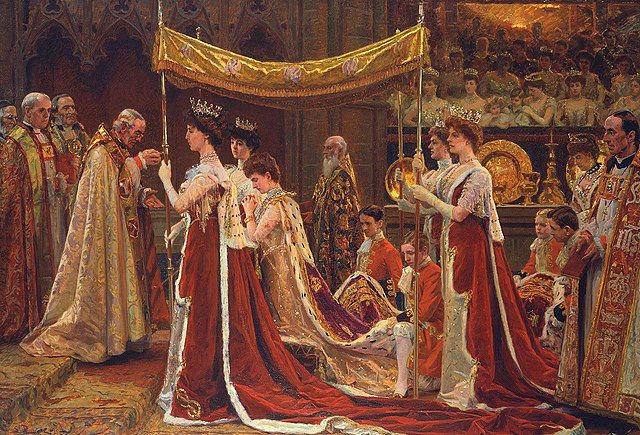
Laurits Tuxen, “The Anointing of Queen Alexandra at the Coronation of Edward VII” (“Dronning Alexandras salvning,” 1903)
Wikimedia Commons public domain image
All the way back in 2016, I posted the following here on this blog:
Encouraged by my wife, I’ve been enjoying the Anglo-American miniseries The Crown. And, I must say, I’ve been enjoying it very much.
For someone who is both an Anglophile and a passionate lover of history, it’s a feast.
And, since I’ve been quite sick for the past week or so, it’s come at a very good time. I’ve felt too terrible to read a lot of serious stuff, and Law and Order gets old fast.
I believe, moreover, that while, even at its grandest, earthly monarchy is only a dim shadow of the divine monarchy that it represents, it does, nonetheless, occasionally capture something of the celestial reality.
And many Latter-day Saints, I think, will recognize that fact most clearly in this drama through its remarkable depiction and discussion of the ritual anointing with oil that is performed in the royal coronation.
I’ve been following the coverage of the passing of Queen Elizabeth II fairly closely when I can. And, against that background, this little article caught my attention in a peculiar way:
I recommend reading it. The author is clearly right that “this woman . . . had neither sparkling intellect [n]or show-stopping looks,” but also that she was something truly remarkable. I’ve sometimes thought the same thing about George Washington, who was certainly not the most brilliant or talented of the American Founding Fathers but to whom, amazingly, virtually all of the Founders deferred. (I’ve been thinking, for quite a while, of writing an essay on that peculiar quality in Washington, who has been, rightly I think, called “the indispensable man.”)
I’ve wondered, with our celebrity culture and given the rather curious fascination with the British monarchy and the Royal Family among many Americans, despite the fact that they threw George III off way back in 1776 and have no real discernible desire for a genuine home-grown aristocracy, if there isn’t a God-shaped hole here.
“There’s such divinity doth hedge a king,” says Shakespeare’s Claudius at Hamlet 4:5:138. In an interview, one of the women who served as a maid of honour for Elizabeth II at her 2 June 1953 coronation commented on the anointing that was part of it, which, she said, the Queen plainly regarded as a real divine consecration that set her apart from ordinary mortals. Not as a matter of pride or arrogance, but as a matter of duty. That duty, and that separateness, were conferred upon her by her special status — a status that wasn’t merely legal or traditional or formal, but real. A status that had been divinely created in her by her anointing.
Famously, Queen Elizabeth’s coronation was televised. There were those who had vigorously opposed televising it, on account of its holiness. The young Queen herself came down on the side of the traditionalists, and against television cameras. A coronation was a sacred occasion, not a sporting event. One consideration was this: Those actually in attendance at Westminster Abbey would, of course, be suitably dressed and behaving appropriately. But what about the ordinary audience, not only British subjects but citizens of the Commonwealth and other people around the globe, who would be staring at the telly at home? Who could guarantee the solemnity of their participation? Might they not be sitting there in their bathrobes, drinking a beer, filling an ashtray with cigarette butts, cracking irreverent jokes, emptying bags of potato crisps?
In the end, apparently, it was Prince Philip who won the day, persuading his wife and the others that the monarchy needed to enter into the modern age. But one specific part of the coronation ceremony was still not allowed to be televised: The Queen’s anointing with holy oil was deemed too awesome, too sacred, for the television cameras, and it was shielded from public view and from those cameras by a golden screen.
I can understand such reservations, and I dare say that many Latter-day Saints will understand them, as well.
But back to this possible hankering to do reverence to a monarch: I’ve been touched, as I’ve watched Britons quietly passing in a line by Queen Elizabeth’s coffin, to see them pause, bow their heads, and curtsy toward it. Something within me, at least, resonates to such a gesture — even as, rationally, I know that the Queen was, from a certain perspective, simply a nice old lady who was not fundamentally very different from the rest of us. We feel a need for reverence.
And that, I think, to borrow an argument-form from C. S. Lewis, suggests to my mind that there does exist, somewhere, a proper object of reverence, a Person who is actually and not merely symbolically worthy of our veneration and worship. The great German theologian, philosopher, and scholar of comparative religions Rudolf Otto (1869-1937) wrote of what he called the mysterium tremendum et fascinans, which he defined as a sense of something mysterious, overwhelming, and daunting that evokes in us feelings of diminution, humility, submission, and creatureliness. I have something like that in mind here.
In this context, I’m reminded of a couple of incidents recorded in the New Testament’s Revelation of John:
And I fell at his feet to worship him. And he said unto me, See thou do it not: I am thy fellowservant, and of thy brethren that have the testimony of Jesus: worship God: for the testimony of Jesus is the spirit of prophecy. (Revelation 19:10)
And he said unto me, These sayings are faithful and true: and the Lord God of the holy prophets sent his angel to shew unto his servants the things which must shortly be done. Behold, I come quickly: blessed is he that keepeth the sayings of the prophecy of this book. And I John saw these things, and heard them. And when I had heard and seen, I fell down to worship before the feet of the angel which shewed me these things. Then saith he unto me, See thou do it not: for I am thy fellowservant, and of thy brethren the prophets, and of them which keep the sayings of this book: worship God. (Revelation 22:6-9)
In both cases, John falls down to worship an angel, who tells him to stop, that he (the angel) is not God and is therefore also not a proper object of worship. In the second instance, the angelic messenger has even begun to speak in the first person as if he were Christ himself, so John has good reason for his error. (Note too, incidentally, that the angel in the second passage identifies himself not as a member of a separate order of angelic beings, as most Jews, Christians, and Muslims have historically conceived angels, but as a “fellowservant, and of thy brethren the prophets, and of them which keep the sayings of this book.”) What brings these passages to mind, though, is the obviously instinctive reaction on John’s part that leads him to “fall down to worship” the glorious being before him.
Earthly monarchs have historically represented God. Always inadequately, it’s true, and sometimes horribly. But I think that there might be a deep sense there, perhaps one might even call it a memory, of a Person before whom it would be entirely appropriate to kneel.
I sometimes read brave declarations from certain atheists who announce what they will say when and if they ever stand before God. They will, they pledge, confront him and demand x and protest y. Frankly, though, I doubt that they’ll say anything at all. And I doubt that they’ll still be standing.
mysterium tremendum et fascinans
Previous Post

September 14, 2022
On His 109th Birthday
Next Post
September 15, 2022 "Evidence of the Afterlife"
Browse Our Archives
Select a Category Uncategorized
Select a Month October 2026 September 2026 August 2026 July 2026 June 2026 May 2026 April 2026 March 2026 February 2026 January 2026 December 2025 November 2025 October 2025 September 2025 August 2025 July 2025 June 2025 May 2025 April 2025 March 2025 February 2025 January 2025 December 2024 November 2024 October 2024 September 2024 August 2024 July 2024 June 2024 May 2024 April 2024 March 2024 February 2024 January 2024 December 2023 November 2023 October 2023 September 2023 August 2023 July 2023 June 2023 May 2023 April 2023 March 2023 February 2023 January 2023 December 2022 November 2022 October 2022 September 2022 August 2022 July 2022 June 2022 May 2022 April 2022 March 2022 February 2022 January 2022 December 2021 November 2021 October 2021 September 2021 August 2021 July 2021 June 2021 May 2021 April 2021 March 2021 February 2021 January 2021 December 2020 November 2020 October 2020 September 2020 August 2020 July 2020 June 2020 May 2020 April 2020 March 2020 February 2020 January 2020 December 2019 November 2019 October 2019 September 2019 August 2019 July 2019 June 2019 May 2019 April 2019 March 2019 February 2019 January 2019 December 2018 November 2018 October 2018 September 2018 August 2018 July 2018 June 2018 May 2018 April 2018 March 2018 February 2018 January 2018 December 2017 November 2017 October 2017 September 2017 August 2017 July 2017 June 2017 May 2017 April 2017 March 2017 February 2017 January 2017 December 2016 November 2016 October 2016 September 2016 August 2016 July 2016 June 2016 May 2016 April 2016 March 2016 February 2016 January 2016 December 2015 November 2015 October 2015 September 2015 August 2015 July 2015 June 2015 May 2015 April 2015 March 2015 February 2015 January 2015 December 2014 November 2014 March 2014 August 2013 February 2012
Follow Us!
TAKE THE
Religious Wisdom Quiz
True or False: Deborah was a prophetess and judge who led Israel to victory over the Canaanites.
Select your answer to see how you score.
TRUE FALSE
Related posts from Sic et Non

Notes on Women, Priesthood, and General Conference

"The Book of Moses as a Temple Text"


TRENDING AT PATHEOS Latter-day Saint

A new article, written by Jeff Lindsay and Gale L. Pooley,...

Swimfan: Forgotten Aughts Pleasures
This is a recovery effort. In 2002, My Big Fat Greek Wedding...

Top Three Anti-Catholic Lies About Catholicism
This is my initial transcript for the video, "THE 3 WORST...

Pope Leo Celebrates Mass for Nurses & Docs...
I don't have any idea how he did it, but Pope Leo...

The Sermon on the Mount, Part I: Matthew...
The Sermon on the Mount, Part I (Matthew 4:12-5:12) St. Matthew moves...

What's up from Crossway: Reviewing some of their latest A few weeks...
view all Latter-day Saint blogs
Ad-Free & Subscriber Log-In Subscription Support
- About Us
- 2026 Calendar
- Videos
- Podcasts
- Library of World Religions
- Faith In Media Tracker
- Advertise With Us
- Write for Us
- Privacy Policy
- Terms of Service
- Do Not Sell My Data
- Contact Us
- Radiant Digital
- Manage Newsletter Subscriptions
- Unsubscribe From Notifications
- Sitemap
Copyright 2008-2026, Patheos. All rights reserved.
Subscription Support Ad-Free & Subscriber Log-In
Follow Patheos