
BuddhistCatholicContemplativeEvangelicalGeneral ChristianHinduJewishLatter-day SaintMuslimNew VisionsProgressive Christian
Beliefs
- Buddhist
- Catholic
- Contemplative
- Evangelical
- General Christian
- Hindu
- Jewish
- Latter-day Saint
- More Voices
- Muslim
- New Visions
- Pagan
- Progressive Christian
Topics
- Religion News
- Food and Religion
- Sports and Religion
- Religious Art
- Religious Music and Entertainment
- Religious Events
- History and Religion
- Style and Religion
- Politics and Religion
- Women in Religion
- Recreation Outdoors and Religion
- Business Finance and Religion
- Careers Workplace and Religion
- Education and Religion
- Family Parenting and Religion
- Health Fitness and Religion
- Home and Religion
- Relationships and Religion
- Technology and Religion
- Travel and Religion
Columnists
- Buddhist Columnists
- Business Finance and Religion Columnists
- Careers Workplace and Religion Columnists
- Catholic Columnists
- Contemplative Columnists
- Education and Religion Columnists
- Evangelists Columnists
- Family Parenting and Religion Columnists
- General Christian Columnists
- Health Fitness and Religion Columnists
- Hindu Columnists
- History and Religion Columnists
- Home and Religion Columnists
- Jewish Columnists
- More Voices Columnists
- Latter Day Columnists
- Muslim Columnists
- New Visions Columnists
- Nonreligious Columnists
- Pagan Columnists
- Politics and Religion Columnists
- Progressive Columnists
- Recreation Outdoors and Religion Columnists
- Relationships and Religion Columnists
- Religion News Columnists
- Religious Art Columnists
- Religious Events Columnists
- Religious Music and Entertainment Columnists
- Sports and Religion Columnists
- Style and Religion Columnists
- Technology and Religion Columnists
- Travel and Religion Columnists
- Women in Religion Columnists
Resource Library
- 2026 Calendar
- Library of World Religions
- The 100 Most Holy Places on Earth
- Patheos Answers
- Podcasts
- Videos
- Faith Leaders Database
- Anglican Episcopalian
- Bahai
- Baptist
- Buddhism
- Christianity
- Confucianism
- Eastern Orthodoxy
- Hinduism
- Holiness and Pentecostal
- ISKCON
- Islam
- Judaism
- Lutheran
- Methodist
- The Church of Jesus Christ of Latter-day Saints
- New Age
- Paganism
- Presbytarian and Reformed
- Protestantism
- Religion Behind the Scenes
- Roman Catholic
- Scientology
- Shia Islam
- Sikhism
- Sufism
- Sunni Islam
- Taoism
- Zen
- See all religions
Research Tools
 Ad-Free & Subscriber Log-In Subscription Support
Ad-Free & Subscriber Log-In Subscription Support
Follow Patheos 

- Trending:
- Forgiveness
- |
- Marriage
- |
- Consciousness
- |
- Death Penalty
- |
- Election
- |
- Halloween

- Home
- Latter-day Saint
- “A Fulfilled Prophecy of Joseph F. Smith,” and Other Matters
“A Fulfilled Prophecy of Joseph F. Smith,” and Other Matters
Last updated on: September 17, 2022 at 12:01 am by Dan Peterson
“A Fulfilled Prophecy of Joseph F. Smith,” and Other Matters 2022-09-17T00:01:40-06:00 Dan Peterson
Patheos Explore the world's faith through different perspectives on religion and spirituality! Patheos has the views of the prevalent religions and spiritualities of the world.

A detail of the Joseph F. Smith Building, where my former office is located and where Friday night’s special screening and discussion will take place. Y Mountain is reflected in the glass.
(Wikimedia Commons public domain photograph)
I’ve just published a new item in Meridian Magazine that some of you might find worthy of a glance:
“Why We Can’t Simply Dismiss the Book of Mormon Witnesses”
Another item that went up today on the Interpreter Foundation website is this one:
“Nibley Lectures: Time Vindicates the Prophets — The Prophets and the Plan of Life”
Between 7 March 1954 and 17 October 1954, Hugh Nibley delivered a series of thirty weekly lectures on KSL Radio that were also published as pamphlets. The series, called “Time Vindicates the Prophets,” was given in answer to those who were challenging the right of members of the Church of Jesus Christ of Latter-day Saints to call themselves Christians.
This lecture discusses man’s tendency to believe in God’s word only where it matches man’s understanding, and how this ties in with the Plan of Life.
And don’t forget about this Friday’s special film screening. Moreover, if you have a student attending BYU you might want to mention it to him or her:
“This Friday: A Special Showing of Witnesses“
Jonn Claybaugh has generously furnished yet another set of his concise notes for the “Come, Follow Me” curriculum to be published on the website of the Interpreter Foundation:
Steve Smoot has just published an interesting little piece on his blog, Ploni Almoni:
“A Fulfilled Prophecy of Joseph F. Smith”
This story seems to be pretty much dead, except in the mind of Dawn Staley, the women’s basketball coach at the University of South Carolina, who is heroically standing by it against all (lack of supporting) evidence:

On the Königssee, beneath but not far from Hitler’s mountain retreat in the Bavarian Alps
(Wikimedia Commons public domain photograph)
Just prior to the tour back in June that I led to Germany and Austria, and while we were there, I did a fair amount of reading on German political and cultural history. My own remarks during the tour focused largely though not entirely on a few particular areas, among them Luther and the Protestant Reformation, King Ludwig II of Bavaria and the composer Richard Wagner, and the history of the Third Reich. On that latter subject, I want to share here a few more of the passages that I marked during my reading of Anton Grabner-Haider and Peter Strasser, Hitlers mythische Religion: Theologische Denklinien und NS-Ideologie (Vienna, Cologne, and Weimar: Böhlau Verlag, 2007). I offer my own translations:
Christendom was [for Hitler] the best model for the building up of an organization devoted to cultivating a worldview, so the dictator described himself as a “believer in God.” Later, he became convinced that science would one day triumph over the teachings of the churches. Accordingly, it wasn’t necessary to become embroiled in a battle against the churches, because their teachings would gradually fade away before the discoveries of science. (149)
The Christian religion, with its doctrine of salvation, was [for Adolf Hitler] the pinnacle of all foolishness and would be destroyed by modern knowledge . . . . Hitler constructed his own mythical religion, with the ancient concepts of “God,” “divine Providence,” and “faith.” They gave his political project metaphysical legitimacy. A manly belief in God should, in the end, replace the weak doctrine of salvation through the crucified Christ. (152)
Monasteries [male cloisters] must be dissolved, because they squandered the valuable energies of the people. The teachings of the churches would soon die out altogether, being overtaken by science. (162)
In the matter of morality and mode of living, they [the Nazi theoreticians] openly developed an anti-Christianity that the psychopath Nietzsche had barely dreamed of. (163)
Even if the dictator [Hitler] only selectively believed in Christian teachings, he urgently needed them to legitimate his war. (164)
How far the dictator actually believed in “the divine Will” and “the direction of divine Providence” cannot be determined today with any degree of certainty. It is highly probable that he did so to various degrees of intensity during the varied phases of his political career. In part, he may simply have used religious language in order to win his religiously socialized people over to his ideology. But there can be no doubt that he gave his political effort a strong religious, metaphysical, and mythical legitimation. (150)
Prior to the beginning of the war in September 1939, Adolf Hitler instructed the Party to avoid all conflicts with the churches, in order to preserve all their energy for the battle against the external enemy. Even so, after the rapid victory over France in June 1940, the Party began to abolish abbeys and to requisition ecclesiastical buildings for the State. Pilgrimages were forbidden, church newspapers were abolished, and only local diocesan newsletters were permitted to appear, because martial law was in force. At this time, already around four hundred priests had been imprisoned in the concentration camp at Dachau. (191-192)
The Catholic Church was the biggest and best organized group in German society and, for that reason, Nazi politicians saw in it the biggest hindrance to the achievement of their political goals. But they planned their destruction of its ecclesiastical structure to take place only in the time after the war, for, in the “Final Battle,” all energy must be unified. (193)
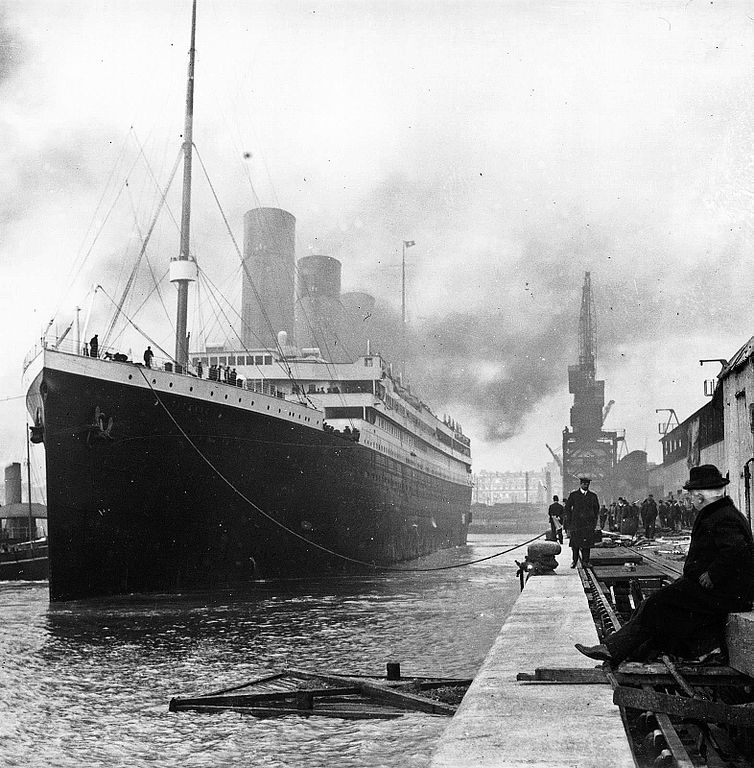
H.M.S. Titanic at the dock in England in April 1912 (Wikimedia Commons public domain image)
With a group of neighbors and friends, we had dinner last night at the Joy Luck Restaurant in Sandy, Utah, as we’ve done on several previous occasions prior to attending a play at the Hale Centre Theatre. It was a very good meal. Then we took in a performance of The Unsinkable Molly Brown over at the Hale. It’s a very curious thing, but I don’t think that I’ve ever seen it before, neither in a live theater nor even in the 1964 film version with Debbie Reynolds and Harve Presnell. May parents saw it, I think, at Grauman’s Chinese Theatre in Hollywood. At least, I seem to recall that we once had a glossy, multi-colored, magazine-sized program of The Unsinkable Molly Brown just like the programs that I know that we bought there for Ben Hur and Doctor Zhivago.
Hitlers mythische Religion: Theologische Denklinien und NS-Ideologie
Previous Post

September 12, 2022
An invitation to attend and to pray
Next Post
September 14, 2022 On His 109th Birthday
Browse Our Archives
Select a Category Uncategorized
Select a Month October 2026 September 2026 August 2026 July 2026 June 2026 May 2026 April 2026 March 2026 February 2026 January 2026 December 2025 November 2025 October 2025 September 2025 August 2025 July 2025 June 2025 May 2025 April 2025 March 2025 February 2025 January 2025 December 2024 November 2024 October 2024 September 2024 August 2024 July 2024 June 2024 May 2024 April 2024 March 2024 February 2024 January 2024 December 2023 November 2023 October 2023 September 2023 August 2023 July 2023 June 2023 May 2023 April 2023 March 2023 February 2023 January 2023 December 2022 November 2022 October 2022 September 2022 August 2022 July 2022 June 2022 May 2022 April 2022 March 2022 February 2022 January 2022 December 2021 November 2021 October 2021 September 2021 August 2021 July 2021 June 2021 May 2021 April 2021 March 2021 February 2021 January 2021 December 2020 November 2020 October 2020 September 2020 August 2020 July 2020 June 2020 May 2020 April 2020 March 2020 February 2020 January 2020 December 2019 November 2019 October 2019 September 2019 August 2019 July 2019 June 2019 May 2019 April 2019 March 2019 February 2019 January 2019 December 2018 November 2018 October 2018 September 2018 August 2018 July 2018 June 2018 May 2018 April 2018 March 2018 February 2018 January 2018 December 2017 November 2017 October 2017 September 2017 August 2017 July 2017 June 2017 May 2017 April 2017 March 2017 February 2017 January 2017 December 2016 November 2016 October 2016 September 2016 August 2016 July 2016 June 2016 May 2016 April 2016 March 2016 February 2016 January 2016 December 2015 November 2015 October 2015 September 2015 August 2015 July 2015 June 2015 May 2015 April 2015 March 2015 February 2015 January 2015 December 2014 November 2014 March 2014 August 2013 February 2012
Follow Us!
TAKE THE
Religious Wisdom Quiz
How many books are in the New Testament?
Select your answer to see how you score.
27 13 30 21
Related posts from Sic et Non

"America's Most Neighborly City"? It's not in Switzerland


Does mind derive from mindless matter?

A note on some (rather atypical) recent reading
TRENDING AT PATHEOS Latter-day Saint

In "Irreplaceable," our book on vocation and technology, Trevor Sutton and I...

I was strolling through the top floor of the brand new Parthenon...

What Does Gêvâh Mean For Kimberley Guifoyle &...
This week, a lot of the news is focused on Kimberly Guilfoyle....

INNER CIRCLE: Profound Mystery (Of Christ In All...
Ephesians 5:31-32 “For this reason, a man will leave his father and...

Do Not Rejoice When Your Enemy Falls: The...
Turning an execution into a public spectacle is a disturbing expression of...

'The Chosen' S6 Trailer: The Passion Gets Very...
Not many watching 'The Chosen' worry about spoilers, but just because they...
view all Latter-day Saint blogs
Ad-Free & Subscriber Log-In Subscription Support
- About Us
- 2026 Calendar
- Videos
- Podcasts
- Library of World Religions
- Faith In Media Tracker
- Advertise With Us
- Write for Us
- Privacy Policy
- Terms of Service
- Do Not Sell My Data
- Contact Us
- Radiant Digital
- Manage Newsletter Subscriptions
- Unsubscribe From Notifications
- Sitemap
Copyright 2008-2026, Patheos. All rights reserved.
Subscription Support Ad-Free & Subscriber Log-In
Follow Patheos