
BuddhistCatholicContemplativeEvangelicalGeneral ChristianHinduJewishLatter-day SaintMuslimNew VisionsProgressive Christian
Beliefs
- Buddhist
- Catholic
- Contemplative
- Evangelical
- General Christian
- Hindu
- Jewish
- Latter-day Saint
- More Voices
- Muslim
- New Visions
- Pagan
- Progressive Christian
Topics
- Religion News
- Food and Religion
- Sports and Religion
- Religious Art
- Religious Music and Entertainment
- Religious Events
- History and Religion
- Style and Religion
- Politics and Religion
- Women in Religion
- Recreation Outdoors and Religion
- Business Finance and Religion
- Careers Workplace and Religion
- Education and Religion
- Family Parenting and Religion
- Health Fitness and Religion
- Home and Religion
- Relationships and Religion
- Technology and Religion
- Travel and Religion
Columnists
- Buddhist Columnists
- Business Finance and Religion Columnists
- Careers Workplace and Religion Columnists
- Catholic Columnists
- Contemplative Columnists
- Education and Religion Columnists
- Evangelists Columnists
- Family Parenting and Religion Columnists
- General Christian Columnists
- Health Fitness and Religion Columnists
- Hindu Columnists
- History and Religion Columnists
- Home and Religion Columnists
- Jewish Columnists
- More Voices Columnists
- Latter Day Columnists
- Muslim Columnists
- New Visions Columnists
- Nonreligious Columnists
- Pagan Columnists
- Politics and Religion Columnists
- Progressive Columnists
- Recreation Outdoors and Religion Columnists
- Relationships and Religion Columnists
- Religion News Columnists
- Religious Art Columnists
- Religious Events Columnists
- Religious Music and Entertainment Columnists
- Sports and Religion Columnists
- Style and Religion Columnists
- Technology and Religion Columnists
- Travel and Religion Columnists
- Women in Religion Columnists
Resource Library
- 2026 Calendar
- Library of World Religions
- The 100 Most Holy Places on Earth
- Patheos Answers
- Podcasts
- Videos
- Faith Leaders Database
- Anglican Episcopalian
- Bahai
- Baptist
- Buddhism
- Christianity
- Confucianism
- Eastern Orthodoxy
- Hinduism
- Holiness and Pentecostal
- ISKCON
- Islam
- Judaism
- Lutheran
- Methodist
- The Church of Jesus Christ of Latter-day Saints
- New Age
- Paganism
- Presbytarian and Reformed
- Protestantism
- Religion Behind the Scenes
- Roman Catholic
- Scientology
- Shia Islam
- Sikhism
- Sufism
- Sunni Islam
- Taoism
- Zen
- See all religions
Research Tools
 Ad-Free & Subscriber Log-In Subscription Support
Ad-Free & Subscriber Log-In Subscription Support
Follow Patheos 

- Trending:
- Forgiveness
- |
- Marriage
- |
- Consciousness
- |
- Death Penalty
- |
- Election
- |
- Halloween

- Home
- Latter-day Saint
- “Should I Be My Brother’s Keeper? Yes and No”
“Should I Be My Brother’s Keeper? Yes and No”
Last updated on: August 19, 2022 at 3:35 pm by Dan Peterson
“Should I Be My Brother’s Keeper? Yes and No” 2022-08-19T15:35:23-06:00 Dan Peterson
Patheos Explore the world's faith through different perspectives on religion and spirituality! Patheos has the views of the prevalent religions and spiritualities of the world.
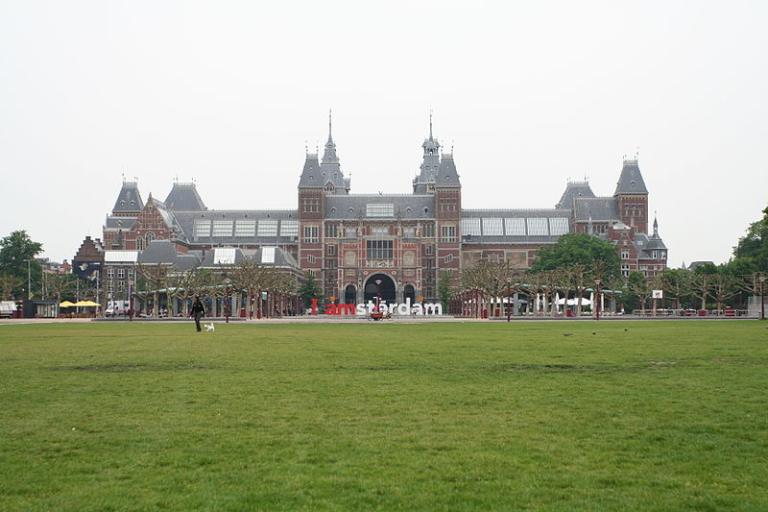
A view of Amsterdam’s Rijksmuseum (Wikimedia Commons public domain photograph)
A new article went up a short while ago in Interpreter: A Journal of Latter-day Saint Faith and Scholarship:
“Should I Be My Brother’s Keeper? Yes and No,” written by . . . well, Daniel C. Peterson
Abstract: We typically teach and often even sing that we should be our brothers’ (and sisters’) keepers. And we do it with the very best and most holy of intentions. For many of us, indeed, loving and caring for our brothers and sisters is at the very heart of what it means to live a life of truly Christian discipleship. And rightly so. But there’s another way to think about this matter. I’ve pondered it for decades, and now, maybe some others will also find it thought-provoking.
And here’s something of mine that recently appeared in Meridian Magazine:
“What Does it Mean to Be a Witness?”
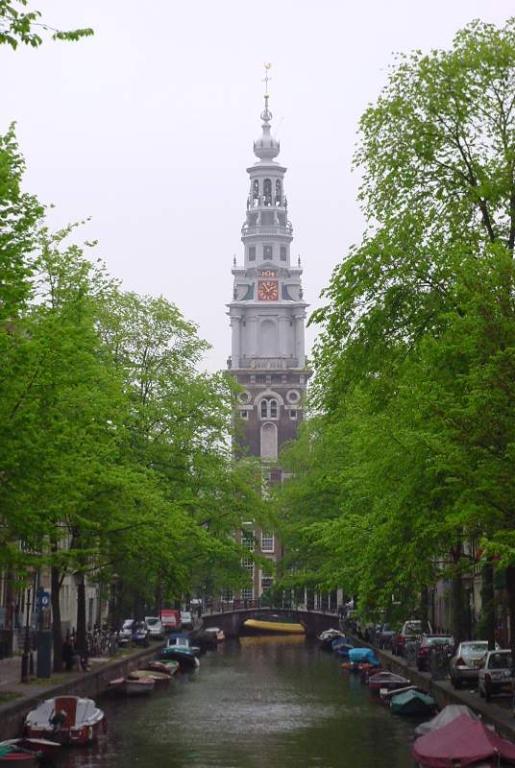
One of the impressive church towers of the city of Amsterdam
(Wikimedia Commons public domain photo)
I very much like this short piece from Elder Gerrit W. Gong, of the Quorum of the Twelve Apostles of the Church of Jesus Christ of Latter-day Saints:
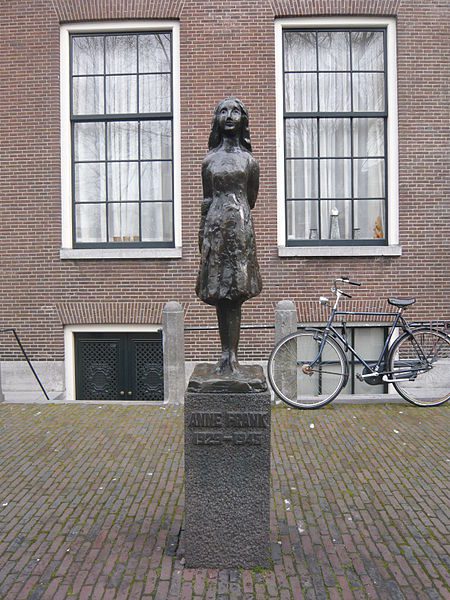
Monument to Anne Frank, in front of the Amsterdam house in which she and her family lived.
(Wikimedia Commons public domain photograph)
We hear a great deal these days about the decline of religious belief in the United States and in the West more generally. Here’s something fresh on the topic:
“Is America’s religion cup half-empty or half-full? Two new takes on the omnipresent ‘nones'”
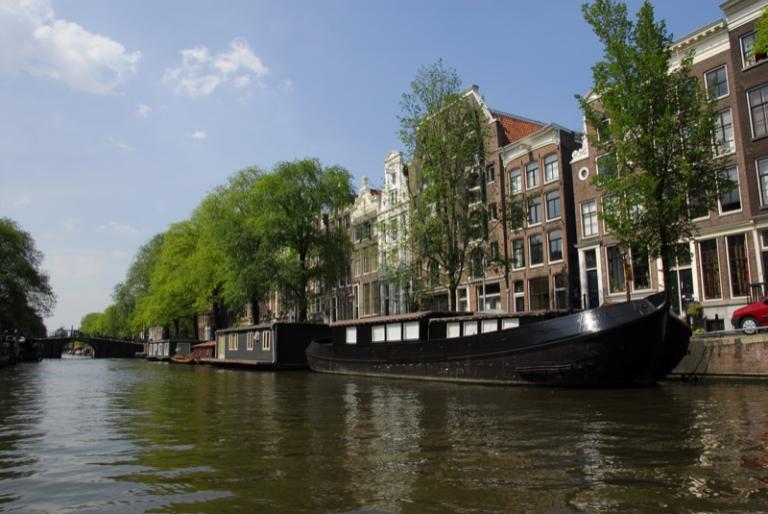
On the Amstel River in Amsterdam, which is named after it.
(Wikimedia Commons public domain image)
With the brutal recent attack on the Anglo-Indian novelist Salman Rushdie, it’s not surprising that some are inquiring again about the Islamic concept of a fatwa. Here’s an article on the subject that was published a few days back:
“What is a fatwa? A religious studies professor explains”
Those who are interested might also find this article helpful. The late William Hamblin and I wrote it for the Deseret News back in 2016
It will be readily apparent that the Deseret News article is taken from a very brief explanation that I had already published in the Macmillan Encyclopedia of Islam and the Muslim World in 2004:
Fatwa.
An advisory opinion issued by a recognized authority on law and tradition in answer to a specific question. Fatwas can range from single-word responses (e.g., “Yes,” “No,” or “Permitted”) to book-length treatises. Although typically focused on legal matters, fatwas also treat more general religious issues, including theology, philosophy, creeds, and ‘ibadat (religious obligations or acts of worship). Traditionally, despite numerous exceptions (particularly since the eleventh century), the issuer of fatwas, termed a mufti—whose authority derives from his knowledge of law and tradition—has functioned independently of the judicial system, indeed often privately.
While court rulings rely on the sifting of evidence and conflicting testimonies, muftis assume the facts presented by their questioners, which, obviously, can bias the answer. Moreover, a fatwa differs from a court judgment, or qada, not only in its wider potential scope—for instance, although ‘ibadat are essential parts of Islamic law, they transcend the jurisdiction of the courts—but because the qada is binding and enforceable, “performative,” while the fatwa is not. Instead, it is “informational,” and, while decisions of shari‘a courts usually pertain only to the specific cases they adjudicate, thus setting no legal precedents, fatwas are very often collected, published, and cited in subsequent cases.
Bibliography
Schacht, Joseph. Origins of Muhammadan Jurisprudence. Oxford and New York: Clarendon Press, 1979.
Weiss, Bernard G. The Spirit of Islamic Law. Athens: University of Georgia Press, 1998.
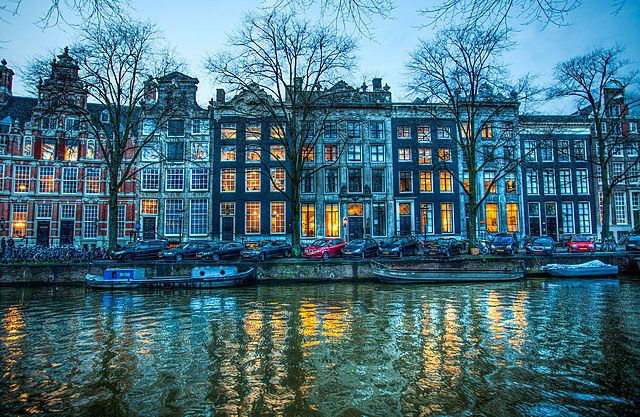
A view of Amsterdam canal houses on the Herengracht just after the sunset of a winter evening. Photograph by Anne Dirkse, http://www.annedirkse.com; ://commons.wikimedia.org/wiki/File:Herengracht,_Amsterdam_in_the_Blue_Hour.jpg
We began our current tour yesterday, meeting with a part of our group who had come to Amsterdam slightly early. We had a local Dutch guide by the name of Joyce, who was, I thought, remarkably good. (Unfortunately, I don’t know her last name, but, just in case somebody might be interested, I found her on a website of local Dutch tour guides.). We went first to a place called the Zaanse Schans, where a number of still-functioning windmills — and exhibits and shops — can be found in a beautiful area of water and grassy meadows. Next, we walked through the village of Edam, which gave its name to the famous cheese (some of which we bought and shared with our group). Edam is a quiet, interesting, and pretty alternative to the bustle of Amsterdam, and we had a very good lunch at L’Auberge Damhotel. Then we dropped by Irene Hoeve, where we were given really amusing and informative presentations on the making of Gouda cheese and the manufacture of wooden shoes (“clogs” or klompen), and offered the chance to buy each of them. Concluding our tour for the day, we walked around the town of Marken, located on what was formerly an island but is now, thanks to Dutch engineering, a peninsula. Its wooden houses are especially memorable. In the evening, we cruised serenely along the Amstel River and about the canals of Amsterdam, including the Herengracht and the Prinsengracht, on a small boat.
Joyce met us again this morning at our hotel and led us for about two hours on a circuitous and very informative walk through the Centrum of Amsterdam to the magnificent Rijksmuseum. There, she left us. But I have to say that traveling about with her allowed me, at least, to see Amsterdam in a different way than I’ve ever seen it before. And I’ve never really spent much time out in the Dutch countryside beyond the city, so this has been an enlightening visit for me.
We had only a very little time in which to visit the Rijksmuseum on this trip (and none at all to visit the nearby Van Gogh Museum) before we needed to go to our boat. So we spent almost all of our time on the Museum’s celebrated second floor, with its marvelous collection of works by, among others, Rembrandt (including, in pride of place, his large painting commonly known as the Night Watch), Johannes Vermeer, Jacob van Ruisdael, and Frans Hals, taking a quick moment at the end to drop by the few paintings by Van Gogh on the first floor. Then we headed to our boat and met our entire group for the first time.
Posted from the North Sea
Previous Post

August 18, 2022
Serious issues are involved
Browse Our Archives
Select a Category Uncategorized
Select a Month October 2026 September 2026 August 2026 July 2026 June 2026 May 2026 April 2026 March 2026 February 2026 January 2026 December 2025 November 2025 October 2025 September 2025 August 2025 July 2025 June 2025 May 2025 April 2025 March 2025 February 2025 January 2025 December 2024 November 2024 October 2024 September 2024 August 2024 July 2024 June 2024 May 2024 April 2024 March 2024 February 2024 January 2024 December 2023 November 2023 October 2023 September 2023 August 2023 July 2023 June 2023 May 2023 April 2023 March 2023 February 2023 January 2023 December 2022 November 2022 October 2022 September 2022 August 2022 July 2022 June 2022 May 2022 April 2022 March 2022 February 2022 January 2022 December 2021 November 2021 October 2021 September 2021 August 2021 July 2021 June 2021 May 2021 April 2021 March 2021 February 2021 January 2021 December 2020 November 2020 October 2020 September 2020 August 2020 July 2020 June 2020 May 2020 April 2020 March 2020 February 2020 January 2020 December 2019 November 2019 October 2019 September 2019 August 2019 July 2019 June 2019 May 2019 April 2019 March 2019 February 2019 January 2019 December 2018 November 2018 October 2018 September 2018 August 2018 July 2018 June 2018 May 2018 April 2018 March 2018 February 2018 January 2018 December 2017 November 2017 October 2017 September 2017 August 2017 July 2017 June 2017 May 2017 April 2017 March 2017 February 2017 January 2017 December 2016 November 2016 October 2016 September 2016 August 2016 July 2016 June 2016 May 2016 April 2016 March 2016 February 2016 January 2016 December 2015 November 2015 October 2015 September 2015 August 2015 July 2015 June 2015 May 2015 April 2015 March 2015 February 2015 January 2015 December 2014 November 2014 March 2014 August 2013 February 2012
Follow Us!
TAKE THE
Religious Wisdom Quiz
What city was Paul heading to when he encountered Jesus?
Select your answer to see how you score.
Antioch Jerusalem Rome Damascus
Related posts from Sic et Non
Fairview, Texas, AI, and Other Challenges



TRENDING AT PATHEOS Latter-day Saint

The First Eucharistic Controversy: Christ’s Real Presence
For Catholics, the Eucharist is the source and summit of the Christian...

What a Stop Sign Can Teach Us About...
How to Make a Decision When You Can't Hear God Main point:...

Archdiocese Hosts Military Marriage Retreat in Germany
RASTATT, Germany — The transient military lifestyle, with its frequent deployments and...

Nearly every morning, I make the drive to Detroit with my high-school-age...

The Real AI Story Is Adoption Without Trust
Artificial intelligence has crossed a political threshold. It is no longer a...

A new article, written by Jeff Lindsay and Gale L. Pooley,...
view all Latter-day Saint blogs
Ad-Free & Subscriber Log-In Subscription Support
- About Us
- 2026 Calendar
- Videos
- Podcasts
- Library of World Religions
- Faith In Media Tracker
- Advertise With Us
- Write for Us
- Privacy Policy
- Terms of Service
- Do Not Sell My Data
- Contact Us
- Radiant Digital
- Manage Newsletter Subscriptions
- Unsubscribe From Notifications
- Sitemap
Copyright 2008-2026, Patheos. All rights reserved.
Subscription Support Ad-Free & Subscriber Log-In
Follow Patheos