
BuddhistCatholicContemplativeEvangelicalGeneral ChristianHinduJewishLatter-day SaintMuslimNew VisionsProgressive Christian
Beliefs
- Buddhist
- Catholic
- Contemplative
- Evangelical
- General Christian
- Hindu
- Jewish
- Latter-day Saint
- More Voices
- Muslim
- New Visions
- Pagan
- Progressive Christian
Topics
- Religion News
- Food and Religion
- Sports and Religion
- Religious Art
- Religious Music and Entertainment
- Religious Events
- History and Religion
- Style and Religion
- Politics and Religion
- Women in Religion
- Recreation Outdoors and Religion
- Business Finance and Religion
- Careers Workplace and Religion
- Education and Religion
- Family Parenting and Religion
- Health Fitness and Religion
- Home and Religion
- Relationships and Religion
- Technology and Religion
- Travel and Religion
Columnists
- Buddhist Columnists
- Business Finance and Religion Columnists
- Careers Workplace and Religion Columnists
- Catholic Columnists
- Contemplative Columnists
- Education and Religion Columnists
- Evangelists Columnists
- Family Parenting and Religion Columnists
- General Christian Columnists
- Health Fitness and Religion Columnists
- Hindu Columnists
- History and Religion Columnists
- Home and Religion Columnists
- Jewish Columnists
- More Voices Columnists
- Latter Day Columnists
- Muslim Columnists
- New Visions Columnists
- Nonreligious Columnists
- Pagan Columnists
- Politics and Religion Columnists
- Progressive Columnists
- Recreation Outdoors and Religion Columnists
- Relationships and Religion Columnists
- Religion News Columnists
- Religious Art Columnists
- Religious Events Columnists
- Religious Music and Entertainment Columnists
- Sports and Religion Columnists
- Style and Religion Columnists
- Technology and Religion Columnists
- Travel and Religion Columnists
- Women in Religion Columnists
Resource Library
- 2026 Calendar
- Library of World Religions
- The 100 Most Holy Places on Earth
- Patheos Answers
- Podcasts
- Videos
- Faith Leaders Database
- Anglican Episcopalian
- Bahai
- Baptist
- Buddhism
- Christianity
- Confucianism
- Eastern Orthodoxy
- Hinduism
- Holiness and Pentecostal
- ISKCON
- Islam
- Judaism
- Lutheran
- Methodist
- The Church of Jesus Christ of Latter-day Saints
- New Age
- Paganism
- Presbytarian and Reformed
- Protestantism
- Religion Behind the Scenes
- Roman Catholic
- Scientology
- Shia Islam
- Sikhism
- Sufism
- Sunni Islam
- Taoism
- Zen
- See all religions
Research Tools
 Ad-Free & Subscriber Log-In Subscription Support
Ad-Free & Subscriber Log-In Subscription Support
Follow Patheos 

- Trending:
- Forgiveness
- |
- Marriage
- |
- Consciousness
- |
- Death Penalty
- |
- Election
- |
- Halloween

- Home
- Latter-day Saint
- “O ye’ll tak’ the high road, and I’ll tak’ the low road”
“O ye’ll tak’ the high road, and I’ll tak’ the low road”
Last updated on: August 23, 2022 at 3:42 pm by Dan Peterson
“O ye’ll tak’ the high road, and I’ll tak’ the low road” 2022-08-23T15:42:43-06:00 Dan Peterson
Patheos Explore the world's faith through different perspectives on religion and spirituality! Patheos has the views of the prevalent religions and spiritualities of the world.

A view across the southern tip of Loch Lomond
(Wikimedia Commons public domain photograph)
I’m not at all sure why, but, although I’ve visited Scotland on several previous occasions (including that wonderful week in my early twenties at St. Andrews) and although I have an unaccountable affection for the Celtic cross, this is the first time that I’ve really felt the pull of my Scots ancestral line. I’ve long had a deep attachment to Norway, and I’m an Anglophile already, without regard to family heritage. I’m afraid that I’m still working on Denmark. But now, suddenly and unexpectedly, I’m feeling Scottish.
It may, I think, have something to do with the famous Scots song “The Bonnie Banks of Loch Lomond.” I’ve been aware of it for pretty much all of my life, I think, but I somehow didn’t know the story behind it. Knowing it, though, makes sense of it, and makes it (to me, at least) not merely sentimental (as I had thought) but powerfully moving. The song tells the story of two imprisoned Scottish soldiers, perhaps in the aftermath of the bloody and tragic 16 April 1746 Battle of Culloden, which grievously wounded and seriously weakened the Highland clans of Scotland. One of the two soldiers is to be executed, decapitated, while the other is to be set free. According to Celtic legend, if someone dies in a foreign land, his spirit returns to his homeland by “the low road,” which is the route for the souls of the dead.
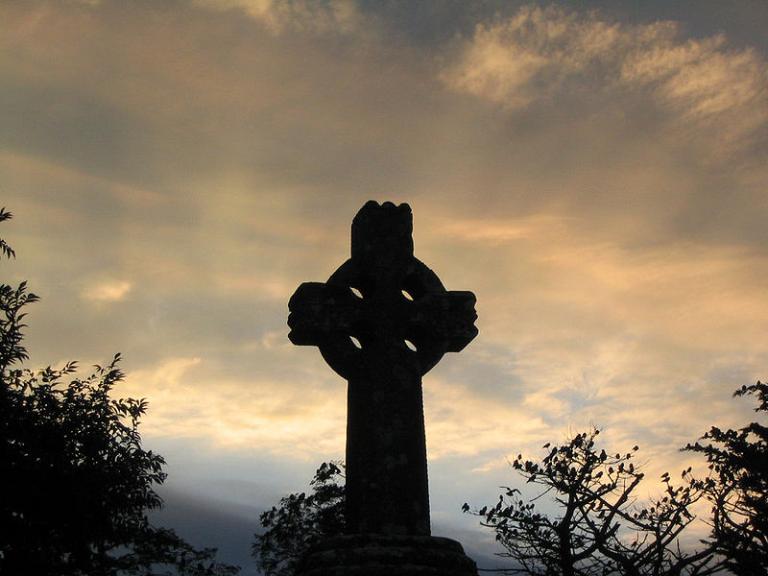
A Celtic cross at dawn (Wikimedia Commons public domain image)
I supply the lyrics below, but here are some notes that should help you to understand them: The adjective bonnie, of course, means “beautiful.” A brae is a steep hillside or bank. Loch Lomond is a freshwater loch or lake, the largest in Great Britain by surface area, that is located about thirty or forty miles to the northwest of Glasgow. The Scottish verb to gae is equivalent to the English verb to go. Ben Lomond (“Beacon Hill”) is a mountain in the Scottish Highlands, on the eastern bank of Loch Lomond; the Ben Lomond near Ogden, Utah, is named after it. Gloaming is an archaic word for “twilight” or “dusk.” The Scots verb to ken is synonymous with the German verb kennen (“to know”). Nae means “no.” Waeful means “woeful.” Frae means “from.”
By yon bonnie banks and by yon bonnie braes,
Where the sun shines bright on Loch Lomond,
Where me and my true love were ever wont to gae,
On the bonnie, bonnie banks o’ Loch Lomond.
Chorus:
O ye’ll tak’ the high road, and I’ll tak’ the low road,
And I’ll be in Scotland a’fore ye,
But me and my true love will never meet again,
On the bonnie, bonnie banks o’ Loch Lomond.
‘Twas there that we parted, in yon shady glen,
On the steep, steep side o’ Ben Lomond,
Where in soft purple hue, the highland hills we view,
And the moon coming out in the gloaming.
Chorus:
O ye’ll tak’ the high road, and I’ll tak’ the low road,
And I’ll be in Scotland a’fore ye,
But me and my true love will never meet again,
On the bonnie, bonnie banks o’ Loch Lomond.
The wee birdies sing and the wildflowers spring,
And in sunshine the waters are sleeping.
But the broken heart it kens nae second spring again,
Though the waeful may cease frae their grieving.
Chorus:
O ye’ll tak’ the high road, and I’ll tak’ the low road,
And I’ll be in Scotland a’fore ye,
But me and my true love will never meet again,
On the bonnie, bonnie banks o’ Loch Lomond.
I share with you here three renditions of the song. The first seems, by the numbers, to be extremely popular, although having it performed by a woman may cloud the original meaning of the lyrics just a bit. (Still, the music video seems to make it work a little, especially with its touching conclusion and its, to me, very congenial suggestion of an eternal, ageless reunion.)
“The Bonnie Banks of Loch Lomond” – Ella Roberts
The second is a performance of the very beautiful arrangement by the English composer Ralph Vaughan Williams (1872-1958):
The third is, well, rather curious:
But all of this has put me in such a Scottish frame of mind and spirit that, as an unasked-for bonus, I’m now going to include the theme “Promontory” from the soundtrack of the 1992 film The Last of the Mohicans. An orchestration by Trevor Jones (and perhaps also Randy Edelman) of the tune “The Gael,” originally written by the Scottish singer-songwriter Dougie MacLean and included in his 1990 album The Search, it’s a big favorite of mine in certain moods. And, ever since I began this cruise, I’ve been increasingly in one of those moods.

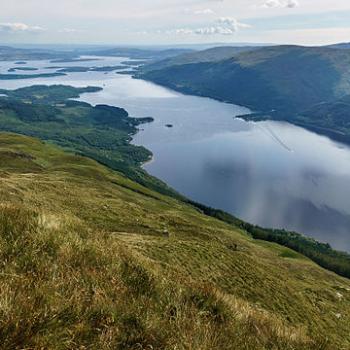
Loch Lomond, as seen looking southward from Ben Lomond
(Wikimedia Commons public domain photograph)
Thus far, I’ve given four lectures or led four discussions (whatever it is that I’m doing, it’s somewhere in between the two) aboard this boat, The Jewel of the Seas. I’ve focused to a large extent on the ecclesiastical history of the United Kingdom, both Latter-day Saint and general Christian, accompanied by some relatively lengthy digressions on the history of the English language (beginning with the Angles and the Saxons and continuing on into the linguistic consequences of the Norman conquest and the history and the literary and linguistic influence of the King James translation of the Bible). I’ve devoted special attention to matters such as the emergence of Christianity, the peculiar nature of Christianity in Ireland, the mission of St. Augustine of Canterbury to bring English Christians under the sway of the papacy, the lethal conflict between King Henry II of England (aka Peter O’Toole) and Thomas Becket (aka Richard Burton, or St. Thomas of Canterbury), Henry VIII and the English Reformation, and the Industrial Revolution (as observed by Brigham Young, Heber C. Kimball, Karl Marx, and Friedrich Engels). Obviously, too, I’ve emphasized the mission of Heber C. Kimball to England and the later mission of the Twelve to England, as well as some highlights of the history of the Church since then. It’s fun to think about these things here. And I’ll be thinking a great deal more about them as we begin to pivot toward our Six Days in August project.
Posted from the Hebrides
Previous Post

August 23, 2022
Lost causes, lost worlds, and lost monsters
Browse Our Archives
Select a Category Uncategorized
Select a Month October 2026 September 2026 August 2026 July 2026 June 2026 May 2026 April 2026 March 2026 February 2026 January 2026 December 2025 November 2025 October 2025 September 2025 August 2025 July 2025 June 2025 May 2025 April 2025 March 2025 February 2025 January 2025 December 2024 November 2024 October 2024 September 2024 August 2024 July 2024 June 2024 May 2024 April 2024 March 2024 February 2024 January 2024 December 2023 November 2023 October 2023 September 2023 August 2023 July 2023 June 2023 May 2023 April 2023 March 2023 February 2023 January 2023 December 2022 November 2022 October 2022 September 2022 August 2022 July 2022 June 2022 May 2022 April 2022 March 2022 February 2022 January 2022 December 2021 November 2021 October 2021 September 2021 August 2021 July 2021 June 2021 May 2021 April 2021 March 2021 February 2021 January 2021 December 2020 November 2020 October 2020 September 2020 August 2020 July 2020 June 2020 May 2020 April 2020 March 2020 February 2020 January 2020 December 2019 November 2019 October 2019 September 2019 August 2019 July 2019 June 2019 May 2019 April 2019 March 2019 February 2019 January 2019 December 2018 November 2018 October 2018 September 2018 August 2018 July 2018 June 2018 May 2018 April 2018 March 2018 February 2018 January 2018 December 2017 November 2017 October 2017 September 2017 August 2017 July 2017 June 2017 May 2017 April 2017 March 2017 February 2017 January 2017 December 2016 November 2016 October 2016 September 2016 August 2016 July 2016 June 2016 May 2016 April 2016 March 2016 February 2016 January 2016 December 2015 November 2015 October 2015 September 2015 August 2015 July 2015 June 2015 May 2015 April 2015 March 2015 February 2015 January 2015 December 2014 November 2014 March 2014 August 2013 February 2012
Follow Us!
TAKE THE
Religious Wisdom Quiz
Who was lowered through a roof to be healed by Jesus?
Select your answer to see how you score.
A paralyzed man A leper Jairus' daughter A blind man
Related posts from Sic et Non

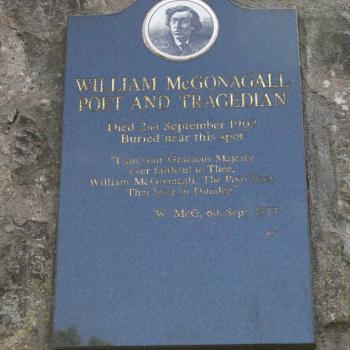
"William McGonagall, Poet and Tragedian"
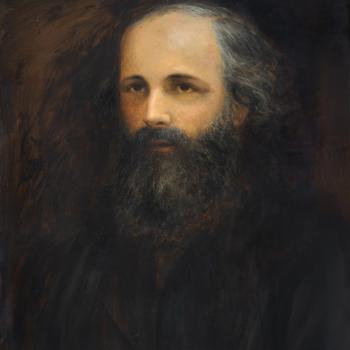
Science and Religion: A Great Scottish Example
TRENDING AT PATHEOS Latter-day Saint

How to Make a Decision When You Can't...
Main point: It’s much more valuable to stay close to God so...

Archdiocese Hosts Military Marriage Retreat in Germany
RASTATT, Germany — The transient military lifestyle, with its frequent deployments and...

Nearly every morning, I make the drive to Detroit with my high-school-age...

The Real AI Story Is Adoption Without Trust
Artificial intelligence has crossed a political threshold. It is no longer a...

A new article, written by Jeff Lindsay and Gale L. Pooley,...

Swimfan: Forgotten Aughts Pleasures
This is a recovery effort. In 2002, My Big Fat Greek Wedding...
view all Latter-day Saint blogs
Ad-Free & Subscriber Log-In Subscription Support
- About Us
- 2026 Calendar
- Videos
- Podcasts
- Library of World Religions
- Faith In Media Tracker
- Advertise With Us
- Write for Us
- Privacy Policy
- Terms of Service
- Do Not Sell My Data
- Contact Us
- Radiant Digital
- Manage Newsletter Subscriptions
- Unsubscribe From Notifications
- Sitemap
Copyright 2008-2026, Patheos. All rights reserved.
Subscription Support Ad-Free & Subscriber Log-In
Follow Patheos