
BuddhistCatholicContemplativeEvangelicalGeneral ChristianHinduJewishLatter-day SaintMuslimNew VisionsProgressive Christian
Beliefs
- Buddhist
- Catholic
- Contemplative
- Evangelical
- General Christian
- Hindu
- Jewish
- Latter-day Saint
- More Voices
- Muslim
- New Visions
- Pagan
- Progressive Christian
Topics
- Religion News
- Food and Religion
- Sports and Religion
- Religious Art
- Religious Music and Entertainment
- Religious Events
- History and Religion
- Style and Religion
- Politics and Religion
- Women in Religion
- Recreation Outdoors and Religion
- Business Finance and Religion
- Careers Workplace and Religion
- Education and Religion
- Family Parenting and Religion
- Health Fitness and Religion
- Home and Religion
- Relationships and Religion
- Technology and Religion
- Travel and Religion
Columnists
- Buddhist Columnists
- Business Finance and Religion Columnists
- Careers Workplace and Religion Columnists
- Catholic Columnists
- Contemplative Columnists
- Education and Religion Columnists
- Evangelists Columnists
- Family Parenting and Religion Columnists
- General Christian Columnists
- Health Fitness and Religion Columnists
- Hindu Columnists
- History and Religion Columnists
- Home and Religion Columnists
- Jewish Columnists
- More Voices Columnists
- Latter Day Columnists
- Muslim Columnists
- New Visions Columnists
- Nonreligious Columnists
- Pagan Columnists
- Politics and Religion Columnists
- Progressive Columnists
- Recreation Outdoors and Religion Columnists
- Relationships and Religion Columnists
- Religion News Columnists
- Religious Art Columnists
- Religious Events Columnists
- Religious Music and Entertainment Columnists
- Sports and Religion Columnists
- Style and Religion Columnists
- Technology and Religion Columnists
- Travel and Religion Columnists
- Women in Religion Columnists
Resource Library
- 2026 Calendar
- Library of World Religions
- The 100 Most Holy Places on Earth
- Patheos Answers
- Podcasts
- Videos
- Faith Leaders Database
- Anglican Episcopalian
- Bahai
- Baptist
- Buddhism
- Christianity
- Confucianism
- Eastern Orthodoxy
- Hinduism
- Holiness and Pentecostal
- ISKCON
- Islam
- Judaism
- Lutheran
- Methodist
- The Church of Jesus Christ of Latter-day Saints
- New Age
- Paganism
- Presbytarian and Reformed
- Protestantism
- Religion Behind the Scenes
- Roman Catholic
- Scientology
- Shia Islam
- Sikhism
- Sufism
- Sunni Islam
- Taoism
- Zen
- See all religions
Research Tools
 Ad-Free & Subscriber Log-In Subscription Support
Ad-Free & Subscriber Log-In Subscription Support
Follow Patheos 

- Trending:
- Forgiveness
- |
- Marriage
- |
- Consciousness
- |
- Death Penalty
- |
- Election
- |
- Halloween

- Home
- Latter-day Saint
- County Cork, and Something That, Sadly, Didn’t Bob Like One
County Cork, and Something That, Sadly, Didn’t Bob Like One
Last updated on: August 28, 2022 at 10:22 am by Dan Peterson
County Cork, and Something That, Sadly, Didn’t Bob Like One 2022-08-28T10:22:54-06:00 Dan Peterson
Patheos Explore the world's faith through different perspectives on religion and spirituality! Patheos has the views of the prevalent religions and spiritualities of the world.
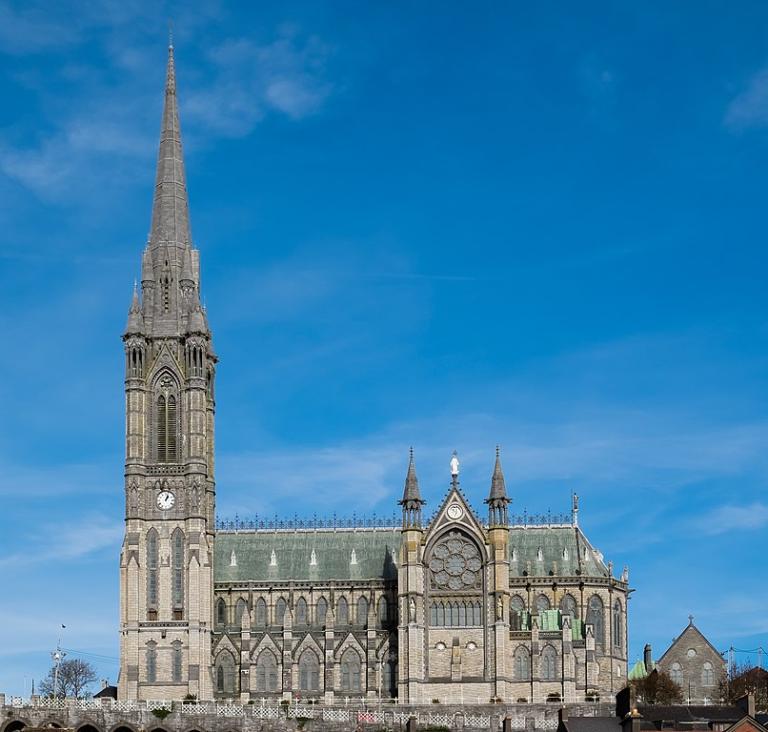
St. Colman’s Cathedral in Cobh, in the Republic of Ireland
(Wikimedia Commons public domain image)
Two new items went up earlier today in Interpreter: A Journal of Latter-day Saint Faith and Scholarship:
“There Is No Beauty That We Should Desire Him,” written by Loren Blake Spendlove
Abstract: In two separate passages Isaiah appears to describe the mortal Messiah as lacking in physical beauty and perhaps as even having some type of physical disfigurement (see Isaiah 52:14 and 53:2–4). On the contrary, Joseph, David, Esther, and Judith — portrayed in the biblical text as physical saviors or deliverers of Israel — are represented as beautiful in form and appearance. In fact, their beauty seems to be a significant factor in the successful exercise of their power as physical saviors of Israel. Unlike Joseph, David, Esther, and Judith, Christ may have been foreordained to descend to his mortal state with a less than attractive physical appearance and as someone who experienced illness throughout his life so that “he may know according to the flesh how to succor his people according to their infirmities” (Alma 7:12).
“Interpreting Interpreter: A Marred Appearance,” written by Kyler Rasmussen
This post is a summary of the article “There Is No Beauty That We Should Desire Him” by Loren Spendlove in Volume 53 of Interpreter: A Journal of Latter-day Saint Faith and Scholarship. An introduction to the Interpreting Interpreter series is available at https://interpreterfoundation.org/interpreting-interpreter-on-abstracting-thought/.
The Takeaway: Spendlove uses Hebrew word usage in Isaiah 52 and 53 to suggest that Christ may have suffered from debilitating and disfiguring illness, fulfilling the prophecy that his appearance would be marred (mishchat, also meaning deformed or impaired), in contrast with the noted beauty of Israel’s other savior-like figures.

A pretty typical street scene in the heart of Kinsale
(Wikimedia Commons public domain image)
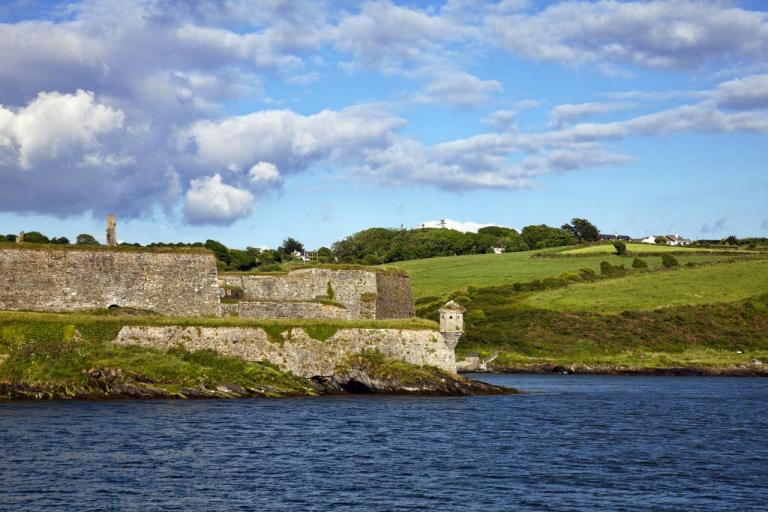
A sample of the landscape around Kinsale, County Cork, Republic of Ireland (Wikimedia Commons public domain photo)
We put in today at Cobh (pronounced like the English word cove), in County Cork in the Republic of Ireland. Known from 1849 until 1920 as Queenstown, Cobh was the last European port of call for RMS Titanic before it set out on its tragic maiden voyage across the North Atlantic to New York, and a monument and a visitor center there commemorate the connection. We spent very little time in Cobh itself, although we did get a very nice view of St. Colman’s Cathedral from our ship as we came into port and from the dock. From Cobh, we drove out to the really lovely seaside town of Kinsale, where we took in some beautiful views in the countryside and spent some time looking about its literally colorful “downtown” area. Several in our group spontaneously indicated their interest in somehow inheriting a home in Kinsale. I was one of them.
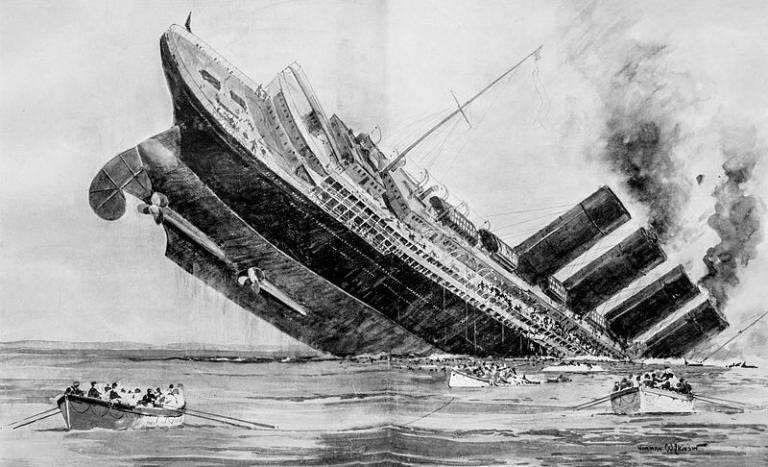
“The Sinking of the Lusitania,” from the “Illustrated London News” (15 May 1915)
Wikimedia Commons public domain image
But Kinsale, too, has its stories of shipwreck and tragedy: Most notable among them is that of RMS Lusitania, which sank about eleven miles offshore roughly eighteen minutes after being torpedoed by a German U-Boat on 7 May 1915. Out of 1962 passengers and crew aboard the vessel, 1198 died. Among them was a prominent member of the wealthy American Vanderbilt family, as well as an American writer by the name of Elbert Hubbard — of whom, for some reason, I’m vaguely aware. (He and his wife are said to have died quite stoically and heroically.) Many of the survivors and many of the bodies of victims were brought to Kinsale, whose fishermen are said to have played a notably heroic role in both rescue and retrieval. The Lusitania was nearing the end of a voyage from New York City to Liverpool, and it carried 139 citizens of the United States among its passengers. Nearly all of them — 128 — died. Although the United States would not enter the First World War for nearly another two years, the sinking of the Lusitania powerfully helped to turn the tide of American public opinion against Germany. Coincidentally, when my father came over to serve in Europe during the Second World War, he sailed on the RMS Aquitania, one of Lusitania‘s two sister ships, which had been converted into a military troop transport vessel. As I intended to mention a couple of days ago but didn’t, he landed somewhere on the Firth of Clyde near Glasgow.
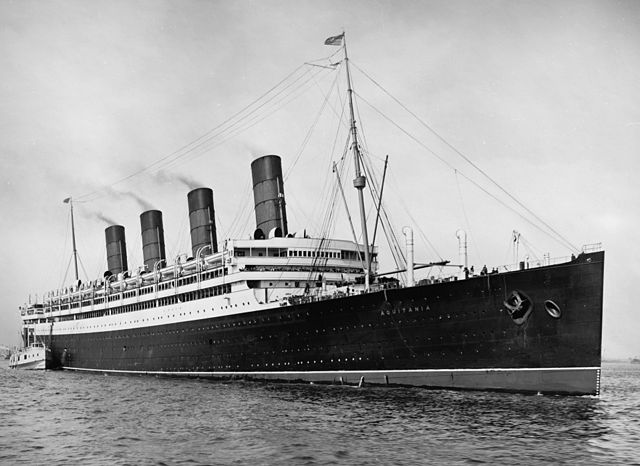
RMS Aquitania, shown sometime between 1914 and 1920.
(Wikimedia Commons public domain image)
After spending time in Kinsale, we drove about in the city of Cork itself, which is the third largest city on the Island of Ireland after Dublin (which is much larger) and Belfast, and the second largest city in the independent Republic of Ireland proper. Then we spent the rest of our time in and about the Castle of Blarney. Some of our number climbed to the top of the castle tower and kissed the famous Blarney Stone there. My wife and I were already here about ten years ago — my brother and my sister in law were planning to come with us on that tour, which I was also accompanying, but he died shortly before it — so we opted to forego the line and the kiss and instead spent our time in the beautiful gardens that surround the castle. Anyhow, I have certain reservations about kissing anything that has previously been kissed by millions of people.

Blarney Castle, in the County of Cork, Republic of Ireland
(Wikimedia Commons public domain image)
Back to Elbert Hubbard for a minute or two: I have never sat down to read anything by Elbert Hubbard, but I very frequently see quotations from him. Here are just a few of them that seem to circulate fairly widely:
“A friend is someone who knows all about you and still loves you.”
“God will not look you over for medals, degrees or diplomas but for scars.”
“To avoid criticism say nothing, do nothing, be nothing.”
“Every man is a damn fool for at least five minutes every day; wisdom consists in not exceeding the limit.”
“Never explain―your friends do not need it and your enemies will not believe you anyway.”
“There is no failure except in no longer trying.”
“The love we give away is the only love we keep.”
“If men could only know each other, they would neither idolize nor hate.”
“Self-discipline is the ability to make yourself do what you should do, when you should do it, whether you feel like it or not.”
“I would rather be able to appreciate things I cannot have than to have things I am not able to appreciate.”
“I do not read a book; I hold a conversation with the author.”
“Genius may have its limitations, but stupidity is not thus handicapped.”
“Know what you want to do, hold the thought firmly, and do every day what should be done, and every sunset will see you that much nearer the goal.”
Such sayings — and there are many, many more like them — may seem like aphorisms from a greeting card company. And, indeed, I’ve pretty much encountered Elbert Hubbard only in such contexts or in similar ones. But there’s actually a fair amount of practical wisdom in what he has to say.
Posted from near St. George’s Channel
Previous Post

August 25, 2022
A city reborn and a doomed ship
Next Post
August 27, 2022 Sacred and Anti-Sacred Sites
Browse Our Archives
Select a Category Uncategorized
Select a Month October 2026 September 2026 August 2026 July 2026 June 2026 May 2026 April 2026 March 2026 February 2026 January 2026 December 2025 November 2025 October 2025 September 2025 August 2025 July 2025 June 2025 May 2025 April 2025 March 2025 February 2025 January 2025 December 2024 November 2024 October 2024 September 2024 August 2024 July 2024 June 2024 May 2024 April 2024 March 2024 February 2024 January 2024 December 2023 November 2023 October 2023 September 2023 August 2023 July 2023 June 2023 May 2023 April 2023 March 2023 February 2023 January 2023 December 2022 November 2022 October 2022 September 2022 August 2022 July 2022 June 2022 May 2022 April 2022 March 2022 February 2022 January 2022 December 2021 November 2021 October 2021 September 2021 August 2021 July 2021 June 2021 May 2021 April 2021 March 2021 February 2021 January 2021 December 2020 November 2020 October 2020 September 2020 August 2020 July 2020 June 2020 May 2020 April 2020 March 2020 February 2020 January 2020 December 2019 November 2019 October 2019 September 2019 August 2019 July 2019 June 2019 May 2019 April 2019 March 2019 February 2019 January 2019 December 2018 November 2018 October 2018 September 2018 August 2018 July 2018 June 2018 May 2018 April 2018 March 2018 February 2018 January 2018 December 2017 November 2017 October 2017 September 2017 August 2017 July 2017 June 2017 May 2017 April 2017 March 2017 February 2017 January 2017 December 2016 November 2016 October 2016 September 2016 August 2016 July 2016 June 2016 May 2016 April 2016 March 2016 February 2016 January 2016 December 2015 November 2015 October 2015 September 2015 August 2015 July 2015 June 2015 May 2015 April 2015 March 2015 February 2015 January 2015 December 2014 November 2014 March 2014 August 2013 February 2012
Follow Us!
TAKE THE
Religious Wisdom Quiz
What did King Nebuchadnezzar order everyone to worship?
Select your answer to see how you score.
A lion His crown A golden statue The sun
Related posts from Sic et Non
Of Potatoes, Ottomans, and the Irish
TRENDING AT PATHEOS Latter-day Saint

When Halloween Unmasks Married Hearts
Written by Dr. David K. Ewen from Eternal Truth Bible College Behind...

Aristotle. He’s been called the father of logic, the father of the...

Methodist Central Hall and Westminster Abbey
Situated on the same square is Methodist Central Hall and Westminster Abbey. ...

57th Dove Awards Honor Dolly Parton, Crown New...
On gospel music’s biggest night, the 57th annual GMA Dove Awards honored...

The First Eucharistic Controversy: Christ’s Real Presence
For Catholics, the Eucharist is the source and summit of the Christian...

What a Stop Sign Can Teach Us About...
How to Make a Decision When You Can't Hear God Main point:...
view all Latter-day Saint blogs
Ad-Free & Subscriber Log-In Subscription Support
- About Us
- 2026 Calendar
- Videos
- Podcasts
- Library of World Religions
- Faith In Media Tracker
- Advertise With Us
- Write for Us
- Privacy Policy
- Terms of Service
- Do Not Sell My Data
- Contact Us
- Radiant Digital
- Manage Newsletter Subscriptions
- Unsubscribe From Notifications
- Sitemap
Copyright 2008-2026, Patheos. All rights reserved.
Subscription Support Ad-Free & Subscriber Log-In
Follow Patheos