
BuddhistCatholicContemplativeEvangelicalGeneral ChristianHinduJewishLatter-day SaintMuslimNew VisionsProgressive Christian
Beliefs
- Buddhist
- Catholic
- Contemplative
- Evangelical
- General Christian
- Hindu
- Jewish
- Latter-day Saint
- More Voices
- Muslim
- New Visions
- Pagan
- Progressive Christian
Topics
- Religion News
- Food and Religion
- Sports and Religion
- Religious Art
- Religious Music and Entertainment
- Religious Events
- History and Religion
- Style and Religion
- Politics and Religion
- Women in Religion
- Recreation Outdoors and Religion
- Business Finance and Religion
- Careers Workplace and Religion
- Education and Religion
- Family Parenting and Religion
- Health Fitness and Religion
- Home and Religion
- Relationships and Religion
- Technology and Religion
- Travel and Religion
Columnists
- Buddhist Columnists
- Business Finance and Religion Columnists
- Careers Workplace and Religion Columnists
- Catholic Columnists
- Contemplative Columnists
- Education and Religion Columnists
- Evangelists Columnists
- Family Parenting and Religion Columnists
- General Christian Columnists
- Health Fitness and Religion Columnists
- Hindu Columnists
- History and Religion Columnists
- Home and Religion Columnists
- Jewish Columnists
- More Voices Columnists
- Latter Day Columnists
- Muslim Columnists
- New Visions Columnists
- Nonreligious Columnists
- Pagan Columnists
- Politics and Religion Columnists
- Progressive Columnists
- Recreation Outdoors and Religion Columnists
- Relationships and Religion Columnists
- Religion News Columnists
- Religious Art Columnists
- Religious Events Columnists
- Religious Music and Entertainment Columnists
- Sports and Religion Columnists
- Style and Religion Columnists
- Technology and Religion Columnists
- Travel and Religion Columnists
- Women in Religion Columnists
Resource Library
- 2026 Calendar
- Library of World Religions
- The 100 Most Holy Places on Earth
- Patheos Answers
- Podcasts
- Videos
- Faith Leaders Database
- Anglican Episcopalian
- Bahai
- Baptist
- Buddhism
- Christianity
- Confucianism
- Eastern Orthodoxy
- Hinduism
- Holiness and Pentecostal
- ISKCON
- Islam
- Judaism
- Lutheran
- Methodist
- The Church of Jesus Christ of Latter-day Saints
- New Age
- Paganism
- Presbytarian and Reformed
- Protestantism
- Religion Behind the Scenes
- Roman Catholic
- Scientology
- Shia Islam
- Sikhism
- Sufism
- Sunni Islam
- Taoism
- Zen
- See all religions
Research Tools
 Ad-Free & Subscriber Log-In Subscription Support
Ad-Free & Subscriber Log-In Subscription Support
Follow Patheos 

- Trending:
- Forgiveness
- |
- Marriage
- |
- Consciousness
- |
- Death Penalty
- |
- Election
- |
- Halloween

- Home
- Latter-day Saint
- What might have been
What might have been
Last updated on: June 23, 2022 at 1:51 am by Dan Peterson
What might have been 2022-06-23T01:51:55-06:00 Dan Peterson
Patheos Explore the world's faith through different perspectives on religion and spirituality! Patheos has the views of the prevalent religions and spiritualities of the world.
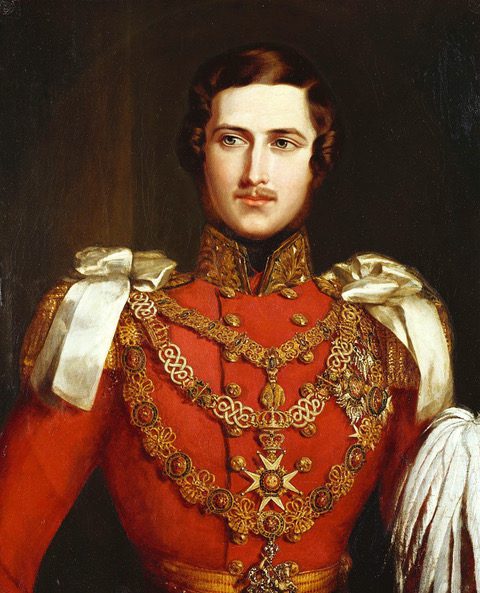
An 1840 portrait, by John Partridge, of Prince Albert of Saxe-Coburg and Gotha (26 August 1819 – 14 December 1861), the consort of Queen Victoria from their marriage on 10 February 1840 until his death in 1861.
(Wikimedia Commons public domain image)
***
During much of my life, especially during my earlier years, the so-called “great man” approach to history has been out of fashion. And there are good reasons for that. Overwhelmingly, for example, the deep, epochal, transformative changes of history — e.g., the domestication of the horse, the invention of movable type, the development of the stirrup, advancements in the technology of sails and shipbuilding, plagues, and the like — haven’t cared who was sitting on the throne. The fundamental characteristics of the “Elizabethan Age” were a long time in coming, very few of them actually had much to do with Queen Elizabeth I personally, and they didn’t suddenly cease to exist on 24 March 1603 when she died.
But I sometimes thought that, in the enthusiasm for the historiography of such figures as Fernand Braudel and such movements as the “Annales school,” scholars were overcorrecting. So I’m pleased that good biographies (e.g., 0f the American Founders, of Lincoln, and of Churchill) continue to be written and to be well received.
During our just-concluded tour, I repeatedly emphasized the unique confluence of impersonal factors (e.g., Gutenberg’s invention of the printing press and the flourishing of mass media that followed) with Luther’s personal gifts as a popular writer, a scholar, a composer of hymns, and a preacher, which greatly contributed to the vast success of the Lutheran Reformation. (Of course, one should also note the academic talents of Philipp Melanchthon and the artistic abilities of Lucas Cranach the Elder., and perhaps the political savvy of Frederick the Wise, the prince-elector of Saxony.)
Without Luther, a “Lutheran” Reformation might still have occurred. But maybe not, and certainly in much different form.
I also spent some time on the personal relationship of Richard Wagner with King Ludwig II of Bavaria. It may well have been much deeper on Ludwig’s side than on that of the constantly indebted (and supremely egotistical) Wagner but, without it, Neuschwanstein Castle might not have existed at all, the Linderhof and Herrenchiemsee castles would be very different, Wagner’s Festspielhaus in Bayreuth might never have been built, his “Ring Cycle” — Der Ring des Nibelungen, consisting of Das Rheingold (“The Rhinegold”), Die Walküre (“The Valkyrie”), Siegfried, and Götterdämmerung (“Twilight of the Gods”) — might not have been staged or even completed, and his Bühnenweihfestspiel (“Festival Play for the Consecration of the Stage”) Parsifal, his last major work, might not have been written.
And would the Third Reich ever have arisen without the talents for oratory and demagoguery and the demonic personality of Adolf Hitler?
But I’ve also been thinking, lately, of how the absence of certain people can affect history.
I recall reading, many years ago, about Gustav Stresemann, who served as chancellor of Germany in 1923 (for 102 days) and as German foreign minister from 1923 to 1929. He is best known for his work toward the reconciliation between Germany and France in the wake of the First World War, for which he and the French prime minister Aristide Briand received the 1926 Nobel Peace Prize. The Weimar Republic was a mess, political unstable and perpetually fragile, with short-lived governments (including his own as chancellor), but he was the most influential cabinet member during most of the Weimar period. He was especially devoted to making the war reparations imposed upon Germany by the punitive Treaty of Versailles less onerous; their oppressive burdensomeness, and Germany’s resentment of their harshness and perceived injustice, loomed large among the grievances out of which Nazism emerged. Unfortunately, Stresemann died suddenly, of a stroke, at the age of fifty-one. Some have wondered whether, had he lived, the rise of the Nazis might never have occurred. As the late Scottish-American diplomatic historian Gordon Craig is quoted by Wikipedia as saying,
No German statesman since Bismarck’s time had demonstrated, as brilliantly as he [Stresemann] was to do, the ability to sense danger and to avoid it by seizing and retaining the initiative, the gift of maintaining perspective and a sense of relative values in the midst of a changing diplomatic situation, and the talent for being more stubborn than his partners in negotiation and for refusing to allow their importunities to force him to accept second-best solutions.
Another of the examples that has come to my mind in recent days is Pope Adrian VI — Hadrian or Hadrianus — a Dutch-born reformist priest who came to the papal throne in January 1522 when the Lutheran Reformation was in its early stages, only to die in September 1523. (There would not be another non-Italian pope until the election of John Paul II in 1978.). Adrian was unwilling to compromise theologically with Martin Luther, but he acknowledged that the Roman Curia bore much of the responsibility for the Lutheran troubles and he sought to make appropriate changes. When he was succeeded by the Medici pope Clement VII, however, Adrian’s proposed reforms were largely buried with him.
And here’s yet another, which has been on my mind since our tour bus began to near Berlin: There were only three emperors or Kaisers who ruled from Berlin. The first of them, of course, was Kaiser Wilhelm I (1797-1888). He was succeeded by his only son, Kaiser Friedrich III. Frederick, to give him the English form of his name, hoped to move the Empire in the direction of greater democracy and greater participation of common citizens. He and his wife, the Kaiserin Victoria, daughter of the British Queen Victoria, hoped to rule jointly in a constitutional monarchy just as her mother and father, Queen Victoria and Prince Albert, had sought to do. Moreover, Frederick hated war, and he was loved by many for his humane nature. But by the time he inherited the German throne, he had been fatally stricken with cancer of the larynx, and he died at the age of fifty-six after a reign of only ninety-nine days — most of them bedridden and gravely ill. His son and successor, the militaristic Kaiser Wilhelm II, rejected essentially all of his proposed reforms and ultimately led Germany into the First World War. Wilhelm II was forced to abdicate in 1918.
My father, incidentally, always remembered a little jingle about Kaiser Wilhelm II that I can only imagine he had heard from an American veteran of World War One. I offer it here for its unparalleled historical importance:
Kaiser Bill went up the hill to take a look at France.
Kaiser Bill came down the hill with bullets in his pants.
I’ve mentioned Queen Victoria and her beloved German-born consort, Prince Albert. He’ll serve as my last example of what the absence of a great personality can mean: I need to write a longer entry about Albert sometime, but, as I’ve noted, he and Victoria were also working toward a shared constitutional monarchy. (She wanted him to bear the title of king, but Parliament refused to authorize it.) Unfortunately, he died at the age of just forty-two. The cause is generally given as typhoid fever, but it may rather have been a chronic illness such as Crohn’s disease, kidney failure, or abdominal cancer. In any event, Queen Victoria was so completely devastated by his death that she wore black for the remainder of her long life and effectively withdrew from many public duties — thus dooming the dream that she and Albert once shared of an active constitutional monarchy. Today’s Queen Elizabeth is essentially a figurehead. Beloved, of course, but merely a figurehead with no real political power.
Posted from Munich, Bavaria, Germany
Previous Post

June 21, 2022
It's not true that all good things come to an end. But this one has.
Next Post
June 22, 2022 Maybe it improved after this?
Browse Our Archives
Select a Category Uncategorized
Select a Month October 2026 September 2026 August 2026 July 2026 June 2026 May 2026 April 2026 March 2026 February 2026 January 2026 December 2025 November 2025 October 2025 September 2025 August 2025 July 2025 June 2025 May 2025 April 2025 March 2025 February 2025 January 2025 December 2024 November 2024 October 2024 September 2024 August 2024 July 2024 June 2024 May 2024 April 2024 March 2024 February 2024 January 2024 December 2023 November 2023 October 2023 September 2023 August 2023 July 2023 June 2023 May 2023 April 2023 March 2023 February 2023 January 2023 December 2022 November 2022 October 2022 September 2022 August 2022 July 2022 June 2022 May 2022 April 2022 March 2022 February 2022 January 2022 December 2021 November 2021 October 2021 September 2021 August 2021 July 2021 June 2021 May 2021 April 2021 March 2021 February 2021 January 2021 December 2020 November 2020 October 2020 September 2020 August 2020 July 2020 June 2020 May 2020 April 2020 March 2020 February 2020 January 2020 December 2019 November 2019 October 2019 September 2019 August 2019 July 2019 June 2019 May 2019 April 2019 March 2019 February 2019 January 2019 December 2018 November 2018 October 2018 September 2018 August 2018 July 2018 June 2018 May 2018 April 2018 March 2018 February 2018 January 2018 December 2017 November 2017 October 2017 September 2017 August 2017 July 2017 June 2017 May 2017 April 2017 March 2017 February 2017 January 2017 December 2016 November 2016 October 2016 September 2016 August 2016 July 2016 June 2016 May 2016 April 2016 March 2016 February 2016 January 2016 December 2015 November 2015 October 2015 September 2015 August 2015 July 2015 June 2015 May 2015 April 2015 March 2015 February 2015 January 2015 December 2014 November 2014 March 2014 August 2013 February 2012
Follow Us!
TAKE THE
Religious Wisdom Quiz
What animal is commonly associated with Jesus?
Select your answer to see how you score.
Fish Donkey Lion Lamb
Related posts from Sic et Non



“Once more unto the breach, dear friends, once...

TRENDING AT PATHEOS Latter-day Saint

The First Eucharistic Controversy: Christ’s Real Presence
For Catholics, the Eucharist is the source and summit of the Christian...

What a Stop Sign Can Teach Us About...
How to Make a Decision When You Can't Hear God Main point:...

Archdiocese Hosts Military Marriage Retreat in Germany
RASTATT, Germany — The transient military lifestyle, with its frequent deployments and...

Nearly every morning, I make the drive to Detroit with my high-school-age...

The Real AI Story Is Adoption Without Trust
Artificial intelligence has crossed a political threshold. It is no longer a...

A new article, written by Jeff Lindsay and Gale L. Pooley,...
view all Latter-day Saint blogs
Ad-Free & Subscriber Log-In Subscription Support
- About Us
- 2026 Calendar
- Videos
- Podcasts
- Library of World Religions
- Faith In Media Tracker
- Advertise With Us
- Write for Us
- Privacy Policy
- Terms of Service
- Do Not Sell My Data
- Contact Us
- Radiant Digital
- Manage Newsletter Subscriptions
- Unsubscribe From Notifications
- Sitemap
Copyright 2008-2026, Patheos. All rights reserved.
Subscription Support Ad-Free & Subscriber Log-In
Follow Patheos