
BuddhistCatholicContemplativeEvangelicalGeneral ChristianHinduJewishLatter-day SaintMuslimNew VisionsProgressive Christian
Beliefs
- Buddhist
- Catholic
- Contemplative
- Evangelical
- General Christian
- Hindu
- Jewish
- Latter-day Saint
- More Voices
- Muslim
- New Visions
- Pagan
- Progressive Christian
Topics
- Religion News
- Food and Religion
- Sports and Religion
- Religious Art
- Religious Music and Entertainment
- Religious Events
- History and Religion
- Style and Religion
- Politics and Religion
- Women in Religion
- Recreation Outdoors and Religion
- Business Finance and Religion
- Careers Workplace and Religion
- Education and Religion
- Family Parenting and Religion
- Health Fitness and Religion
- Home and Religion
- Relationships and Religion
- Technology and Religion
- Travel and Religion
Columnists
- Buddhist Columnists
- Business Finance and Religion Columnists
- Careers Workplace and Religion Columnists
- Catholic Columnists
- Contemplative Columnists
- Education and Religion Columnists
- Evangelists Columnists
- Family Parenting and Religion Columnists
- General Christian Columnists
- Health Fitness and Religion Columnists
- Hindu Columnists
- History and Religion Columnists
- Home and Religion Columnists
- Jewish Columnists
- More Voices Columnists
- Latter Day Columnists
- Muslim Columnists
- New Visions Columnists
- Nonreligious Columnists
- Pagan Columnists
- Politics and Religion Columnists
- Progressive Columnists
- Recreation Outdoors and Religion Columnists
- Relationships and Religion Columnists
- Religion News Columnists
- Religious Art Columnists
- Religious Events Columnists
- Religious Music and Entertainment Columnists
- Sports and Religion Columnists
- Style and Religion Columnists
- Technology and Religion Columnists
- Travel and Religion Columnists
- Women in Religion Columnists
Resource Library
- 2026 Calendar
- Library of World Religions
- The 100 Most Holy Places on Earth
- Patheos Answers
- Podcasts
- Videos
- Faith Leaders Database
- Anglican Episcopalian
- Bahai
- Baptist
- Buddhism
- Christianity
- Confucianism
- Eastern Orthodoxy
- Hinduism
- Holiness and Pentecostal
- ISKCON
- Islam
- Judaism
- Lutheran
- Methodist
- The Church of Jesus Christ of Latter-day Saints
- New Age
- Paganism
- Presbytarian and Reformed
- Protestantism
- Religion Behind the Scenes
- Roman Catholic
- Scientology
- Shia Islam
- Sikhism
- Sufism
- Sunni Islam
- Taoism
- Zen
- See all religions
Research Tools
 Ad-Free & Subscriber Log-In Subscription Support
Ad-Free & Subscriber Log-In Subscription Support
Follow Patheos 

- Trending:
- Forgiveness
- |
- Marriage
- |
- Consciousness
- |
- Death Penalty
- |
- Election
- |
- Halloween

- Home
- Latter-day Saint
- Paying our respects to St. André and St. Émilion and to other Saints
Paying our respects to St. André and St. Émilion and to other Saints
Last updated on: June 4, 2022 at 4:31 pm by Dan Peterson
Paying our respects to St. André and St. Émilion and to other Saints 2022-06-04T16:31:38-06:00 Dan Peterson
Patheos Explore the world's faith through different perspectives on religion and spirituality! Patheos has the views of the prevalent religions and spiritualities of the world.
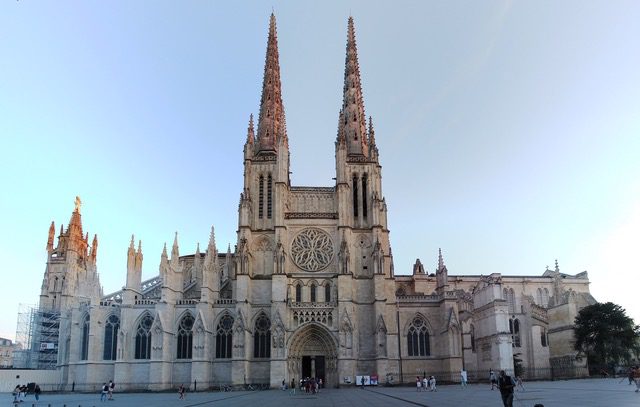
The north side of the Primatial Cathedral of St. Andrew of Bourdeaux. Please note, to the left, the cathedral’s free-standing bell tower with its surmounting gold statue.
(Wikimedia Commons public domain photograph)
***
We spent yesterday morning with friends looking around the Cathedral of Bordeaux — or, more precisely, the Cathédrale-Primatiale Saint-André de Bordeaux. Dedicated to St. Andrew the apostle, recognized by UNESCO for its importance and important position along one of the French pilgrimage routes to the shrine of Santiago de Compostela, and the seat of the archbishop of Bordeaux, the church, or anyway a forerunner, was first mentioned (so far as anybody today knows) in a document from the early ninth century. In 1096, it was formally consecrated by the French-born Pope Urban II, the very same pope who, in that very same year, launched the Crusades.
This is the cathedral in which Eleanor of Aquitaine (playing herself, not waiting to be portrayed by either Katharine Hepburn or Glenn Close) married Louis VII of France, some years before she went on to marry Henry II of England and to bear him, among others, Richard I (aka “Richard Cœur de Lion” or “Richard the Lionheart”) and John (Robin Hood’s evil Prince John, who later, as King John of England, was obliged by his unhappy barons to sign the Magna Carta at Runnymede, near Windsor).
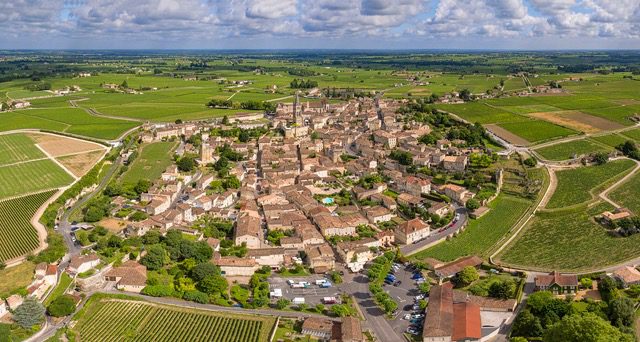
An aerial view of Saint-Émilion, a commune in the Gironde department of Nouvelle-Aquitaine in southwestern France. It has a population of perhaps just slightly less than two thousand.
(Wikimedia Commons public domain image)
In the afternoon, my wife and I joined a tour out to the small wine-producing village of Saint-Émilion, which is a roughly forty-five- or fifty-minute drive from downtown Bordeaux when the traffic is good. I wasn’t expecting anything. I hadn’t read a line about Saint-Émilion. But I was very pleasantly surprised.
First of all, the village is very pretty and quaint. Its varied elevations and overlooks and its narrow cobblestone streets are good enough for a Disney movie. And, although I’m a tee-totaling, fun-denying, faithfully observant follower of the Word of Wisdom, the beautiful vineyards that surround the town are the very quintessence of (my image of) French wine country. (Couldn’t they just repurpose them for the production of cheaper, more abundant red grape juice? I love red grape juice.)
What I found most interesting was the religious history of the village, which is named after a Breton monk called Émilion who settled in a hermitage carved into the rock there in the middle of the eighth century. Probably already by the time of his death in AD 767, other monks had begun to join him — so much for being a hermit! (rather like the original hermit, St. Anthony, in the eastern desert of Egypt) — and a community of them continued thereafter. In fact, since Saint-Émilion is located on the route of the Camino de Santiago (yes, that again), many monasteries and churches were built in it during the Middle Ages.
We visited the town’s parish church — visible in the photograph above — which is at least partially Romanesque, and thus probably dates to 1200 AD or before. But what was really astounding to me, partially because I didn’t expect it at all, was the village’s ancient monolithic or rock-hewn church which was carved into the side of the hill on which Saint-Émilion sits, out of a single block of stone. It is very large. Almost as large, I would estimate, as the parish church, which is not small. It was probably once rather brightly painted, but today only some faint outlines of saints and the Virgin and Christ himself are still visible if one looks very carefully.
Adjacent to the monolithic church is a multi-story catacomb, of which we visited only one level, the highest. The most striking feature of the catacomb, in my judgment, is a kind of tunnel in the ceiling that goes upward to the light. Speculation is that this was thought to symbolize the portal through which the souls of the deceased would travel toward heaven and into the next life. I wonder whether they had any notion of the tunnel that has been reported by so many near-death experiencers. Certainly such “tunnels” seem to have been known long before modern writers about NDEs began to discuss them. Hieronymus Bosch, for example, seems pretty clearly to have been aware of the concept in the early sixteenth century”
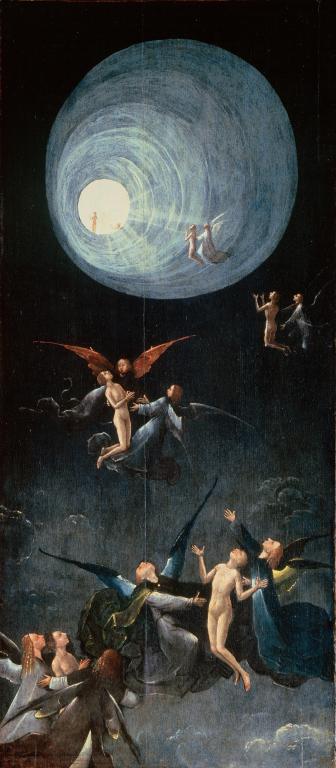
Hieronymus Bosch (d. 1516), “Ascent of the Blest”
(Wikimedia Commons public domain)
Also adjacent to the monolithic church is the cell in which St. Émilion appears to have lived during his sojourn in the middle of the 700s AD. The woman who took us through the area called our attention to the baptismal font that it contained. She noted that there were stairs leading down into the font, which still to this day contains some water. Referring to the stairs, she explained that the saint, and others of his day, baptized the whole body of the new Christian convert by immersion. Not, she said, merely by sprinkling. That is a very weird concept, don’t you agree?
***
This essay offers some food for thought (I think):
***
Over dinner tonight, the conversation turned to people we’ve known who weren’t particularly sophisticated, or who had a difficult time with the Word of Wisdom or whatever, but who were reliably on the scene when service was called for — and how much we’ve come to admire such people and to hope the best for them.
I had one man particularly in mind. He sometimes worked for the construction company that my not-yet converted father and my never-a-member uncle founded and owned, and he was an adult convert to the Church of Jesus Christ of Latter-day Saints. (I expect that he’s been gone for decades, but I won’t name him because I don’t want to risk embarrassing his family.) He wasn’t a well-educated man. His grammar was poor, and I’ve sometimes joked, in recalling him to my wife and kids, that he had no idea at all where to locate 2 Nephi in the Old Testament. But even as a rather oblivious early teen, I noticed that he was the first to arrive at service projects and the last to leave, and that he was at every single such project in which I ever participated — and quite a few others besides. If there was a widow’s house to be fixed, he was there. Sometimes I was, too, but I had little to offer. I realized then that, while he was far from cultivated or urbane, and while I aspired in those days to be at least somewhat more cultivated and urbane than I was, he was worth minimally two of me. I was convinced then, and I’m convinced now, that he will occupy a wonderful place in the celestial kingdom. Me, though? Well, I can hope.
I was reminded of a quotation from the great Rabbi Abraham Joshua Heschel: “When I was young,” he once commented, “I admired clever people. Now that I am old, I admire kind people.”
Posted from the Atlantic Ocean, bound for Southampton, England
Cathédrale-Primatiale Saint-André de Bordeaux
Primatial Cathedral of St. Andrew of Bourdeaux
Previous Post

June 3, 2022
"The Queer Philosophies of Men Mingled with Scripture," and Other Matters
Next Post
June 5, 2022 From "England's green and pleasant land"
Browse Our Archives
Select a Category Uncategorized
Select a Month October 2026 September 2026 August 2026 July 2026 June 2026 May 2026 April 2026 March 2026 February 2026 January 2026 December 2025 November 2025 October 2025 September 2025 August 2025 July 2025 June 2025 May 2025 April 2025 March 2025 February 2025 January 2025 December 2024 November 2024 October 2024 September 2024 August 2024 July 2024 June 2024 May 2024 April 2024 March 2024 February 2024 January 2024 December 2023 November 2023 October 2023 September 2023 August 2023 July 2023 June 2023 May 2023 April 2023 March 2023 February 2023 January 2023 December 2022 November 2022 October 2022 September 2022 August 2022 July 2022 June 2022 May 2022 April 2022 March 2022 February 2022 January 2022 December 2021 November 2021 October 2021 September 2021 August 2021 July 2021 June 2021 May 2021 April 2021 March 2021 February 2021 January 2021 December 2020 November 2020 October 2020 September 2020 August 2020 July 2020 June 2020 May 2020 April 2020 March 2020 February 2020 January 2020 December 2019 November 2019 October 2019 September 2019 August 2019 July 2019 June 2019 May 2019 April 2019 March 2019 February 2019 January 2019 December 2018 November 2018 October 2018 September 2018 August 2018 July 2018 June 2018 May 2018 April 2018 March 2018 February 2018 January 2018 December 2017 November 2017 October 2017 September 2017 August 2017 July 2017 June 2017 May 2017 April 2017 March 2017 February 2017 January 2017 December 2016 November 2016 October 2016 September 2016 August 2016 July 2016 June 2016 May 2016 April 2016 March 2016 February 2016 January 2016 December 2015 November 2015 October 2015 September 2015 August 2015 July 2015 June 2015 May 2015 April 2015 March 2015 February 2015 January 2015 December 2014 November 2014 March 2014 August 2013 February 2012
Follow Us!
TAKE THE
Religious Wisdom Quiz
Which is the only book that does not mention "God"?
Select your answer to see how you score.
Lamentations Song of Solomon Esther Ezra
Related posts from Sic et Non




Comments from two near-death experiencers
TRENDING AT PATHEOS Latter-day Saint

Janie Learns the Way of the Cross: A...
Teaching children about Jesus' Passion can be challenging. Many parents and educators...

Looking For Good Catholic Writing - October 2026
He alone extends the heavens, and he walks upon the waves of...

In "Irreplaceable," our book on vocation and technology, Trevor Sutton and I...

I was strolling through the top floor of the brand new Parthenon...

What Does Gêvâh Mean For Kimberley Guifoyle &...
This week, a lot of the news is focused on Kimberly Guilfoyle....

INNER CIRCLE: Profound Mystery (Of Christ In All...
Ephesians 5:31-32 “For this reason, a man will leave his father and...
view all Latter-day Saint blogs
Ad-Free & Subscriber Log-In Subscription Support
- About Us
- 2026 Calendar
- Videos
- Podcasts
- Library of World Religions
- Faith In Media Tracker
- Advertise With Us
- Write for Us
- Privacy Policy
- Terms of Service
- Do Not Sell My Data
- Contact Us
- Radiant Digital
- Manage Newsletter Subscriptions
- Unsubscribe From Notifications
- Sitemap
Copyright 2008-2026, Patheos. All rights reserved.
Subscription Support Ad-Free & Subscriber Log-In
Follow Patheos