
BuddhistCatholicContemplativeEvangelicalGeneral ChristianHinduJewishLatter-day SaintMuslimNew VisionsProgressive Christian
Beliefs
- Buddhist
- Catholic
- Contemplative
- Evangelical
- General Christian
- Hindu
- Jewish
- Latter-day Saint
- More Voices
- Muslim
- New Visions
- Pagan
- Progressive Christian
Topics
- Religion News
- Food and Religion
- Sports and Religion
- Religious Art
- Religious Music and Entertainment
- Religious Events
- History and Religion
- Style and Religion
- Politics and Religion
- Women in Religion
- Recreation Outdoors and Religion
- Business Finance and Religion
- Careers Workplace and Religion
- Education and Religion
- Family Parenting and Religion
- Health Fitness and Religion
- Home and Religion
- Relationships and Religion
- Technology and Religion
- Travel and Religion
Columnists
- Buddhist Columnists
- Business Finance and Religion Columnists
- Careers Workplace and Religion Columnists
- Catholic Columnists
- Contemplative Columnists
- Education and Religion Columnists
- Evangelists Columnists
- Family Parenting and Religion Columnists
- General Christian Columnists
- Health Fitness and Religion Columnists
- Hindu Columnists
- History and Religion Columnists
- Home and Religion Columnists
- Jewish Columnists
- More Voices Columnists
- Latter Day Columnists
- Muslim Columnists
- New Visions Columnists
- Nonreligious Columnists
- Pagan Columnists
- Politics and Religion Columnists
- Progressive Columnists
- Recreation Outdoors and Religion Columnists
- Relationships and Religion Columnists
- Religion News Columnists
- Religious Art Columnists
- Religious Events Columnists
- Religious Music and Entertainment Columnists
- Sports and Religion Columnists
- Style and Religion Columnists
- Technology and Religion Columnists
- Travel and Religion Columnists
- Women in Religion Columnists
Resource Library
- 2026 Calendar
- Library of World Religions
- The 100 Most Holy Places on Earth
- Patheos Answers
- Podcasts
- Videos
- Faith Leaders Database
- Anglican Episcopalian
- Bahai
- Baptist
- Buddhism
- Christianity
- Confucianism
- Eastern Orthodoxy
- Hinduism
- Holiness and Pentecostal
- ISKCON
- Islam
- Judaism
- Lutheran
- Methodist
- The Church of Jesus Christ of Latter-day Saints
- New Age
- Paganism
- Presbytarian and Reformed
- Protestantism
- Religion Behind the Scenes
- Roman Catholic
- Scientology
- Shia Islam
- Sikhism
- Sufism
- Sunni Islam
- Taoism
- Zen
- See all religions
Research Tools
 Ad-Free & Subscriber Log-In Subscription Support
Ad-Free & Subscriber Log-In Subscription Support
Follow Patheos 

- Trending:
- Forgiveness
- |
- Marriage
- |
- Consciousness
- |
- Death Penalty
- |
- Election
- |
- Halloween

- Home
- Latter-day Saint
- In the footsteps of Martin Luther
In the footsteps of Martin Luther
Last updated on: June 23, 2022 at 2:02 am by Dan Peterson
In the footsteps of Martin Luther 2022-06-23T02:02:29-06:00 Dan Peterson
Patheos Explore the world's faith through different perspectives on religion and spirituality! Patheos has the views of the prevalent religions and spiritualities of the world.
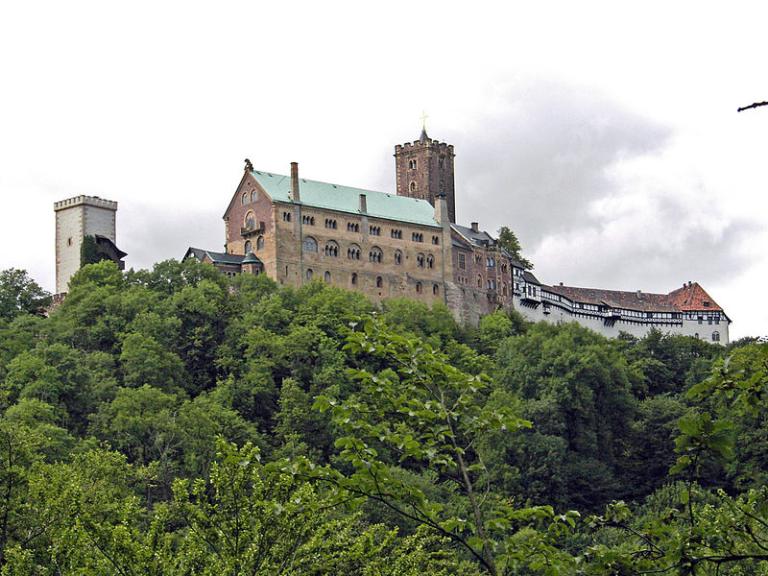
The Wartburg. (Wikimedia Commons public domain photograph)
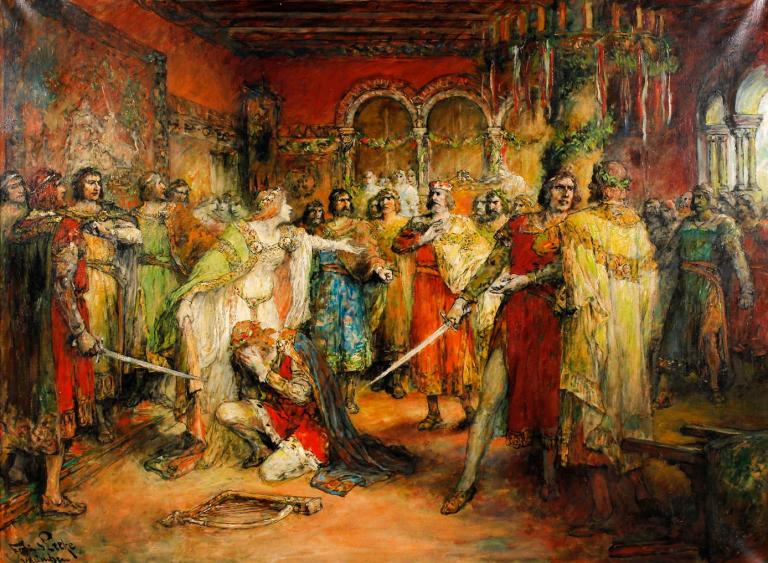
Ferdinand Leeke, “Tannhäuser und der Sängerkrieg auf der Wartburg” (“Tannhäuser and the Battle of the Troubadours on the Wartburg”; ca. 1920)
Wikimedia Commons public domain image
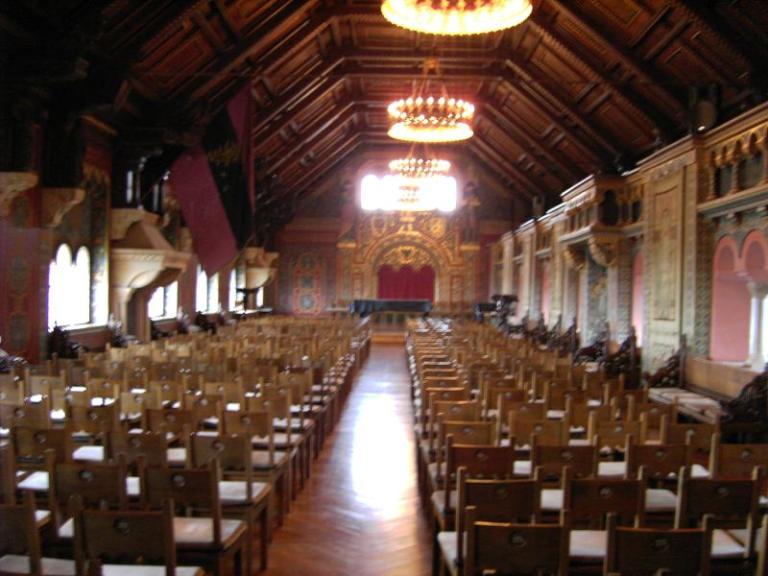
The Festsaal or Festival Hall in the Wartburg, redesigned by Franz Liszt in the 19th century, where concerts are often given — including, appropriately, performances of Wagner’s opera “Tannhäuser” — which is partially set in this very hall
(Wikimedia Commons public domain image)
***
Before leaving for the Wartburg yesterday, we did a guided walking tour within the walls of Rothenburg ob der Tauber. It’s a quaint and picturesque little city, the very image of a late medieval German town. (Or even of a French one. I can easily imagine the story of Beauty and the Beast being filmed in Rothenburg o.d.T.) We had visited it only once before, so this brief repeated stay and the excellent local guide who took our group around really helped us to learn more about the place.
The drive from Rothenburg to the Wartburg and on to Lutherstadt Wittenberg was a long one, so, naturally, being precisely the monster of sadistic cruelty that my most keen-eyed online critics intuitively know me to be, I sought to make it yet longer and even more miserable for the hapless members of our tour group. I accomplished my fiendish design by discoursing on the bus about Martin Luther, the Reformation, and, yes, the Wartburg. After all, they had no real means of escape.
The Wartburg is an eleventh-century fortress looking down upon the town of Eisenach, where, eventually, Martin Luther would attend school and where, even later, Johann Sebastian Bach would be born. For several years before her death in 1231 at age twenty-four, St. Elizabeth of Hungary (or St. Elizabeth of Thuringia) lived in the fortress. Already by her time, though, the Wartburg had been the scene of the famous Sängerkrieg (“minstrel contest,” also known as the Wartburgkrieg), in 1207. If this competition really occurred at all, which it may not have, it involved such famous genuine medieval Minnesänger as Walther von der Vogelweide and Wolfram von Eschenbach (the author of Parzifal) and the at least semi-fictional magician Klingsor of Hungary and the semi-fictional poet Heinrich von Ofterdingen. Later, it features prominently in a number of important literary works, and in Richard Wagner’s music-drama or opera Tannhäuser. (Listen here to the majestic “Pilgrims’ Chorus” from Wagner’s opera.)
In 1817, the Wartburg was the site of an important meeting that reflected some of the earliest stirrings of German nationalism and that, though unsuccessful in its own time, marked a milestone on the road to the unification of Germany.
But the fortress is most famous as the place where Martin Luther, proclaimed an outlaw by Emperor Charles V, was hidden for the better part of a year (1521-1522) after a feigned kidnapping on the road back from Wurms to Wittenberg, and where, in a remarkable ten or eleven weeks, he translated the New Testament into German. Thereby, he essentially created Hochdeutsch (the “High German” language) and revolutionized the religious landscape of Europe.
I was really pleased for our group to see the Wartburg and to learn something of its remarkable history. It has even been suggested that his time living as a boy in the shadow of the Wartburg and his months living as an adult in the Wartburg under the assumed name of Junker Jörg (“Squire George”) influenced the formulation of Luther’s most famous hymn, “A Mighty Fortress is Our God” (“Ein feste Burg ist unser Gott”). I’m sympathetic to the suggestion.
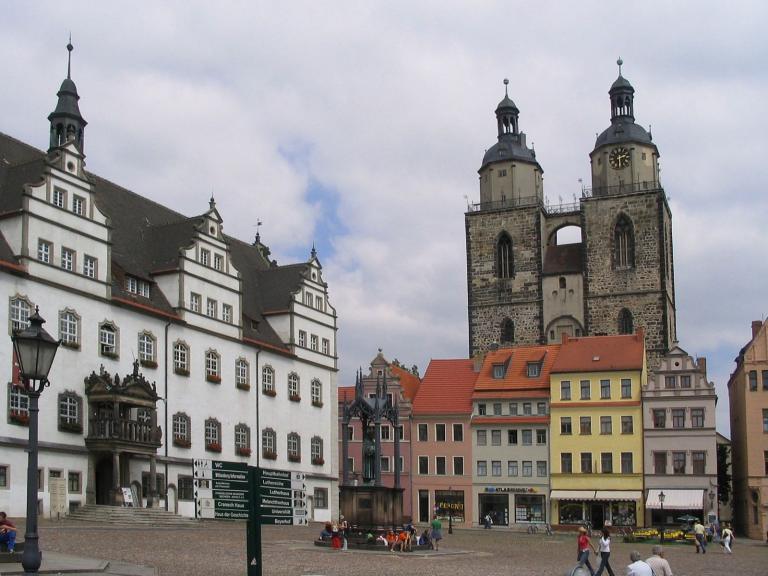
Marktplatz, or Market Square, in Wittenberg. In the background are the two towers of the Stadtkirche, also known as the St. Marienkirche, which is considered “the mother church of the Reformation.” Martin Luther preached in it perhaps two thousand times, and it was the first place where the mass was said in the vernacular language (German, specifically) and where both wafer and wine were administered to the laity.
(Wikimedia Commons public domain image)
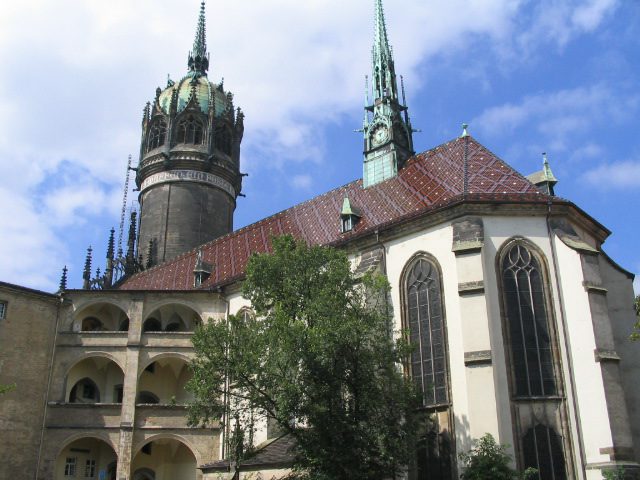
The Schlosskirche (All Saints’ Church or “Castle Church”) in Wittenberg
(Wikimedia Commons public domain image)
From the Wartburg, we drove on to Lutherstadt Wittenberg. That’s its official name now: Luther City Wittenberg. I’ve wanted to bring a group to Wittenberg ever since I first visited it about seven or eight years ago. In fact, I published an article about the town in the Deseret News, back on 13 June 2015:
“A small German town with a vast history”
We arrived in Wittenberg fairly late in the evening. This morning, though, a good local guide joined us for a walking tour of the Altstadt or “Old City.” And, this time, I was pleased to be able to go inside the Schloßkirche or “Castle Church” where Martin Luther and Philipp Melanchthon and Friedrich, the Elector of Saxony and Luther’s protector, are buried. The church had been closed for renovations during our prior visit to Wittenberg, because the five hundredth anniversary of the Lutheran Reformation was approaching. And what event was chosen to mark the beginning of Luther’s Reformation? It was Luther’s nailing of his famous “Ninety-Five Theses” to the door of precisely this “Castle Church,” on 31 October 1517. After our walking tour had concluded, and after lunch, some of us spent most of our time in Luther’s house, the former Augustinian cloister of Wittenberg, which is now an excellent museum of Luther and the Reformation.
A word about our hotel: To my very great pleasure, our group stayed in the same hotel where my wife and I had lodged during our first visit. I had been disappointed, on that occasion, when I learned that we were going to be staying in the Best Western there. But my attitude changed instantly when I grasped where it was, directly next door to Luther’s house, within just a few feet of Melanchthon’s house, and not more than several blocks of level walking from all of the other major Reformation sites in Wittenberg. Location, location, location! Absolutely fabulous. And I was pleased today to find that my memory was correct about one site that, curiously, our walking tour didn’t cover: A few hundred yards from our hotel, in the opposite direction from the former university and the Schloßkirche and almost all of the other sites, is a small park marking the place where, in 1520, Luther burned Pope Leo X’s bull of excommunication. I led a small subset of our group to it, and was relieved to find that my memory hadn’t led me (and them) astray. Later, as our bus drove out of the town, we passed by the little park and I was able to point it out to the others.
Posted from Berlin, Germany
Previous Post

June 19, 2022
He's a very quotable fellow
Next Post
June 21, 2022 It's not true that all good things come to an end. But this one has.
Browse Our Archives
Select a Category Uncategorized
Select a Month October 2026 September 2026 August 2026 July 2026 June 2026 May 2026 April 2026 March 2026 February 2026 January 2026 December 2025 November 2025 October 2025 September 2025 August 2025 July 2025 June 2025 May 2025 April 2025 March 2025 February 2025 January 2025 December 2024 November 2024 October 2024 September 2024 August 2024 July 2024 June 2024 May 2024 April 2024 March 2024 February 2024 January 2024 December 2023 November 2023 October 2023 September 2023 August 2023 July 2023 June 2023 May 2023 April 2023 March 2023 February 2023 January 2023 December 2022 November 2022 October 2022 September 2022 August 2022 July 2022 June 2022 May 2022 April 2022 March 2022 February 2022 January 2022 December 2021 November 2021 October 2021 September 2021 August 2021 July 2021 June 2021 May 2021 April 2021 March 2021 February 2021 January 2021 December 2020 November 2020 October 2020 September 2020 August 2020 July 2020 June 2020 May 2020 April 2020 March 2020 February 2020 January 2020 December 2019 November 2019 October 2019 September 2019 August 2019 July 2019 June 2019 May 2019 April 2019 March 2019 February 2019 January 2019 December 2018 November 2018 October 2018 September 2018 August 2018 July 2018 June 2018 May 2018 April 2018 March 2018 February 2018 January 2018 December 2017 November 2017 October 2017 September 2017 August 2017 July 2017 June 2017 May 2017 April 2017 March 2017 February 2017 January 2017 December 2016 November 2016 October 2016 September 2016 August 2016 July 2016 June 2016 May 2016 April 2016 March 2016 February 2016 January 2016 December 2015 November 2015 October 2015 September 2015 August 2015 July 2015 June 2015 May 2015 April 2015 March 2015 February 2015 January 2015 December 2014 November 2014 March 2014 August 2013 February 2012
Follow Us!
TAKE THE
Religious Wisdom Quiz
What did Moses do after breaking the tablets?
Select your answer to see how you score.
Left the camp Fasted for 30 days Returned to Sinai for new tablets Destroyed the calf
Related posts from Sic et Non

"A Fulfilled Prophecy of Joseph F. Smith," and...
Thomas Müntzer -- strange, sinister, and curiously akin
Martin Luther, on "people to whom Christ is...
TRENDING AT PATHEOS Latter-day Saint

How to Make a Decision When You Can't...
Main point: It’s much more valuable to stay close to God so...

Archdiocese Hosts Military Marriage Retreat in Germany
RASTATT, Germany — The transient military lifestyle, with its frequent deployments and...

Nearly every morning, I make the drive to Detroit with my high-school-age...

The Real AI Story Is Adoption Without Trust
Artificial intelligence has crossed a political threshold. It is no longer a...

A new article, written by Jeff Lindsay and Gale L. Pooley,...

Swimfan: Forgotten Aughts Pleasures
This is a recovery effort. In 2002, My Big Fat Greek Wedding...
view all Latter-day Saint blogs
Ad-Free & Subscriber Log-In Subscription Support
- About Us
- 2026 Calendar
- Videos
- Podcasts
- Library of World Religions
- Faith In Media Tracker
- Advertise With Us
- Write for Us
- Privacy Policy
- Terms of Service
- Do Not Sell My Data
- Contact Us
- Radiant Digital
- Manage Newsletter Subscriptions
- Unsubscribe From Notifications
- Sitemap
Copyright 2008-2026, Patheos. All rights reserved.
Subscription Support Ad-Free & Subscriber Log-In
Follow Patheos