
BuddhistCatholicContemplativeEvangelicalGeneral ChristianHinduJewishLatter-day SaintMuslimNew VisionsProgressive Christian
Beliefs
- Buddhist
- Catholic
- Contemplative
- Evangelical
- General Christian
- Hindu
- Jewish
- Latter-day Saint
- More Voices
- Muslim
- New Visions
- Pagan
- Progressive Christian
Topics
- Religion News
- Food and Religion
- Sports and Religion
- Religious Art
- Religious Music and Entertainment
- Religious Events
- History and Religion
- Style and Religion
- Politics and Religion
- Women in Religion
- Recreation Outdoors and Religion
- Business Finance and Religion
- Careers Workplace and Religion
- Education and Religion
- Family Parenting and Religion
- Health Fitness and Religion
- Home and Religion
- Relationships and Religion
- Technology and Religion
- Travel and Religion
Columnists
- Buddhist Columnists
- Business Finance and Religion Columnists
- Careers Workplace and Religion Columnists
- Catholic Columnists
- Contemplative Columnists
- Education and Religion Columnists
- Evangelists Columnists
- Family Parenting and Religion Columnists
- General Christian Columnists
- Health Fitness and Religion Columnists
- Hindu Columnists
- History and Religion Columnists
- Home and Religion Columnists
- Jewish Columnists
- More Voices Columnists
- Latter Day Columnists
- Muslim Columnists
- New Visions Columnists
- Nonreligious Columnists
- Pagan Columnists
- Politics and Religion Columnists
- Progressive Columnists
- Recreation Outdoors and Religion Columnists
- Relationships and Religion Columnists
- Religion News Columnists
- Religious Art Columnists
- Religious Events Columnists
- Religious Music and Entertainment Columnists
- Sports and Religion Columnists
- Style and Religion Columnists
- Technology and Religion Columnists
- Travel and Religion Columnists
- Women in Religion Columnists
Resource Library
- 2026 Calendar
- Library of World Religions
- The 100 Most Holy Places on Earth
- Patheos Answers
- Podcasts
- Videos
- Faith Leaders Database
- Anglican Episcopalian
- Bahai
- Baptist
- Buddhism
- Christianity
- Confucianism
- Eastern Orthodoxy
- Hinduism
- Holiness and Pentecostal
- ISKCON
- Islam
- Judaism
- Lutheran
- Methodist
- The Church of Jesus Christ of Latter-day Saints
- New Age
- Paganism
- Presbytarian and Reformed
- Protestantism
- Religion Behind the Scenes
- Roman Catholic
- Scientology
- Shia Islam
- Sikhism
- Sufism
- Sunni Islam
- Taoism
- Zen
- See all religions
Research Tools
 Ad-Free & Subscriber Log-In Subscription Support
Ad-Free & Subscriber Log-In Subscription Support
Follow Patheos 

- Trending:
- Forgiveness
- |
- Marriage
- |
- Consciousness
- |
- Death Penalty
- |
- Election
- |
- Halloween

- Home
- Latter-day Saint
- The Earliest Text of the Book of Mormon
The Earliest Text of the Book of Mormon
Last updated on: May 13, 2022 at 8:58 pm by Dan Peterson
The Earliest Text of the Book of Mormon 2022-05-13T20:58:11-06:00 Dan Peterson
Patheos Explore the world's faith through different perspectives on religion and spirituality! Patheos has the views of the prevalent religions and spiritualities of the world.
***
But briefly, first, please have a look at this article from today’s Meridian Magazine:
***
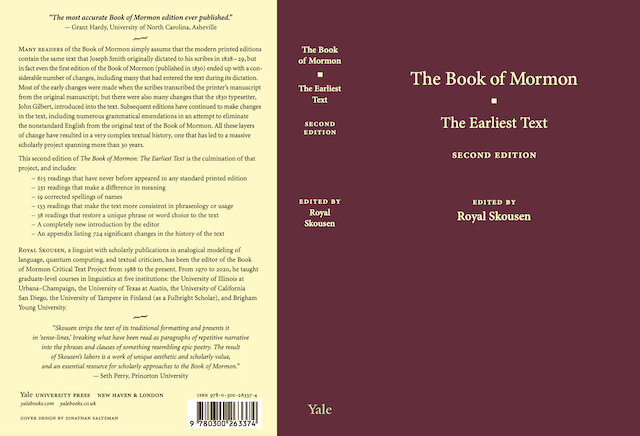
I’m pleased to mention here that tomorrow, 10 May 2022, is the date for which Yale University Press has scheduled the release of the second edition of The Book of Mormon: The Earliest Text. Edited by my longtime friend and colleague Royal Skousen, the new book will appear as a trade paperback.
After five printings of the hardback edition (from 2009 up through 2020) — a record of success, by the way, that I’m told may have caught Yale somewhat by surprise (academic presses have relatively little experience with high sales figures) — YUP has decided to issue this durable softbound edition, which has a somewhat smaller format (6 × 9 × 1 inches) than the first hardbound edition’s 7½ × 9½ × 2 inches.
The image above shows the entire cover – front, back, and spine – for the new edition.
There are several features of this new version of The Earliest Text, most but by no means all of them continued from the landmark first edition, that I want to mention here:
For one thing, opaque paper has been specially selected to help the reader see a clean page of text, without interference from the printing on the reverse side of the page. And yet, remarkably, the physical thickness of the book has been reduced by one half. Its reduced dimensions will make it very handy for travel and for taking to church.
The format continues to use the sense-lines of the first edition. Instead of breaking the text up into two columns of verses (as the current official LDS text does) or in a paragraph system (like the first edition in 1830), this format makes it so that each line of text ends naturally, where the text breaks, at the end of a phrase or clause. This is the only format that allows the reader to recover a sense of how Joseph Smith dictated the original text to his scribes in 1828-29: it would have been in sense-lines. And it makes the Yale editions exceptionally readable.
The actual scriptural text in this new edition remains the same as in the first Yale edition, in accord with the evidence of the earliest text from the two manuscripts and the 1830 edition, and occasionally from the two subsequent editions in 1837 and 1840. When compared against the most recent printing of the hardbound Yale edition (the fifth printing, dating from 2020), there are only a few relatively minor changes in punctuation, capitalization, and sense-line breaks. A comparison to the official Latter-day Saint edition will provide quite a few interesting surprises — although none of them affect fundamental doctrines in any way and, certainly, none of them cast doubt upon the inspired authenticity of the Book of Mormon. (Quite the contrary, in fact!)
The appendix now contains 724 textual variants, five more than appeared in the appendix to the first edition. One interesting improvement is that the title page now begins with a significant change in the punctuation and a shift in the sense-lines, so that we now read that the Book of Mormon is “an account written by the hand of Mormon upon plates” and that this account was “taken from the plates of Nephi”.
The most striking difference in the new edition, besides its sturdy softbound cover and a somewhat smaller format, is that the new edition has a completely new introduction, written by the editor, Royal Skousen, specifically for this second edition. In this introduction, Skousen explains how the Yale edition derives from the Critical Text Project of the Book of Mormon, which Skousen has headed from 1988 to the present — representing nearly thirty-five years of intense and meticulous scholarly labor that is virtually without peer in the history of the Restoration. The text itself was not keyed in, but was systematically generated from the computerized collation that was originally produced in the late 1990s. The Yale edition of the Book of Mormon takes advantage of all the important findings of the Critical Text Project, including the following:
615 readings that have never before appeared in any standard printed edition
251 readings that make a difference in meaning
19 corrected spellings of names
133 readings that make the text more consistent in phraseology or usage
38 readings that restore a unique phrase or word choice to the text
The easiest source for purchasing the second edition is found on Amazon.com under “royal skousen earliest text of the book of mormon,” which brings up the right page on Amazon.com:
https://www.amazon.com/Book-Mormon-Earliest-Text/dp/0300263376/
Some of the explanatory material describes the first Yale edition. And, as we would expect, the 106 reviews of the Yale edition are all based on the first edition.
But please take special note of this important fact: The Kindle version being offered here on this webpage is not the new edition, but the second printing in 2010 of the hardbound version, dating from 2009 and now textually inaccurate in a number of places. We hope to get Yale to make a Kindle version of the new edition as soon as possible.
It should also be emphasized that this paperback version is not simply a reprint of the original hardback edition. It is a second edition, with a completely new introduction that more directly ties the Yale text to the Book of Mormon Critical Text Project. Usually a publisher issues a paperback as a reprint of its original hardback publication. That is definitely not the case here, with over twelve years having elapsed since the publication of the original first edition in 2009.
The “look inside” provides a sample that is actually from the just-published softbound edition, the second edition. You should ignore the computer-generated statement that this sample is from the first, hardbound edition (it is not!), nor should you accept Amazon’s suggestion that you buy the first edition — unless, of course, you want to do so. The sample provides Skousen’s new introduction in its entirety, plus the first 40 pages of this Book of Mormon edition (covering up to 1 Nephi 14:23).
The editor of The Book of Mormon: The Earliest Text, Royal Skousen, is an internationally respected linguist with scholarly publications in analogical modeling of language, quantum computing of analogical modeling, and textual criticism of the Book of Mormon. He has been the editor of the Book of Mormon Critical Text Project for 34 years, from 1988 to the present. For 50 years, from 1970 to 2020, he taught graduate-level courses in linguistics at five institutions: the University of Illinois at Urbana-Champaign, the University of Texas at Austin, the University of California at San Diego, the University of Tampere in Finland (as a Fulbright Scholar), and Brigham Young University (for 41 years).
Church of Jesus Christ of Latter-day Saints
Previous Post

May 8, 2022
An important part of my approach to other faiths and worldviews
Next Post
May 10, 2022 Remembrance
Browse Our Archives
Select a Category Uncategorized
Select a Month October 2026 September 2026 August 2026 July 2026 June 2026 May 2026 April 2026 March 2026 February 2026 January 2026 December 2025 November 2025 October 2025 September 2025 August 2025 July 2025 June 2025 May 2025 April 2025 March 2025 February 2025 January 2025 December 2024 November 2024 October 2024 September 2024 August 2024 July 2024 June 2024 May 2024 April 2024 March 2024 February 2024 January 2024 December 2023 November 2023 October 2023 September 2023 August 2023 July 2023 June 2023 May 2023 April 2023 March 2023 February 2023 January 2023 December 2022 November 2022 October 2022 September 2022 August 2022 July 2022 June 2022 May 2022 April 2022 March 2022 February 2022 January 2022 December 2021 November 2021 October 2021 September 2021 August 2021 July 2021 June 2021 May 2021 April 2021 March 2021 February 2021 January 2021 December 2020 November 2020 October 2020 September 2020 August 2020 July 2020 June 2020 May 2020 April 2020 March 2020 February 2020 January 2020 December 2019 November 2019 October 2019 September 2019 August 2019 July 2019 June 2019 May 2019 April 2019 March 2019 February 2019 January 2019 December 2018 November 2018 October 2018 September 2018 August 2018 July 2018 June 2018 May 2018 April 2018 March 2018 February 2018 January 2018 December 2017 November 2017 October 2017 September 2017 August 2017 July 2017 June 2017 May 2017 April 2017 March 2017 February 2017 January 2017 December 2016 November 2016 October 2016 September 2016 August 2016 July 2016 June 2016 May 2016 April 2016 March 2016 February 2016 January 2016 December 2015 November 2015 October 2015 September 2015 August 2015 July 2015 June 2015 May 2015 April 2015 March 2015 February 2015 January 2015 December 2014 November 2014 March 2014 August 2013 February 2012
Follow Us!
TAKE THE
Religious Wisdom Quiz
Who said: "See to it that no one takes you captive through hollow and deceptive philosophy"?
Select your answer to see how you score.
Peter John James Paul
Related posts from Sic et Non


Notes on Women, Priesthood, and General Conference

"The Book of Moses as a Temple Text"

TRENDING AT PATHEOS Latter-day Saint

Pope Leo Celebrates Mass for Nurses & Docs...
I don't have any idea how he did it, but Pope Leo...

The Sermon on the Mount, Part I: Matthew...
The Sermon on the Mount, Part I (Matthew 4:12-5:12) St. Matthew moves...

What's up from Crossway: Reviewing some of their latest A few weeks...

Janie Learns the Way of the Cross: A...
Teaching children about Jesus' Passion can be challenging. Many parents and educators...

Looking For Good Catholic Writing - October 2026
He alone extends the heavens, and he walks upon the waves of...

In "Irreplaceable," our book on vocation and technology, Trevor Sutton and I...
view all Latter-day Saint blogs
Ad-Free & Subscriber Log-In Subscription Support
- About Us
- 2026 Calendar
- Videos
- Podcasts
- Library of World Religions
- Faith In Media Tracker
- Advertise With Us
- Write for Us
- Privacy Policy
- Terms of Service
- Do Not Sell My Data
- Contact Us
- Radiant Digital
- Manage Newsletter Subscriptions
- Unsubscribe From Notifications
- Sitemap
Copyright 2008-2026, Patheos. All rights reserved.
Subscription Support Ad-Free & Subscriber Log-In
Follow Patheos