
BuddhistCatholicContemplativeEvangelicalGeneral ChristianHinduJewishLatter-day SaintMuslimNew VisionsProgressive Christian
Beliefs
- Buddhist
- Catholic
- Contemplative
- Evangelical
- General Christian
- Hindu
- Jewish
- Latter-day Saint
- More Voices
- Muslim
- New Visions
- Pagan
- Progressive Christian
Topics
- Religion News
- Food and Religion
- Sports and Religion
- Religious Art
- Religious Music and Entertainment
- Religious Events
- History and Religion
- Style and Religion
- Politics and Religion
- Women in Religion
- Recreation Outdoors and Religion
- Business Finance and Religion
- Careers Workplace and Religion
- Education and Religion
- Family Parenting and Religion
- Health Fitness and Religion
- Home and Religion
- Relationships and Religion
- Technology and Religion
- Travel and Religion
Columnists
- Buddhist Columnists
- Business Finance and Religion Columnists
- Careers Workplace and Religion Columnists
- Catholic Columnists
- Contemplative Columnists
- Education and Religion Columnists
- Evangelists Columnists
- Family Parenting and Religion Columnists
- General Christian Columnists
- Health Fitness and Religion Columnists
- Hindu Columnists
- History and Religion Columnists
- Home and Religion Columnists
- Jewish Columnists
- More Voices Columnists
- Latter Day Columnists
- Muslim Columnists
- New Visions Columnists
- Nonreligious Columnists
- Pagan Columnists
- Politics and Religion Columnists
- Progressive Columnists
- Recreation Outdoors and Religion Columnists
- Relationships and Religion Columnists
- Religion News Columnists
- Religious Art Columnists
- Religious Events Columnists
- Religious Music and Entertainment Columnists
- Sports and Religion Columnists
- Style and Religion Columnists
- Technology and Religion Columnists
- Travel and Religion Columnists
- Women in Religion Columnists
Resource Library
- 2026 Calendar
- Library of World Religions
- The 100 Most Holy Places on Earth
- Patheos Answers
- Podcasts
- Videos
- Faith Leaders Database
- Anglican Episcopalian
- Bahai
- Baptist
- Buddhism
- Christianity
- Confucianism
- Eastern Orthodoxy
- Hinduism
- Holiness and Pentecostal
- ISKCON
- Islam
- Judaism
- Lutheran
- Methodist
- The Church of Jesus Christ of Latter-day Saints
- New Age
- Paganism
- Presbytarian and Reformed
- Protestantism
- Religion Behind the Scenes
- Roman Catholic
- Scientology
- Shia Islam
- Sikhism
- Sufism
- Sunni Islam
- Taoism
- Zen
- See all religions
Research Tools
 Ad-Free & Subscriber Log-In Subscription Support
Ad-Free & Subscriber Log-In Subscription Support
Follow Patheos 

- Trending:
- Forgiveness
- |
- Marriage
- |
- Consciousness
- |
- Death Penalty
- |
- Election
- |
- Halloween

- Home
- Latter-day Saint
- Some Cosmic Thoughts to Ponder on a Weekend
Some Cosmic Thoughts to Ponder on a Weekend
Last updated on: April 23, 2022 at 11:21 am by Dan Peterson
Some Cosmic Thoughts to Ponder on a Weekend 2022-04-23T11:21:45-06:00 Dan Peterson
Patheos Explore the world's faith through different perspectives on religion and spirituality! Patheos has the views of the prevalent religions and spiritualities of the world.
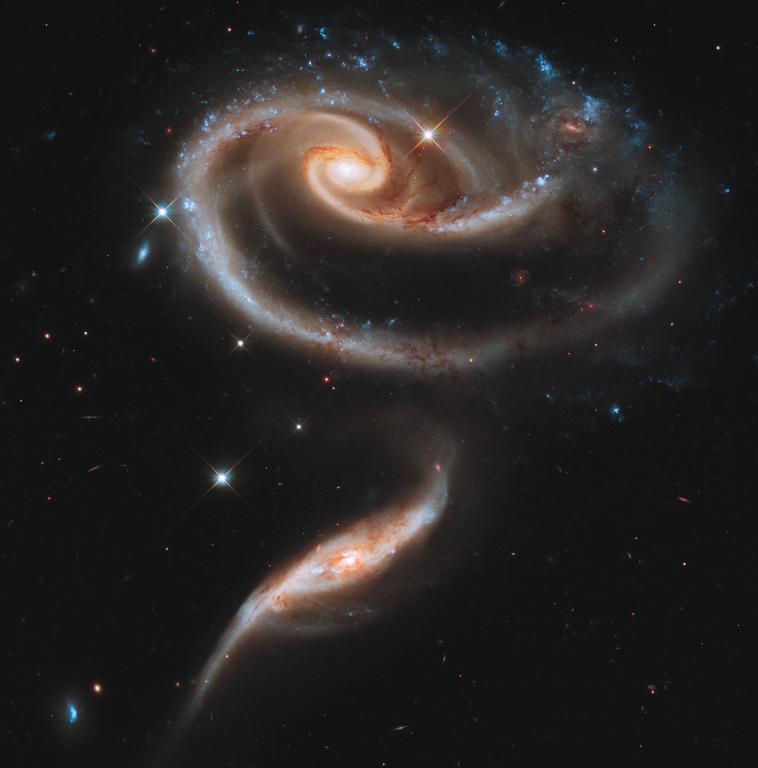
“A rose made of galaxies”
This image of a pair of interacting galaxies called Arp 273 was released to celebrate the 21st anniversary of the launch of the NASA/ESA Hubble Space Telescope. The distorted shape of the larger of the two galaxies shows signs of tidal interactions with the smaller of the two. It is thought that the smaller galaxy has actually passed through the larger one.
(NASA, ESA and the Hubble Heritage Team [STScI/AURA])
***
I like to think about such things as these from time to time, and I hope that you find it interesting and valuable, as well. First, though, a lead-in passage that comes, perhaps rather unexpectedly, from Shakespeare’s The Merchant of Venice. It nicely expresses the ancient belief, which flourished up through the time of Shakespeare, in the so-called “harmony of the spheres” — which was another way, in a sense, of referring to the mathematical harmony that pre-modern observers saw in the apparent movements of the stars and the planets:
How sweet the moonlight sleeps upon this bank!
Here will we sit and let the sounds of music
Creep in our ears: soft stillness and the night
Become the touches of sweet harmony.
Sit, Jessica. Look how the floor of heaven
Is thick inlaid with patines of bright gold:
There’s not the smallest orb which thou behold’st
But in his motion like an angel sings,
Still quiring to the young-eyed cherubins;
Such harmony is in immortal souls;
But whilst this muddy vesture of decay
Doth grossly close it in, we cannot hear it.
(Lorenzo, in Act V, Scene 1 of William Shakespeare’s The Merchant of Venice)
In case that’s a bit too “Shakespearean” for full understanding, here’s one attempt that I found online at a modern English “translation” of the passage:
How sweet the moonlight shines on this bank! We will sit here and let the sounds of music slip into our ears. This soft stillness and night are perfect for some sweet harmony. Sit down, Jessica. Look how the sky, which is like the floor of heaven, is inlaid with bright gold stars. All the little orbs that you see up in the sky are like angels singing to the young cherubs in a choir. That same kind of harmony is in our immortal souls, but while our souls are enclosed in our mortal, decaying bodies, we can’t hear it.
And that meditation, from before what is generally reckoned as the founding of modern science, leads very neatly into this much more recent reflection and, indirectly, to the others that follow:
In the discoveries of science the harmony of the spheres is also now the harmony of life. And as the eerie illumination of science penetrates evermore deeply into the order of nature, the cosmos appears increasingly to be a vast system finely tuned to generate life and organisms of biology very similar, perhaps identical, to ourselves. All the evidence available in the biological sciences supports the core proposition of traditional natural theology — that the cosmos is a specially designed whole with life and mankind as a fundamental goal and purpose, a whole in which all facets of reality, from the size of galaxies to the thermal capacity of water, have their meaning and explanation in this central fact.
Four centuries after the scientific revolution apparently destroyed irretrievably man’s special place in the universe, banished Aristotle, and rendered teleological speculation obsolete, the relentless stream of discovery has turned dramatically in favor of teleology and design, and the doctrine of the microcosm is reborn. As I hope the evidence presented in this book has shown, science, which has been for centuries the great ally of atheism and skepticism, has become at last, in the final days of the second millennium, what Newton and many of its early advocates had so fervently wished — the “defender of the anthropocentric faith.”
(Michael Denton, Nature’s Destiny: How the Laws of Biology Reveal Purpose in the Universe)
To get our universe, with all of its potential for complexities or any kind of potential for any kind of life-form, everything has to be precisely defined on this knife edge of improbability. . . . [Y]ou have to see the hands of a creator who set the parameters to be just so because the creator was interested in something a little more complicated than random particles.
(Francis Collins)
Life cannot have had a random beginning. . . . The trouble is that there are about 2000 enzymes, and the chance of obtaining them all in a random trial is only one part in 10^40,000, an outrageously small probability that could not be faced even if the whole universe consisted of organic soup.
(Sir Fred Hoyle [1915 – 2001], British astrophysicist)
Scientists are slowly waking up to an inconvenient truth – the universe looks suspiciously like a fix. The issue concerns the very laws of nature themselves. For 40 years, physicists and cosmologists have been quietly collecting examples of all too convenient “coincidences” and special features in the underlying laws of the universe that seem to be necessary in order for life, and hence conscious beings, to exist. Change any one of them and the consequences would be lethal. Fred Hoyle, the distinguished cosmologist, once said it was as if “a super-intellect has monkeyed with physics”.
To see the problem, imagine playing God with the cosmos. Before you is a designer machine that lets you tinker with the basics of physics. Twiddle this knob and you make all electrons a bit lighter, twiddle that one and you make gravity a bit stronger, and so on. It happens that you need to set thirtysomething knobs to fully describe the world about us. The crucial point is that some of those metaphorical knobs must be tuned very precisely, or the universe would be sterile.
Example: neutrons are just a tad heavier than protons. If it were the other way around, atoms couldn’t exist, because all the protons in the universe would have decayed into neutrons shortly after the big bang. No protons, then no atomic nucleuses and no atoms. No atoms, no chemistry, no life. Like Baby Bear’s porridge in the story of Goldilocks, the universe seems to be just right for life.
(Paul Davies, English theoretical physicist)
The unsolved problems of the physical world now seem even more formidable than those solved in the twentieth century.
Though in application it works splendidly, we do not even understand the physical meaning of quantum mechanics, much less how it might be united with general relativity.
We don’t know why the dimensionless constants (ratios of masses of elementary particles, ratios of strength of gravitational to electric forces, fine structure constant, etc.) have the values they do, unless we appeal to the implausible anthropic principle, which seems like a regression to Aristotelian teleology.
(Gerald Holton, Physics, the Human Adventure: From Copernicus to Einstein and Beyond)
An honest man, armed with all the knowledge available to us now, could only state that in some sense, the origin of life appears at the moment to be almost a miracle, so many are the conditions which would have had to have been satisfied to get it going.
(Francis Crick, co-discoverer of the structure of the DNA molecule in 1953, co-winner of the 1962 Nobel Prize for Physiology or Medicine, and outspoken atheist)
Previous Post

April 22, 2022
"Putting Down the Priests"
Next Post
April 23, 2022 The First of Interpreter's Short Video Features is Now Up, for Free
Browse Our Archives
Select a Category Uncategorized
Select a Month October 2026 September 2026 August 2026 July 2026 June 2026 May 2026 April 2026 March 2026 February 2026 January 2026 December 2025 November 2025 October 2025 September 2025 August 2025 July 2025 June 2025 May 2025 April 2025 March 2025 February 2025 January 2025 December 2024 November 2024 October 2024 September 2024 August 2024 July 2024 June 2024 May 2024 April 2024 March 2024 February 2024 January 2024 December 2023 November 2023 October 2023 September 2023 August 2023 July 2023 June 2023 May 2023 April 2023 March 2023 February 2023 January 2023 December 2022 November 2022 October 2022 September 2022 August 2022 July 2022 June 2022 May 2022 April 2022 March 2022 February 2022 January 2022 December 2021 November 2021 October 2021 September 2021 August 2021 July 2021 June 2021 May 2021 April 2021 March 2021 February 2021 January 2021 December 2020 November 2020 October 2020 September 2020 August 2020 July 2020 June 2020 May 2020 April 2020 March 2020 February 2020 January 2020 December 2019 November 2019 October 2019 September 2019 August 2019 July 2019 June 2019 May 2019 April 2019 March 2019 February 2019 January 2019 December 2018 November 2018 October 2018 September 2018 August 2018 July 2018 June 2018 May 2018 April 2018 March 2018 February 2018 January 2018 December 2017 November 2017 October 2017 September 2017 August 2017 July 2017 June 2017 May 2017 April 2017 March 2017 February 2017 January 2017 December 2016 November 2016 October 2016 September 2016 August 2016 July 2016 June 2016 May 2016 April 2016 March 2016 February 2016 January 2016 December 2015 November 2015 October 2015 September 2015 August 2015 July 2015 June 2015 May 2015 April 2015 March 2015 February 2015 January 2015 December 2014 November 2014 March 2014 August 2013 February 2012
Follow Us!
TAKE THE
Religious Wisdom Quiz
Who is the "friend at midnight" in one of Jesus' parables?
Select your answer to see how you score.
A soldier An angel A fisherman A neighbor seeking bread
Related posts from Sic et Non

Looking at the Largest Orthodox Cathedral on Earth

The Iron Gates and the Lion of the...


Learning more about a region of which I've...
TRENDING AT PATHEOS Latter-day Saint

Looking at the Largest Orthodox Cathedral on Earth
There is often a considerable amount of anger and, shall we...

The Problem with False Prophets
Miller’s Station UMC| 10/18/26| Anchor Verse: Jeremiah 23: 1, 9-23 I...

Emotion in Early Christianity by Andrew Crislip
Andrew Crislip’s Emotion in Early Christianity examines an often overlooked dimension of...

16 Spiritual Touchstones for a More Grounded Life
After decades of spiritual study, here are 16 principles I try...

Catholic Evangelization: Sharing Your Faith Every Day
Welcome back to the Graceful Awakening mini-series called, “From Faith to Mission.” ...

The Pillar of the Boatmen: the Ancient Monument...
The Pillar of the Boatmen is a Romano-Gaulish sculpture that dates from...
view all Latter-day Saint blogs
Ad-Free & Subscriber Log-In Subscription Support
- About Us
- 2026 Calendar
- Videos
- Podcasts
- Library of World Religions
- Faith In Media Tracker
- Advertise With Us
- Write for Us
- Privacy Policy
- Terms of Service
- Do Not Sell My Data
- Contact Us
- Radiant Digital
- Manage Newsletter Subscriptions
- Unsubscribe From Notifications
- Sitemap
Copyright 2008-2026, Patheos. All rights reserved.
Subscription Support Ad-Free & Subscriber Log-In
Follow Patheos