
BuddhistCatholicContemplativeEvangelicalGeneral ChristianHinduJewishLatter-day SaintMuslimNew VisionsProgressive Christian
Beliefs
- Buddhist
- Catholic
- Contemplative
- Evangelical
- General Christian
- Hindu
- Jewish
- Latter-day Saint
- More Voices
- Muslim
- New Visions
- Pagan
- Progressive Christian
Topics
- Religion News
- Food and Religion
- Sports and Religion
- Religious Art
- Religious Music and Entertainment
- Religious Events
- History and Religion
- Style and Religion
- Politics and Religion
- Women in Religion
- Recreation Outdoors and Religion
- Business Finance and Religion
- Careers Workplace and Religion
- Education and Religion
- Family Parenting and Religion
- Health Fitness and Religion
- Home and Religion
- Relationships and Religion
- Technology and Religion
- Travel and Religion
Columnists
- Buddhist Columnists
- Business Finance and Religion Columnists
- Careers Workplace and Religion Columnists
- Catholic Columnists
- Contemplative Columnists
- Education and Religion Columnists
- Evangelists Columnists
- Family Parenting and Religion Columnists
- General Christian Columnists
- Health Fitness and Religion Columnists
- Hindu Columnists
- History and Religion Columnists
- Home and Religion Columnists
- Jewish Columnists
- More Voices Columnists
- Latter Day Columnists
- Muslim Columnists
- New Visions Columnists
- Nonreligious Columnists
- Pagan Columnists
- Politics and Religion Columnists
- Progressive Columnists
- Recreation Outdoors and Religion Columnists
- Relationships and Religion Columnists
- Religion News Columnists
- Religious Art Columnists
- Religious Events Columnists
- Religious Music and Entertainment Columnists
- Sports and Religion Columnists
- Style and Religion Columnists
- Technology and Religion Columnists
- Travel and Religion Columnists
- Women in Religion Columnists
Resource Library
- 2026 Calendar
- Library of World Religions
- The 100 Most Holy Places on Earth
- Patheos Answers
- Podcasts
- Videos
- Faith Leaders Database
- Anglican Episcopalian
- Bahai
- Baptist
- Buddhism
- Christianity
- Confucianism
- Eastern Orthodoxy
- Hinduism
- Holiness and Pentecostal
- ISKCON
- Islam
- Judaism
- Lutheran
- Methodist
- The Church of Jesus Christ of Latter-day Saints
- New Age
- Paganism
- Presbytarian and Reformed
- Protestantism
- Religion Behind the Scenes
- Roman Catholic
- Scientology
- Shia Islam
- Sikhism
- Sufism
- Sunni Islam
- Taoism
- Zen
- See all religions
Research Tools
 Ad-Free & Subscriber Log-In Subscription Support
Ad-Free & Subscriber Log-In Subscription Support
Follow Patheos 

- Trending:
- Forgiveness
- |
- Marriage
- |
- Consciousness
- |
- Death Penalty
- |
- Election
- |
- Halloween

- Home
- Latter-day Saint
- Entering into Easter Week
Entering into Easter Week
Last updated on: May 13, 2022 at 10:29 pm by Dan Peterson
Entering into Easter Week 2022-05-13T22:29:52-06:00 Dan Peterson
Patheos Explore the world's faith through different perspectives on religion and spirituality! Patheos has the views of the prevalent religions and spiritualities of the world.
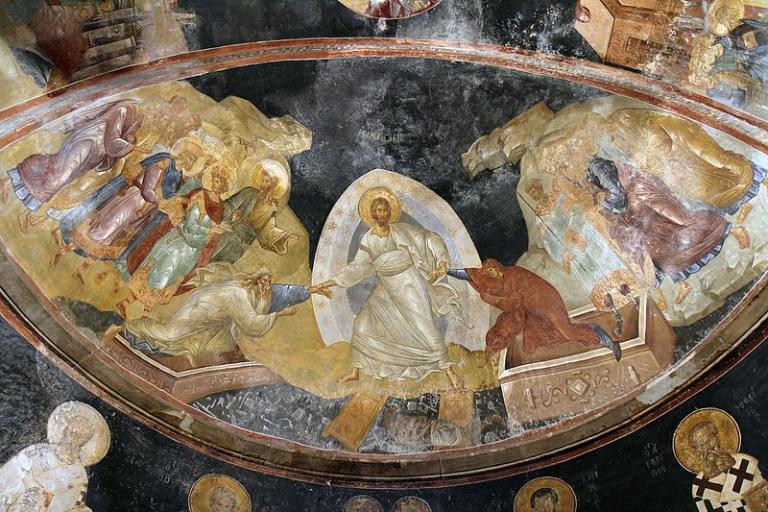
Between his crucifixion and his resurrection, Christ visits the world of spirits and, taking them by the hand, lifts Adam and Eve from their lost state. This fresco –entitled “He Anastasis” (“The Resurrection”) appears in Istanbul’s (Constantinople’s) marvelous “Chora Church,” which is also known as the Kariye Mosque (Turkish: Kariye Camii), or the Church of the Holy Savior in Chora (Greek: Ἐκκλησία τοῦ Ἁγίου Σωτῆρος ἐν τῇ Χώρᾳ), and is located in the Edirnekapı neighborhood of Istanbul, Turkey, outside the city’s great Byzantine walls.
(Wikimedia Commons public domain image)
***
Virtually all historians, of all religious opinions, agree that Jesus was crucified. The New Testament says that he died just prior to Passover.
One of his inner circle of twelve apostles betrayed him, nine fled at his arrest, and another — Peter — pretended not to know him. The last, John, seems to have watched events unfold from a safe distance (Luke 23:49; John 19:25-27). Thereafter, as prominent followers of a convicted and executed “criminal,” they went into hiding.
Only a few weeks later, though, the eleven surviving apostles were transformed. They even appointed a willing replacement for Judas.
What happened?
According to Acts 1:2-9, the risen Jesus trained his apostles for forty days during a series of post-resurrection appearances and then ascended into heaven. Less than two weeks later, they began their first public preaching in connection with the feast of Pentecost, seven weeks after Passover and Easter Sunday (Acts 2).
The content of their first preaching is significant. Boldly speaking for the other apostles, Peter flatly identified the residents of Jerusalem as the killers of Jesus, testifying that God had raised Jesus from the dead and identifying himself and his colleagues as witnesses to these claims (Acts 2:23-24, 32). At this point, if Peter’s assertion were false, critics could easily have exhumed Jesus’ body and ended the nonsense. But, in fact, Luke tells us that mass conversions followed the apostles’ testimony (2:41, 47).
A few days later, Peter and John were in the courtyard of the temple, again openly accusing the people of Jerusalem of having murdered Jesus (3:13-15), testifying that God had raised Jesus from the dead (3:15, 26), and identifying themselves as “witnesses” to these facts (3:15).
The chief priests and Sadducees were understandably threatened by these public challenges and, so, the two apostles were arrested and brought before Annas, Caiaphas, and other members of the city’s elite (4:1-7) — the very men who, less than two months before, had engineered the execution of Jesus.
Without hesitation, Peter testified of “Jesus Christ of Nazareth, whom ye crucified, whom God raised from the dead” (4:10).
Uncertain how to respond to this fearless defiance, the chief priests decided to “threaten” Peter and John, and to order them to speak no further about Jesus (4:17-18) — to which the two apostles replied that they would not obey the order (4:19-20). Baffled as to what to do next, Annas and Caiaphas and the others simply threatened them again and let them go (4:21).
But the little Christian movement continued its public preaching to the extent that, exasperated and “filled with indignation,” the high priest and the Sadducees had the apostles arrested and jailed. However, they were miraculously delivered from prison and immediately proceeded to the temple to preach still more (5:17-25).
So they were arrested yet again and hauled once more before the high priest and his council, where they were reminded that they had been ordered not to teach about Jesus (5:26-28).
And, yet again, the apostles were defiant and unintimidated. “We ought to obey God rather than men,” explained Peter (5:29). You killed Jesus, he said, but God raised him from the dead “and we are his witnesses of these things” (see 5:30-32).
At this point, according to Acts, the council considered killing them. But a prominent rabbi named Gamaliel stood up and strongly advised against that. So the council had them beaten yet again and ordered them, yet again, to be quiet about Jesus (see 5:33-40).
“And they departed from the presence of the council, rejoicing that they were counted worthy to suffer shame for his name. And daily in the temple, and in every house, they ceased not to teach and preach Jesus Christ” (5:41-42).
Some will argue that this account is fiction, inspiring but wholly mythical. But its author, the evangelist Luke, seems to have been a well-educated and careful historian who based his narrative upon eyewitness interviews (Luke 1:1-4). And the New Testament doesn’t shrink from casting early church leaders in a negative light when appropriate; it feels no apparent need to glorify them by falsifying history. Furthermore, given the remarkable and well-documented growth of earliest Christianity, something very like what Luke reports must necessarily have happened.
So what transformed the fearful, cowering apostles of Passover weekend into fearless preachers of Christ’s resurrection less than two months later? There is a very obvious possible answer. Everything hinges on it.
***
It’s an appropriate time, I think, to share one of my two favorite Easter poems (as I do every year):
I’m very fond of the excellent second-tier English poet A. E. Housman (d. 1936), who, along with writing such works as “To an athlete dying young,” from A Shropshire Lad, was a prominent classicist at the University of Cambridge. The melancholy mood of many of his poems speaks to me. I’ve even made a minor pilgrimage to his grave.
Housman was an atheist, and sometimes a hostile one. But he had moments of yearning. This poem, entitled “Easter Hymn,” captures those feelings of longing for a belief that, in the end, he simply couldn’t muster. It expresses wonderfully well part of the Christian hope invested in this season of the year and, more particularly, in the event that it commemorates. And so, as is my custom, I share Dr. Housman’s brief poem at this Easter season:
If in that Syrian garden, ages slain,
You sleep, and know not you are dead in vain,
Nor even in dreams behold how dark and bright
Ascends in smoke and fire by day and night
The hate you died to quench and could but fan,
Sleep well and see no morning, son of man.
But if, the grave rent and the stone rolled by,
At the right hand of majesty on high
You sit, and sitting so remember yet
Your tears, your agony and bloody sweat,
Your cross and passion and the life you gave,
Bow hither out of heaven and see and save.
Previous Post

April 9, 2022
"But why are the damned in hell?"
Next Post
April 11, 2022 Seventeen Years
Browse Our Archives
Select a Category Uncategorized
Select a Month October 2026 September 2026 August 2026 July 2026 June 2026 May 2026 April 2026 March 2026 February 2026 January 2026 December 2025 November 2025 October 2025 September 2025 August 2025 July 2025 June 2025 May 2025 April 2025 March 2025 February 2025 January 2025 December 2024 November 2024 October 2024 September 2024 August 2024 July 2024 June 2024 May 2024 April 2024 March 2024 February 2024 January 2024 December 2023 November 2023 October 2023 September 2023 August 2023 July 2023 June 2023 May 2023 April 2023 March 2023 February 2023 January 2023 December 2022 November 2022 October 2022 September 2022 August 2022 July 2022 June 2022 May 2022 April 2022 March 2022 February 2022 January 2022 December 2021 November 2021 October 2021 September 2021 August 2021 July 2021 June 2021 May 2021 April 2021 March 2021 February 2021 January 2021 December 2020 November 2020 October 2020 September 2020 August 2020 July 2020 June 2020 May 2020 April 2020 March 2020 February 2020 January 2020 December 2019 November 2019 October 2019 September 2019 August 2019 July 2019 June 2019 May 2019 April 2019 March 2019 February 2019 January 2019 December 2018 November 2018 October 2018 September 2018 August 2018 July 2018 June 2018 May 2018 April 2018 March 2018 February 2018 January 2018 December 2017 November 2017 October 2017 September 2017 August 2017 July 2017 June 2017 May 2017 April 2017 March 2017 February 2017 January 2017 December 2016 November 2016 October 2016 September 2016 August 2016 July 2016 June 2016 May 2016 April 2016 March 2016 February 2016 January 2016 December 2015 November 2015 October 2015 September 2015 August 2015 July 2015 June 2015 May 2015 April 2015 March 2015 February 2015 January 2015 December 2014 November 2014 March 2014 August 2013 February 2012
Follow Us!
TAKE THE
Religious Wisdom Quiz
I will come like a thief in the night when people say 'peace and safety.' Sudden destruction will come. What am I?
Select your answer to see how you score.
Judgment day The end times The day of the Lord The second coming
Related posts from Sic et Non

“Once more unto the breach, dear friends, once...

An action movie and some vacuous theology
"The Appeal of Socialism and the Case Against...
Reflections on People Who Leave the Church
TRENDING AT PATHEOS Latter-day Saint

In "Irreplaceable," our book on vocation and technology, Trevor Sutton and I...

I was strolling through the top floor of the brand new Parthenon...

What Does Gêvâh Mean For Kimberley Guifoyle &...
This week, a lot of the news is focused on Kimberly Guilfoyle....

INNER CIRCLE: Profound Mystery (Of Christ In All...
Ephesians 5:31-32 “For this reason, a man will leave his father and...

Do Not Rejoice When Your Enemy Falls: The...
Turning an execution into a public spectacle is a disturbing expression of...

'The Chosen' S6 Trailer: The Passion Gets Very...
Not many watching 'The Chosen' worry about spoilers, but just because they...
view all Latter-day Saint blogs
Ad-Free & Subscriber Log-In Subscription Support
- About Us
- 2026 Calendar
- Videos
- Podcasts
- Library of World Religions
- Faith In Media Tracker
- Advertise With Us
- Write for Us
- Privacy Policy
- Terms of Service
- Do Not Sell My Data
- Contact Us
- Radiant Digital
- Manage Newsletter Subscriptions
- Unsubscribe From Notifications
- Sitemap
Copyright 2008-2026, Patheos. All rights reserved.
Subscription Support Ad-Free & Subscriber Log-In
Follow Patheos