
BuddhistCatholicContemplativeEvangelicalGeneral ChristianHinduJewishLatter-day SaintMuslimNew VisionsProgressive Christian
Beliefs
- Buddhist
- Catholic
- Contemplative
- Evangelical
- General Christian
- Hindu
- Jewish
- Latter-day Saint
- More Voices
- Muslim
- New Visions
- Pagan
- Progressive Christian
Topics
- Religion News
- Food and Religion
- Sports and Religion
- Religious Art
- Religious Music and Entertainment
- Religious Events
- History and Religion
- Style and Religion
- Politics and Religion
- Women in Religion
- Recreation Outdoors and Religion
- Business Finance and Religion
- Careers Workplace and Religion
- Education and Religion
- Family Parenting and Religion
- Health Fitness and Religion
- Home and Religion
- Relationships and Religion
- Technology and Religion
- Travel and Religion
Columnists
- Buddhist Columnists
- Business Finance and Religion Columnists
- Careers Workplace and Religion Columnists
- Catholic Columnists
- Contemplative Columnists
- Education and Religion Columnists
- Evangelists Columnists
- Family Parenting and Religion Columnists
- General Christian Columnists
- Health Fitness and Religion Columnists
- Hindu Columnists
- History and Religion Columnists
- Home and Religion Columnists
- Jewish Columnists
- More Voices Columnists
- Latter Day Columnists
- Muslim Columnists
- New Visions Columnists
- Nonreligious Columnists
- Pagan Columnists
- Politics and Religion Columnists
- Progressive Columnists
- Recreation Outdoors and Religion Columnists
- Relationships and Religion Columnists
- Religion News Columnists
- Religious Art Columnists
- Religious Events Columnists
- Religious Music and Entertainment Columnists
- Sports and Religion Columnists
- Style and Religion Columnists
- Technology and Religion Columnists
- Travel and Religion Columnists
- Women in Religion Columnists
Resource Library
- 2026 Calendar
- Library of World Religions
- The 100 Most Holy Places on Earth
- Patheos Answers
- Podcasts
- Videos
- Faith Leaders Database
- Anglican Episcopalian
- Bahai
- Baptist
- Buddhism
- Christianity
- Confucianism
- Eastern Orthodoxy
- Hinduism
- Holiness and Pentecostal
- ISKCON
- Islam
- Judaism
- Lutheran
- Methodist
- The Church of Jesus Christ of Latter-day Saints
- New Age
- Paganism
- Presbytarian and Reformed
- Protestantism
- Religion Behind the Scenes
- Roman Catholic
- Scientology
- Shia Islam
- Sikhism
- Sufism
- Sunni Islam
- Taoism
- Zen
- See all religions
Research Tools
 Ad-Free & Subscriber Log-In Subscription Support
Ad-Free & Subscriber Log-In Subscription Support
Follow Patheos 

- Trending:
- Forgiveness
- |
- Marriage
- |
- Consciousness
- |
- Death Penalty
- |
- Election
- |
- Halloween

- Home
- Latter-day Saint
- “But why are the damned in hell?”
“But why are the damned in hell?”
Last updated on: April 9, 2022 at 1:27 pm by Dan Peterson
“But why are the damned in hell?” 2022-04-09T13:27:08-06:00 Dan Peterson
Patheos Explore the world's faith through different perspectives on religion and spirituality! Patheos has the views of the prevalent religions and spiritualities of the world.
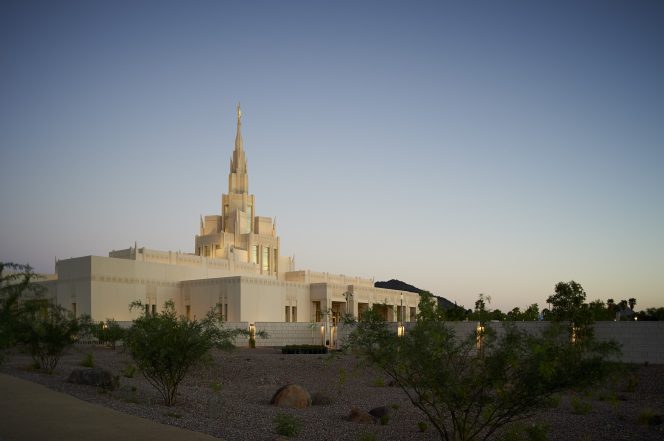
The Phoenix Arizona Temple (LDS Media Library) is one of the three temples in the Greater Phoenix area. The other two are in Mesa and in Gilbert. Such temples represent not only Latter-day Saint belief in life beyond the grave but our confidence that salvation is still available to those who were unable to receive the good news of Christ during their mortal lives.
***
I’ve enjoyed the work of Stephen T. Davis, Russell K. Pitzer Emeritus Professor of Philosophy at Claremont McKenna College in California, for a long time. Some time ago, I read his 2015 book After We Die: Theology, Philosophy, and the Question of Life after Death.
Latter-day Saints don’t believe in the traditional Christian concept of hell. (Moreover, I personally lean toward a modified form of near-universalism.) But I’ve just finished reading Professor Davis’s defense of the concept of hell — he identifies himself as a believing and relatively conservative Protestant Christian — and I excerpt a couple of passages from it because . . . well, because I agree with them:
[H]ell is separation from God in the sense of being cut off from the source of all love, joy, peace, and light. There is no deep or ultimate joy in hell, and I believe its denizens are miserable. To be apart from the source of love, joy, peace, and light is to live miserably.
But why are the damned in hell? As noted, I am not much attracted to the idea of retribution, although there are biblical texts that might be taken to support the idea. To put the point bluntly, I believe they are in hell because they choose to be there. People are not sent to hell, kicking and screaming, against their wills. Unfortunately, some people choose to live their lives apart from God; they harden their hearts and will continue to say no to God after death; some will doubtless do so forever. For such people, the prospect of living in the presence of God will seem worse than living apart from God. Allowing them to live forever in hell is simply God’s continuing to grant them the freedom that they experienced in this life to say yes or no to God. Nevertheless, I suspect the people in hell are deeply remorseful.
Can people both freely choose hell over heaven, knowing that they would be unable to endure heaven, but still regret the fact that they cannot happily choose heaven? Yes, I believe that this is quite possible. There are people who can carry a grudge against an enemy for years despite realizing that it would be better for all concerned if they forgave the enemy and moved on with their lives. Moreover, the evidence that we have from this life is that some people will go on denying God forever. Their hostility will grow; their hearts will grow ever harder. People in hell will surely suffer, but their suffering will be largely self-inflicted. Moreover, I suspect that they will cause each other to suffer; that is, they will inflict pain on others who are within reach.
It might be objected that the notion that some people will voluntarily choose hell might make sense initially (i.e., immediately after death) but that the idea that they will do so everlastingly does not. And it is certainly true that heaven will always be the most sensible option. But, again, I hold that people who continue voluntarily to choose hell (even if we grant that they will always be offered the option of repenting and being promoted to heaven) will not be sensible. Their hatred of God will have overcome them. (95-96)
Is the existence of hell consistent with the loving and gracious nature of God? Yes, it is. Some Christians try to justify the existence of hell by viewing it as the “natural consequence” of a life of sin. I accept the notion that hell is a natural consequence of a life of rebellion against God (and, in that sense, hell is a punishment). But this point does not in itself justify God in condemning people to hell, because it does not justify the divinely ordained laws of natural necessity that make hell sin’s natural consequence. My claim, then, is that the denizens of hell are in hell because they freely choose to be there. That is, they freely choose not to live in the presence of God. If so, then hell is not only an expression of divine justice but of divine love as well. And hell will exist eternally because the hearts of some of the condemned will grow ever and ever harder against God. They will never choose anything other than hell. (96)
For the record, Professor Davis — who is a Protestant Christian — entertains at least the hypothetical possibility of postmortem salvation (rather like that in which Latter-day Saints believe, including even a reference to 1 Corinthians 15:29 and its mention of baptism on behalf of the dead), which might offer the inhabitants of hell a chance to leave it. He simply thinks that some in hell will refuse that choice. I believe — as hard as it may be to imagine — that that is indeed the case.
***
I’m very much looking forward to reading this study or “statement”:
““Near-Death Experiences” Are Not Hallucinations, Says First-Ever Study Of Its Kind”
Thanks to Nanakat Woodbury for calling it to my attention.
***
And, finally, after a period of cruel neglect, I have something to share with you once again from the deliciously horrifying Christopher Hitchens Memorial “How Religion Poisons Everything” File©. It was kindly brought to my notice by Dr. Lynn Johnson:
The new issue of Journal of Health Psychology includes a study: “Is there a relationship between spirituality/religiosity and resilience? A systematic review and meta-analysis of observational studies.”
The authors are Fábio Duarte Schwalm, Rafaela Brugalli Zandavalli, Eno Dias de Castro Filho, & Giancarlo Lucchetti.
Here’s the abstract: “Resilience is the ability to recover or cope with adverse situations. Spiritual and religious beliefs may be associated with important “resilience resources.” To investigate whether there is a relationship between spirituality/religiosity (S/R) and resilience. This is a systematic review (observational studies) with meta-analysis following the PRISMA guidelines. From a total of 2468 articles, 34 observational studies were included. We identified a moderate positive correlation between S/R and resilience (r = 0.40 (95% CI, 0.32–0.48], p < 0.01). When only high-quality articles were included, the results were maintained. Conclusion: A moderate positive correlation was found between S/R and resilience.”
TO OBTAIN A COPY OF THE ARTICLE: Contact info for reprint requests and questions or other correspondence about this article: Fábio Duarte Schwalm, Family Physician, Conceição Hospital Group – GHC, Av. Francisco Trein, 596 – Cristo Redentor, Porto Alegre, RS 91350-200, Brazil — Email: [email protected]
Previous Post

April 8, 2022
"Experiential Knowledge"
Next Post
April 10, 2022 Entering into Easter Week
Browse Our Archives
Select a Category Uncategorized
Select a Month October 2026 September 2026 August 2026 July 2026 June 2026 May 2026 April 2026 March 2026 February 2026 January 2026 December 2025 November 2025 October 2025 September 2025 August 2025 July 2025 June 2025 May 2025 April 2025 March 2025 February 2025 January 2025 December 2024 November 2024 October 2024 September 2024 August 2024 July 2024 June 2024 May 2024 April 2024 March 2024 February 2024 January 2024 December 2023 November 2023 October 2023 September 2023 August 2023 July 2023 June 2023 May 2023 April 2023 March 2023 February 2023 January 2023 December 2022 November 2022 October 2022 September 2022 August 2022 July 2022 June 2022 May 2022 April 2022 March 2022 February 2022 January 2022 December 2021 November 2021 October 2021 September 2021 August 2021 July 2021 June 2021 May 2021 April 2021 March 2021 February 2021 January 2021 December 2020 November 2020 October 2020 September 2020 August 2020 July 2020 June 2020 May 2020 April 2020 March 2020 February 2020 January 2020 December 2019 November 2019 October 2019 September 2019 August 2019 July 2019 June 2019 May 2019 April 2019 March 2019 February 2019 January 2019 December 2018 November 2018 October 2018 September 2018 August 2018 July 2018 June 2018 May 2018 April 2018 March 2018 February 2018 January 2018 December 2017 November 2017 October 2017 September 2017 August 2017 July 2017 June 2017 May 2017 April 2017 March 2017 February 2017 January 2017 December 2016 November 2016 October 2016 September 2016 August 2016 July 2016 June 2016 May 2016 April 2016 March 2016 February 2016 January 2016 December 2015 November 2015 October 2015 September 2015 August 2015 July 2015 June 2015 May 2015 April 2015 March 2015 February 2015 January 2015 December 2014 November 2014 March 2014 August 2013 February 2012
Follow Us!
TAKE THE
Religious Wisdom Quiz
Who was crucified and rose again after three days?
Select your answer to see how you score.
Moses John the Baptist Jesus Paul
Related posts from Sic et Non

Learning more about a region of which I've...

From Serbia's "White City," Belgrade


TRENDING AT PATHEOS Latter-day Saint

The Sermon on the Mount, Part I: Matthew...
The Sermon on the Mount, Part I (Matthew 4:12-5:12) St. Matthew moves...

What's up from Crossway: Reviewing some of their latest A few weeks...

Janie Learns the Way of the Cross: A...
Teaching children about Jesus' Passion can be challenging. Many parents and educators...

Looking For Good Catholic Writing - October 2026
He alone extends the heavens, and he walks upon the waves of...

In "Irreplaceable," our book on vocation and technology, Trevor Sutton and I...

I was strolling through the top floor of the brand new Parthenon...
view all Latter-day Saint blogs
Ad-Free & Subscriber Log-In Subscription Support
- About Us
- 2026 Calendar
- Videos
- Podcasts
- Library of World Religions
- Faith In Media Tracker
- Advertise With Us
- Write for Us
- Privacy Policy
- Terms of Service
- Do Not Sell My Data
- Contact Us
- Radiant Digital
- Manage Newsletter Subscriptions
- Unsubscribe From Notifications
- Sitemap
Copyright 2008-2026, Patheos. All rights reserved.
Subscription Support Ad-Free & Subscriber Log-In
Follow Patheos