
BuddhistCatholicContemplativeEvangelicalGeneral ChristianHinduJewishLatter-day SaintMuslimNew VisionsProgressive Christian
Beliefs
- Buddhist
- Catholic
- Contemplative
- Evangelical
- General Christian
- Hindu
- Jewish
- Latter-day Saint
- More Voices
- Muslim
- New Visions
- Pagan
- Progressive Christian
Topics
- Religion News
- Food and Religion
- Sports and Religion
- Religious Art
- Religious Music and Entertainment
- Religious Events
- History and Religion
- Style and Religion
- Politics and Religion
- Women in Religion
- Recreation Outdoors and Religion
- Business Finance and Religion
- Careers Workplace and Religion
- Education and Religion
- Family Parenting and Religion
- Health Fitness and Religion
- Home and Religion
- Relationships and Religion
- Technology and Religion
- Travel and Religion
Columnists
- Buddhist Columnists
- Business Finance and Religion Columnists
- Careers Workplace and Religion Columnists
- Catholic Columnists
- Contemplative Columnists
- Education and Religion Columnists
- Evangelists Columnists
- Family Parenting and Religion Columnists
- General Christian Columnists
- Health Fitness and Religion Columnists
- Hindu Columnists
- History and Religion Columnists
- Home and Religion Columnists
- Jewish Columnists
- More Voices Columnists
- Latter Day Columnists
- Muslim Columnists
- New Visions Columnists
- Nonreligious Columnists
- Pagan Columnists
- Politics and Religion Columnists
- Progressive Columnists
- Recreation Outdoors and Religion Columnists
- Relationships and Religion Columnists
- Religion News Columnists
- Religious Art Columnists
- Religious Events Columnists
- Religious Music and Entertainment Columnists
- Sports and Religion Columnists
- Style and Religion Columnists
- Technology and Religion Columnists
- Travel and Religion Columnists
- Women in Religion Columnists
Resource Library
- 2026 Calendar
- Library of World Religions
- The 100 Most Holy Places on Earth
- Patheos Answers
- Podcasts
- Videos
- Faith Leaders Database
- Anglican Episcopalian
- Bahai
- Baptist
- Buddhism
- Christianity
- Confucianism
- Eastern Orthodoxy
- Hinduism
- Holiness and Pentecostal
- ISKCON
- Islam
- Judaism
- Lutheran
- Methodist
- The Church of Jesus Christ of Latter-day Saints
- New Age
- Paganism
- Presbytarian and Reformed
- Protestantism
- Religion Behind the Scenes
- Roman Catholic
- Scientology
- Shia Islam
- Sikhism
- Sufism
- Sunni Islam
- Taoism
- Zen
- See all religions
Research Tools
 Ad-Free & Subscriber Log-In Subscription Support
Ad-Free & Subscriber Log-In Subscription Support
Follow Patheos 

- Trending:
- Forgiveness
- |
- Marriage
- |
- Consciousness
- |
- Death Penalty
- |
- Election
- |
- Halloween

- Home
- Latter-day Saint
- A quite congenial galaxy
A quite congenial galaxy
Last updated on: April 4, 2022 at 11:13 pm by Dan Peterson
A quite congenial galaxy 2022-04-04T23:13:36-06:00 Dan Peterson
Patheos Explore the world's faith through different perspectives on religion and spirituality! Patheos has the views of the prevalent religions and spiritualities of the world.
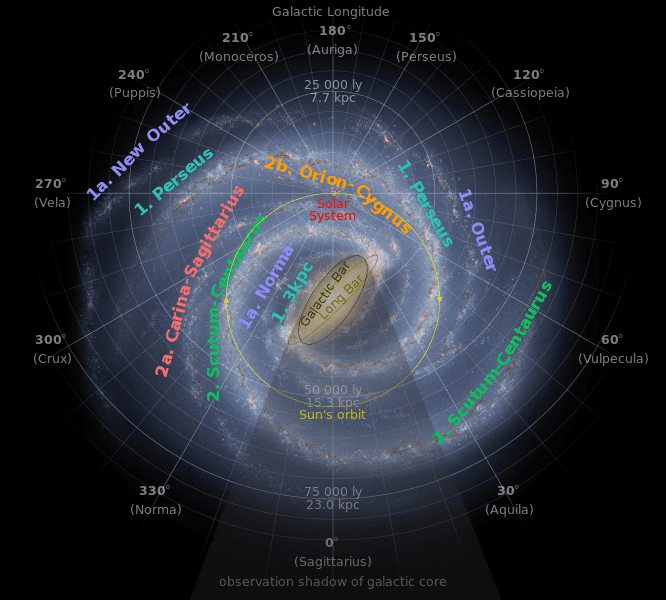
A NASA/JPL artist’s conception of the Milky Way galaxy from “above” it.
(Wikimedia CC public domain image)
***
Among the most interesting living writers on religion and science is the Israeli-American Gerald L. Schroeder, an Orthodox Jew who earned his B.Sc., his M.Sc., and his Ph.D. in nuclear physics and in earth and planetary sciences at the Massachusetts Institute of Technology (MIT). He teaches currently at the College of Jewish Studies, in Jerusalem.
Here, from his book God According to God: A Scientist Discovers We’ve Been Wrong About God All Along (New York: HarperOne, 2009), is a trio of passages about carbon, first, but also about our rather special location in a quite congenial galaxy and a very nice solar system:
The significance of carbon in life cannot be overstated. It accounts for half the dry weight of our bodies. Carbon along with oxygen, nitrogen, calcium, potassium, iron, and a multitude of other life-essential elements are dependent upon star formation and explosive death (supernovae). As such, they are not distributed uniformly throughout our universe and not even uniformly within a given galaxy. Galaxy type and position within a galaxy play a strong determining factor in the local metal content. The stars of elliptical galaxies are often first-generation stars, many being almost as old as the universe. As such, they are poor in heavy elements.
Globular clusters of stars are also typically metal-poor (“metal” is astronomers’ terminology for elements heavier than helium, that is, those elements formed within stellar furnaces). In addition, the dense packing of the stars within the cluster creates problems for life. Within a radius of 10 to 15 light-years (one light-year, the distance travels in one year, is approximately 9.5 trillion kilometers; trillion in the American use, a million million), a cluster might contain in excess of a thousand stars. The same size sphere around our sun contains less than two dozen stars, with the nearest star, Alpha Centauri (actually a system of three stars locked in gravitational orbit) being 4.3 light-years (40 trillion kilometers) distant. The close proximity among stars in the clusters results in devastating local instabilities. Frequent nearby supernovae and other active sources of intense, sterilizing radiation along with stellar gravitational interactions perturbing planetary orbits spell death for nascent life struggling to gain a planetary foothold. Our star, the sun, is located in what might be termed as a stellar desert.
Collisions among galaxies, though not common at least from evidence within the visible universe, can result in what astronomers refer to as supernovae factories, with stellar explosions every few years. The gestation period for the development of complex animal life exceeded three billion years on earth. If this timing is typical, then the nearly continual onslaught of ruinous radiation associated with these stellar explosions would obviate the potential for advanced life. (63-64)
Spiral galaxies are fit for life because spiral galaxies provide a range of conditions among which are those optimal for nurturing life. The spiral structure offers a variety of stellar concentrations throughout, from high densities near the galactic center and within the spiral arms to very much lower densities of stars in the spaces between the arms. Depending upon how the outer limit of the Milky Way is defined, the diameter of our galaxy is between 80,000 and 100,000 light-years. Our sun likes between two spiral arms, some 27,000 light-years, or approximately two-thirds of the way, out from the Milky Way’s center. Relative to the thickness of the Milky Way’s galactic disk, the solar system is just above (or below, depending upon one’s orientation) the center of the 6,000-light-year-thick central plane.
The earth revolves around the sun at approximately 30 kilometers per second. The sun and the solar system revolve around the center of the Milky Way at some ten times that speed. All revolutions are in the same direction. A deep challenge remains to discover why all components of the universe revolve or rotate. Angular momentum, as the forces of rotation are categorized, is always conserved unless acted upon by an outside force. What force acted to induce the rotations observed is an unsolved puzzle. A universe without rotation would mean a universe without planets and without life. All solids and gases would be gravitationally drawn directly into the parent star rather than revolving around the parent star. (64-65)
That the sun is located between two spiral arms means that it is in a region of low stellar density, with all the life-supporting features that that implies, most important of which are the fewer destructive interactions originating from neighboring stars. Being far from the galactic center shields us from the radiation-rich star-forming processes of the central region and distances us from the devastatingly powerful gravitational reach of the central black hole.
The edges of most galaxies are metal-poor; our positioning within the galaxy places us in a metal-rich area. These heavier elements are needed not only for the molecular structures of life They also are essential for the formation of rocky planets such as our earth.
Our sun is about halfway through its theoretical ten-billion-year life expectancy. All indications are that its energy output has remained fairly constant over the past billion years, neither frying nor freezing the earth’s surface. More than 90 percent of all stars are smaller than the sun. Smaller generally means longer-lived, more time for “evolution” to work its processes, provided it is not so long-lived that it is a first-generation star. That would make it metal deficient.
A planet’s distance from its parent star has a crucial influence on its suitability to nurture life. Proximity to the parent star results in gravitational drag on the planet’s rotation, slowing the rotation through what is termed tidal locking. Gradually the period of rotation becomes similar to the period of the planet’s revolution around the star. The outcome is that the same side of the planet continuously faces the star. The moon relative to the earth and Mercury relative to the sun are cases of tidal lock. We always see the same side of the moon. Mercury revolves around the sun in eighty-eight days and rotates on its axis once in fifty-nine days. On Mercury, the extraordinarily long day results in the sun side baking at 400 degrees C while the shaded side drops to minus 170 degrees C. Our twenty-four-hour rotation spreads the sun’s heat. Our nearly circular orbit keeps the solar input nearly constant year-round. These are two of the many life-giving characteristics of the earth-sun system. (65-66)
Previous Post

April 1, 2022
"The Messenger of Salvation"
Next Post
April 3, 2022 "So strange and unusual appearances"
Browse Our Archives
Select a Category Uncategorized
Select a Month October 2026 September 2026 August 2026 July 2026 June 2026 May 2026 April 2026 March 2026 February 2026 January 2026 December 2025 November 2025 October 2025 September 2025 August 2025 July 2025 June 2025 May 2025 April 2025 March 2025 February 2025 January 2025 December 2024 November 2024 October 2024 September 2024 August 2024 July 2024 June 2024 May 2024 April 2024 March 2024 February 2024 January 2024 December 2023 November 2023 October 2023 September 2023 August 2023 July 2023 June 2023 May 2023 April 2023 March 2023 February 2023 January 2023 December 2022 November 2022 October 2022 September 2022 August 2022 July 2022 June 2022 May 2022 April 2022 March 2022 February 2022 January 2022 December 2021 November 2021 October 2021 September 2021 August 2021 July 2021 June 2021 May 2021 April 2021 March 2021 February 2021 January 2021 December 2020 November 2020 October 2020 September 2020 August 2020 July 2020 June 2020 May 2020 April 2020 March 2020 February 2020 January 2020 December 2019 November 2019 October 2019 September 2019 August 2019 July 2019 June 2019 May 2019 April 2019 March 2019 February 2019 January 2019 December 2018 November 2018 October 2018 September 2018 August 2018 July 2018 June 2018 May 2018 April 2018 March 2018 February 2018 January 2018 December 2017 November 2017 October 2017 September 2017 August 2017 July 2017 June 2017 May 2017 April 2017 March 2017 February 2017 January 2017 December 2016 November 2016 October 2016 September 2016 August 2016 July 2016 June 2016 May 2016 April 2016 March 2016 February 2016 January 2016 December 2015 November 2015 October 2015 September 2015 August 2015 July 2015 June 2015 May 2015 April 2015 March 2015 February 2015 January 2015 December 2014 November 2014 March 2014 August 2013 February 2012
Follow Us!
TAKE THE
Religious Wisdom Quiz
Who saw the vision of the valley of dry bones?
Select your answer to see how you score.
Ezekiel Daniel Isaiah Jeremiah
Related posts from Sic et Non

On the Origin of Life on Earth, and...

On the trail of ancient Martians

A Note on the Miller-Urey Experiment
TRENDING AT PATHEOS Latter-day Saint

Janie Learns the Way of the Cross: A...
Teaching children about Jesus' Passion can be challenging. Many parents and educators...

Looking For Good Catholic Writing - October 2026
He alone extends the heavens, and he walks upon the waves of...

In "Irreplaceable," our book on vocation and technology, Trevor Sutton and I...

I was strolling through the top floor of the brand new Parthenon...

What Does Gêvâh Mean For Kimberley Guifoyle &...
This week, a lot of the news is focused on Kimberly Guilfoyle....

INNER CIRCLE: Profound Mystery (Of Christ In All...
Ephesians 5:31-32 “For this reason, a man will leave his father and...
view all Latter-day Saint blogs
Ad-Free & Subscriber Log-In Subscription Support
- About Us
- 2026 Calendar
- Videos
- Podcasts
- Library of World Religions
- Faith In Media Tracker
- Advertise With Us
- Write for Us
- Privacy Policy
- Terms of Service
- Do Not Sell My Data
- Contact Us
- Radiant Digital
- Manage Newsletter Subscriptions
- Unsubscribe From Notifications
- Sitemap
Copyright 2008-2026, Patheos. All rights reserved.
Subscription Support Ad-Free & Subscriber Log-In
Follow Patheos