
BuddhistCatholicContemplativeEvangelicalGeneral ChristianHinduJewishLatter-day SaintMuslimNew VisionsProgressive Christian
Beliefs
- Buddhist
- Catholic
- Contemplative
- Evangelical
- General Christian
- Hindu
- Jewish
- Latter-day Saint
- More Voices
- Muslim
- New Visions
- Pagan
- Progressive Christian
Topics
- Religion News
- Food and Religion
- Sports and Religion
- Religious Art
- Religious Music and Entertainment
- Religious Events
- History and Religion
- Style and Religion
- Politics and Religion
- Women in Religion
- Recreation Outdoors and Religion
- Business Finance and Religion
- Careers Workplace and Religion
- Education and Religion
- Family Parenting and Religion
- Health Fitness and Religion
- Home and Religion
- Relationships and Religion
- Technology and Religion
- Travel and Religion
Columnists
- Buddhist Columnists
- Business Finance and Religion Columnists
- Careers Workplace and Religion Columnists
- Catholic Columnists
- Contemplative Columnists
- Education and Religion Columnists
- Evangelists Columnists
- Family Parenting and Religion Columnists
- General Christian Columnists
- Health Fitness and Religion Columnists
- Hindu Columnists
- History and Religion Columnists
- Home and Religion Columnists
- Jewish Columnists
- More Voices Columnists
- Latter Day Columnists
- Muslim Columnists
- New Visions Columnists
- Nonreligious Columnists
- Pagan Columnists
- Politics and Religion Columnists
- Progressive Columnists
- Recreation Outdoors and Religion Columnists
- Relationships and Religion Columnists
- Religion News Columnists
- Religious Art Columnists
- Religious Events Columnists
- Religious Music and Entertainment Columnists
- Sports and Religion Columnists
- Style and Religion Columnists
- Technology and Religion Columnists
- Travel and Religion Columnists
- Women in Religion Columnists
Resource Library
- 2026 Calendar
- Library of World Religions
- The 100 Most Holy Places on Earth
- Patheos Answers
- Podcasts
- Videos
- Faith Leaders Database
- Anglican Episcopalian
- Bahai
- Baptist
- Buddhism
- Christianity
- Confucianism
- Eastern Orthodoxy
- Hinduism
- Holiness and Pentecostal
- ISKCON
- Islam
- Judaism
- Lutheran
- Methodist
- The Church of Jesus Christ of Latter-day Saints
- New Age
- Paganism
- Presbytarian and Reformed
- Protestantism
- Religion Behind the Scenes
- Roman Catholic
- Scientology
- Shia Islam
- Sikhism
- Sufism
- Sunni Islam
- Taoism
- Zen
- See all religions
Research Tools
 Ad-Free & Subscriber Log-In Subscription Support
Ad-Free & Subscriber Log-In Subscription Support
Follow Patheos 

- Trending:
- Forgiveness
- |
- Marriage
- |
- Consciousness
- |
- Death Penalty
- |
- Election
- |
- Halloween

- Home
- Latter-day Saint
- “Holiness to the Eternal One”
“Holiness to the Eternal One”
Last updated on: March 17, 2022 at 9:44 am by Dan Peterson
“Holiness to the Eternal One” 2022-03-17T09:44:49-06:00 Dan Peterson
Patheos Explore the world's faith through different perspectives on religion and spirituality! Patheos has the views of the prevalent religions and spiritualities of the world.

The Rome Italy Temple, in a photo taken by my friend and neighbor Kent Flack.
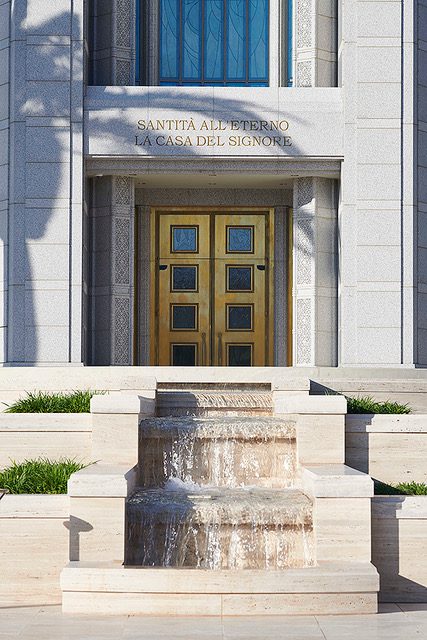
The main doors to the Rome Italy Temple, with inscription
(image sent to me by correspondent; ultimate provenance unknown)
***
I received an email yesterday afternoon from a former neighbor of mine from long ago, back when I was an unmarried BYU undergraduate. He had observed that all of the temples of the Church of Jesus Christ of Latter-day Saints bear an inscription, typically over the main entrance, announcing “Holiness to the Lord / The House of the Lord,” or whatever the equivalent might be in the predominant language of the area where the temple stands.
He had noticed, however, that the inscription on the Rome Italy Temple reads differently. “Santità all’Eterno,” it says. “La Casa del Signore.” “Holiness to the Eternal [One]. The House of the Lord.”
Puzzled, he looked at many different temples, and could find none, even in non-English languages, that didn’t use the same word in both phrases.
Why, he wanted to know, is that not the case in Italian? Does the difference between Eterno and Signore arise because the underlying words are different in Hebrew?
I spent a few minutes putting together an answer for him — it’s still incomplete, but I’m away from my home library and, anyway, I was running out of time. It occurs to me, though, that perhaps a few folks besides myself might enjoy reading what I came up with. Maybe — no, certainly — I’m just weird, but I enjoy words a lot:
Dear NNNN:
Good to hear from you!
Your question made me curious, so I’ve done a bit of looking. (Sorry to be slow in getting back to you. We were out tonight with friends.)
I examined four Old Testament passages (Psalm 23:6, Psalm 27:4, Psalm 122:1, 1 Samuel 1:7) containing the equivalent of “the House of the Lord.” And I also examined three Old Testament passages that the King James Bible renders as “Holiness to the Lord.”
In all of them, the Hebrew word translated as “Lord”— יְ֝הוָ֗ה (Yahweh, or Jehovah) — is the same. (Of course, Jews didn’t pronounce the divine name aloud, but replaced it with Adonai or Lord.). Likewise, in the ancient Greek Septuagint translation, the word is the same in all examples: κύριος (“Lord”). It’s also the same across all of the passages in the ancient Latin Vulgate: Dominus (“Lord”).
There is no difference in the words behind the passages. So the variation between Eterno and Signore above the entrance to the Temple doesn’t reflect a variation in the ancient texts that underlie it.
Where does it come from, then? I can only speculate—and not merely because I don’t have access, where I am right now, to the books that I should be consulting.
My speculative explanation is that the difference occurs because of the Bible translation that, I’m guessing, has been adopted by members of the Church of Jesus Christ of Latter-day Saints in Italy.
The 1971 CEI Bible, which is published by the Italian Bishops’ Conference (Conferenza Episcopale Italiana), is the official version of the Italian Catholic Church. For Psalm 23:6, Psalm 27:4, Psalm 122:1, and 1 Samuel 1:7, it has casa del Signore (“House of the Lord”). In Exodus 28:36 and 39:30, as well as in Zechariah 14:20-21, it has Sacro al Signore (“holy to the Lord”).
However, the most commonly used version of the Bible among Italian Protestants—and, I’m betting, among Italian Latter-day Saints—was translated by Giovanni Diodati in 1607, from Latin and Jewish documents. It has since been published in revised versions in 1641, 1712, 1744, 1819 and 1821. An edition in modern Italian, La Nuova Diodati, was published in 1991. In La Nuova Diodati, the relevant passages read, respectively casa dell’Eterno (“house of the Eternal”) and Santità all’Eterno (“Sanctity/Holiness to the Lord).
So, almost certainly, the first phrase of the Rome Italy Temple inscription, Santità all’Eterno, comes from the Protestant Nuova Diodati translation of the Bible. But the second phrase of the inscription, La Casa del Signore, plainly doesn’t. My bet is that it comes from the plain translation of the term “house of the Lord” as it occurs in the uniquely Latter-day Saint scriptures. (In Italian, James E. Talmage’s book The House of the Lord is titled La Casa del Signore.) But (beyond the Bible, which is easily accessible online) I don’t have access here to the Italian Standard Works .
Does that make sense? More than you wanted to know!
Dan Peterson
Incidentally, a Rome Italy Temple would have been unthinkable earlier in my life. And now my friend and longtime BYU Arabist colleague Jim Toronto — formerly president of the Central Eurasian Mission, based in Istanbul, from 2015 to 2017, and, before that, of the Italy Catania Mission from 2007 to 2010 — has recently been announced as the second president of that very temple, to be accompanied his wife, Diane Gillett Toronto, as temple matron.
My wife and I also know the first temple president and temple matron — Craig and Julie Anne Metcalfe Pacini — somewhat, having met them earlier, when they were presiding over the Italy Rome Mission. (They were very excited at that time about the temple that had recently been announced for Rome.) Among other things, we had dinner with them in a charming little ristorante, after which, President Pacini promised, he would take us to a place where, standing in one country, one could look across another country and see a third country. I was very curious as to what kind of place this might be. He took us to the embassy of the Republic of Malta, where, standing upon Italian soil, we bent down to peer through a grand, old-fashioned keyhole. Doing so, we could see the dome of St. Peter’s Basilica through a large window in the opposite wall of the embassy. How did this fulfill President Pacini’s promise? Embassies are the sovereign and inviolable territory of the countries that they represent. So, standing before the Maltese embassy’s door, we were gazing across Maltese territory. And, of course, St. Peter’s Basilica rises at the heart of Vatican City, which is an independent country of which the Pope is the head of state. Ergo, we were looking across to a third nation. We got a kick out of that.
Posted from St. George, Utah
Previous Post

March 15, 2022
Hints of the Presence of the Creator
Next Post
March 17, 2022 Thoughts on Genesis, Science, and Faith
Browse Our Archives
Select a Category Uncategorized
Select a Month October 2026 September 2026 August 2026 July 2026 June 2026 May 2026 April 2026 March 2026 February 2026 January 2026 December 2025 November 2025 October 2025 September 2025 August 2025 July 2025 June 2025 May 2025 April 2025 March 2025 February 2025 January 2025 December 2024 November 2024 October 2024 September 2024 August 2024 July 2024 June 2024 May 2024 April 2024 March 2024 February 2024 January 2024 December 2023 November 2023 October 2023 September 2023 August 2023 July 2023 June 2023 May 2023 April 2023 March 2023 February 2023 January 2023 December 2022 November 2022 October 2022 September 2022 August 2022 July 2022 June 2022 May 2022 April 2022 March 2022 February 2022 January 2022 December 2021 November 2021 October 2021 September 2021 August 2021 July 2021 June 2021 May 2021 April 2021 March 2021 February 2021 January 2021 December 2020 November 2020 October 2020 September 2020 August 2020 July 2020 June 2020 May 2020 April 2020 March 2020 February 2020 January 2020 December 2019 November 2019 October 2019 September 2019 August 2019 July 2019 June 2019 May 2019 April 2019 March 2019 February 2019 January 2019 December 2018 November 2018 October 2018 September 2018 August 2018 July 2018 June 2018 May 2018 April 2018 March 2018 February 2018 January 2018 December 2017 November 2017 October 2017 September 2017 August 2017 July 2017 June 2017 May 2017 April 2017 March 2017 February 2017 January 2017 December 2016 November 2016 October 2016 September 2016 August 2016 July 2016 June 2016 May 2016 April 2016 March 2016 February 2016 January 2016 December 2015 November 2015 October 2015 September 2015 August 2015 July 2015 June 2015 May 2015 April 2015 March 2015 February 2015 January 2015 December 2014 November 2014 March 2014 August 2013 February 2012
Follow Us!
TAKE THE
Religious Wisdom Quiz
Which book of the Bible contains the Ten Plagues of Egypt?
Select your answer to see how you score.
Leviticus Exodus Genesis Deuteronomy
Related posts from Sic et Non

The Iron Gates and the Lion of the...


Learning more about a region of which I've...

From Serbia's "White City," Belgrade
TRENDING AT PATHEOS Latter-day Saint

In one sense walking into Westminster Abbey is like walking down the...

'Super Scam Me' Exposes AI Jon Bon Jovi...
Leslie Pickett believed she was in a relationship with Jon Bon Jovi....

The Brazilian Remake of Kendricks' 'Flywheel' Opens in...
“Flywheel,” the story that launched the Kendrick Brothers’ filmmaking career is getting...

The Dangers of Gradual Accommodation (Winking at Sin)
Recently, the “law of gradualness” resurfaced during the opening of a weeklong,...

The Iron Gates and the Lion of the...
Yesterday, I didn't finish my report about, well, yesterday. So I'll...

The Image: On the Horror of Capitalism and...
The Image Then went the Pharisees, and took counsel how they might...
view all Latter-day Saint blogs
Ad-Free & Subscriber Log-In Subscription Support
- About Us
- 2026 Calendar
- Videos
- Podcasts
- Library of World Religions
- Faith In Media Tracker
- Advertise With Us
- Write for Us
- Privacy Policy
- Terms of Service
- Do Not Sell My Data
- Contact Us
- Radiant Digital
- Manage Newsletter Subscriptions
- Unsubscribe From Notifications
- Sitemap
Copyright 2008-2026, Patheos. All rights reserved.
Subscription Support Ad-Free & Subscriber Log-In
Follow Patheos