
BuddhistCatholicContemplativeEvangelicalGeneral ChristianHinduJewishLatter-day SaintMuslimNew VisionsProgressive Christian
Beliefs
- Buddhist
- Catholic
- Contemplative
- Evangelical
- General Christian
- Hindu
- Jewish
- Latter-day Saint
- More Voices
- Muslim
- New Visions
- Pagan
- Progressive Christian
Topics
- Religion News
- Food and Religion
- Sports and Religion
- Religious Art
- Religious Music and Entertainment
- Religious Events
- History and Religion
- Style and Religion
- Politics and Religion
- Women in Religion
- Recreation Outdoors and Religion
- Business Finance and Religion
- Careers Workplace and Religion
- Education and Religion
- Family Parenting and Religion
- Health Fitness and Religion
- Home and Religion
- Relationships and Religion
- Technology and Religion
- Travel and Religion
Columnists
- Buddhist Columnists
- Business Finance and Religion Columnists
- Careers Workplace and Religion Columnists
- Catholic Columnists
- Contemplative Columnists
- Education and Religion Columnists
- Evangelists Columnists
- Family Parenting and Religion Columnists
- General Christian Columnists
- Health Fitness and Religion Columnists
- Hindu Columnists
- History and Religion Columnists
- Home and Religion Columnists
- Jewish Columnists
- More Voices Columnists
- Latter Day Columnists
- Muslim Columnists
- New Visions Columnists
- Nonreligious Columnists
- Pagan Columnists
- Politics and Religion Columnists
- Progressive Columnists
- Recreation Outdoors and Religion Columnists
- Relationships and Religion Columnists
- Religion News Columnists
- Religious Art Columnists
- Religious Events Columnists
- Religious Music and Entertainment Columnists
- Sports and Religion Columnists
- Style and Religion Columnists
- Technology and Religion Columnists
- Travel and Religion Columnists
- Women in Religion Columnists
Resource Library
- 2026 Calendar
- Library of World Religions
- The 100 Most Holy Places on Earth
- Patheos Answers
- Podcasts
- Videos
- Faith Leaders Database
- Anglican Episcopalian
- Bahai
- Baptist
- Buddhism
- Christianity
- Confucianism
- Eastern Orthodoxy
- Hinduism
- Holiness and Pentecostal
- ISKCON
- Islam
- Judaism
- Lutheran
- Methodist
- The Church of Jesus Christ of Latter-day Saints
- New Age
- Paganism
- Presbytarian and Reformed
- Protestantism
- Religion Behind the Scenes
- Roman Catholic
- Scientology
- Shia Islam
- Sikhism
- Sufism
- Sunni Islam
- Taoism
- Zen
- See all religions
Research Tools
 Ad-Free & Subscriber Log-In Subscription Support
Ad-Free & Subscriber Log-In Subscription Support
Follow Patheos 

- Trending:
- Forgiveness
- |
- Marriage
- |
- Consciousness
- |
- Death Penalty
- |
- Election
- |
- Halloween

- Home
- Latter-day Saint
- A Pretty Good Planet to Be Born On
A Pretty Good Planet to Be Born On
Last updated on: March 31, 2022 at 6:54 pm by Dan Peterson
A Pretty Good Planet to Be Born On 2022-03-31T18:54:37-06:00 Dan Peterson
Patheos Explore the world's faith through different perspectives on religion and spirituality! Patheos has the views of the prevalent religions and spiritualities of the world.
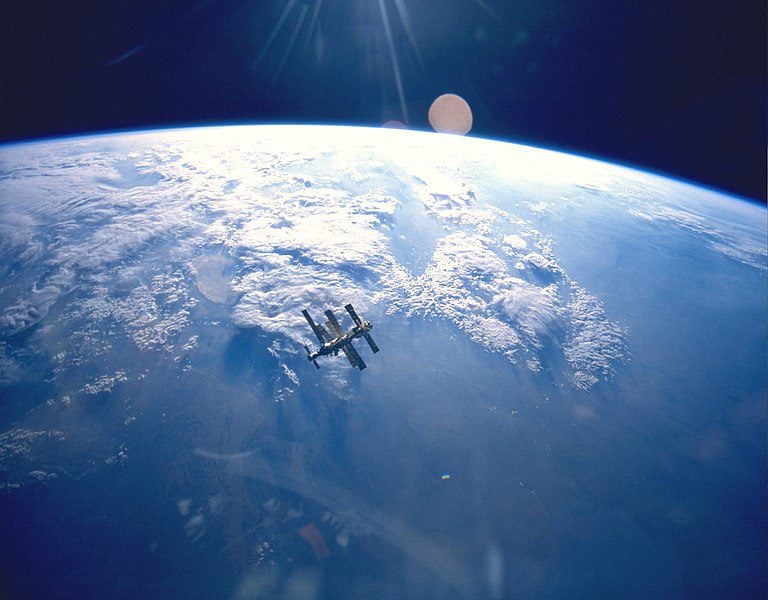
The Russian space station Mir, photographed from the American shuttle Atlantis on 4 July 1995
(NASA public domain photo)
Mir’s orbital altitude averaged about 223 miles above Earth’s surface.
***
From the Best-Laid Plans Department: I gave a lecture last night up at the Jordan Events Center on the life of the Reformer Martin Luther. It was occasioned by the fact that, in June, I’ll be accompanying a tour to Germany in connection with the Oberammergau Passion Play. Thanks to my wife, I had some really good images put together to illustrate Luther’s biography and times. Thanks to the on-site computer, the PowerPoint presentation didn’t work. But the folks there spent the first twenty of my lecture vainly trying to make it work, which pretty well nuked the opening of my remarks and considerably weakened what I had to say. Oh well. Live by technology, die by technology.
Happily, though, the technology worked for us pretty well today. Most of my day was devoted to an interview by Camrey Bagley Fox — Emma Smith in our theatrical film, Witnesses — for one of the short features that we’re producing as the culminating part of our overall “Witnesses” film project. I thought that the interview went fairly well, and I hope that our filmmakers can get something useful from it. These are pretty involved affairs; today’s filming involved two cameramen (Mark Goodman and James Jordan), a sound specialist (Russell Richins), and a make-up specialist (Laurie Vukich) — in my case, of course, the expression “lipstick on a pig” comes to mind — who also ran the teleprompter when it was needed for certain introductory material.
I’m grateful to Margaret and Lynn Dayton, who surrendered their beautiful home to us for the better part of the day. It provided a very nice place for an interview. I just hope that what I had to say proves worthy of the time and effort that others put into the work today.
***
The annual General Conference of the Church of Jesus Christ of Latter-day Saints will convene this weekend. I’m looking forward to it. In that light, though, here is a somewhat challenging article:
***
Gerald L. Schroeder is an Israeli-American and a devout Orthodox Jew who currently teaches at Jerusalem’s College of Jewish Studies. He studied at MIT, the Massachusetts Institute of Technology, earning B.Sc., M.Sc., and Ph.D. degrees there in nuclear physics and in earth and planetary sciences.
Here, drawn from his book God According to God: A Scientist Discovers We’ve Been Wrong About God All Along (New York: HarperOne, 2009), is a discussion about our rather special location among the planets orbiting our sun:
It is not surprising that Mercury is tidally locked to the sun. At 58 million kilometers from the sun, it is the closest planet to the sun. What is unexpected, on a superficial analysis, is that Venus is also tidally locked to the sun. Venus, at 108 million kilometers from the sun, is twice the distance from the sun compared to Mercury, and still the force of the sun’s pull has locked it into rotational sync. Venus is just under 30 percent closer to the sun than earth. Its period of rotation is 243 days, while its revolution around the sun takes 225 days. Aside from Mercury, Venus is the only other solar planet thus locked. Had the earth been closer to the sun, it too would have suffered a similar fate, one side baking and one side freezing.
A glance at the spacing of the seven inner planets tells wonders. (Neptune and Pluto are not considered here, since their orbits cross and therefore interact. From 1979 to 1999 Pluto was actually closer to the sun than was Neptune.) The orbit of each of the seven inner planets places it at approximately twice the distance to the sun as the planet in front of it. For example, Mercury is 58 million kilometers from the sun, and Venus is 108 million kilometers. Mars’s distance, 228 million kilometers, is approximately twice the distance of Venus from the sun. The asteroid belt similarly is twice the distance from the sun as is Mars. The nominal doubling pattern repeats with Jupiter (780 million kilometers), Saturn (1,430 million kilometers), and Uranus (2,870 million kilometers).
The exception to the pattern of doubled spacing between the planets is earth. According to this pattern, there should be no planet in the exceptionally life-friendly region between Venus (too close) and Mars (too far). But here we are. As we say, the exception proves the rule. The rule here is that we reside on a very special planet at a very special location within a very special stellar system, formed at just the right position within the right kind of galaxy. The earth’s distance from the sun, for the right amount of warmth, and its mass and gravity, for the ability to retain a proper atmosphere, put us in the only habitable zone within the solar system. (66-67)
Mars is already too far from the sun for tidal locking. It revolves around the sun in 687 of our days and rotates each 24.6 hours, a match of the earth’s rotation rate. But at 228 million kilometers from the sun, insufficient solar radiation reaches it. Average surface temperature is minus 50 degrees C (minus 58 degrees F). Mars is also much smaller than the earth, with one-tenth the earth’s mass and just over half the earth’s diameter. Its gravity is too weak to hold a deep atmosphere. Surface atmospheric pressure is approximately 1 percent of earth’s. Though the surface topography of Mars shows geological signs of past water-derived erosion, there are no clear signs of abundant liquid water on its surface today. Its weak gravitational field may have allowed the gradual loss of water vapor to space. If the locations of earth and Mars were reversed, there’d be a slim chance of life larger than one-celled microbes developing on either planet.
The next planet past Mars, or more accurately stated, the debris that might have formed into [a] planet were it in another location, is the asteroid belt. That ring of stellar debris, rocks and boulders, might have coalesced into a planet, had it not been for the huge disruptive gravitational forces of giant Jupiter, the next planet in the solar system. The gravity of Jupiter working against the gravity of the sun literally tore apart any cohesive groupings of these asteroid rocks that might have formed into a planet.
The distance between the asteroid belt and Jupiter is similar to the distance between the asteroid belt and the sun. Had a planet the mass of Jupiter been able to form in the region now occupied by the asteroids, then, just as the gravitational force of Jupiter has obviated the possibility of a planet forming at that distance, the gravitational force of the hypothetical Jupiter-like planet located in the asteroid belt would have torn apart any inner planets between it and the sun, the earth included. There’d be no planet within the habitable zone of the solar system. Are we seeing the hidden hand of God at work here? Perhaps. (67-68)
Previous Post

March 30, 2022
"Their prison is only in their own minds"
Next Post
April 1, 2022 "The Messenger of Salvation"
Browse Our Archives
Select a Category Uncategorized
Select a Month October 2026 September 2026 August 2026 July 2026 June 2026 May 2026 April 2026 March 2026 February 2026 January 2026 December 2025 November 2025 October 2025 September 2025 August 2025 July 2025 June 2025 May 2025 April 2025 March 2025 February 2025 January 2025 December 2024 November 2024 October 2024 September 2024 August 2024 July 2024 June 2024 May 2024 April 2024 March 2024 February 2024 January 2024 December 2023 November 2023 October 2023 September 2023 August 2023 July 2023 June 2023 May 2023 April 2023 March 2023 February 2023 January 2023 December 2022 November 2022 October 2022 September 2022 August 2022 July 2022 June 2022 May 2022 April 2022 March 2022 February 2022 January 2022 December 2021 November 2021 October 2021 September 2021 August 2021 July 2021 June 2021 May 2021 April 2021 March 2021 February 2021 January 2021 December 2020 November 2020 October 2020 September 2020 August 2020 July 2020 June 2020 May 2020 April 2020 March 2020 February 2020 January 2020 December 2019 November 2019 October 2019 September 2019 August 2019 July 2019 June 2019 May 2019 April 2019 March 2019 February 2019 January 2019 December 2018 November 2018 October 2018 September 2018 August 2018 July 2018 June 2018 May 2018 April 2018 March 2018 February 2018 January 2018 December 2017 November 2017 October 2017 September 2017 August 2017 July 2017 June 2017 May 2017 April 2017 March 2017 February 2017 January 2017 December 2016 November 2016 October 2016 September 2016 August 2016 July 2016 June 2016 May 2016 April 2016 March 2016 February 2016 January 2016 December 2015 November 2015 October 2015 September 2015 August 2015 July 2015 June 2015 May 2015 April 2015 March 2015 February 2015 January 2015 December 2014 November 2014 March 2014 August 2013 February 2012
Follow Us!
TAKE THE
Religious Wisdom Quiz
What Christian tradition is famous for the musical "Gregorian chant"?
Select your answer to see how you score.
Anglican Methodist Roman Catholic Presbyterian
Related posts from Sic et Non


Learning more about a region of which I've...

From Serbia's "White City," Belgrade

TRENDING AT PATHEOS Latter-day Saint

Methodist Central Hall and Westminster Abbey
Situated on the same square is Methodist Central Hall and Westminster Abbey. ...

57th Dove Awards Honor Dolly Parton, Crown New...
On gospel music’s biggest night, the 57th annual GMA Dove Awards honored...

The First Eucharistic Controversy: Christ’s Real Presence
For Catholics, the Eucharist is the source and summit of the Christian...

What a Stop Sign Can Teach Us About...
How to Make a Decision When You Can't Hear God Main point:...

Archdiocese Hosts Military Marriage Retreat in Germany
RASTATT, Germany — The transient military lifestyle, with its frequent deployments and...

Nearly every morning, I make the drive to Detroit with my high-school-age...
view all Latter-day Saint blogs
Ad-Free & Subscriber Log-In Subscription Support
- About Us
- 2026 Calendar
- Videos
- Podcasts
- Library of World Religions
- Faith In Media Tracker
- Advertise With Us
- Write for Us
- Privacy Policy
- Terms of Service
- Do Not Sell My Data
- Contact Us
- Radiant Digital
- Manage Newsletter Subscriptions
- Unsubscribe From Notifications
- Sitemap
Copyright 2008-2026, Patheos. All rights reserved.
Subscription Support Ad-Free & Subscriber Log-In
Follow Patheos