
BuddhistCatholicContemplativeEvangelicalGeneral ChristianHinduJewishLatter-day SaintMuslimNew VisionsProgressive Christian
Beliefs
- Buddhist
- Catholic
- Contemplative
- Evangelical
- General Christian
- Hindu
- Jewish
- Latter-day Saint
- More Voices
- Muslim
- New Visions
- Pagan
- Progressive Christian
Topics
- Religion News
- Food and Religion
- Sports and Religion
- Religious Art
- Religious Music and Entertainment
- Religious Events
- History and Religion
- Style and Religion
- Politics and Religion
- Women in Religion
- Recreation Outdoors and Religion
- Business Finance and Religion
- Careers Workplace and Religion
- Education and Religion
- Family Parenting and Religion
- Health Fitness and Religion
- Home and Religion
- Relationships and Religion
- Technology and Religion
- Travel and Religion
Columnists
- Buddhist Columnists
- Business Finance and Religion Columnists
- Careers Workplace and Religion Columnists
- Catholic Columnists
- Contemplative Columnists
- Education and Religion Columnists
- Evangelists Columnists
- Family Parenting and Religion Columnists
- General Christian Columnists
- Health Fitness and Religion Columnists
- Hindu Columnists
- History and Religion Columnists
- Home and Religion Columnists
- Jewish Columnists
- More Voices Columnists
- Latter Day Columnists
- Muslim Columnists
- New Visions Columnists
- Nonreligious Columnists
- Pagan Columnists
- Politics and Religion Columnists
- Progressive Columnists
- Recreation Outdoors and Religion Columnists
- Relationships and Religion Columnists
- Religion News Columnists
- Religious Art Columnists
- Religious Events Columnists
- Religious Music and Entertainment Columnists
- Sports and Religion Columnists
- Style and Religion Columnists
- Technology and Religion Columnists
- Travel and Religion Columnists
- Women in Religion Columnists
Resource Library
- 2026 Calendar
- Library of World Religions
- The 100 Most Holy Places on Earth
- Patheos Answers
- Podcasts
- Videos
- Faith Leaders Database
- Anglican Episcopalian
- Bahai
- Baptist
- Buddhism
- Christianity
- Confucianism
- Eastern Orthodoxy
- Hinduism
- Holiness and Pentecostal
- ISKCON
- Islam
- Judaism
- Lutheran
- Methodist
- The Church of Jesus Christ of Latter-day Saints
- New Age
- Paganism
- Presbytarian and Reformed
- Protestantism
- Religion Behind the Scenes
- Roman Catholic
- Scientology
- Shia Islam
- Sikhism
- Sufism
- Sunni Islam
- Taoism
- Zen
- See all religions
Research Tools
 Ad-Free & Subscriber Log-In Subscription Support
Ad-Free & Subscriber Log-In Subscription Support
Follow Patheos 

- Trending:
- Forgiveness
- |
- Marriage
- |
- Consciousness
- |
- Death Penalty
- |
- Election
- |
- Halloween

- Home
- Latter-day Saint
- Against the Gospel of Instagram
Against the Gospel of Instagram
Last updated on: March 29, 2022 at 11:09 pm by Dan Peterson
Against the Gospel of Instagram 2022-03-29T23:09:51-06:00 Dan Peterson
Patheos Explore the world's faith through different perspectives on religion and spirituality! Patheos has the views of the prevalent religions and spiritualities of the world.
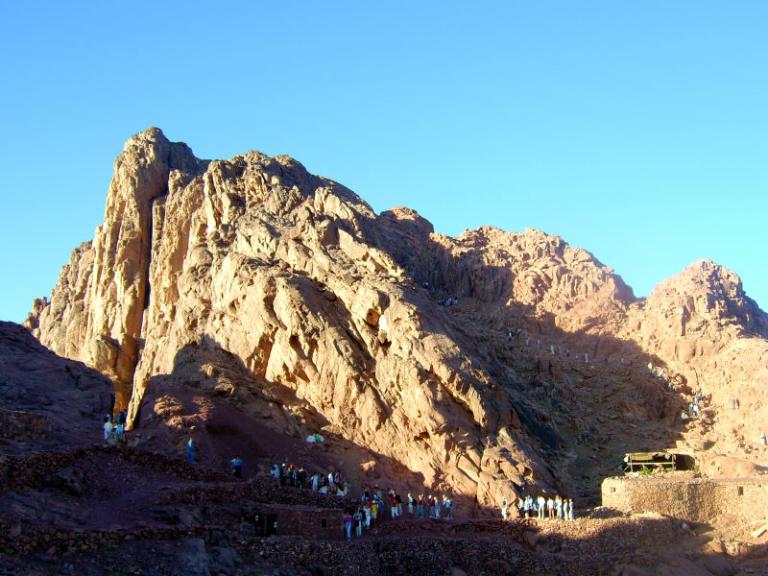
A large group of pilgrims (or tourists) near the summit of Jabal Musa (Mount Moses), the traditional location of Mount Sinai
(Wikimedia Commons public domain photo.)
***
I recently sat down with Scott and Maurine Proctor of Meridian Magazine for another “Come, Follow Me” podcast discussion:
(I had previously also discussed Exodus 1-6 with the Proctors.)
Tomorrow night — 7 PM, Sunday night, 27 March 2022 — I’m scheduled to be on the Interpreter Radio Show; during its second hour, I’ll be discussing Exodus 35-40 with Steve Densley, Mark Johnson, and Matt Bowen.
***
I wonder how many of you have seen a film called The Cokeville Miracle. I think that it would be appropriate for viewing on the Sabbath. Years ago, I read some things about the remarkable 1986 story upon which the film is based, and I’ve spoken with people who had family members there in Cokeville, Wyoming. And, two or three times now, I’ve even stopped off in Cokeville while driving home from Yellowstone, wanting to have a sense for where the events unfolded.
That said, I still learned a few things about the story from the film that I hadn’t known. I assume, though I don’t know it for certain, that they’re based in fact.
The standard source on the events at Cokeville has long been the book by Judene and Hartt Wixom, which, I believe, has now been reissued under a revised title in connection with the movie. The Wixoms’ son Kamron, twelve years old at the time, was among the hostages at the elementary school.
Here’s a good website on the story, including eyewitness accounts:
http://www.cokevillemiracle.com
I like its banner headline: “If you don’t believe in divine intervention then you weren’t there that day,” which it attributes to “Scott Miller, Lincoln County Sheriff’s Office.”
***
Steve Smoot kindly sent me this note some time back, and I just ran across it again:
Thought you’d appreciate this.
http://www.vox.com/2015/5/13/8591837/how-science-is-broken
That science can fail, however, shouldn’t come as a surprise to anyone. It’s a human construct, after all. And if we simply accepted that science often works imperfectly, we’d be better off. We’d stop considering science a collection of immutable facts. We’d stop assuming every single study has definitive answers that should be trumpeted in over-the-top headlines. Instead, we’d start to appreciate science for what it is: a long and grinding process carried out by fallible humans, involving false starts, dead ends, and, along the way, incorrect and unimportant studies that only grope at the truth, slowly and incrementally.
So why aren’t these problems caught prior to publication of a study? Consider peer review, in which scientists send their papers to other experts for vetting prior to publication. The idea is that those peers will detect flaws and help improve papers before they are published as journal articles. Peer review won’t guarantee that an article is perfect or even accurate, but it’s supposed to act as an initial quality-control step.
Yet there are flaws in this traditional “pre-publication” review model: it relies on the goodwill of scientists who are increasingly pressed and may not spend the time required to properly critique a work, it’s subject to the biases of a select few, and it’s slow – so it’s no surprise that peer review sometimes fails. These factors raise the odds that even in the highest-quality journals, mistakes, flaws, and even fraudulent work will make it through. (“Fake peer review” reports are also now a thing.)
But when Dan Peterson says any of this relatively uncontroversial stuff about science and peer review, he’s branded an anti-science fundamentalist loon.
Alas!
***
Here’s a pair of short but interesting reads. The first of them is by Richard Ostling, who is, among other things, a former senior editor of Time:
“This is still a question that scholars debate: Why did early Christianity rise so rapidly?”
The second of them is a very important warning from the redoubtable Cassandra Hedelius:
***
Finally, I first read the Meditations of the Stoic Roman Emperor Marcus Aurelius (AD 121-180) back when I was in high school. I’ve had a deep fondness for him ever since, and (although he himself was a pagan and not particularly friendly toward the novel sect of the Christians) much of what he had to say seems appropriate, in my view, for reflection on the Sabbath. After all, Sunday — tomorrow, as I write — is a time when faithful Latter-day Saints renew their covenants with God in the sacrament and when many of us resolve to try to make the next week better than the last one was. Here are some words of wisdom from Marcus Aurelius for such resolutions, though I sincerely hope that the first maxim doesn’t actually describe the members of your ward:
Ἕωθεν προλέγειν ἑαυτῷ: συντεύξομαι περιέργῳ, ἀχαρίστῳ, ὑβριστῇ, δολερῷ, βασκάνῳ, ἀκοινωνήτῳ: πάντα ταῦτα συμβέβηκεν ἐκείνοις παρὰ τὴν ἄγνοιαν τῶν ἀγαθῶν καὶ κακῶν.
“When you wake up in the morning, tell yourself: The people I deal with today will be meddling, ungrateful, arrogant, dishonest, jealous, and surly. They are like this because they can’t tell good from evil.”
Ὀλίγα πρῆσσε, φησίν, εἰ μέλλεις εὐθυμήσειν
“‘Let your occupations be few,’ says the sage, ‘if you would lead a tranquil life.'”
Ὄρθρου, ὅταν δυσόκνως ἐξεγείρῃ, πρόχειρον ἔστω ὅτι ἐπὶ ἀνθρώπου ἔργον ἐγείρομαι· ἔτι οὖν δυσκολαίνω, εἰ πορεύομαι ἐπὶ τὸ ποιεῖν ὧν ἕνεκεν γέγονα καὶ ὧν χάριν προῆγμαι εἰς τὸν κόσμον; ἢ ἐπὶ τοῦτο κατεσκεύασμαι, ἵνα κατακείμενος ἐν στρωματίοις ἐμαυτὸν θάλπω;
“At dawn, when you have trouble getting out of bed, tell yourself: ‘I have to go to work – as a human being. What do I have to complain of, if I’m going to do what I was born for – the things I was brought into the world to do? Or is this what I was created for? To huddle under the blankets and stay warm?’”
Μηκέθ᾽ ὅλως περὶ τοῦ οἷόν τινα εἶναι τὸν ἀγαθὸν ἄνδρα διαλέγεσθαι, ἀλλὰ εἶναι τοιοῦτον.
“Waste no more time arguing what a good man should be. Be one.”
I’m also fond of this passage from the great UCLA basketball coach John Wooden:
“Make each day your masterpiece.”
I fail at it every day.
Marcus Aurelius is especially good in times of tumult or worry. His is a very calm and calming spirit, encouraging us to focus on what’s most important and and on what’s unchanging rather than on the often distressing and almost always distracting things about us.
I see considerable consistency between much of the Emperor’s counsel and some of the teaching of the late Thomas S. Monson:
“Do not pray for tasks equal to your abilities, but pray for abilities equal to your tasks. Then the performance of your tasks will be no miracle, but you will be the miracle.”
“The principles of living greatly include the capacity to face trouble with courage, disappointment with cheerfulness, and trial with humility.”
Previous Post

March 25, 2022
"An Unexpected Case for an Anthropomorphic God"
Next Post
March 27, 2022 "Reflections on the God Debate"
Browse Our Archives
Select a Category Uncategorized
Select a Month October 2026 September 2026 August 2026 July 2026 June 2026 May 2026 April 2026 March 2026 February 2026 January 2026 December 2025 November 2025 October 2025 September 2025 August 2025 July 2025 June 2025 May 2025 April 2025 March 2025 February 2025 January 2025 December 2024 November 2024 October 2024 September 2024 August 2024 July 2024 June 2024 May 2024 April 2024 March 2024 February 2024 January 2024 December 2023 November 2023 October 2023 September 2023 August 2023 July 2023 June 2023 May 2023 April 2023 March 2023 February 2023 January 2023 December 2022 November 2022 October 2022 September 2022 August 2022 July 2022 June 2022 May 2022 April 2022 March 2022 February 2022 January 2022 December 2021 November 2021 October 2021 September 2021 August 2021 July 2021 June 2021 May 2021 April 2021 March 2021 February 2021 January 2021 December 2020 November 2020 October 2020 September 2020 August 2020 July 2020 June 2020 May 2020 April 2020 March 2020 February 2020 January 2020 December 2019 November 2019 October 2019 September 2019 August 2019 July 2019 June 2019 May 2019 April 2019 March 2019 February 2019 January 2019 December 2018 November 2018 October 2018 September 2018 August 2018 July 2018 June 2018 May 2018 April 2018 March 2018 February 2018 January 2018 December 2017 November 2017 October 2017 September 2017 August 2017 July 2017 June 2017 May 2017 April 2017 March 2017 February 2017 January 2017 December 2016 November 2016 October 2016 September 2016 August 2016 July 2016 June 2016 May 2016 April 2016 March 2016 February 2016 January 2016 December 2015 November 2015 October 2015 September 2015 August 2015 July 2015 June 2015 May 2015 April 2015 March 2015 February 2015 January 2015 December 2014 November 2014 March 2014 August 2013 February 2012
Follow Us!
TAKE THE
Religious Wisdom Quiz
What did God change Abram’s name to?
Select your answer to see how you score.
Moses Isaac Jacob Abraham
Related posts from Sic et Non

"The Book of Moses as a Temple Text"



A Potpourri of Thoughts on the Fourth of...
TRENDING AT PATHEOS Latter-day Saint

Swimfan: Forgotten Aughts Pleasures
This is a recovery effort. In 2002, My Big Fat Greek Wedding...

Top Three Anti-Catholic Lies About Catholicism
This is my initial transcript for the video, "THE 3 WORST...

Pope Leo Celebrates Mass for Nurses & Docs...
I don't have any idea how he did it, but Pope Leo...

The Sermon on the Mount, Part I: Matthew...
The Sermon on the Mount, Part I (Matthew 4:12-5:12) St. Matthew moves...

What's up from Crossway: Reviewing some of their latest A few weeks...

Janie Learns the Way of the Cross: A...
Teaching children about Jesus' Passion can be challenging. Many parents and educators...
view all Latter-day Saint blogs
Ad-Free & Subscriber Log-In Subscription Support
- About Us
- 2026 Calendar
- Videos
- Podcasts
- Library of World Religions
- Faith In Media Tracker
- Advertise With Us
- Write for Us
- Privacy Policy
- Terms of Service
- Do Not Sell My Data
- Contact Us
- Radiant Digital
- Manage Newsletter Subscriptions
- Unsubscribe From Notifications
- Sitemap
Copyright 2008-2026, Patheos. All rights reserved.
Subscription Support Ad-Free & Subscriber Log-In
Follow Patheos