
BuddhistCatholicContemplativeEvangelicalGeneral ChristianHinduJewishLatter-day SaintMuslimNew VisionsProgressive Christian
Beliefs
- Buddhist
- Catholic
- Contemplative
- Evangelical
- General Christian
- Hindu
- Jewish
- Latter-day Saint
- More Voices
- Muslim
- New Visions
- Pagan
- Progressive Christian
Topics
- Religion News
- Food and Religion
- Sports and Religion
- Religious Art
- Religious Music and Entertainment
- Religious Events
- History and Religion
- Style and Religion
- Politics and Religion
- Women in Religion
- Recreation Outdoors and Religion
- Business Finance and Religion
- Careers Workplace and Religion
- Education and Religion
- Family Parenting and Religion
- Health Fitness and Religion
- Home and Religion
- Relationships and Religion
- Technology and Religion
- Travel and Religion
Columnists
- Buddhist Columnists
- Business Finance and Religion Columnists
- Careers Workplace and Religion Columnists
- Catholic Columnists
- Contemplative Columnists
- Education and Religion Columnists
- Evangelists Columnists
- Family Parenting and Religion Columnists
- General Christian Columnists
- Health Fitness and Religion Columnists
- Hindu Columnists
- History and Religion Columnists
- Home and Religion Columnists
- Jewish Columnists
- More Voices Columnists
- Latter Day Columnists
- Muslim Columnists
- New Visions Columnists
- Nonreligious Columnists
- Pagan Columnists
- Politics and Religion Columnists
- Progressive Columnists
- Recreation Outdoors and Religion Columnists
- Relationships and Religion Columnists
- Religion News Columnists
- Religious Art Columnists
- Religious Events Columnists
- Religious Music and Entertainment Columnists
- Sports and Religion Columnists
- Style and Religion Columnists
- Technology and Religion Columnists
- Travel and Religion Columnists
- Women in Religion Columnists
Resource Library
- 2026 Calendar
- Library of World Religions
- The 100 Most Holy Places on Earth
- Patheos Answers
- Podcasts
- Videos
- Faith Leaders Database
- Anglican Episcopalian
- Bahai
- Baptist
- Buddhism
- Christianity
- Confucianism
- Eastern Orthodoxy
- Hinduism
- Holiness and Pentecostal
- ISKCON
- Islam
- Judaism
- Lutheran
- Methodist
- The Church of Jesus Christ of Latter-day Saints
- New Age
- Paganism
- Presbytarian and Reformed
- Protestantism
- Religion Behind the Scenes
- Roman Catholic
- Scientology
- Shia Islam
- Sikhism
- Sufism
- Sunni Islam
- Taoism
- Zen
- See all religions
Research Tools
 Ad-Free & Subscriber Log-In Subscription Support
Ad-Free & Subscriber Log-In Subscription Support
Follow Patheos 

- Trending:
- Forgiveness
- |
- Marriage
- |
- Consciousness
- |
- Death Penalty
- |
- Election
- |
- Halloween

- Home
- Latter-day Saint
- Life in a Finely-Tuned Cosmos
Life in a Finely-Tuned Cosmos
Last updated on: March 1, 2022 at 12:16 am by Dan Peterson
Life in a Finely-Tuned Cosmos 2022-03-01T00:16:49-07:00 Dan Peterson
Patheos Explore the world's faith through different perspectives on religion and spirituality! Patheos has the views of the prevalent religions and spiritualities of the world.
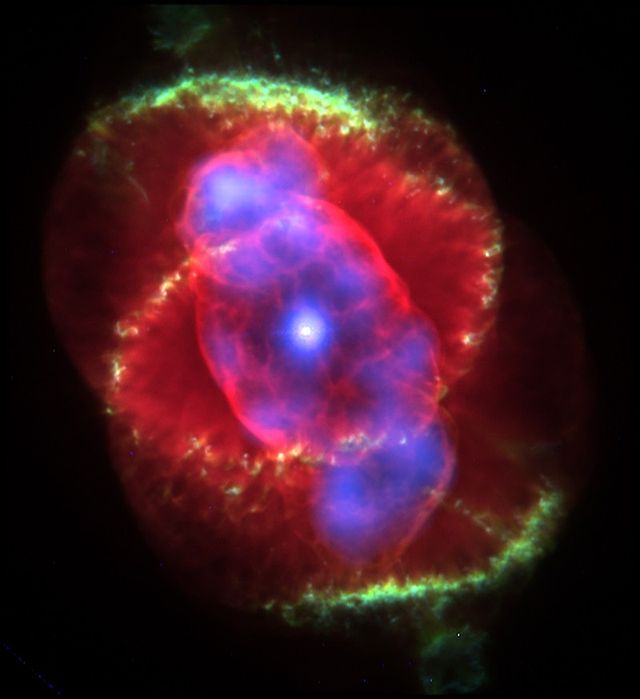
Composite photograph of the Cat’s Eye Nebula (Wikimedia Commons public domain image)
***
Some time back, I read Geraint F. Lewis and Luke A. Barnes, A Fortunate Universe: Life in a Finely Tuned Cosmos (Cambridge: Cambridge University Press, 2016). Here are just a few of the passages from the book that I marked for future use:
Consider gravity. Newton described gravity with his famous ‘inverse square’ law: any two masses attract each other, with a force that decreases with the square of the distance. Einstein’s General Theory of Relativity is a more accurate and more difficult improvement on Newton’s theory. In both theories, a quantity known as Newton’s gravitational constant appears, which is usually given the symbol of G and has a value of 6.67 x 10⁻¹¹ m3 kg-1 s-2.
If the value of G were different, what would happen? We need to be a bit careful here. Suppose we’ve transported you to another universe and asked you to measure G. You’ll need to calibrate your instruments to measure metres, seconds and kilograms. But wait . . . that platinum-iridium lump is back in our Universe! Thankfully, changing G doesn’t affect the elements, so we can (in principle!) make what we need. With some caesium 133, you can calibrate your clocks to measure seconds. Measuring the speed of light gives the metre: the distance light travels in 1/299, 792, 458 of a second. We can then construct a replica platinum-iridium lump to give us the kilogram. You can then measure G.
Nothing in Newton’s or Einstein’s theory tells us the value of G. We have to ask nature, measuring from experiment.
In Newton’s theory, if G were twice as large, the gravitational force between masses would be twice as large. In Einstein’s deeper understanding of gravity, G measures how strongly mass and energy distort the geometry of spacetime. Changing the value of G affects just about everything in astrophysics, from the expansion of the Universe and the formation of galaxies to the size and stability of stars and planets.
Similar constants appear in all of the force laws, where they are called coupling constants. The only way we have of knowing the value of these constants is to measure them from nature. (pages 30-32)
Let me repeat two of those sentences: (1) “Nothing in Newton’s or Einstein’s theory tells us the value of G. We have to ask nature, measuring from experiment.” (2) “The only way we have of knowing the value of these constants is to measure them from nature.”
In other words, important as these constants are to the emergence of the Universe and of life within it, there is (so far as we now know) nothing inevitable about them. Neither Newton’s theory nor Einstein’s theory predicts their specific values. That is — once again, so far as we know — they’re both contingent. They could have been otherwise. And, in many cases, had they been even slightly different than they actually are, neither we nor the planets, stars, and galaxies would be here.
‘Almost everything is already discovered’, a young Max Planck was told in 1874. Planck, who would become one of the greatest scientists of the twentieth century, had travelled to Munich to embark on a career in physics, only to be told by Professor Philipp von Jolly to study something else, as ‘theoretical physics was approaching a degree of completion which geometry had possessed for hundreds of year.'” (p. 183) [Quoted from Friedel Weinert, The Scientist as Philosopher: Philosophical Consequences of Great Scientific Discoveries (New York: Springer, 2004), 193.]
Science is facing a seemingly simple question whose answer would completely change what we think about the physical world. And that question is ‘Why is the Universe just right for the formation of complex, intelligent beings? . . . Why, in the almost infinite sea of possibilities, was our Universe born with the conditions that allow life to arise?’ (pp. 1, 2)
Also, even our best and deepest physical theories have loose ends. There are numbers in the equations that the theory cannot predict. We just have to measure them. They are called the constants of nature. Why do they have the value that we measure? If that question has an answer, it must go beyond our current theories. (p. 8)
Luke: Maybe it’s like the lottery — a winning ticket isn’t too unlikely because lots of people buy different tickets.
That last idea, applied to the fine-tuning of the Universe for life, is rather ambitious. It supposes that a universe that is right for life exists because there are untold multitudes of universes with different properties. In the cosmic lottery, we got lucky.
Geraint: Sounds like science fiction.
Luke: Some think so. Others, seeing the lack of plausible ideas for explaining the values of the constants of nature, take the idea seriously.
Geraint: And us?
Luke: We’re writing a book about it. (p. 9)
Every cell in your body, for example, has molecular machines for moving itself, tagging and transporting molecules, processing food, defending against invaders, DNA duplication and repair, producing proteins and receiving and processing outside signals. On top of all that, this entire machine can tear itself in half and produce a complete working copy in about 20 minutes. A modern computer is pretty great, but it can’t do that. (pp. 11-12)
Our models are mixtures of well-tested theories, reasonable assumptions and guesses; as Richard Feynman [d. 1988; 1965 Nobel laureate in physics] noted, ‘it is not unscientific to make a guess.’ Science happens when we ask the Universe whether we guessed right. Otherwise, the experimenter is doing little more than stamp collecting, and the theorist is just playing with numbers! (26)
A bank vault is robbed. The armoured door was opened without force; the robbers used the access code. The police arrive on the scene.
Drebin: Maybe they guessed the code.
Hocken: No way, Frank. There are a trillion combinations. The system shows that they entered the code correctly on the first attempt. Surely the odds agains that are astronomical.
Drebin: But it’s still possible, right? (28)
The fine-tuning of the Universe for life, then, is fine-tuning applied specifically to the fact that this universe supports life forms. The claim is that small changes in the free parameters of the laws of nature as we know them have dramatic, uncompensated and detrimental effects on the ability of the Universe to support the complexity needed for physical life forms. (29)
Here’s one of those parameters for consideration:
The electron is one of the fundamental particles of the Universe. Electron orbits around the nuclei of atoms dictate the processes of chemistry. With the appropriate experimental equipment, we can measure the mass of an individual proton: 9.109 382 15 x 10-31 kg (and, with our most accurate equipment, we know this value has an uncertainty of 0.000 000 45 x 10-31 kg). If you measure the mass of any electron in the Universe, you get the same answer!
When we measure the mass of an object in kilograms, we are implicitly comparing it to a lump of platinum-iridium alloy held in uniform conditions at the International Bureau of Weights and Measure laboratories in the outer reaches of Paris. There is nothing special about this lump, and so nothing special about the kilogram. Nothing changes if we were to express the mass of the electron in pounds, long tons, grains or carats.
However, the mass of the electron relative to other particles in the Universe is important. Each member of the menagerie of fundamental particles comes with a mass, and while some are zero, many are just plain, unexplained numbers.
Here we can play our ‘what if?’ games. If we change the relative masses of the fundamental particles, what effect does this have on a complex, multi-cellular, balding primate sitting and typing on a planet orbiting a star? We’ll see in later chapters that the existence of life depends critically upon particle masses. Universes with different mass ratios are often sterile. (29-30)
Previous Post

February 26, 2022
What can Ukrainian Latter-day Saints expect if Putin gets his way?
Next Post
February 27, 2022 Brief Notes on "Terminal Lucidity" and Consciousness in Brain-Death
Browse Our Archives
Select a Category Uncategorized
Select a Month October 2026 September 2026 August 2026 July 2026 June 2026 May 2026 April 2026 March 2026 February 2026 January 2026 December 2025 November 2025 October 2025 September 2025 August 2025 July 2025 June 2025 May 2025 April 2025 March 2025 February 2025 January 2025 December 2024 November 2024 October 2024 September 2024 August 2024 July 2024 June 2024 May 2024 April 2024 March 2024 February 2024 January 2024 December 2023 November 2023 October 2023 September 2023 August 2023 July 2023 June 2023 May 2023 April 2023 March 2023 February 2023 January 2023 December 2022 November 2022 October 2022 September 2022 August 2022 July 2022 June 2022 May 2022 April 2022 March 2022 February 2022 January 2022 December 2021 November 2021 October 2021 September 2021 August 2021 July 2021 June 2021 May 2021 April 2021 March 2021 February 2021 January 2021 December 2020 November 2020 October 2020 September 2020 August 2020 July 2020 June 2020 May 2020 April 2020 March 2020 February 2020 January 2020 December 2019 November 2019 October 2019 September 2019 August 2019 July 2019 June 2019 May 2019 April 2019 March 2019 February 2019 January 2019 December 2018 November 2018 October 2018 September 2018 August 2018 July 2018 June 2018 May 2018 April 2018 March 2018 February 2018 January 2018 December 2017 November 2017 October 2017 September 2017 August 2017 July 2017 June 2017 May 2017 April 2017 March 2017 February 2017 January 2017 December 2016 November 2016 October 2016 September 2016 August 2016 July 2016 June 2016 May 2016 April 2016 March 2016 February 2016 January 2016 December 2015 November 2015 October 2015 September 2015 August 2015 July 2015 June 2015 May 2015 April 2015 March 2015 February 2015 January 2015 December 2014 November 2014 March 2014 August 2013 February 2012
Follow Us!
TAKE THE
Religious Wisdom Quiz
What does the Bible say is better than gold?
Select your answer to see how you score.
Strength Bread Wisdom Wine
Related posts from Sic et Non

This Wednesday, at 4 PM, Utah time

What if Wallace had prevailed, rather than Darwin?

"Water, water everywhere, nor any drop to drink"
TRENDING AT PATHEOS Latter-day Saint

57th Dove Awards Honor Dolly Parton, Crown New...
On gospel music’s biggest night, the 57th annual GMA Dove Awards honored...

The First Eucharistic Controversy: Christ’s Real Presence
For Catholics, the Eucharist is the source and summit of the Christian...

What a Stop Sign Can Teach Us About...
How to Make a Decision When You Can't Hear God Main point:...

Archdiocese Hosts Military Marriage Retreat in Germany
RASTATT, Germany — The transient military lifestyle, with its frequent deployments and...

Nearly every morning, I make the drive to Detroit with my high-school-age...

The Real AI Story Is Adoption Without Trust
Artificial intelligence has crossed a political threshold. It is no longer a...
view all Latter-day Saint blogs
Ad-Free & Subscriber Log-In Subscription Support
- About Us
- 2026 Calendar
- Videos
- Podcasts
- Library of World Religions
- Faith In Media Tracker
- Advertise With Us
- Write for Us
- Privacy Policy
- Terms of Service
- Do Not Sell My Data
- Contact Us
- Radiant Digital
- Manage Newsletter Subscriptions
- Unsubscribe From Notifications
- Sitemap
Copyright 2008-2026, Patheos. All rights reserved.
Subscription Support Ad-Free & Subscriber Log-In
Follow Patheos