
BuddhistCatholicContemplativeEvangelicalGeneral ChristianHinduJewishLatter-day SaintMuslimNew VisionsProgressive Christian
Beliefs
- Buddhist
- Catholic
- Contemplative
- Evangelical
- General Christian
- Hindu
- Jewish
- Latter-day Saint
- More Voices
- Muslim
- New Visions
- Pagan
- Progressive Christian
Topics
- Religion News
- Food and Religion
- Sports and Religion
- Religious Art
- Religious Music and Entertainment
- Religious Events
- History and Religion
- Style and Religion
- Politics and Religion
- Women in Religion
- Recreation Outdoors and Religion
- Business Finance and Religion
- Careers Workplace and Religion
- Education and Religion
- Family Parenting and Religion
- Health Fitness and Religion
- Home and Religion
- Relationships and Religion
- Technology and Religion
- Travel and Religion
Columnists
- Buddhist Columnists
- Business Finance and Religion Columnists
- Careers Workplace and Religion Columnists
- Catholic Columnists
- Contemplative Columnists
- Education and Religion Columnists
- Evangelists Columnists
- Family Parenting and Religion Columnists
- General Christian Columnists
- Health Fitness and Religion Columnists
- Hindu Columnists
- History and Religion Columnists
- Home and Religion Columnists
- Jewish Columnists
- More Voices Columnists
- Latter Day Columnists
- Muslim Columnists
- New Visions Columnists
- Nonreligious Columnists
- Pagan Columnists
- Politics and Religion Columnists
- Progressive Columnists
- Recreation Outdoors and Religion Columnists
- Relationships and Religion Columnists
- Religion News Columnists
- Religious Art Columnists
- Religious Events Columnists
- Religious Music and Entertainment Columnists
- Sports and Religion Columnists
- Style and Religion Columnists
- Technology and Religion Columnists
- Travel and Religion Columnists
- Women in Religion Columnists
Resource Library
- 2026 Calendar
- Library of World Religions
- The 100 Most Holy Places on Earth
- Patheos Answers
- Podcasts
- Videos
- Faith Leaders Database
- Anglican Episcopalian
- Bahai
- Baptist
- Buddhism
- Christianity
- Confucianism
- Eastern Orthodoxy
- Hinduism
- Holiness and Pentecostal
- ISKCON
- Islam
- Judaism
- Lutheran
- Methodist
- The Church of Jesus Christ of Latter-day Saints
- New Age
- Paganism
- Presbytarian and Reformed
- Protestantism
- Religion Behind the Scenes
- Roman Catholic
- Scientology
- Shia Islam
- Sikhism
- Sufism
- Sunni Islam
- Taoism
- Zen
- See all religions
Research Tools
 Ad-Free & Subscriber Log-In Subscription Support
Ad-Free & Subscriber Log-In Subscription Support
Follow Patheos 

- Trending:
- Forgiveness
- |
- Marriage
- |
- Consciousness
- |
- Death Penalty
- |
- Election
- |
- Halloween

- Home
- Latter-day Saint
- Places
Places
Last updated on: January 11, 2022 at 1:21 pm by Dan Peterson
Places 2022-01-11T13:21:23-07:00 Dan Peterson
Patheos Explore the world's faith through different perspectives on religion and spirituality! Patheos has the views of the prevalent religions and spiritualities of the world.
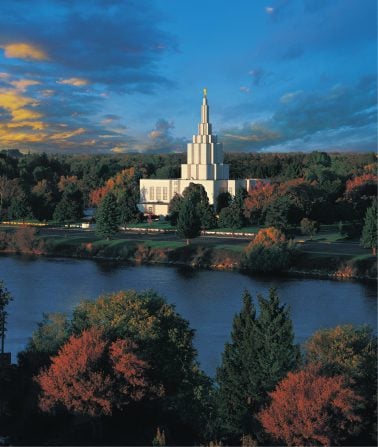
The Idaho Falls Idaho Temple, on the Snake River
(LDS Media Library)
***
For something that I’m writing, I read a 2016 article today entitled “Living and Traveling in the Arab and Moslem Worlds” that was written by my longtime BYU colleague Professor Chad F. Emmett, of the Department of Geography at Brigham Young University: Chad F. Emmett, “Living and Traveling in the Arab and Moslem Worlds,” The Arab World Geographer / Le Géographe du monde arabe 19: 3-4 (2016).
Professor Emmett begins his article with a quite negative account of the Palestinian Arab city of Nazareth that was written by a nineteenth-century traveler. A former missionary in Indonesia who went on to study Arabic and who has since traveled extensively in the Islamic world, Professor Emmett himself spent (and enjoyed) a year in Nazareth doing research for his University of Chicago doctoral dissertation. And then he closes his article with this comment, with which I heartily concur:
As a 19th-century pilgrim who also visited Nazareth and had little positive to say, Mark Twain once wrote: “Travel is fatal to prejudice, bigotry, and narrow-mindedness, and many of our people need it sorely on these accounts. Broad, wholesome, charitable views of men and things cannot be acquired by vegetating in one little corner of the earth all one’s lifetime” (Innocents Abroad).
***
Tonight, I read Henry B. Eyring, A Sacred Place Like This (Salt Lake City: Deseret Book, 2021). It’s a very short book and very small, and it consists mostly of (beautiful) photographs of temples. At the very beginning of the book, President Eyring recalls an experience from his youth:
I recall the first day I walked into the Salt Lake Temple. I was a young man. My parents were my only companions that day. Inside, they paused for a moment to be greeted by a temple worker. I walked on ahead of them, alone for a moment. . . .
I looked up at a high white ceiling that made the room so light it seemed almost as if it were open to the sky. And in that moment, the thought came into my mind in these clear words: “I have been in this lighted place before.”
gfBut then immediately there came into my mind, not in my own voice, these words: “No, you have never been here before. You are remembering a moment before you were born. You were in a sacred place like this.” (3, 6)
President Eyring’s recollection resonates powerfully with me, because I had a somewhat similar experience many years ago, probably when I was about fourteen or fifteen. I’ve never forgotten it.
I was visiting Idaho Falls for the first time, I think with my brother and his wife. (If I’m correct, it was the time that they took me with them on a long loop trip up through Utah, the Grand Tetons, Yellowstone, Glacier National Park, Banff and Jasper, and then down home to California via Olympic National Park in Washington. I fell in lifelong love with those places on that trip.) We stopped to walk around the temple grounds in the late summer evening, and it grew dark.
In those days, at least, the entrance to the temple consisted of a large area of clear glass, through which someone standing outside could see back to what I now know must have been the recommend desk. I was intrigued, I confess, by a place to which I could not be admitted, and I looked long and curiously at what I could see through the glass. I had just begun to develop an interest in, and a young testimony, of the Gospel. What was this place about?
I saw men and women, all dressed in white, silently passing back and forth before my eyes within this brilliantly illuminated and, to me, mysterious edifice. And suddenly it seemed very familiar, although I had never previously been in Idaho Falls. Not, at least, since I was a very, very small child on the way to Yellowstone with parents — one an inactive Latter-day Saint and the other a nonmember — who almost certainly wouldn’t have stopped to visit the temple there but would have simply passed on through. I seemed to remember having been in some such place before, a place that was full of light, quiet and deeply serene, holy, with people dressed in white. I felt as if I were looking into heaven. I’ve never forgotten that piercing and entirely unexpected sense of déjà vu, and I can certainly appreciate what the young Henry B. Eyring felt in the Salt Lake Temple.
***
The thirteenth-century poet Jalal al-Din Rumi is not only one of the greatest figures in the history of Persian literature but one of the very greatest of all Sufi mystics — Sufism being the mystical tradition in Islam. And Coleman Barks, who teaches poetry at the University of Georgia, has become a premiere Western interpreter of Rumi’s work.
I quote here from Coleman Barks, trans., The Essential Rumi (Edison, New Jersey: Castle Books, 1997), some passages illustrating Rumi’s belief — rare but not wholly unknown among classical Muslim writers — in the antemortal existence of the human soul or spirit. Unfortunately, I’ve been unable to fully reproduce Barks’s formatting:
Where did I come from, and what am I supposed to be doing?
I have no idea.
My soul is from elsewhere, I’m sure of that,
and I intend to end up there.
This drunkenness began in some other tavern.
When I get back around to that place,
I’ll be completely sober. Meanwhile,
I’m like a bird from another continent, sitting in this aviary.
The day is coming when I fly off . . .
Who looks out with my eyes? What is the soul?
I cannot stop asking.
If I could taste one sip of an answer,
I could break out of this prison for drunks.
I didn’t come here of my own accord, and I can’t leave that way.
Whoever brought me here will have to take me home. (2)
Another passage uses the image of a reed flute, with its plaintive sound, to talk about our finding ourselves “strangers and foreigners” in this fallen world, still vaguely aware that our true home is elsewhere:
Listen to the story told by the reed,
of being separated.
“Since I was cut from the reedbed,
I have made this crying sound.
Anyone apart from someone he loves
understands what I say.
Anyone pulled from a source
longs to go back.
At any gathering I am there,
mingling in the laughing and grieving,
a friend to each, but few
will hear the secrets hidden
within the notes. No ears for that.” (17-18)
Previous Post

January 9, 2022
"The spiritual power and influence of this gospel"
Next Post
January 11, 2022 "The veneer of civilization is frighteningly thin"
Browse Our Archives
Select a Category Uncategorized
Select a Month October 2026 September 2026 August 2026 July 2026 June 2026 May 2026 April 2026 March 2026 February 2026 January 2026 December 2025 November 2025 October 2025 September 2025 August 2025 July 2025 June 2025 May 2025 April 2025 March 2025 February 2025 January 2025 December 2024 November 2024 October 2024 September 2024 August 2024 July 2024 June 2024 May 2024 April 2024 March 2024 February 2024 January 2024 December 2023 November 2023 October 2023 September 2023 August 2023 July 2023 June 2023 May 2023 April 2023 March 2023 February 2023 January 2023 December 2022 November 2022 October 2022 September 2022 August 2022 July 2022 June 2022 May 2022 April 2022 March 2022 February 2022 January 2022 December 2021 November 2021 October 2021 September 2021 August 2021 July 2021 June 2021 May 2021 April 2021 March 2021 February 2021 January 2021 December 2020 November 2020 October 2020 September 2020 August 2020 July 2020 June 2020 May 2020 April 2020 March 2020 February 2020 January 2020 December 2019 November 2019 October 2019 September 2019 August 2019 July 2019 June 2019 May 2019 April 2019 March 2019 February 2019 January 2019 December 2018 November 2018 October 2018 September 2018 August 2018 July 2018 June 2018 May 2018 April 2018 March 2018 February 2018 January 2018 December 2017 November 2017 October 2017 September 2017 August 2017 July 2017 June 2017 May 2017 April 2017 March 2017 February 2017 January 2017 December 2016 November 2016 October 2016 September 2016 August 2016 July 2016 June 2016 May 2016 April 2016 March 2016 February 2016 January 2016 December 2015 November 2015 October 2015 September 2015 August 2015 July 2015 June 2015 May 2015 April 2015 March 2015 February 2015 January 2015 December 2014 November 2014 March 2014 August 2013 February 2012
Follow Us!
TAKE THE
Religious Wisdom Quiz
True or False: Twelve spies were sent to explore Canaan, and all gave a positive report.
Select your answer to see how you score.
TRUE FALSE
Related posts from Sic et Non


Notes on Women, Priesthood, and General Conference

"The Book of Moses as a Temple Text"
TRENDING AT PATHEOS Latter-day Saint

The Sermon on the Mount, Part I: Matthew...
The Sermon on the Mount, Part I (Matthew 4:12-5:12) St. Matthew moves...

What's up from Crossway: Reviewing some of their latest A few weeks...

Janie Learns the Way of the Cross: A...
Teaching children about Jesus' Passion can be challenging. Many parents and educators...

Looking For Good Catholic Writing - October 2026
He alone extends the heavens, and he walks upon the waves of...

In "Irreplaceable," our book on vocation and technology, Trevor Sutton and I...

I was strolling through the top floor of the brand new Parthenon...
view all Latter-day Saint blogs
Ad-Free & Subscriber Log-In Subscription Support
- About Us
- 2026 Calendar
- Videos
- Podcasts
- Library of World Religions
- Faith In Media Tracker
- Advertise With Us
- Write for Us
- Privacy Policy
- Terms of Service
- Do Not Sell My Data
- Contact Us
- Radiant Digital
- Manage Newsletter Subscriptions
- Unsubscribe From Notifications
- Sitemap
Copyright 2008-2026, Patheos. All rights reserved.
Subscription Support Ad-Free & Subscriber Log-In
Follow Patheos