
BuddhistCatholicContemplativeEvangelicalGeneral ChristianHinduJewishLatter-day SaintMuslimNew VisionsProgressive Christian
Beliefs
- Buddhist
- Catholic
- Contemplative
- Evangelical
- General Christian
- Hindu
- Jewish
- Latter-day Saint
- More Voices
- Muslim
- New Visions
- Pagan
- Progressive Christian
Topics
- Religion News
- Food and Religion
- Sports and Religion
- Religious Art
- Religious Music and Entertainment
- Religious Events
- History and Religion
- Style and Religion
- Politics and Religion
- Women in Religion
- Recreation Outdoors and Religion
- Business Finance and Religion
- Careers Workplace and Religion
- Education and Religion
- Family Parenting and Religion
- Health Fitness and Religion
- Home and Religion
- Relationships and Religion
- Technology and Religion
- Travel and Religion
Columnists
- Buddhist Columnists
- Business Finance and Religion Columnists
- Careers Workplace and Religion Columnists
- Catholic Columnists
- Contemplative Columnists
- Education and Religion Columnists
- Evangelists Columnists
- Family Parenting and Religion Columnists
- General Christian Columnists
- Health Fitness and Religion Columnists
- Hindu Columnists
- History and Religion Columnists
- Home and Religion Columnists
- Jewish Columnists
- More Voices Columnists
- Latter Day Columnists
- Muslim Columnists
- New Visions Columnists
- Nonreligious Columnists
- Pagan Columnists
- Politics and Religion Columnists
- Progressive Columnists
- Recreation Outdoors and Religion Columnists
- Relationships and Religion Columnists
- Religion News Columnists
- Religious Art Columnists
- Religious Events Columnists
- Religious Music and Entertainment Columnists
- Sports and Religion Columnists
- Style and Religion Columnists
- Technology and Religion Columnists
- Travel and Religion Columnists
- Women in Religion Columnists
Resource Library
- 2026 Calendar
- Library of World Religions
- The 100 Most Holy Places on Earth
- Patheos Answers
- Podcasts
- Videos
- Faith Leaders Database
- Anglican Episcopalian
- Bahai
- Baptist
- Buddhism
- Christianity
- Confucianism
- Eastern Orthodoxy
- Hinduism
- Holiness and Pentecostal
- ISKCON
- Islam
- Judaism
- Lutheran
- Methodist
- The Church of Jesus Christ of Latter-day Saints
- New Age
- Paganism
- Presbytarian and Reformed
- Protestantism
- Religion Behind the Scenes
- Roman Catholic
- Scientology
- Shia Islam
- Sikhism
- Sufism
- Sunni Islam
- Taoism
- Zen
- See all religions
Research Tools
 Ad-Free & Subscriber Log-In Subscription Support
Ad-Free & Subscriber Log-In Subscription Support
Follow Patheos 

- Trending:
- Forgiveness
- |
- Marriage
- |
- Consciousness
- |
- Death Penalty
- |
- Election
- |
- Halloween

- Home
- Latter-day Saint
- A Nobel laureate’s late return to faith
A Nobel laureate’s late return to faith
Last updated on: January 10, 2022 at 8:36 pm by Dan Peterson
A Nobel laureate’s late return to faith 2022-01-10T20:36:58-07:00 Dan Peterson
Patheos Explore the world's faith through different perspectives on religion and spirituality! Patheos has the views of the prevalent religions and spiritualities of the world.
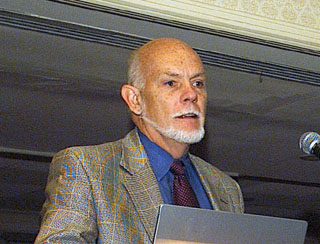
Richard Smalley, 1996 Nobel laureate in Chemistry, shown in 2003
(Wikimedia Commons public domain image)
***
Several times each year, some atheist or other triumphantly flings in my face the fact that most members of the elite National Academy of Sciences aren’t religious.
In this context, I was interested some time back to learn a bit about Richard Smalley, formerly the Hackerman Professor of Chemistry as well as a Professor of Physics and Astronomy at Houston’s Rice University. Smalley, who died in 2005 of leukemia at the relatively young age of 62, was honored upon his death by a resolution in the United States Senate as the “Father of Nanotechnology.” In 1996, he shared the Nobel Prize in Chemistry for the discovery of a new form of carbon, dubbed (in humorous tribute to R. Buckminster Fuller) “buckminsterfullerene” or, colloquially, “buckyballs.”
He was, of course, a member of the National Academy of Sciences, having been elected in 1990.
Smalley came from a religious background, but he evidently rejected his faith fairly early. According to at least one source, he became for a long time an outspoken critic of Christianity. And then he wasn’t.
Here’s an interesting passage from Professor Smalley, reflecting upon his own chemical specialty in the study of carbon:
I know that, except for carbon, there would be no life in the universe. Except for this one atom, there would be no life. Well, why? When you think about it, it does get spooky. Encountering these molecules are spiritual experiences similar to what I remember in church as a child, only these are more serious.
Shortly before his death, he wrote a fascinating letter, from which the following is excerpted:
As I write this I am at M.D. Anderson Cancer Center a few miles from my home in Houston, Texas. I am being infused with a modern miracle, a nanotechnological stroke of engineered genius called Rituxan. It is a monoclonal antibody that is part mouse, part human and with great purity and reliability targets the cancer cells in my body and marks them for graceful death. The motto of M. D. Anderson is “Making Cancer History”, and I am convinced that within the next 20 years they and other scientists around the world will do just that: they will develop cures for the main forms of cancer that have plagued mankind since the dawn of history. I hope to see this all happen, and come back to Hope for my 60th reunion to tell you all about it. . . .
Recently I have gone back to church regularly with a new focus to understand as best I can what it is that makes Christianity so vital and powerful in the lives of billions of people today, even though almost 2000 years have passed since the death and resurrection of Christ.
Although I suspect I will never fully understand, I now think the answer is very simple: it’s true. God did create the universe about 13.7 billion years ago, and of necessity has involved Himself with His creation ever since. The purpose of this universe is something that only God knows for sure, but it is increasingly clear to modern science that the universe was exquisitely fine-tuned to enable human life. We are somehow critically involved in His purpose. Our job is to sense that purpose as best we can, love one another, and help Him get that job done.
Critics will respond, of course, that Dr. Smalley’s return to Christianity was the desperate act of a fatally ill man. Belief, they will say, comes from emotional, not rational, sources — such as the fear of death — whereas, apparently, unbelief is purely rational. But might it not be said with equal probability that his return to church came because, after decades of intense involvement with scientific research, he had just been powerfully reminded of his mortality and of the general human condition?
Why is the faith of religious scientists regarded by some as insignificant, while these same folks often trumpet the lack of faith of unbelieving scientists as somehow revelatory of the true character of the universe?
I’ve fairly frequently posted quotations on this blog from believing Nobel laureates and other prominent scientists. Some have assumed that I intended, thereby, to prove theism true. They’re mistaken. I post such quotations mostly because I’ve often thought that they made important points. But I’ve also posted them, simply, to illustrate the indisputable fact that more than a few prominent scientists see no incompatibility between religious faith and rigorous science.
Caltech’s Kip Thorne, who shared the 2017 Nobel Prize in Physics, comes from a Latter-day Saint background although, sadly, he currently describes himself as an atheist. But he rejects the notion, argued by many much lesser scientific lights (and, quite often, by people who aren’t scientists at all), of an absolute opposition between theistic faith and scientific reason: “There are,” says Thorne, “large numbers of my finest colleagues who are quite devout and believe in God, ranging from an abstract humanist God to a very concrete Catholic or Mormon God. There is no fundamental incompatibility between science and religion.”
But what would he know?
***
How embarrassing this is. And yet the star of the show doesn’t seem to be embarrassed. For the sake of my adopted home state, though, I’m content that he’s settled in Puerto Rico.
“Entrata founder who sent antisemitic email will divest holdings in company”
***
Here are a couple of articles from Kerry Muhlestein that I think you might like — or that, if you’re of a certain mindset, I think you’ll absolutely loathe:
“How we got the Book of Abraham”
“Faulty Assumptions about the Book of Abraham”
***
I just watched a CNN special of James Taylor and Carol King, two of my very favorite singers since the end of my teenage years. Great stuff. It really took me back. And that’s a very long distance to travel.
Previous Post

January 8, 2022
Memento mori
Next Post
January 9, 2022 "And each land was called earth"
Browse Our Archives
Select a Category Uncategorized
Select a Month October 2026 September 2026 August 2026 July 2026 June 2026 May 2026 April 2026 March 2026 February 2026 January 2026 December 2025 November 2025 October 2025 September 2025 August 2025 July 2025 June 2025 May 2025 April 2025 March 2025 February 2025 January 2025 December 2024 November 2024 October 2024 September 2024 August 2024 July 2024 June 2024 May 2024 April 2024 March 2024 February 2024 January 2024 December 2023 November 2023 October 2023 September 2023 August 2023 July 2023 June 2023 May 2023 April 2023 March 2023 February 2023 January 2023 December 2022 November 2022 October 2022 September 2022 August 2022 July 2022 June 2022 May 2022 April 2022 March 2022 February 2022 January 2022 December 2021 November 2021 October 2021 September 2021 August 2021 July 2021 June 2021 May 2021 April 2021 March 2021 February 2021 January 2021 December 2020 November 2020 October 2020 September 2020 August 2020 July 2020 June 2020 May 2020 April 2020 March 2020 February 2020 January 2020 December 2019 November 2019 October 2019 September 2019 August 2019 July 2019 June 2019 May 2019 April 2019 March 2019 February 2019 January 2019 December 2018 November 2018 October 2018 September 2018 August 2018 July 2018 June 2018 May 2018 April 2018 March 2018 February 2018 January 2018 December 2017 November 2017 October 2017 September 2017 August 2017 July 2017 June 2017 May 2017 April 2017 March 2017 February 2017 January 2017 December 2016 November 2016 October 2016 September 2016 August 2016 July 2016 June 2016 May 2016 April 2016 March 2016 February 2016 January 2016 December 2015 November 2015 October 2015 September 2015 August 2015 July 2015 June 2015 May 2015 April 2015 March 2015 February 2015 January 2015 December 2014 November 2014 March 2014 August 2013 February 2012
Follow Us!
TAKE THE
Religious Wisdom Quiz
True or False: Cornelius was a Roman centurion who was the first Gentile convert.
Select your answer to see how you score.
TRUE FALSE
Related posts from Sic et Non


Once more unto the breach, dear friends, once...

TRENDING AT PATHEOS Latter-day Saint

The Sermon on the Mount, Part I: Matthew...
The Sermon on the Mount, Part I (Matthew 4:12-5:12) St. Matthew moves...

What's up from Crossway: Reviewing some of their latest A few weeks...

Janie Learns the Way of the Cross: A...
Teaching children about Jesus' Passion can be challenging. Many parents and educators...

Looking For Good Catholic Writing - October 2026
He alone extends the heavens, and he walks upon the waves of...

In "Irreplaceable," our book on vocation and technology, Trevor Sutton and I...

I was strolling through the top floor of the brand new Parthenon...
view all Latter-day Saint blogs
Ad-Free & Subscriber Log-In Subscription Support
- About Us
- 2026 Calendar
- Videos
- Podcasts
- Library of World Religions
- Faith In Media Tracker
- Advertise With Us
- Write for Us
- Privacy Policy
- Terms of Service
- Do Not Sell My Data
- Contact Us
- Radiant Digital
- Manage Newsletter Subscriptions
- Unsubscribe From Notifications
- Sitemap
Copyright 2008-2026, Patheos. All rights reserved.
Subscription Support Ad-Free & Subscriber Log-In
Follow Patheos