
BuddhistCatholicContemplativeEvangelicalGeneral ChristianHinduJewishLatter-day SaintMuslimNew VisionsProgressive Christian
Beliefs
- Buddhist
- Catholic
- Contemplative
- Evangelical
- General Christian
- Hindu
- Jewish
- Latter-day Saint
- More Voices
- Muslim
- New Visions
- Pagan
- Progressive Christian
Topics
- Religion News
- Food and Religion
- Sports and Religion
- Religious Art
- Religious Music and Entertainment
- Religious Events
- History and Religion
- Style and Religion
- Politics and Religion
- Women in Religion
- Recreation Outdoors and Religion
- Business Finance and Religion
- Careers Workplace and Religion
- Education and Religion
- Family Parenting and Religion
- Health Fitness and Religion
- Home and Religion
- Relationships and Religion
- Technology and Religion
- Travel and Religion
Columnists
- Buddhist Columnists
- Business Finance and Religion Columnists
- Careers Workplace and Religion Columnists
- Catholic Columnists
- Contemplative Columnists
- Education and Religion Columnists
- Evangelists Columnists
- Family Parenting and Religion Columnists
- General Christian Columnists
- Health Fitness and Religion Columnists
- Hindu Columnists
- History and Religion Columnists
- Home and Religion Columnists
- Jewish Columnists
- More Voices Columnists
- Latter Day Columnists
- Muslim Columnists
- New Visions Columnists
- Nonreligious Columnists
- Pagan Columnists
- Politics and Religion Columnists
- Progressive Columnists
- Recreation Outdoors and Religion Columnists
- Relationships and Religion Columnists
- Religion News Columnists
- Religious Art Columnists
- Religious Events Columnists
- Religious Music and Entertainment Columnists
- Sports and Religion Columnists
- Style and Religion Columnists
- Technology and Religion Columnists
- Travel and Religion Columnists
- Women in Religion Columnists
Resource Library
- 2026 Calendar
- Library of World Religions
- The 100 Most Holy Places on Earth
- Patheos Answers
- Podcasts
- Videos
- Faith Leaders Database
- Anglican Episcopalian
- Bahai
- Baptist
- Buddhism
- Christianity
- Confucianism
- Eastern Orthodoxy
- Hinduism
- Holiness and Pentecostal
- ISKCON
- Islam
- Judaism
- Lutheran
- Methodist
- The Church of Jesus Christ of Latter-day Saints
- New Age
- Paganism
- Presbytarian and Reformed
- Protestantism
- Religion Behind the Scenes
- Roman Catholic
- Scientology
- Shia Islam
- Sikhism
- Sufism
- Sunni Islam
- Taoism
- Zen
- See all religions
Research Tools
 Ad-Free & Subscriber Log-In Subscription Support
Ad-Free & Subscriber Log-In Subscription Support
Follow Patheos 

- Trending:
- Forgiveness
- |
- Marriage
- |
- Consciousness
- |
- Death Penalty
- |
- Election
- |
- Halloween

- Home
- Latter-day Saint
- “The Struggle for Survival”
“The Struggle for Survival”
Last updated on: December 21, 2021 at 9:44 pm by Dan Peterson
“The Struggle for Survival” 2021-12-21T21:44:05-07:00 Dan Peterson
Patheos Explore the world's faith through different perspectives on religion and spirituality! Patheos has the views of the prevalent religions and spiritualities of the world.
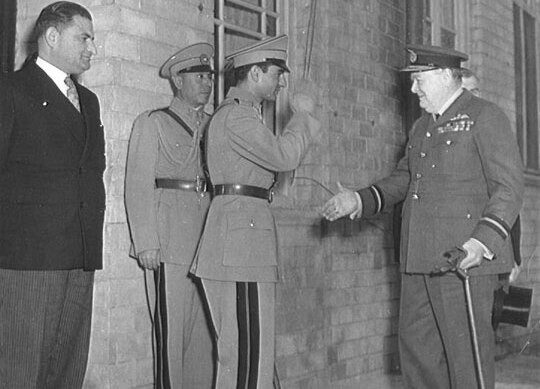
At the conclusion of the November 1943 Tehran Conference, the Shah of Iran salutes Sir Winston Churchill on his 69th birthday.
(Wikimedia Commons public domain)
I never met Mr. Churchill, but, for what it’s worth, I did meet and speak with the Shah for a few minutes during his exile in Cairo. I recall being quite astonished at the fact that I was shaking the hand of a man who had, as a fellow head of state, shaken the hands of Roosevelt, Churchill, and Stalin at that conference. It was oddly moving.
In scattered moments at the beginning of the day and at its end, I’ve been reading a condensed version of Churchill — Der Kampf ums Überleben 1940/65, which is a German translation of Winston Churchill –The Struggle for Survival 1940-1965, which (in its turn) is allegedly (though somewhat controversially) based on the diary of Lord Moran (Sir Charles Wilson), his personal physician. It offers an interesting perspective on Churchill and the Second World War. I’ve marked just a few passages thus far that especially caught my interest, and I offer them here either in paraphrase or, oddly, in an English translation of the German translation of the English original:
“The most important thing in politics,” said our host [the then Canadian prime minister Mackenzie King], “is to avoid mistakes.” I could imagine the PM’s [Churchill’s] face as Mackenzie King made this observation, looking at us through his pince-nez. The two men are, naturally, friendly to one another, but it cannot be concealed that Churchill isn’t especially interested in King, while he flatly courts Roosevelt. (Ottawa, 29-31 December 1941; pages 256-257)
The expressly risk-averse King was a polar opposite to the deliberately daring Winston Churchill (see below).
While the others were changing for dinner, [Jan Christian] Smuts [the South African general, statesman, and philosopher] sits out in the garden alone. This evening, I kept him company. I offered him my books, but he said that he reads no novels. He always carries a handbook of botany with him, and it is said that a Greek Bible sits on his nightstand. He is of the opinion that a man with ideas is more important than a coolly deliberative head. “That is why Winston is indispensable. He has ideas. Men of action, by contrast, live on the surface of things; they’re not creative.” (Cairo, 7 August 1942; page 266)
I’ve already mentioned the exchange between Smuts and Churchill regarding Gandhi that occurs on the same page.
This morning, the PM spoke with me about the long and painful learning period that he had to pass through. Few people have worked with such almost religious dedication on the craft of using words. In peacetime, he used it to make his political fortune; in wartime, he won everybody’s heart by means of it. “It began already at Harrow,” he said. Sitting in the back of the class, always in others’ shadow, he discovered that he could do something that others couldn’t: write. From the beginning, it was his goal “to distinguish myself personally,” and, in particular, he wanted to become a great orator. He read everything he could find about Lord Chatham [William Pitt the Elder], the mighty eighteenth century statesman; he studied his father’s [Lord Randolph Churchill’s] speeches, and practiced his own in front of the mirror.
He told me this very plainly. Occasionally, he interrupted himself when his voice disobeyed him out of sheer emotion. As I listened to him, I saw the sensitive boy, beaten up and tyrannized, grow to be a man, short of stature, with thin, unmuscular limbs and the white, delicate hands of a woman. He lisped and stuttered a bit. Whenever he began to give a speech in the House of Commons, he was always anxious lest something come out that would blight his prospects. “At that time,” he reported, “I absolutely could not speak without the most careful preparation.” On one occasion, he stood up in Parliament and realized that his mind had gone completely blank; there was respectful silence all around him that was interrupted only by a few friendly calls of encouragement. He returned to his place and hid his face in his hands. Thereafter, he was even more reluctant than before to try to put in a word. But he refused to recognize defeats.
I’m astonished at his willpower and his dedication to his goals. He was determined to become robust and hardy, and, in wartime, he deliberately exposed himself to danger. In France, during the First World War, he rode a white horse in the front lines because he wanted to test his nerve. And he worked hard on himself to cope with the humiliations and injustices of life and overcome them. . . .
“When I was young,” the PM reflected, “a deep depression came over me that lasted two or three years. As soon as I spoke with Clemmie, though, it got better. Still today, though, I don’t like to stand on a train platform when an express train races by; I also don’t like to stand at the railing of a ship and look down into the water. A second’s decision, a few drops of despair — and everything would be at an end. And yet, at such moments, I really don’t want to depart this world.
“Do you know much of grief, Charles? It helps me to try to write down a half dozen things that trouble me. Two of these problems, let’s say, will solve themselves. Two of them can’t be changed, so there’s no point in driving oneself crazy over them; and two of them might be manageable.” . . .
He called his bouts of depression “the black dog.” I said “You inherited ‘the black dog’ from your ancestors and you’ve fought against it y0ur entire life. That’s why you don’t visit military clinics or hospitals. You always avoid anything that might bring you down.”
He stared at me as if I knew too much. Finally, he said “Presumably you believe in a life after death. You’ve surely learned to think logically. Please explain to me how you can believe in such a thing.”
I had the feeling that he desperately wanted to believe in something too, but that it wasn’t easy for him. (London, 29 October 1943; pages 289-291)
There’s something reminiscent of Theodore Roosevelt in Churchill’s determination to overcome youthful weakness and become “robust and hardy.” And, ironically, Churchill’s practice of rehearsing his speeches in front of a mirror, at least in his early political career, recalls Adolf Hitler’s similar practice. In a sense, World War Two was a contest between two master orators.
Posted from Richmond, Virginia
Previous Post

December 20, 2021
An example of the witness of ancient texts for modern scripture
Next Post
December 21, 2021 "Conspiring men in the last days"
Browse Our Archives
Select a Category Uncategorized
Select a Month October 2026 September 2026 August 2026 July 2026 June 2026 May 2026 April 2026 March 2026 February 2026 January 2026 December 2025 November 2025 October 2025 September 2025 August 2025 July 2025 June 2025 May 2025 April 2025 March 2025 February 2025 January 2025 December 2024 November 2024 October 2024 September 2024 August 2024 July 2024 June 2024 May 2024 April 2024 March 2024 February 2024 January 2024 December 2023 November 2023 October 2023 September 2023 August 2023 July 2023 June 2023 May 2023 April 2023 March 2023 February 2023 January 2023 December 2022 November 2022 October 2022 September 2022 August 2022 July 2022 June 2022 May 2022 April 2022 March 2022 February 2022 January 2022 December 2021 November 2021 October 2021 September 2021 August 2021 July 2021 June 2021 May 2021 April 2021 March 2021 February 2021 January 2021 December 2020 November 2020 October 2020 September 2020 August 2020 July 2020 June 2020 May 2020 April 2020 March 2020 February 2020 January 2020 December 2019 November 2019 October 2019 September 2019 August 2019 July 2019 June 2019 May 2019 April 2019 March 2019 February 2019 January 2019 December 2018 November 2018 October 2018 September 2018 August 2018 July 2018 June 2018 May 2018 April 2018 March 2018 February 2018 January 2018 December 2017 November 2017 October 2017 September 2017 August 2017 July 2017 June 2017 May 2017 April 2017 March 2017 February 2017 January 2017 December 2016 November 2016 October 2016 September 2016 August 2016 July 2016 June 2016 May 2016 April 2016 March 2016 February 2016 January 2016 December 2015 November 2015 October 2015 September 2015 August 2015 July 2015 June 2015 May 2015 April 2015 March 2015 February 2015 January 2015 December 2014 November 2014 March 2014 August 2013 February 2012
Follow Us!
TAKE THE
Religious Wisdom Quiz
According to Romans 3:23, who has sinned?
Select your answer to see how you score.
Only those who break the Ten Commandments Everyone Those who do not accept Christ The Gentiles
Related posts from Sic et Non


Here's a little shchedrivka for you

Insights into a flawed but very great man
TRENDING AT PATHEOS Latter-day Saint

The Sermon on the Mount, Part I: Matthew...
The Sermon on the Mount, Part I (Matthew 4:12-5:12) St. Matthew moves...

What's up from Crossway: Reviewing some of their latest A few weeks...

Janie Learns the Way of the Cross: A...
Teaching children about Jesus' Passion can be challenging. Many parents and educators...

Looking For Good Catholic Writing - October 2026
He alone extends the heavens, and he walks upon the waves of...

In "Irreplaceable," our book on vocation and technology, Trevor Sutton and I...

I was strolling through the top floor of the brand new Parthenon...
view all Latter-day Saint blogs
Ad-Free & Subscriber Log-In Subscription Support
- About Us
- 2026 Calendar
- Videos
- Podcasts
- Library of World Religions
- Faith In Media Tracker
- Advertise With Us
- Write for Us
- Privacy Policy
- Terms of Service
- Do Not Sell My Data
- Contact Us
- Radiant Digital
- Manage Newsletter Subscriptions
- Unsubscribe From Notifications
- Sitemap
Copyright 2008-2026, Patheos. All rights reserved.
Subscription Support Ad-Free & Subscriber Log-In
Follow Patheos