
BuddhistCatholicContemplativeEvangelicalGeneral ChristianHinduJewishLatter-day SaintMuslimNew VisionsProgressive Christian
Beliefs
- Buddhist
- Catholic
- Contemplative
- Evangelical
- General Christian
- Hindu
- Jewish
- Latter-day Saint
- More Voices
- Muslim
- New Visions
- Pagan
- Progressive Christian
Topics
- Religion News
- Food and Religion
- Sports and Religion
- Religious Art
- Religious Music and Entertainment
- Religious Events
- History and Religion
- Style and Religion
- Politics and Religion
- Women in Religion
- Recreation Outdoors and Religion
- Business Finance and Religion
- Careers Workplace and Religion
- Education and Religion
- Family Parenting and Religion
- Health Fitness and Religion
- Home and Religion
- Relationships and Religion
- Technology and Religion
- Travel and Religion
Columnists
- Buddhist Columnists
- Business Finance and Religion Columnists
- Careers Workplace and Religion Columnists
- Catholic Columnists
- Contemplative Columnists
- Education and Religion Columnists
- Evangelists Columnists
- Family Parenting and Religion Columnists
- General Christian Columnists
- Health Fitness and Religion Columnists
- Hindu Columnists
- History and Religion Columnists
- Home and Religion Columnists
- Jewish Columnists
- More Voices Columnists
- Latter Day Columnists
- Muslim Columnists
- New Visions Columnists
- Nonreligious Columnists
- Pagan Columnists
- Politics and Religion Columnists
- Progressive Columnists
- Recreation Outdoors and Religion Columnists
- Relationships and Religion Columnists
- Religion News Columnists
- Religious Art Columnists
- Religious Events Columnists
- Religious Music and Entertainment Columnists
- Sports and Religion Columnists
- Style and Religion Columnists
- Technology and Religion Columnists
- Travel and Religion Columnists
- Women in Religion Columnists
Resource Library
- 2026 Calendar
- Library of World Religions
- The 100 Most Holy Places on Earth
- Patheos Answers
- Podcasts
- Videos
- Faith Leaders Database
- Anglican Episcopalian
- Bahai
- Baptist
- Buddhism
- Christianity
- Confucianism
- Eastern Orthodoxy
- Hinduism
- Holiness and Pentecostal
- ISKCON
- Islam
- Judaism
- Lutheran
- Methodist
- The Church of Jesus Christ of Latter-day Saints
- New Age
- Paganism
- Presbytarian and Reformed
- Protestantism
- Religion Behind the Scenes
- Roman Catholic
- Scientology
- Shia Islam
- Sikhism
- Sufism
- Sunni Islam
- Taoism
- Zen
- See all religions
Research Tools
 Ad-Free & Subscriber Log-In Subscription Support
Ad-Free & Subscriber Log-In Subscription Support
Follow Patheos 

- Trending:
- Forgiveness
- |
- Marriage
- |
- Consciousness
- |
- Death Penalty
- |
- Election
- |
- Halloween

- Home
- Latter-day Saint
- Is man “nothing”?
Is man “nothing”?
Last updated on: January 1, 2022 at 4:43 pm by Dan Peterson
Is man “nothing”? 2022-01-01T16:43:23-07:00 Dan Peterson
Patheos Explore the world's faith through different perspectives on religion and spirituality! Patheos has the views of the prevalent religions and spiritualities of the world.
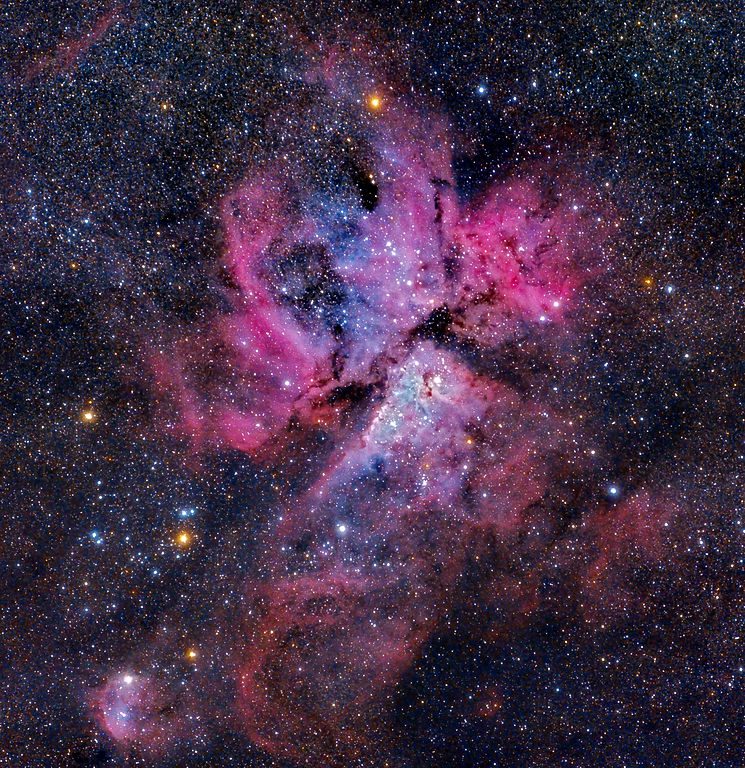
The Carina Nebula, NGC 3372 (Wikimedia Commons public domain image)
I was thinking, this morning, about the famous passage at Moses 1:39 that says
For behold, this is my work and my glory—to bring to pass the immortality and eternal life of man.
It’s often quoted, and I think with good reason.
Many years ago, with my late friend Huston Smith, the eminent comparative religionist, I co-wrote an article on “The Purpose of Earth Life (Comparative Perspective)” for Macmillan’s Encyclopedia of Mormonism. One of the paragraphs in that article reads as follows:
A pervasive Christian view is expressed in the Westminster Shorter Catechism of 1647, which declares that “man’s chief end is to glorify God, and to enjoy him forever.” God created us to bring glory to himself — which was not vanity on his part, since he fully deserves that glory, whereas human beings do not — and will reward those whom he saves with the enjoyment of himself. This can be compared with the position of Islamic tradition that attributes to God the words “I was a hidden treasure but wished to be known, and therefore I created the world.” The aim of human beings in Islam is therefore to submit (aslama ) themselves to the will of God and to glorify him through their actions. Judaism and Islam are closely related in their emphasis upon law and right behavior and in their declaration that obedience to the commandments of God is the purpose of life. Judaism, however, differs from Islam in its belief that the full range of the divine commandments (mitzvoth ) is incumbent only upon Jews, with non-Jews subject to the few basic “Noachian precepts.” Islam, on the other hand, insists that God’s demands are identical for all human beings. “I did not create the jinn and mankind,” the Koran quotes Allah as saying, “except to serve me.”
The notion that God created humanity to praise him and to glorify him — that, in other words, he created humanity in some sense for himself — contrasts very clearly with the Restoration concept that God didn’t actually create humanity at all, because humanity is in some sense self-existent, and, more importantly, that God’s purpose isn’t to be served by humanity but, rather to serve humanity.
This is instructive: There might be a tendency to think that we serve in this life in order to earn points for entry into heaven. That service is a kind of entry fee that we pay, and that the need for service is then past. Serving is, under such a conception, extraneous to heavenly life, irrelevant to it except as the cost of getting in. Rather like tuition paid for the learning in a university. Except for practical reasons of earthly finance, education and tuition charges are quite unrelated.
Moses 1:39 clearly indicates, though, that loving service is a divine characteristic, not merely part of the cost of salvation. It strongly suggests, in fact, that willingness to serve is intrinsic to the divine nature or character and that, accordingly, it isn’t just part of the extrinsic charge for admission to heaven but, rather, an important and intrinsic part of what makes the inhabitants of heaven heavenly.
And there is something else that I want to say here about Moses 1:39:
In the first few verses of Moses 1, the prophet is “caught up into an exceedingly high mountain.” “And he saw God face to face, and he talked with him, and the glory of God was upon Moses” (though only a limited portion of it, lest he die). “And God spake unto Moses, saying: Behold, I am the Lord God Almighty, and Endless is my name.” And then God tells Moses that “I will show thee the workmanship of mine hands; but not all, for my works are without end, and also my words, for they never cease. Wherefore, no man can behold all my works, except he behold all my glory; and no man can behold all my glory, and afterwards remain in the flesh on the earth”–though “all things are present with me, for I know them all.” “And it came to pass that Moses looked, and beheld the world upon which he was created; and Moses beheld the world and the ends thereof, and all the children of men which are, and which were created; of the same he greatly marveled and wondered.”
When the vision concludes, Moses is overwhelmed. And understandably so, given the divine glory and the sheer vastness that he has just witnessed. “And he said unto himself: Now, for this cause I know that man is nothing, which thing I never had supposed.”
Later in Moses 1, Moses and the chapter’s readers are given even more grounds for wonder at the incomprehensible scope of the universe and at the power of God:
[O]nly an account of this earth, and the inhabitants thereof, give I unto you. For behold, there are many worlds that have passed away by the word of my power. And there are many that now stand, and innumerable are they unto man; but all things are numbered unto me, for they are mine and I know them.
And it came to pass that Moses spake unto the Lord, saying: Be merciful unto thy servant, O God, and tell me concerning this earth, and the inhabitants thereof, and also the heavens, and then thy servant will be content.
And the Lord God spake unto Moses, saying: The heavens, they are many, and they cannot be numbered unto man; but they are numbered unto me, for they are mine.
And as one earth shall pass away, and the heavens thereof even so shall another come; and there is no end to my works, neither to my words.
But is humanity really “nothing”? Yes and no. Confronted with the sheer size of things and with the power and glory of God, we have obvious grounds for humility. That, though, is not the final note of Moses 1.
For behold, this is my work and my glory—to bring to pass the immortality and eternal life of man.
God himself, the supreme power in the universe, pronounces it his work and his glory neither to create stars nor to shepherd the planets nor to supervise stellar nucleosynthesis nor to sculpt grand canyons, but to bring about the immortality and eternal life of his children. That is a remarkable thing to know.
Posted from Richmond, Virginia
Previous Post

December 25, 2021
“Then pealed the bells more loud and deep"
Next Post
December 27, 2021 "The Corporate Christmas Carol"
Browse Our Archives
Select a Category Uncategorized
Select a Month October 2026 September 2026 August 2026 July 2026 June 2026 May 2026 April 2026 March 2026 February 2026 January 2026 December 2025 November 2025 October 2025 September 2025 August 2025 July 2025 June 2025 May 2025 April 2025 March 2025 February 2025 January 2025 December 2024 November 2024 October 2024 September 2024 August 2024 July 2024 June 2024 May 2024 April 2024 March 2024 February 2024 January 2024 December 2023 November 2023 October 2023 September 2023 August 2023 July 2023 June 2023 May 2023 April 2023 March 2023 February 2023 January 2023 December 2022 November 2022 October 2022 September 2022 August 2022 July 2022 June 2022 May 2022 April 2022 March 2022 February 2022 January 2022 December 2021 November 2021 October 2021 September 2021 August 2021 July 2021 June 2021 May 2021 April 2021 March 2021 February 2021 January 2021 December 2020 November 2020 October 2020 September 2020 August 2020 July 2020 June 2020 May 2020 April 2020 March 2020 February 2020 January 2020 December 2019 November 2019 October 2019 September 2019 August 2019 July 2019 June 2019 May 2019 April 2019 March 2019 February 2019 January 2019 December 2018 November 2018 October 2018 September 2018 August 2018 July 2018 June 2018 May 2018 April 2018 March 2018 February 2018 January 2018 December 2017 November 2017 October 2017 September 2017 August 2017 July 2017 June 2017 May 2017 April 2017 March 2017 February 2017 January 2017 December 2016 November 2016 October 2016 September 2016 August 2016 July 2016 June 2016 May 2016 April 2016 March 2016 February 2016 January 2016 December 2015 November 2015 October 2015 September 2015 August 2015 July 2015 June 2015 May 2015 April 2015 March 2015 February 2015 January 2015 December 2014 November 2014 March 2014 August 2013 February 2012
Follow Us!
TAKE THE
Religious Wisdom Quiz
Who was the only woman to rule as queen over Judah?
Select your answer to see how you score.
Miriam Athaliah Bathsheba Jezebel
Related posts from Sic et Non

"The Book of Moses as a Temple Text"


"An Early Christian Context for the Book of...

TRENDING AT PATHEOS Latter-day Saint

The First Eucharistic Controversy: Christ’s Real Presence
For Catholics, the Eucharist is the source and summit of the Christian...

What a Stop Sign Can Teach Us About...
How to Make a Decision When You Can't Hear God Main point:...

Archdiocese Hosts Military Marriage Retreat in Germany
RASTATT, Germany — The transient military lifestyle, with its frequent deployments and...

Nearly every morning, I make the drive to Detroit with my high-school-age...

The Real AI Story Is Adoption Without Trust
Artificial intelligence has crossed a political threshold. It is no longer a...

A new article, written by Jeff Lindsay and Gale L. Pooley,...
view all Latter-day Saint blogs
Ad-Free & Subscriber Log-In Subscription Support
- About Us
- 2026 Calendar
- Videos
- Podcasts
- Library of World Religions
- Faith In Media Tracker
- Advertise With Us
- Write for Us
- Privacy Policy
- Terms of Service
- Do Not Sell My Data
- Contact Us
- Radiant Digital
- Manage Newsletter Subscriptions
- Unsubscribe From Notifications
- Sitemap
Copyright 2008-2026, Patheos. All rights reserved.
Subscription Support Ad-Free & Subscriber Log-In
Follow Patheos