
BuddhistCatholicContemplativeEvangelicalGeneral ChristianHinduJewishLatter-day SaintMuslimNew VisionsProgressive Christian
Beliefs
- Buddhist
- Catholic
- Contemplative
- Evangelical
- General Christian
- Hindu
- Jewish
- Latter-day Saint
- More Voices
- Muslim
- New Visions
- Pagan
- Progressive Christian
Topics
- Religion News
- Food and Religion
- Sports and Religion
- Religious Art
- Religious Music and Entertainment
- Religious Events
- History and Religion
- Style and Religion
- Politics and Religion
- Women in Religion
- Recreation Outdoors and Religion
- Business Finance and Religion
- Careers Workplace and Religion
- Education and Religion
- Family Parenting and Religion
- Health Fitness and Religion
- Home and Religion
- Relationships and Religion
- Technology and Religion
- Travel and Religion
Columnists
- Buddhist Columnists
- Business Finance and Religion Columnists
- Careers Workplace and Religion Columnists
- Catholic Columnists
- Contemplative Columnists
- Education and Religion Columnists
- Evangelists Columnists
- Family Parenting and Religion Columnists
- General Christian Columnists
- Health Fitness and Religion Columnists
- Hindu Columnists
- History and Religion Columnists
- Home and Religion Columnists
- Jewish Columnists
- More Voices Columnists
- Latter Day Columnists
- Muslim Columnists
- New Visions Columnists
- Nonreligious Columnists
- Pagan Columnists
- Politics and Religion Columnists
- Progressive Columnists
- Recreation Outdoors and Religion Columnists
- Relationships and Religion Columnists
- Religion News Columnists
- Religious Art Columnists
- Religious Events Columnists
- Religious Music and Entertainment Columnists
- Sports and Religion Columnists
- Style and Religion Columnists
- Technology and Religion Columnists
- Travel and Religion Columnists
- Women in Religion Columnists
Resource Library
- 2026 Calendar
- Library of World Religions
- The 100 Most Holy Places on Earth
- Patheos Answers
- Podcasts
- Videos
- Faith Leaders Database
- Anglican Episcopalian
- Bahai
- Baptist
- Buddhism
- Christianity
- Confucianism
- Eastern Orthodoxy
- Hinduism
- Holiness and Pentecostal
- ISKCON
- Islam
- Judaism
- Lutheran
- Methodist
- The Church of Jesus Christ of Latter-day Saints
- New Age
- Paganism
- Presbytarian and Reformed
- Protestantism
- Religion Behind the Scenes
- Roman Catholic
- Scientology
- Shia Islam
- Sikhism
- Sufism
- Sunni Islam
- Taoism
- Zen
- See all religions
Research Tools
 Ad-Free & Subscriber Log-In Subscription Support
Ad-Free & Subscriber Log-In Subscription Support
Follow Patheos 

- Trending:
- Forgiveness
- |
- Marriage
- |
- Consciousness
- |
- Death Penalty
- |
- Election
- |
- Halloween

- Home
- Latter-day Saint
- “If God Does Not Exist, Is Everything Permitted?”
“If God Does Not Exist, Is Everything Permitted?”
Last updated on: January 11, 2022 at 8:14 pm by Dan Peterson
“If God Does Not Exist, Is Everything Permitted?” 2022-01-11T20:14:37-07:00 Dan Peterson
Patheos Explore the world's faith through different perspectives on religion and spirituality! Patheos has the views of the prevalent religions and spiritualities of the world.
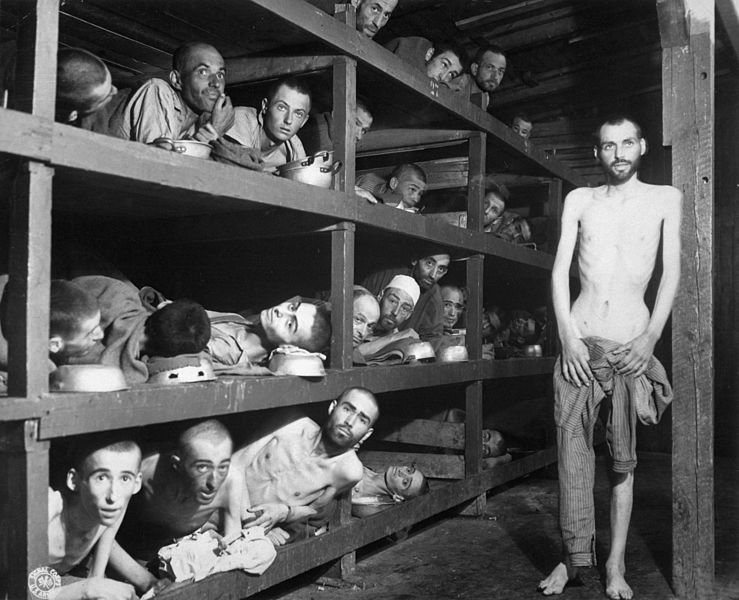
In this photograph, taken five days after the liberation of the concentration camp at Buchenwald, the future Nobel laureate Elie Wiesel’s face is visible just to the right of center. If you move your cursor to that position, his face will be outlined with a yellow square. (Wikimedia Commons public domain image) Serious question: Can atheistic naturalism sustain a moral argument against genocide or against slavery? The Nazis believed that, by eliminating or enslaving non-Aryans, they were furthering the interests of their own “tribe” and creating “Lebensraum” for its expansion and flourishing. Given their social Darwinist presuppositions, doing so, in their view, was a moral imperative.
***
A new essay appeared at noon today, Utah time, in Interpreter: A Journal of Latter-day Saint Faith and Scholarship. I regret to say that I wrote it. I don’t regret my authorship of the essay because I disagree with anything that it contains, but because I don’t like the fact that this is the second Interpreter essay in a row by, well, me. I hadn’t intended to author this year’s Christmas message, which was published last week. But circumstances forced my hand. Anyway, here is this week’s offering:
“If God Does Not Exist, Is Everything Permitted?” by Daniel C. Peterson
Abstract: Can people be good without believing in God? Obviously, yes. They can. Is atheistic naturalism capable of supplying a foundation for morality? That is a separate question, to which more than a few theists have answered No. However, a relatively new book by a very prominent student of religion and society suggests otherwise. A rational morality can, it argues, be founded upon atheistic naturalism — but it will necessarily be a modest and quite limited one, lacking universal scope and without a belief in human rights as objective “moral facts.”
***
As has been my practice for a while, I now offer links to some articles from a prior issue of Interpreter. Perhaps you’ve forgotten them, or perhaps you missed them. Or perhaps you’ll want to take another look at one or more of them:
“Oh, That I Were an Angel!” by Daniel C. Peterson
Abstract: Alma’s conversion experience was both unusual and unusually powerful, and yet he fervently wished that he could provide others with the same experience. So much so, in fact, that he actually feared that he might be sinning in his wish by seeming to oppose the will of God. Increasingly, though, I find myself sharing that wish. My involvement with the Interpreter Foundation can correctly be regarded as one manifestation of that fact. I invite others to join us.
“Be Ye Therefore Loyal, Even as Your Father Which is in Heaven is Loyal,” by Taylor Halverson
Abstract: The scriptures are saturated with covenantal words and terms. Any serious or close reading of the scriptures that misses or ignores the covenantal words, phrases, and literary structure of scripture runs the risk of missing the full purpose of why God preserved the scriptures for us. This is especially true for the Old Testament and the Book of Mormon, which emerged out of an Old Testament cultural context. Research during the past century on ancient Near Eastern covenants has brought clarity to the covenantal meaning and context of a variety of words and literary structures in the Old Testament and the Book of Mormon. This article builds on that revealing research to show that the English word “perfect” in a covenantal context in scripture can also be represented with the covenantal synonyms of “loyal, loyalty, faithful, and trustworthy.” God has revealed and preserved the scriptures as records of these covenants and of the consequences of covenantal loyalty or disloyalty. The Lord’s injunction to “be ye therefore perfect” (Matthew 5:48) is beautifully magnified when we realize that we are not simply asked to be without sin, but, rather, to “be ye therefore covenantally loyal” even as God has been eternally and covenantally loyal to us.
“Ancient Sacred Vestments: Scriptural Symbols and Meanings,” by Donald W. Parry
Abstract: In this essay Parry starts with the symbology of ritual vestments, and then discusses in detail how the ancient clothing worn in Old Testament temples are part of the rituals and religious gestures that are conducted by those who occupy the path that leads from the profane to the sacred. The profane is removed, one is ritually washed, anointed, invested with special clothing, offers sacrifices, is ordained (hands are filled), and offers incense at the altar, before entering the veil. Putting on clothes, in a Christian context, is often seen as symbol of putting on Christ, as witnessed by the apostle Paul using the word “enduo,” when talking about putting on Christ, a word mainly used in the Septuagint for donning sacred vestments (symbols also for salvation, righteousness, glory, strength and resurrection) in order to be prepared to stand before God. Parry then goes on explaining how priestly officiants wearing sacred vestments, emulated celestial persons who wear sacred vestments, making one an image of those celestial persons. He concludes with showing how the ancient garbs of the High Priest point to Christ.
[Editor’s Note: Part of our book chapter reprint series, this article is reprinted here as a service to the LDS community. Original pagination and page numbers have necessarily changed, otherwise the reprint has the same content as the original.
See Donald W. Parry, “Ancient Sacred Vestments: Scriptural Symbols and Meanings,” in Temple Insights: Proceedings of the Interpreter Matthew B. Brown Memorial Conference, “The Temple on Mount Zion,” 22 September 2012, ed. William J. Hamblin and David Rolph Seely (Orem, UT: The Interpreter Foundation; Salt Lake City: Eborn Books, 2014), 219–40. Further information at https://interpreterfoundation.org/books/temple-insights/.]
“An Ishmael Buried Near Nahom,” by Neal Rappleye
Abstract: Latter-day Saint scholars generally agree that “the place called… Nahom,” where Ishmael was buried (1 Nephi 16:34) is identified as the Nihm tribal region in Yemen. Significantly, a funerary stela with the name y s1mʿʾl — the South Arabian equivalent of Ishmael — was found near the Nihm region and dated to ca. 6th century bc. Although it cannot be determined with certainty that this is the Ishmael from the Book of Mormon, circumstantial evidence suggests that such is a possibility worth considering.
Previous Post

December 31, 2021
Starting Over Again, New Year or Not
Next Post
January 1, 2022 Go Utes!
Browse Our Archives
Select a Category Uncategorized
Select a Month October 2026 September 2026 August 2026 July 2026 June 2026 May 2026 April 2026 March 2026 February 2026 January 2026 December 2025 November 2025 October 2025 September 2025 August 2025 July 2025 June 2025 May 2025 April 2025 March 2025 February 2025 January 2025 December 2024 November 2024 October 2024 September 2024 August 2024 July 2024 June 2024 May 2024 April 2024 March 2024 February 2024 January 2024 December 2023 November 2023 October 2023 September 2023 August 2023 July 2023 June 2023 May 2023 April 2023 March 2023 February 2023 January 2023 December 2022 November 2022 October 2022 September 2022 August 2022 July 2022 June 2022 May 2022 April 2022 March 2022 February 2022 January 2022 December 2021 November 2021 October 2021 September 2021 August 2021 July 2021 June 2021 May 2021 April 2021 March 2021 February 2021 January 2021 December 2020 November 2020 October 2020 September 2020 August 2020 July 2020 June 2020 May 2020 April 2020 March 2020 February 2020 January 2020 December 2019 November 2019 October 2019 September 2019 August 2019 July 2019 June 2019 May 2019 April 2019 March 2019 February 2019 January 2019 December 2018 November 2018 October 2018 September 2018 August 2018 July 2018 June 2018 May 2018 April 2018 March 2018 February 2018 January 2018 December 2017 November 2017 October 2017 September 2017 August 2017 July 2017 June 2017 May 2017 April 2017 March 2017 February 2017 January 2017 December 2016 November 2016 October 2016 September 2016 August 2016 July 2016 June 2016 May 2016 April 2016 March 2016 February 2016 January 2016 December 2015 November 2015 October 2015 September 2015 August 2015 July 2015 June 2015 May 2015 April 2015 March 2015 February 2015 January 2015 December 2014 November 2014 March 2014 August 2013 February 2012
Follow Us!
TAKE THE
Religious Wisdom Quiz
Who refused to bow to the king's statue and was thrown in the fire?
Select your answer to see how you score.
Paul Daniel Joseph Shadrach, Meshach, Abednego
Related posts from Sic et Non

Notes on Women, Priesthood, and General Conference

"The Book of Moses as a Temple Text"


Some notes on the archaeology of the Bible
TRENDING AT PATHEOS Latter-day Saint

Janie Learns the Way of the Cross: A...
Teaching children about Jesus' Passion can be challenging. Many parents and educators...

Looking For Good Catholic Writing - October 2026
He alone extends the heavens, and he walks upon the waves of...

In "Irreplaceable," our book on vocation and technology, Trevor Sutton and I...

I was strolling through the top floor of the brand new Parthenon...

What Does Gêvâh Mean For Kimberley Guifoyle &...
This week, a lot of the news is focused on Kimberly Guilfoyle....

INNER CIRCLE: Profound Mystery (Of Christ In All...
Ephesians 5:31-32 “For this reason, a man will leave his father and...
view all Latter-day Saint blogs
Ad-Free & Subscriber Log-In Subscription Support
- About Us
- 2026 Calendar
- Videos
- Podcasts
- Library of World Religions
- Faith In Media Tracker
- Advertise With Us
- Write for Us
- Privacy Policy
- Terms of Service
- Do Not Sell My Data
- Contact Us
- Radiant Digital
- Manage Newsletter Subscriptions
- Unsubscribe From Notifications
- Sitemap
Copyright 2008-2026, Patheos. All rights reserved.
Subscription Support Ad-Free & Subscriber Log-In
Follow Patheos