
BuddhistCatholicContemplativeEvangelicalGeneral ChristianHinduJewishLatter-day SaintMuslimNew VisionsProgressive Christian
Beliefs
- Buddhist
- Catholic
- Contemplative
- Evangelical
- General Christian
- Hindu
- Jewish
- Latter-day Saint
- More Voices
- Muslim
- New Visions
- Pagan
- Progressive Christian
Topics
- Religion News
- Food and Religion
- Sports and Religion
- Religious Art
- Religious Music and Entertainment
- Religious Events
- History and Religion
- Style and Religion
- Politics and Religion
- Women in Religion
- Recreation Outdoors and Religion
- Business Finance and Religion
- Careers Workplace and Religion
- Education and Religion
- Family Parenting and Religion
- Health Fitness and Religion
- Home and Religion
- Relationships and Religion
- Technology and Religion
- Travel and Religion
Columnists
- Buddhist Columnists
- Business Finance and Religion Columnists
- Careers Workplace and Religion Columnists
- Catholic Columnists
- Contemplative Columnists
- Education and Religion Columnists
- Evangelists Columnists
- Family Parenting and Religion Columnists
- General Christian Columnists
- Health Fitness and Religion Columnists
- Hindu Columnists
- History and Religion Columnists
- Home and Religion Columnists
- Jewish Columnists
- More Voices Columnists
- Latter Day Columnists
- Muslim Columnists
- New Visions Columnists
- Nonreligious Columnists
- Pagan Columnists
- Politics and Religion Columnists
- Progressive Columnists
- Recreation Outdoors and Religion Columnists
- Relationships and Religion Columnists
- Religion News Columnists
- Religious Art Columnists
- Religious Events Columnists
- Religious Music and Entertainment Columnists
- Sports and Religion Columnists
- Style and Religion Columnists
- Technology and Religion Columnists
- Travel and Religion Columnists
- Women in Religion Columnists
Resource Library
- 2026 Calendar
- Library of World Religions
- The 100 Most Holy Places on Earth
- Patheos Answers
- Podcasts
- Videos
- Faith Leaders Database
- Anglican Episcopalian
- Bahai
- Baptist
- Buddhism
- Christianity
- Confucianism
- Eastern Orthodoxy
- Hinduism
- Holiness and Pentecostal
- ISKCON
- Islam
- Judaism
- Lutheran
- Methodist
- The Church of Jesus Christ of Latter-day Saints
- New Age
- Paganism
- Presbytarian and Reformed
- Protestantism
- Religion Behind the Scenes
- Roman Catholic
- Scientology
- Shia Islam
- Sikhism
- Sufism
- Sunni Islam
- Taoism
- Zen
- See all religions
Research Tools
 Ad-Free & Subscriber Log-In Subscription Support
Ad-Free & Subscriber Log-In Subscription Support
Follow Patheos 

- Trending:
- Forgiveness
- |
- Marriage
- |
- Consciousness
- |
- Death Penalty
- |
- Election
- |
- Halloween

- Home
- Latter-day Saint
- Adam and Eve, Early Christian Temples, Baptism for the Dead, and Other Fascinating Topics
Adam and Eve, Early Christian Temples, Baptism for the Dead, and Other Fascinating Topics
Last updated on: December 10, 2021 at 9:40 pm by Dan Peterson
Adam and Eve, Early Christian Temples, Baptism for the Dead, and Other Fascinating Topics 2021-12-10T21:40:05-07:00 Dan Peterson
Patheos Explore the world's faith through different perspectives on religion and spirituality! Patheos has the views of the prevalent religions and spiritualities of the world.
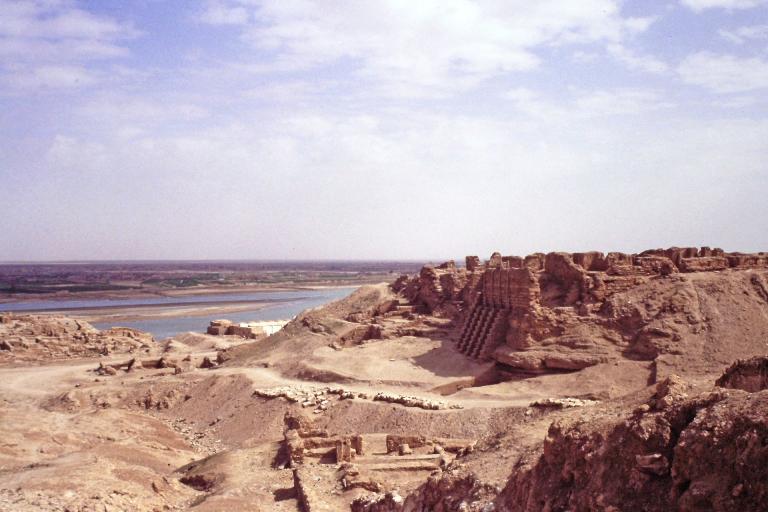
A view of some of the excavations at Dura Europos, with the Euphrates River in the background
(Wikimedia Commons public domain photograph)
***
Here are five Interpreter articles from a previous number of the journal that might catch your interest:
Abstract: This paper addresses the early Christian transition from temple-based Judaism to the Constantinian basilica of the fourth century. David argues that some Christians of the second and early third centuries may have had places of worship that, while not monumental in scale, qualify typologically as temples and were understood as such. These sacred structures may have been used for the performance of baptisms for the dead, as suggested by Doctrine and Covenants 124. In support of this thesis, he takes as case studies the Christian places of worship at ancient Edessa and Dura Europos, based on a combination of textual sources and archaeological remains. David then briefly applies these findings to a question posed years ago in studies by Hugh Nibley and John Lundquist, “What Is a Temple?”
[Editor’s Note: Part of our book chapter reprint series, this article is reprinted here as a service to the Latter-day Saint community. Original pagination and page numbers have necessarily changed, otherwise the reprint has the same content as the original.
See David Calabro, “From temple to church: Defining sacred space in the Near East,” in The Temple: Past, Present, and Future. Proceedings of the Fifth Interpreter Foundation Matthew B. Brown Memorial Conference, 7 November 2020, ed. Stephen D. Ricks and Jeffrey M. Bradshaw (Orem, UT: The Interpreter Foundation; Salt Lake City: Eborn Books, 2021), page numbers forthcoming. Further information at https://interpreterfoundation.org/books/the-temple-past-present-and-future/.]
Abstract: This article offers evidence that at least some Book of Mormon authors may have understood the potential for post-mortal preaching of the gospel. Indeed, they may have recognized that the future Book of Mormon would be a tool to spread the gospel not only among the living but also among those in the spirit world. Prophecies about the message of the Book of Mormon and the restored gospel being for all mankind may have broader scope than previously recognized, with application on both sides of the veil.
Abstract: The phrase goodness of God does occur occasionally in the Hebrew Bible but has not been considered by Old Testament scholars to be an independent principle in Israelite theology. Rather, it has been interpreted as just another way of talking about God’s acts of hesed, or loving kindness for his covenant people and is usually interpreted in the context of the covenants Israel received through Abraham and Moses. The Book of Mormon clearly echoes that Old Testament pattern but also presents two additional conceptual frameworks that are explained in terms of the goodness of God. It advances an explicit divine plan of redemption or salvation that existed before Abraham — even before the creation of the earth — which had as its purpose making eternal life possible for God’s human children universally — not just the descendants of Abraham. And it also teaches the gospel or doctrine of Christ that provides the path individuals must walk to take full advantage of that plan — as they become good like God and qualify to enter his presence and receive eternal life. Nephite usage radically expands the Old Testament concept by portraying this mortal probation as each person’s God-given opportunity to become good like God. The goodness of God is frequently invoked by the Nephite prophets as a basic theological concept which can explain why God advanced his plan of salvation for men before the world was and why he is completely reliable in blessing and protecting those who have entered the covenant path by embracing his gospel and striving to endure to the end. The Nephites also used the phrase in the Old Testament pattern to explain the acts of God in delivering, blessing, and preserving his covenant people. Furthermore, some usages seem to invoke all three of these contexts simultaneously, demonstrating the comfortable integration of each of these perspectives in Nephite theological understanding.
Abstract: The authors begin by highlighting the importance of Book of Moses research that has discovered plausible findings for its historicity, rendering it at least reasonable to give the benefit of the doubt to sacred premises — even if, ultimately, the choice of premises is just that, a choice. Emphasizing the relevance of the Book of Moses to the temple, they note that the Book of Moses is not only an ancient temple text, but also the ideal scriptural context for a modern temple preparation course. Going further, the authors address an important question raised by some who have asked: “Since Christ is at the center of the gospel, why doesn’t the temple endowment teach the story of the life of Christ? What’s all this about Adam and Eve?” The answer given in detail in the paper is as follows: “The story of the life of Christ is the story of giving the Atonement. And the story of Adam and Eve is the story of receiving the Atonement. Their story is our story, too.”
[Editor’s Note: Part of our book chapter reprint series, this article is reprinted here as a service to the Latter-day Saint community. Original pagination and page numbers have necessarily changed, otherwise the reprint has the same content as the original.
See Bruce C. Hafen and Marie K. Hafen, “Adam, Eve, the Book of Moses, and the Temple: The Story of Receiving Christ’s Atonement,” in Tracing Ancient Threads in the Book of Moses: Inspired Origins, Temple Contexts, and Literary Qualities, edited by Jeffrey M. Bradshaw, David R. Seely, John W. Welch and Scott Gordon (Orem, UT: The Interpreter Foundation; Springville, UT: Book of Mormon Central; Redding, CA: FAIR; Tooele, UT: Eborn Books, 2021), page numbers forthcoming. Further information at https://interpreterfoundation.org/books/ancient-threads-in-the-book-of-moses/.]
Abstract: We are told in the Title Page of the Book of Mormon that the Book of Mormon was revealed in our day “to show unto the remnant of the house of Israel what great things the Lord hath done for their fathers; and that they may know the covenants of the Lord, that they are not cast off forever.” Hence, the covenantal context, structure, and logic of the Book of Mormon demand further consideration, exploration, and elucidation. A prosperous starting point is the phrase “If ye keep my commandments ye shall prosper in the land.” This covenantal phrase is used throughout the Book of Mormon as a summary of the theological logic of the suzerain-vassal treaty covenant type in which God sought to secure the fidelity of his people, who would receive in exchange continued prosperity in His appointed promised lands.
Previous Post

December 10, 2021
Some verses for Christmas from the Qur‘an
Next Post
December 10, 2021 "Demythizing the Lamanites’ “Skin of Blackness.”"
Browse Our Archives
Select a Category Uncategorized
Select a Month October 2026 September 2026 August 2026 July 2026 June 2026 May 2026 April 2026 March 2026 February 2026 January 2026 December 2025 November 2025 October 2025 September 2025 August 2025 July 2025 June 2025 May 2025 April 2025 March 2025 February 2025 January 2025 December 2024 November 2024 October 2024 September 2024 August 2024 July 2024 June 2024 May 2024 April 2024 March 2024 February 2024 January 2024 December 2023 November 2023 October 2023 September 2023 August 2023 July 2023 June 2023 May 2023 April 2023 March 2023 February 2023 January 2023 December 2022 November 2022 October 2022 September 2022 August 2022 July 2022 June 2022 May 2022 April 2022 March 2022 February 2022 January 2022 December 2021 November 2021 October 2021 September 2021 August 2021 July 2021 June 2021 May 2021 April 2021 March 2021 February 2021 January 2021 December 2020 November 2020 October 2020 September 2020 August 2020 July 2020 June 2020 May 2020 April 2020 March 2020 February 2020 January 2020 December 2019 November 2019 October 2019 September 2019 August 2019 July 2019 June 2019 May 2019 April 2019 March 2019 February 2019 January 2019 December 2018 November 2018 October 2018 September 2018 August 2018 July 2018 June 2018 May 2018 April 2018 March 2018 February 2018 January 2018 December 2017 November 2017 October 2017 September 2017 August 2017 July 2017 June 2017 May 2017 April 2017 March 2017 February 2017 January 2017 December 2016 November 2016 October 2016 September 2016 August 2016 July 2016 June 2016 May 2016 April 2016 March 2016 February 2016 January 2016 December 2015 November 2015 October 2015 September 2015 August 2015 July 2015 June 2015 May 2015 April 2015 March 2015 February 2015 January 2015 December 2014 November 2014 March 2014 August 2013 February 2012
Follow Us!
TAKE THE
Religious Wisdom Quiz
True or False: Paul instructs the Philippians to do everything without grumbling or arguing.
Select your answer to see how you score.
FALSE TRUE
Related posts from Sic et Non

Notes on Women, Priesthood, and General Conference

"The Book of Moses as a Temple Text"


Some notes on the archaeology of the Bible
TRENDING AT PATHEOS Latter-day Saint

Janie Learns the Way of the Cross: A...
Teaching children about Jesus' Passion can be challenging. Many parents and educators...

Looking For Good Catholic Writing - October 2026
He alone extends the heavens, and he walks upon the waves of...

In "Irreplaceable," our book on vocation and technology, Trevor Sutton and I...

I was strolling through the top floor of the brand new Parthenon...

What Does Gêvâh Mean For Kimberley Guifoyle &...
This week, a lot of the news is focused on Kimberly Guilfoyle....

INNER CIRCLE: Profound Mystery (Of Christ In All...
Ephesians 5:31-32 “For this reason, a man will leave his father and...
view all Latter-day Saint blogs
Ad-Free & Subscriber Log-In Subscription Support
- About Us
- 2026 Calendar
- Videos
- Podcasts
- Library of World Religions
- Faith In Media Tracker
- Advertise With Us
- Write for Us
- Privacy Policy
- Terms of Service
- Do Not Sell My Data
- Contact Us
- Radiant Digital
- Manage Newsletter Subscriptions
- Unsubscribe From Notifications
- Sitemap
Copyright 2008-2026, Patheos. All rights reserved.
Subscription Support Ad-Free & Subscriber Log-In
Follow Patheos