
BuddhistCatholicContemplativeEvangelicalGeneral ChristianHinduJewishLatter-day SaintMuslimNew VisionsProgressive Christian
Beliefs
- Buddhist
- Catholic
- Contemplative
- Evangelical
- General Christian
- Hindu
- Jewish
- Latter-day Saint
- More Voices
- Muslim
- New Visions
- Pagan
- Progressive Christian
Topics
- Religion News
- Food and Religion
- Sports and Religion
- Religious Art
- Religious Music and Entertainment
- Religious Events
- History and Religion
- Style and Religion
- Politics and Religion
- Women in Religion
- Recreation Outdoors and Religion
- Business Finance and Religion
- Careers Workplace and Religion
- Education and Religion
- Family Parenting and Religion
- Health Fitness and Religion
- Home and Religion
- Relationships and Religion
- Technology and Religion
- Travel and Religion
Columnists
- Buddhist Columnists
- Business Finance and Religion Columnists
- Careers Workplace and Religion Columnists
- Catholic Columnists
- Contemplative Columnists
- Education and Religion Columnists
- Evangelists Columnists
- Family Parenting and Religion Columnists
- General Christian Columnists
- Health Fitness and Religion Columnists
- Hindu Columnists
- History and Religion Columnists
- Home and Religion Columnists
- Jewish Columnists
- More Voices Columnists
- Latter Day Columnists
- Muslim Columnists
- New Visions Columnists
- Nonreligious Columnists
- Pagan Columnists
- Politics and Religion Columnists
- Progressive Columnists
- Recreation Outdoors and Religion Columnists
- Relationships and Religion Columnists
- Religion News Columnists
- Religious Art Columnists
- Religious Events Columnists
- Religious Music and Entertainment Columnists
- Sports and Religion Columnists
- Style and Religion Columnists
- Technology and Religion Columnists
- Travel and Religion Columnists
- Women in Religion Columnists
Resource Library
- 2026 Calendar
- Library of World Religions
- The 100 Most Holy Places on Earth
- Patheos Answers
- Podcasts
- Videos
- Faith Leaders Database
- Anglican Episcopalian
- Bahai
- Baptist
- Buddhism
- Christianity
- Confucianism
- Eastern Orthodoxy
- Hinduism
- Holiness and Pentecostal
- ISKCON
- Islam
- Judaism
- Lutheran
- Methodist
- The Church of Jesus Christ of Latter-day Saints
- New Age
- Paganism
- Presbytarian and Reformed
- Protestantism
- Religion Behind the Scenes
- Roman Catholic
- Scientology
- Shia Islam
- Sikhism
- Sufism
- Sunni Islam
- Taoism
- Zen
- See all religions
Research Tools
 Ad-Free & Subscriber Log-In Subscription Support
Ad-Free & Subscriber Log-In Subscription Support
Follow Patheos 

- Trending:
- Forgiveness
- |
- Marriage
- |
- Consciousness
- |
- Death Penalty
- |
- Election
- |
- Halloween

- Home
- Latter-day Saint
- The Valley of the Kings, Deir al-Bahri, and the Two Colossi
The Valley of the Kings, Deir al-Bahri, and the Two Colossi
Last updated on: December 2, 2021 at 12:06 am by Dan Peterson
The Valley of the Kings, Deir al-Bahri, and the Two Colossi 2021-12-02T00:06:41-07:00 Dan Peterson
Patheos Explore the world's faith through different perspectives on religion and spirituality! Patheos has the views of the prevalent religions and spiritualities of the world.
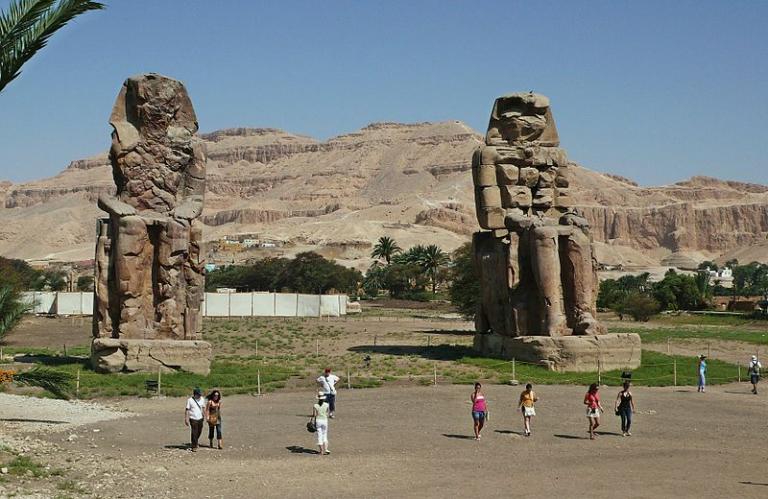
The “Colossi of Memnon” (Wikimedia Commons public domain image)
***
I’ve found it essentially impossible, over the past few days, to establish a connection to the internet. But I seem to have one right now, however fleeting it may be, so I’ll try to strike quickly while the iron is hot. I have to admit that the sporadic access to unreliable internet that I’ve always experienced during recent trips to Egypt — this trip has actually been worse than usual and, accordingly, worse than I had expected — is a major source of frustration for me. I’ve had a difficult time, this trip, keeping up with even minimal (essential) emails.
***
Many of our group got up very, very early on Tuesday for a hot air balloon ride over the area to the west of the Nile. My wife and I have done that balloon ride several times, so we opted to get some extra sleep on this occasion. But it’s a remarkable opportunity that all who can should try to experience; it certainly provides an amazing (and revealing) view of the temples and tombs and fields below.
Afterwards, the entire group crossed the river and visited the valley temple of Queen Hatshepsut at Deir al-Bahri, one of the most beautiful buildings in the world. Nearby, we took the opportunity to point out the general vicinity of the tomb from which the Joseph Smith Papyri came. (We know the general area, but there are three leading candidates, all close together, for the specific site.) Then we went to the Valley of the Kings, where we visited three of the tombs — Ramses III, Ramses IX, and Merenptah — and where those who chose to do so could also visit the tomb of Tutankhamen. There followed a shopping visit to an “alabaster factory.”
When we were all finished there — I was personally finished very soon, as I always am — we drove slowly by the famous “Colossi of Memnon,” which once stood at the entrance of the now-vanished mortuary temple of Amenhotep III (aka Amenophis III, Amenhotep the Great, or Amenhotep the Magnificent) who reigned for nearly forty years (d. ca. 1350 BC). He was the father of Amenhotep IV, who is far more famous today as the “heretic ” pharaoh Akhenaten (or Ikhnaton). That temple is now essentially gone; it probably vanished in pre-Christian antiquity, perhaps even being used as a quarry by Amenhotep III’s pharaonic successors.
The two hard sandstone monoliths depicted Amenhotep III seated on a throne between the much smaller figures of his mother, Mutemwiya (left) and his wife, Queen Tiy (right). Each throne is decorated on its sides with an intertwined lotus representing Upper Egypt and papyrus representing Lower Egypt, which surround the hieroglyph meaning “to unite.” For some reason, though, the ancient Greeks thought that the statues represent Memnon, who was killed by Achilles at Troy. Memnon was the son of Eos, the Dawn, and of Tithonus, a legendary king of Egypt.
When an earthquake hit the area in AD 27, it evidently split the northernmost of the Colossi and, thereafter, that statue emitted a musical note almost every morning. The Greeks evidently decided that Memnon had returned as a statue after his death, and that the morning sound — mourning sound? — represented either his plaintive cry to his mother (remember that she was Eos or Aurora, the dawn) or her lament for him. (The morning dew represented her tears on his behalf.)
Many travelers came to experience the phenomenon — not least among them the Roman emperor Hadrian in AD 130, and the graffiti on the bases of the statutes, in both Greek and Latin, include the names of more than a few visiting celebrities. Unfortunately, though, the Roman emperor Septimus Severus repaired the statue in AD 199 and, accordingly, it never made the sound again.
I read a poem to my group in this connection, as I always do when we visit the site. It’s “Ozymandias,” by Percy Bysshe Shelley. He was inspired to write it by a portrait bust in the British Museum in London that was fancifully labeled “The Younger Memnon.” The bust actually represents Ramses II, and it comes from the thirteenth-century mortuary temple known as the “Ramesseum” that is located only a few hundred yards from the Colossi. (In the photo above, it would be in the distance to the upper right.)
Shelley’s poem seems exceptionally appropriate to the area, and it runs as follows:
I met a traveller from an antique land,
Who said—“Two vast and trunkless legs of stone
Stand in the desert. . . . Near them, on the sand,
Half sunk a shattered visage lies, whose frown,
And wrinkled lip, and sneer of cold command,
Tell that its sculptor well those passions read
Which yet survive, stamped on these lifeless things,
The hand that mocked them, and the heart that fed;
And on the pedestal, these words appear:
My name is Ozymandias, King of Kings;
Look on my Works, ye Mighty, and despair!
Nothing beside remains. Round the decay
Of that colossal Wreck, boundless and bare
The lone and level sands stretch far away.”
Written in Aswan, Egypt
Today — Friday, 26 November 2021 — we began the morning with a visit to the beautiful Temple of Isis at Philae. It’s a Ptolemaic-era structure, which is to say that it’s a fairly late one — that is located on an island between the original Aswan Dam and the more recent Aswan High Dam. It’s also one of the most scenic places in the entire country of Egypt. Like Abu Simbel, it was rescued from rising waters created by the dams and was moved to an island higher than its original location. Afterwards, we drove out onto the High Dam itself, which was completed in 1971, and took a look at both the enormous Lake Nasser behind it and the much lower Nile that flows northward from beneath it.
Then we caught a flight from Aswan back to Cairo and returned to our original hotel. This is, I think, the only hotel that we’ve stayed in when we’ve come on tours with Hany Tawfeek and Alex City Travel. And I’m fairly happy with it: The spectacular location of the Grand Nile Tower can hardly be surpassed.
Written in Cairo, Egypt
Posted from Cairo, Egypt
Previous Post

November 24, 2021
From Edfu to Kom Ombo
Next Post
November 27, 2021 Book of Mormon Onomastics and Syntax, O My!
Browse Our Archives
Select a Category Uncategorized
Select a Month October 2026 September 2026 August 2026 July 2026 June 2026 May 2026 April 2026 March 2026 February 2026 January 2026 December 2025 November 2025 October 2025 September 2025 August 2025 July 2025 June 2025 May 2025 April 2025 March 2025 February 2025 January 2025 December 2024 November 2024 October 2024 September 2024 August 2024 July 2024 June 2024 May 2024 April 2024 March 2024 February 2024 January 2024 December 2023 November 2023 October 2023 September 2023 August 2023 July 2023 June 2023 May 2023 April 2023 March 2023 February 2023 January 2023 December 2022 November 2022 October 2022 September 2022 August 2022 July 2022 June 2022 May 2022 April 2022 March 2022 February 2022 January 2022 December 2021 November 2021 October 2021 September 2021 August 2021 July 2021 June 2021 May 2021 April 2021 March 2021 February 2021 January 2021 December 2020 November 2020 October 2020 September 2020 August 2020 July 2020 June 2020 May 2020 April 2020 March 2020 February 2020 January 2020 December 2019 November 2019 October 2019 September 2019 August 2019 July 2019 June 2019 May 2019 April 2019 March 2019 February 2019 January 2019 December 2018 November 2018 October 2018 September 2018 August 2018 July 2018 June 2018 May 2018 April 2018 March 2018 February 2018 January 2018 December 2017 November 2017 October 2017 September 2017 August 2017 July 2017 June 2017 May 2017 April 2017 March 2017 February 2017 January 2017 December 2016 November 2016 October 2016 September 2016 August 2016 July 2016 June 2016 May 2016 April 2016 March 2016 February 2016 January 2016 December 2015 November 2015 October 2015 September 2015 August 2015 July 2015 June 2015 May 2015 April 2015 March 2015 February 2015 January 2015 December 2014 November 2014 March 2014 August 2013 February 2012
Follow Us!
TAKE THE
Religious Wisdom Quiz
What root attitude does Paul say is the "root of all kinds of evil"?
Select your answer to see how you score.
Love of wisdom Love of animals Love of music Love of money
Related posts from Sic et Non
"Look on my Works, ye Mighty, and despair!"
Ancient Egyptian Cosmology Illustrated in Soil Core Samples

For his 101st, recalling a minor incident with...
TRENDING AT PATHEOS Latter-day Saint

The Sermon on the Mount, Part I: Matthew...
The Sermon on the Mount, Part I (Matthew 4:12-5:12) St. Matthew moves...

What's up from Crossway: Reviewing some of their latest A few weeks...

Janie Learns the Way of the Cross: A...
Teaching children about Jesus' Passion can be challenging. Many parents and educators...

Looking For Good Catholic Writing - October 2026
He alone extends the heavens, and he walks upon the waves of...

In "Irreplaceable," our book on vocation and technology, Trevor Sutton and I...

I was strolling through the top floor of the brand new Parthenon...
view all Latter-day Saint blogs
Ad-Free & Subscriber Log-In Subscription Support
- About Us
- 2026 Calendar
- Videos
- Podcasts
- Library of World Religions
- Faith In Media Tracker
- Advertise With Us
- Write for Us
- Privacy Policy
- Terms of Service
- Do Not Sell My Data
- Contact Us
- Radiant Digital
- Manage Newsletter Subscriptions
- Unsubscribe From Notifications
- Sitemap
Copyright 2008-2026, Patheos. All rights reserved.
Subscription Support Ad-Free & Subscriber Log-In
Follow Patheos