
BuddhistCatholicContemplativeEvangelicalGeneral ChristianHinduJewishLatter-day SaintMuslimNew VisionsProgressive Christian
Beliefs
- Buddhist
- Catholic
- Contemplative
- Evangelical
- General Christian
- Hindu
- Jewish
- Latter-day Saint
- More Voices
- Muslim
- New Visions
- Pagan
- Progressive Christian
Topics
- Religion News
- Food and Religion
- Sports and Religion
- Religious Art
- Religious Music and Entertainment
- Religious Events
- History and Religion
- Style and Religion
- Politics and Religion
- Women in Religion
- Recreation Outdoors and Religion
- Business Finance and Religion
- Careers Workplace and Religion
- Education and Religion
- Family Parenting and Religion
- Health Fitness and Religion
- Home and Religion
- Relationships and Religion
- Technology and Religion
- Travel and Religion
Columnists
- Buddhist Columnists
- Business Finance and Religion Columnists
- Careers Workplace and Religion Columnists
- Catholic Columnists
- Contemplative Columnists
- Education and Religion Columnists
- Evangelists Columnists
- Family Parenting and Religion Columnists
- General Christian Columnists
- Health Fitness and Religion Columnists
- Hindu Columnists
- History and Religion Columnists
- Home and Religion Columnists
- Jewish Columnists
- More Voices Columnists
- Latter Day Columnists
- Muslim Columnists
- New Visions Columnists
- Nonreligious Columnists
- Pagan Columnists
- Politics and Religion Columnists
- Progressive Columnists
- Recreation Outdoors and Religion Columnists
- Relationships and Religion Columnists
- Religion News Columnists
- Religious Art Columnists
- Religious Events Columnists
- Religious Music and Entertainment Columnists
- Sports and Religion Columnists
- Style and Religion Columnists
- Technology and Religion Columnists
- Travel and Religion Columnists
- Women in Religion Columnists
Resource Library
- 2026 Calendar
- Library of World Religions
- The 100 Most Holy Places on Earth
- Patheos Answers
- Podcasts
- Videos
- Faith Leaders Database
- Anglican Episcopalian
- Bahai
- Baptist
- Buddhism
- Christianity
- Confucianism
- Eastern Orthodoxy
- Hinduism
- Holiness and Pentecostal
- ISKCON
- Islam
- Judaism
- Lutheran
- Methodist
- The Church of Jesus Christ of Latter-day Saints
- New Age
- Paganism
- Presbytarian and Reformed
- Protestantism
- Religion Behind the Scenes
- Roman Catholic
- Scientology
- Shia Islam
- Sikhism
- Sufism
- Sunni Islam
- Taoism
- Zen
- See all religions
Research Tools
 Ad-Free & Subscriber Log-In Subscription Support
Ad-Free & Subscriber Log-In Subscription Support
Follow Patheos 

- Trending:
- Forgiveness
- |
- Marriage
- |
- Consciousness
- |
- Death Penalty
- |
- Election
- |
- Halloween

- Home
- Latter-day Saint
- Scripture, Temples, and Hugh Nibley
Scripture, Temples, and Hugh Nibley
Last updated on: November 15, 2021 at 8:25 pm by Dan Peterson
Scripture, Temples, and Hugh Nibley 2021-11-15T20:25:08-07:00 Dan Peterson
Patheos Explore the world's faith through different perspectives on religion and spirituality! Patheos has the views of the prevalent religions and spiritualities of the world.
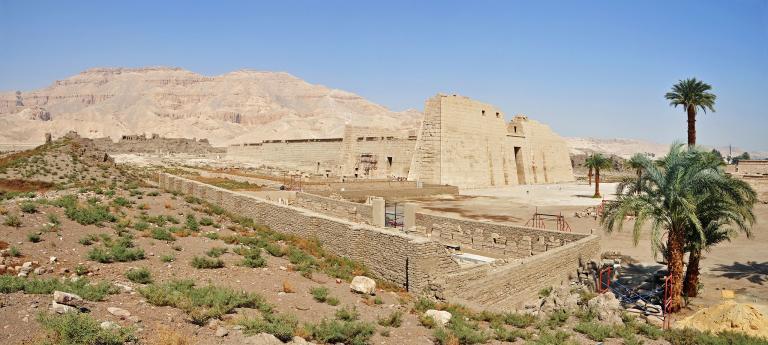
A general view from the south toward the great mortuary temple of Ramses III, which is often called “Medinet Habu” today
(Wikimedia CC public domain photo)
***
Here are a few links to articles that have previously appeared in Interpreter: A Journal of Latter-day Saint Faith and Scholarship. Perhaps you missed one or more of them:
John Gee, ““Put Off Thy Shoes from Off Thy Feet”: Sandals and Sacred Space”
Abstract: While many have written on ancient temples looking at the big picture, John Gee discusses one small detail on a single Egyptian temple from the New Kingdom. He focuses on depictions of Ramses III in and out of the temple of Medinet Habu. Outside the temple and when entering and leaving there are depictions of him wearing sandals. Inside the temple proper the king is always shown barefoot. Ramses III built Medinet Habu only slightly after the time of Moses and as Gee further notes, while not wearing footwear was a clear practice among the Egyptians it is far more explicit in Moses’ encounter with Deity when he is told to remove his “shoes from off thy feet, for the place whereon thou standest is holy ground.” Gee observes that contemporary Egyptian temple practice “reflects the commands of God recorded in the Pentateuch,” as well as reflects Moses’ Egyptian background.
Duane Boyce, “Did Captain Moroni Lack the Typical Religious Virtues?”
Abstract: In his well-known volume about the Book of Mormon, Grant Hardy focuses primarily on the book’s main narrators. However, he also makes a number of observations about other figures in the book that are of particular interest, including some about Captain Moroni. In addition to those I address elsewhere, these observations include the claim that Moroni lacked the typical religious virtues — which Hardy identifies as “humility, self-sacrifice, kindness, and relying upon the Lord.” They also include the assertion that Helaman, in his manifest reliance upon God, serves as a counterexample to Moroni’s military leadership. A close look at the text, however, indicates that both these claims are mistaken.
Review of Hugh Nibley Observed, edited by Jeffrey M. Bradshaw, Shirley Ricks, and Stephen Whitlock (Orem, UT: Interpreter Foundation, 2021). 820 pages. $45.00 (hardback), $35.00 (paperback).
Abstract: Those who knew Brother Nibley best knew he was a remarkable man of both depth and breadth. This new volume plumbs both that depth and breadth in the recounting of personal stories and colorful history. This volume is a welcome addition to any library.
Abstract: David J. Larsen, after showing how many of the Qumran texts rely on the “Royal Psalms” in the Bible—which have a vital connection to the temple drama—then goes on to exaltation in the views of the Qumran community. He indicates how Adam and Eve are archetypal for Israelite temple ritual, which makes humans kings and priests, bringing the participant into the presence of God by a journey accompanied with covenants, making him part of the Divine Council. Bestowed with knowledge of the divine mysteries, one then becomes a teacher helping others on the way through divine mysteries, who then, as a group are raised to the same end. It is, Larsen shows, a journey where one is dressed in royal and priestly robes and receives a crown of righteousness, in a ritual setting.
[Editor’s Note: Part of our book chapter reprint series, this article is reprinted here as a service to the LDS community. Original pagination and page numbers have necessarily changed, otherwise the reprint has the same content as the original.
See David J. Larsen, “From Dust to Exalted Crown: Royal and Temple Themes Common to the Psalms and the Dead Sea Scrolls,” in Temple Insights: Proceedings of the Interpreter Matthew B. Brown Memorial Conference, “The Temple on Mount Zion,” 22 September 2012, ed. William J. Hamblin and David Rolph Seely (Orem, UT: The Interpreter Foundation; Salt Lake City: Eborn Books, 2014), 145–156. Further information at https://interpreterfoundation.org/books/temple-insights/.]
Alan Goff, “Types of Repetition and Shadows of History in Hebraic Narrative”
Abstract: Modern readers too often misunderstand ancient narrative. Typical of this incomprehension has been the inclination of modern biblical critics to view repetitions as narrative failures. Whether you call such repetitions types, narrative analogies, type scenes, midrashic recurrences, or numerous other names, this view of repeated elements has dominated modern readings of Hebraic narratives for at least 200 years. Robert Alter, who introduced a new yet antique understanding of repetitions in the Hebrew Bible in the 1980s, began to reverse this trend. Such repeated elements aren’t failures or shortcomings but are themselves artistic clues to narrative meaning that call readers to appreciate the depth of the story understood against the background of allusion and tradition. Richard Hays has brought similar insights to Christian scripture. The Book of Mormon incorporates the same narrative features as are present in other Hebraic narrative. The ancient rabbis highlighted the repeating elements in biblical narrative, noting that “what happens to the fathers, happens to the sons.” The story of Moroni’s raising the standard of liberty in Alma 46 illustrates the repetitive expectation by seeing the events of the biblical Joseph’s life repeated in the lives of these Nephite descendants of Joseph. Such recurrence in narratives can, considering the insights of Alter and Hays, reveal richness and depth in the narrative without detracting from the historical qualities of the text.
***
It’s more than a bit tough, but, well, in my judgment it unfortunately needs to be said:
“Neville asks why, so we provide the answers”
***
This item, from Forbes, was passed on to me by somebody and I’m sorry to say that I can’t remember who it was, so I can’t offer personal thanks. Anyway, since it concerns what some exceptionally clever critics like to dub Utard, the home state of the “MORmONS,” it plainly comes from the general vicinity of the enormous Christopher Hitchens Memorial “How Religion Poisons Everything” File©:
Utah occupied the top spot in Forbes’ Best States for Business six times in seven years between 2010 and 2016 (Virginia in 2013 was the lone outlier), but fell to third in 2017 due to rising business costs and a softer economic outlook. The state has a very pro-business climate and companies benefit from energy costs that are 16% below the national average, according to Moody’s Analytics. Utah’s employment has expanded 3.3% a year over the past five years—second best in the U.S. Utah is well known for its winter activities and tourism has soared since the 2002 Winter Olympics. With two-thirds of Utahns being members of The Church of Jesus Christ of Latter-day Saints, Utah is the most religiously homogeneous state in the U.S.
Christopher Hitchens Memorial "How Religion Poisons Everything" File
Church of Jesus Christ of Latter-day Saints
Previous Post

November 14, 2021
"Remember Pearl Harbor!"
Browse Our Archives
Select a Category Uncategorized
Select a Month October 2026 September 2026 August 2026 July 2026 June 2026 May 2026 April 2026 March 2026 February 2026 January 2026 December 2025 November 2025 October 2025 September 2025 August 2025 July 2025 June 2025 May 2025 April 2025 March 2025 February 2025 January 2025 December 2024 November 2024 October 2024 September 2024 August 2024 July 2024 June 2024 May 2024 April 2024 March 2024 February 2024 January 2024 December 2023 November 2023 October 2023 September 2023 August 2023 July 2023 June 2023 May 2023 April 2023 March 2023 February 2023 January 2023 December 2022 November 2022 October 2022 September 2022 August 2022 July 2022 June 2022 May 2022 April 2022 March 2022 February 2022 January 2022 December 2021 November 2021 October 2021 September 2021 August 2021 July 2021 June 2021 May 2021 April 2021 March 2021 February 2021 January 2021 December 2020 November 2020 October 2020 September 2020 August 2020 July 2020 June 2020 May 2020 April 2020 March 2020 February 2020 January 2020 December 2019 November 2019 October 2019 September 2019 August 2019 July 2019 June 2019 May 2019 April 2019 March 2019 February 2019 January 2019 December 2018 November 2018 October 2018 September 2018 August 2018 July 2018 June 2018 May 2018 April 2018 March 2018 February 2018 January 2018 December 2017 November 2017 October 2017 September 2017 August 2017 July 2017 June 2017 May 2017 April 2017 March 2017 February 2017 January 2017 December 2016 November 2016 October 2016 September 2016 August 2016 July 2016 June 2016 May 2016 April 2016 March 2016 February 2016 January 2016 December 2015 November 2015 October 2015 September 2015 August 2015 July 2015 June 2015 May 2015 April 2015 March 2015 February 2015 January 2015 December 2014 November 2014 March 2014 August 2013 February 2012
Follow Us!
TAKE THE
Religious Wisdom Quiz
Which tribe first accepted David as king after Saul's death?
Select your answer to see how you score.
Ephraim Dan Benjamin Judah
Related posts from Sic et Non


Notes on Women, Priesthood, and General Conference

"America's Most Neighborly City"? It's not in Switzerland

"The Book of Moses as a Temple Text"
TRENDING AT PATHEOS Latter-day Saint

Top Three Anti-Catholic Lies About Catholicism
This is my initial transcript for the video, "THE 3 WORST...

Pope Leo Celebrates Mass for Nurses & Docs...
I don't have any idea how he did it, but Pope Leo...

The Sermon on the Mount, Part I: Matthew...
The Sermon on the Mount, Part I (Matthew 4:12-5:12) St. Matthew moves...

What's up from Crossway: Reviewing some of their latest A few weeks...

Janie Learns the Way of the Cross: A...
Teaching children about Jesus' Passion can be challenging. Many parents and educators...

Looking For Good Catholic Writing - October 2026
He alone extends the heavens, and he walks upon the waves of...
view all Latter-day Saint blogs
Ad-Free & Subscriber Log-In Subscription Support
- About Us
- 2026 Calendar
- Videos
- Podcasts
- Library of World Religions
- Faith In Media Tracker
- Advertise With Us
- Write for Us
- Privacy Policy
- Terms of Service
- Do Not Sell My Data
- Contact Us
- Radiant Digital
- Manage Newsletter Subscriptions
- Unsubscribe From Notifications
- Sitemap
Copyright 2008-2026, Patheos. All rights reserved.
Subscription Support Ad-Free & Subscriber Log-In
Follow Patheos