
BuddhistCatholicContemplativeEvangelicalGeneral ChristianHinduJewishLatter-day SaintMuslimNew VisionsProgressive Christian
Beliefs
- Buddhist
- Catholic
- Contemplative
- Evangelical
- General Christian
- Hindu
- Jewish
- Latter-day Saint
- More Voices
- Muslim
- New Visions
- Pagan
- Progressive Christian
Topics
- Religion News
- Food and Religion
- Sports and Religion
- Religious Art
- Religious Music and Entertainment
- Religious Events
- History and Religion
- Style and Religion
- Politics and Religion
- Women in Religion
- Recreation Outdoors and Religion
- Business Finance and Religion
- Careers Workplace and Religion
- Education and Religion
- Family Parenting and Religion
- Health Fitness and Religion
- Home and Religion
- Relationships and Religion
- Technology and Religion
- Travel and Religion
Columnists
- Buddhist Columnists
- Business Finance and Religion Columnists
- Careers Workplace and Religion Columnists
- Catholic Columnists
- Contemplative Columnists
- Education and Religion Columnists
- Evangelists Columnists
- Family Parenting and Religion Columnists
- General Christian Columnists
- Health Fitness and Religion Columnists
- Hindu Columnists
- History and Religion Columnists
- Home and Religion Columnists
- Jewish Columnists
- More Voices Columnists
- Latter Day Columnists
- Muslim Columnists
- New Visions Columnists
- Nonreligious Columnists
- Pagan Columnists
- Politics and Religion Columnists
- Progressive Columnists
- Recreation Outdoors and Religion Columnists
- Relationships and Religion Columnists
- Religion News Columnists
- Religious Art Columnists
- Religious Events Columnists
- Religious Music and Entertainment Columnists
- Sports and Religion Columnists
- Style and Religion Columnists
- Technology and Religion Columnists
- Travel and Religion Columnists
- Women in Religion Columnists
Resource Library
- 2026 Calendar
- Library of World Religions
- The 100 Most Holy Places on Earth
- Patheos Answers
- Podcasts
- Videos
- Faith Leaders Database
- Anglican Episcopalian
- Bahai
- Baptist
- Buddhism
- Christianity
- Confucianism
- Eastern Orthodoxy
- Hinduism
- Holiness and Pentecostal
- ISKCON
- Islam
- Judaism
- Lutheran
- Methodist
- The Church of Jesus Christ of Latter-day Saints
- New Age
- Paganism
- Presbytarian and Reformed
- Protestantism
- Religion Behind the Scenes
- Roman Catholic
- Scientology
- Shia Islam
- Sikhism
- Sufism
- Sunni Islam
- Taoism
- Zen
- See all religions
Research Tools
 Ad-Free & Subscriber Log-In Subscription Support
Ad-Free & Subscriber Log-In Subscription Support
Follow Patheos 

- Trending:
- Forgiveness
- |
- Marriage
- |
- Consciousness
- |
- Death Penalty
- |
- Election
- |
- Halloween

- Home
- Latter-day Saint
- “Salvation is neither a gift won nor a reward earned”
“Salvation is neither a gift won nor a reward earned”
Last updated on: November 9, 2021 at 2:23 pm by Dan Peterson
“Salvation is neither a gift won nor a reward earned” 2021-11-09T14:23:05-07:00 Dan Peterson
Patheos Explore the world's faith through different perspectives on religion and spirituality! Patheos has the views of the prevalent religions and spiritualities of the world.
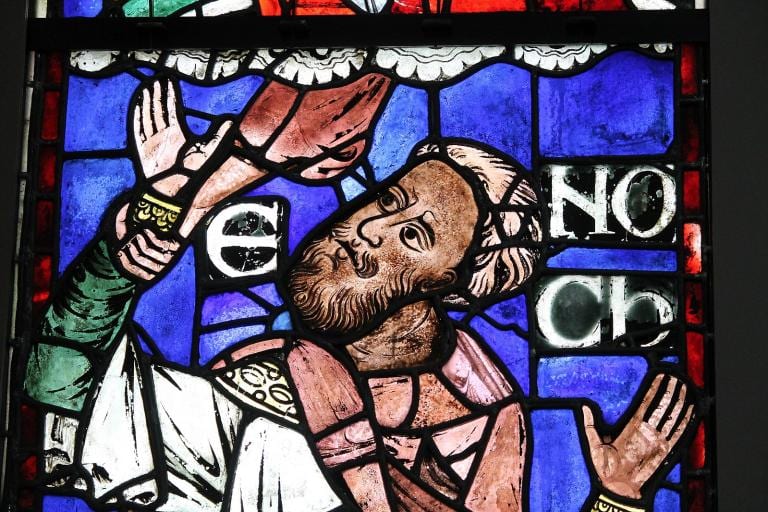
In this stained glass window from Canterbury Cathedral in the United Kingdom, a hand reaches down from within a cloud (or behind a veil) to take Enoch into heaven.
(Wikimedia Commons public domain image)
***
Here’s a new item that’s just appeared on the website of the Interpreter Foundation, kindly supplied by Jonn Claybaugh:
And this has also just one up on Interpreter’s website:
The Interpreter Radio Roundtable for Come, Follow Me Doctrine and Covenants Lesson 47, “Prepare Ye for the Coming of the Bridegroom,” on D&C 133-134, has been extracted — liberated from commercial and other interruptions — from the 10 October 2021 broadcast of the Interpreter Radio Show. The participants in this particular roundtable were Terry Hutchinson, John Gee, and Kevin Christensen. The complete two-hour program can be heard at https://interpreterfoundation.org/interpreter-radio-show-October-10-2021/. The Interpreter Radio Show can be heard Sunday evenings every week between 7 PM to 9 PM (MDT), on K-TALK, AM 1640 or, alternatively, you can listen live on the Internet at ktalkmedia.com.
***
As I said a couple of days ago, I recently read Terryl L. Givens, Stretching the Heavens: The Life of Eugene England and the Crisis of Modern Mormonism (Chapel Hill: University of North Carolina Press, 2021). Here are just a couple of the passages in it that, as the currently somewhat fashionable term has it, “resonated’ with me:
Grace cannot bestow salvation because salvation is neither a gift won nor a reward earned. It is a condition attained when sanctified individuals become the kind of persons, in the kinds of relationships, that constitute the divine nature. (121)
The sort of idea is something of an implicit subtheme in an article that I published a while back:
“Notes on Mormonism and the Trinity”
A God who weeps over human misery (and does so in actual corporeal form!) is the most economical and irrefutable argument conceivable for the church’s placement far outside the historical Christian tradition with which many of England’s contemporaries were pleading affinity. God’s distress at the predicament humans have brought upon themselves clearly evidences a disappointment, a regret, at the course of events — which can only mean they are not consistent with his will. We are here at almost the farthest remove imaginable from the God of Augustine and John Calvin, for whom in the latter case “everything is governed by God’s hand,” from who is saved to where and when earthquakes hit. The Latter-day Saint God, by contrast, does not orchestrate human behavior, choice, and events to comport perfectly with his will. He participates in rather than transcends the ebb and flow of human history, human tragedy, and human grief. Sterling McMurrin, like England, recognized that “Mormon theological writing and sermonizing are more often than not replete with the vocabulary of absolutism. But, like it or not, the Mormon or theologian must sooner or later return to the finitistic conception of God upon which both his technical theology and his theological myths are founded.” England unabashedly embraced a finitistic God the Father, physically embodied and susceptible to vicarious suffering. He found in that conception his faith tradition’s greatest strength, rather than weakness. (122)
With his wife, Fiona, Terryl Givens has actually written on this subject. See, for instance, The God Who Weeps: How Mormonism Makes Sense of Life. And, for what little it may be worth, so have I. See my article “On the Motif of the Weeping God in Moses 7,” which can be found online in an oddly formatted form — thanks, Maxwell Institute! — via a simple Google search.
I was also rather gratified to notice this brief passage in which Terryl illustrates what he regards as the more intellectually open nature of the contemporary Church of Jesus Christ of Latter-day Saints:
As long as a scholar’s “speculative theology” makes no authoritative claims, it is highly unlikely to be condemned today; in fact, a Society for Mormon Philosophy and Theology was organized in 2003 and publishes its own journal, Element. (280)
I was present at the creation of Society for Mormon Philosophy and Theology, have spoken at several of its conferences, and published in its journal, Element. In fact, I served for several years not only on its board but as its president.
***
I’m pleased that Gene England is receiving some renewed attention. He has much to offer. And, yes, we can learn from his troubled time at Brigham Young University. Here are two quotations from him that I found just now online:
We must truly listen to each other, respecting our essential brotherhood and the courage of those who try to speak, however they may differ from us in professional standing or religious belief or moral vision. We must speak and listen patiently, with good humor, with real expectation, and our dialogue can serve both truth and charity.
I know God has been found by unusual people in unusual places–in a sudden vision in a grove or orchard or grotto, or on a mountain or in a closet, or through saintly service to African lepers or to Calcutta untouchables. But for most of us, most of the time, I am convinced he can be found most surely in ‘the natural sequence to the performance’ of the duties he has given us that all of us (not just the unusual) can perform in our own homes and neighborhoods.
I endorse both of them.
***
Finally, on a quite unrelated personal note:
I’ve been, umm, blessed over the past fifteen years or so, every single day of every week of every month, to be a principal focus of attention for a small group of anonymous online folks who scrutinize everything I do and say and write. They’re looking for evidence of real or perceived errors and wickedness. Most recently, they’ve discovered that the one-hundred-word twenty-third paragraph of my recent nearly-four-thousand-word essay “De Profundis,” a paragraph devoted to defining the Greek New Testament word metanoia and the roughly equivalent Hebrew term teshuvah, is verbally far closer than it ought to be to the respectively relevant articles, first, on Wikipedia and, second, on a website called My Jewish Learning.
And they’re right. And I’m surprised, somewhat perplexed, and, they’ll be delighted to know, embarrassed. I’m not exactly sure how it happened. I vaguely recall that I checked the Wikipedia article and the My Jewish Learning article in order to confirm my sense of the exact meanings of the terms. I wanted to check it against that of people who shared neither my background, my faith, nor my particular “agenda.” But I certainly didn’t mean to simply reproduce the precise language of those other people. What would I gain from that? After all, it’s not as if their precise language was particularly unique or elegant or eloquent. And it’s not as if I needed to look up the basic meaning of terms that I’ve known for decades. (I earned an undergraduate degree in classical Greek, and I took my first Hebrew course before embarking on my mission at the age of nineteen. And these are absolutely central words, not peripheral obscurities, in the New Testament and in the Jewish tradition.) Had I not already known the basic meaning of the two terms, it would never have occurred to me to look them up. I looked them up in much the same way, and for much the same reason, that I’ll sometimes, when writing, check out the exact meaning in the Oxford English Dictionary of a word that I use pretty much every day of my life.
Oh well. I can only apologize and make an effort to take pleasure in the fact that I’ve made at least one tiny group of online enthusiasts very, very happy today. In a world such as ours, that’s not a small thing. I freely plead guilty to the unforced error, but I won’t concede their eager imputations of depravity or corruption.
Previous Post

November 8, 2021
Lighting the World
Next Post
November 10, 2021 "Gold Mountain"
Browse Our Archives
Select a Category Uncategorized
Select a Month October 2026 September 2026 August 2026 July 2026 June 2026 May 2026 April 2026 March 2026 February 2026 January 2026 December 2025 November 2025 October 2025 September 2025 August 2025 July 2025 June 2025 May 2025 April 2025 March 2025 February 2025 January 2025 December 2024 November 2024 October 2024 September 2024 August 2024 July 2024 June 2024 May 2024 April 2024 March 2024 February 2024 January 2024 December 2023 November 2023 October 2023 September 2023 August 2023 July 2023 June 2023 May 2023 April 2023 March 2023 February 2023 January 2023 December 2022 November 2022 October 2022 September 2022 August 2022 July 2022 June 2022 May 2022 April 2022 March 2022 February 2022 January 2022 December 2021 November 2021 October 2021 September 2021 August 2021 July 2021 June 2021 May 2021 April 2021 March 2021 February 2021 January 2021 December 2020 November 2020 October 2020 September 2020 August 2020 July 2020 June 2020 May 2020 April 2020 March 2020 February 2020 January 2020 December 2019 November 2019 October 2019 September 2019 August 2019 July 2019 June 2019 May 2019 April 2019 March 2019 February 2019 January 2019 December 2018 November 2018 October 2018 September 2018 August 2018 July 2018 June 2018 May 2018 April 2018 March 2018 February 2018 January 2018 December 2017 November 2017 October 2017 September 2017 August 2017 July 2017 June 2017 May 2017 April 2017 March 2017 February 2017 January 2017 December 2016 November 2016 October 2016 September 2016 August 2016 July 2016 June 2016 May 2016 April 2016 March 2016 February 2016 January 2016 December 2015 November 2015 October 2015 September 2015 August 2015 July 2015 June 2015 May 2015 April 2015 March 2015 February 2015 January 2015 December 2014 November 2014 March 2014 August 2013 February 2012
Follow Us!
TAKE THE
Religious Wisdom Quiz
True or False: Mark is the only Gospel that records Jesus asking 'Who touched my clothes?' after power went out from him.
Select your answer to see how you score.
FALSE TRUE
Related posts from Sic et Non

Learning more about a region of which I've...

From Serbia's "White City," Belgrade


TRENDING AT PATHEOS Latter-day Saint

Janie Learns the Way of the Cross: A...
Teaching children about Jesus' Passion can be challenging. Many parents and educators...

Looking For Good Catholic Writing - October 2026
He alone extends the heavens, and he walks upon the waves of...

In "Irreplaceable," our book on vocation and technology, Trevor Sutton and I...

I was strolling through the top floor of the brand new Parthenon...

What Does Gêvâh Mean For Kimberley Guifoyle &...
This week, a lot of the news is focused on Kimberly Guilfoyle....

INNER CIRCLE: Profound Mystery (Of Christ In All...
Ephesians 5:31-32 “For this reason, a man will leave his father and...
view all Latter-day Saint blogs
Ad-Free & Subscriber Log-In Subscription Support
- About Us
- 2026 Calendar
- Videos
- Podcasts
- Library of World Religions
- Faith In Media Tracker
- Advertise With Us
- Write for Us
- Privacy Policy
- Terms of Service
- Do Not Sell My Data
- Contact Us
- Radiant Digital
- Manage Newsletter Subscriptions
- Unsubscribe From Notifications
- Sitemap
Copyright 2008-2026, Patheos. All rights reserved.
Subscription Support Ad-Free & Subscriber Log-In
Follow Patheos