
BuddhistCatholicContemplativeEvangelicalGeneral ChristianHinduJewishLatter-day SaintMuslimNew VisionsProgressive Christian
Beliefs
- Buddhist
- Catholic
- Contemplative
- Evangelical
- General Christian
- Hindu
- Jewish
- Latter-day Saint
- More Voices
- Muslim
- New Visions
- Pagan
- Progressive Christian
Topics
- Religion News
- Food and Religion
- Sports and Religion
- Religious Art
- Religious Music and Entertainment
- Religious Events
- History and Religion
- Style and Religion
- Politics and Religion
- Women in Religion
- Recreation Outdoors and Religion
- Business Finance and Religion
- Careers Workplace and Religion
- Education and Religion
- Family Parenting and Religion
- Health Fitness and Religion
- Home and Religion
- Relationships and Religion
- Technology and Religion
- Travel and Religion
Columnists
- Buddhist Columnists
- Business Finance and Religion Columnists
- Careers Workplace and Religion Columnists
- Catholic Columnists
- Contemplative Columnists
- Education and Religion Columnists
- Evangelists Columnists
- Family Parenting and Religion Columnists
- General Christian Columnists
- Health Fitness and Religion Columnists
- Hindu Columnists
- History and Religion Columnists
- Home and Religion Columnists
- Jewish Columnists
- More Voices Columnists
- Latter Day Columnists
- Muslim Columnists
- New Visions Columnists
- Nonreligious Columnists
- Pagan Columnists
- Politics and Religion Columnists
- Progressive Columnists
- Recreation Outdoors and Religion Columnists
- Relationships and Religion Columnists
- Religion News Columnists
- Religious Art Columnists
- Religious Events Columnists
- Religious Music and Entertainment Columnists
- Sports and Religion Columnists
- Style and Religion Columnists
- Technology and Religion Columnists
- Travel and Religion Columnists
- Women in Religion Columnists
Resource Library
- 2026 Calendar
- Library of World Religions
- The 100 Most Holy Places on Earth
- Patheos Answers
- Podcasts
- Videos
- Faith Leaders Database
- Anglican Episcopalian
- Bahai
- Baptist
- Buddhism
- Christianity
- Confucianism
- Eastern Orthodoxy
- Hinduism
- Holiness and Pentecostal
- ISKCON
- Islam
- Judaism
- Lutheran
- Methodist
- The Church of Jesus Christ of Latter-day Saints
- New Age
- Paganism
- Presbytarian and Reformed
- Protestantism
- Religion Behind the Scenes
- Roman Catholic
- Scientology
- Shia Islam
- Sikhism
- Sufism
- Sunni Islam
- Taoism
- Zen
- See all religions
Research Tools
 Ad-Free & Subscriber Log-In Subscription Support
Ad-Free & Subscriber Log-In Subscription Support
Follow Patheos 

- Trending:
- Forgiveness
- |
- Marriage
- |
- Consciousness
- |
- Death Penalty
- |
- Election
- |
- Halloween

- Home
- Latter-day Saint
- “Oh, that I were an angel”
“Oh, that I were an angel”
Last updated on: November 5, 2021 at 11:28 pm by Dan Peterson
“Oh, that I were an angel” 2021-11-05T23:28:56-06:00 Dan Peterson
Patheos Explore the world's faith through different perspectives on religion and spirituality! Patheos has the views of the prevalent religions and spiritualities of the world.
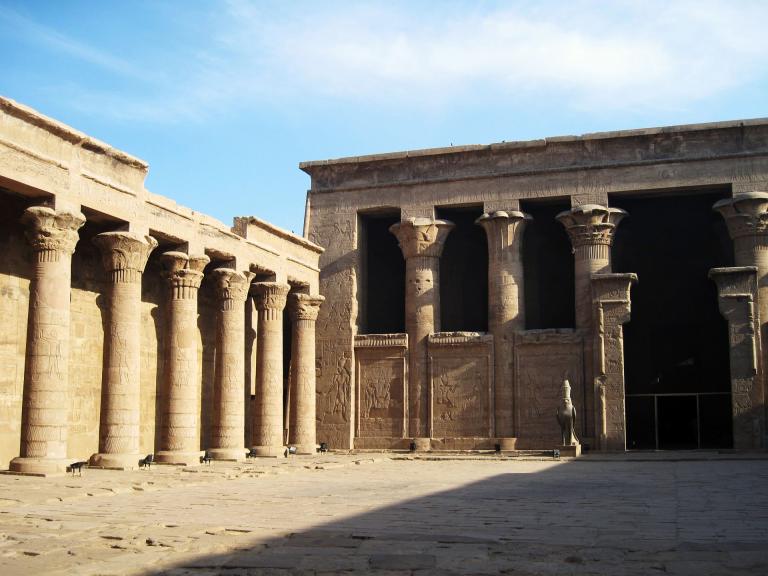
In the main inner courtyard of the Temple of Horus at Edfu, in Egypt. The Interpreter Foundation “Ultimate Egypt” tour will visit the Edfu Temple later this month (November 2021).
(Wikimedia Commons public domain image)
***
A new article appeared today in Interpreter: A Journal of Latter-day Saint Faith and Scholarship. It was written by someone too mean-spirited, nasty, dishonest, and ignorant to mention. (I’ve been reading some anonymous online comments about the author, so I know.)
Abstract: Alma’s conversion experience was both unusual and unusually powerful, and yet he fervently wished that he could provide others with the same experience. So much so, in fact, that he actually feared that he might be sinning in his wish by seeming to oppose the will of God. Increasingly, though, I find myself sharing that wish. My involvement with the Interpreter Foundation can correctly be regarded as one manifestation of that fact. I invite others to join us.
***
And here are links to a few articles from a prior number of Interpreter:
Val Larsen, “Josiah to Zoram to Sherem to Jarom and the Big Little Book of Omni”
Abstract: The first 450 years of Nephite history are dominated by two main threads: the ethno-political tension between Nephites and Lamanites and religious tension between adherents of rival theologies. These rival Nephite theologies are a Mantic theology that affirms the existence of Christ and a Sophic theology that denies Christ. The origin of both narrative threads lies in the Old World: the first in conflicts between Nephi and Laman, the second in Lehi’s rejection of King Josiah’s theological and political reforms. This article focuses on these interrelated conflicts. It suggests that Zoram, Laman, Lemuel, Sherem, and the Zeniffites were Deuteronomist followers of Josiah. The small plates give an account of how their Deuteronomist theology gradually supplanted the gospel of Christ. As the small plates close, their last author, Amaleki, artfully confronts his readers with a life-defining choice: having read the Book of Mormon thus far, will you remain, metaphorically, with the prophets in Zarahemla and embrace the Restored Gospel of Jesus Christ, or will you return to the land of Nephi and the theology you believed and the life you lived before you read the Book of Mormon?
Steven L. Olsen, “The Latest in Chiastic Studies for Interested Scholars and Lay Readers Alike”
Review of Chiasmus: The State of the Art, edited by John W. Welch and Donald W. Parry (Provo, UT: BYU Studies and Book of Mormon Central, 2020). 358 pages. $24.68, paperback.
Abstract: This collection of essays represents the latest scholarship on chiasmus. They were selected from papers delivered at an academic conference at Brigham Young University in 2017. Articles reflect both “the state of the art” and the state of the technique in chiastic studies.
Abstract: In this essay John Gee draws a connection between the Egyptian “Book of the Temple” and the book of Exodus, both in structure and topic, describing the temple from the inside out. Gee concludes that both probably go back to a common source older than either of them.
[Editor’s Note: Part of our book chapter reprint series, this article is reprinted here as a service to the LDS community. Original pagination and page numbers have necessarily changed, otherwise the reprint has the same content as the original.
See John Gee, “Edfu and Exodus,” in Temple Insights: Proceedings of the Interpreter Matthew B. Brown Memorial Conference, “The Temple on Mount Zion,” 22 September 2012, ed. William J. Hamblin and David Rolph Seely (Orem, UT: The Interpreter Foundation; Salt Lake City: Eborn Books, 2014), 67–82. Further information at https://interpreterfoundation.org/books/temple-insights/.]
Abstract: In sermons and writings, Jacob twice quotes the prophecy of Isaiah 11:11 (“the Lord [ʾădōnāy] shall set his hand again [yôsîp] the second time to gather the remnant of his people”). In 2 Nephi 6:14 and Jacob 6:2, Jacob uses Isaiah 11:11 as a lens through which he interprets much lengthier prophetic texts that detail the restoration, redemption, and gathering of Israel: namely, Isaiah 49:22–52:2 and Zenos’s Allegory of the Olive Trees (Jacob 5). In using Isaiah 11:11 in 2 Nephi 6:14, Jacob, consistent with the teaching of his father Lehi (2 Nephi 2:6), identifies ʾădōnāy (“the Lord”) in Isaiah 11:11 as “the Messiah” and the one who will “set himself again the second time to recover” his people (both Israel and the righteous Gentiles who “believe in him”) and “manifest himself unto them in great glory.” This recovery and restoration will be so thoroughgoing as to include the resurrection of the dead (see 2 Nephi 9:1–2, 12–13). In Jacob 6:2, Jacob equates the image of the Lord “set[ting] his hand again [yôsîp] the second time to recover his people” (Isaiah 11:11) to the Lord of the vineyard’s “labor[ing] in” and “nourish[ing] again” the vineyard to “bring forth again” (cf. Hebrew yôsîp*) the natural fruit (Jacob 5:29–33, 51–77) into the vineyard. All of this suggests that Jacob saw Isaiah 49:22–52:2 and Zenos’s allegory (Jacob 5) as telling essentially the same story. For Jacob, the prophetic declaration of Isaiah 11:11 concisely summed up this story, describing divine initiative and iterative action to “recover” or gather Israel in terms of the verb* yôsîp*. Jacob, foresaw this the divine action as being accomplished through the “servant” and “servants” in Isaiah 49–52, “servants” analogous to those described by Zenos in his allegory. For Jacob, the idiomatic use of* yôsîp in Isaiah 11:11 as he quotes it in 2 Nephi 6:14 and Jacob 6:2 and as repeated throughout Zenos’s allegory (Jacob 5) reinforces the patriarch Joseph’s statement preserved in 2 Nephi 3 that this figure would be a “Joseph” (yôsēp).
Jeffrey Thayne, “Understanding Covenants Anew: Using Ancient Thought to Enrich Modern Faith”
Review of Jennifer C. Lane, Finding Christ in the Covenant Path: Ancient Insights for Modern Life, (Provo, UT: Religious Studies Center at Brigham Young University / Salt Lake City: Deseret Book, 2020). 188 pages. Hardcover, $29.99.
Abstract: In the first half of her book, Lane takes us on a tour of ancient worlds by introducing us to ancient words, such as bĕrît (covenant), gā’al (redemption), pānîm (presence of the Lord), and so forth, while deftly weaving linguistic and historical insights with personal narratives that ground these insights in the practical affairs of day-to-day living. In the second half of the book, Lane takes us on a tour of medieval art and images, centering on how art has been used to portray the Savior and His mission. Throughout the entire book, Lane centers the attention of the reader on Christ, inviting us to take upon ourselves His image and likeness and to more fully appreciate the images crafted of Him by artists of prior centuries.
Zina Petersen, “Nibley’s Early Education”
Abstract: In this intimate glimpse of Hugh Nibley’s childhood, written by his daughter Zina, we read of what it was like for Hugh to grow up as a gifted child with Victorian parents and, in turn, what it was like for Zina and her siblings to grow up as a child in the home of Hugh and Phyllis. These poignant, never-before-told stories reveal why, in Zina’s words, “Hugh’s uniqueness lay as much in his inabilities as in his abilities, as much in what he refused to learn as what he refused to allow to remain unexamined.” And though it was obvious that his mind was extraordinarily sharp, we learn why “it was Hugh Nibley’s heart that made the difference. And it was a very good heart.”
[Editor’s Note: Part of our book chapter reprint series, this article is reprinted here as a service to the LDS community. Original pagination and page numbers have necessarily changed, otherwise the reprint has the same content as the original.
See Zina Nibley Petersen, “Nibley’s Early Education,” in Hugh Nibley Observed, ed. Jeffrey M. Bradshaw, Shirley S. Ricks, and Stephen T. Whitlock (Orem, UT: The Interpreter Foundation; Salt Lake City: Eborn Books, 2021), 57–76. Further information at https://interpreterfoundation.org/books/hugh-nibley-observed/.]
Posted from Cedar City, Utah
Previous Post

November 4, 2021
See it!
Next Post
November 7, 2021 Some Thoughts on Science and Faith
Browse Our Archives
Select a Category Uncategorized
Select a Month October 2026 September 2026 August 2026 July 2026 June 2026 May 2026 April 2026 March 2026 February 2026 January 2026 December 2025 November 2025 October 2025 September 2025 August 2025 July 2025 June 2025 May 2025 April 2025 March 2025 February 2025 January 2025 December 2024 November 2024 October 2024 September 2024 August 2024 July 2024 June 2024 May 2024 April 2024 March 2024 February 2024 January 2024 December 2023 November 2023 October 2023 September 2023 August 2023 July 2023 June 2023 May 2023 April 2023 March 2023 February 2023 January 2023 December 2022 November 2022 October 2022 September 2022 August 2022 July 2022 June 2022 May 2022 April 2022 March 2022 February 2022 January 2022 December 2021 November 2021 October 2021 September 2021 August 2021 July 2021 June 2021 May 2021 April 2021 March 2021 February 2021 January 2021 December 2020 November 2020 October 2020 September 2020 August 2020 July 2020 June 2020 May 2020 April 2020 March 2020 February 2020 January 2020 December 2019 November 2019 October 2019 September 2019 August 2019 July 2019 June 2019 May 2019 April 2019 March 2019 February 2019 January 2019 December 2018 November 2018 October 2018 September 2018 August 2018 July 2018 June 2018 May 2018 April 2018 March 2018 February 2018 January 2018 December 2017 November 2017 October 2017 September 2017 August 2017 July 2017 June 2017 May 2017 April 2017 March 2017 February 2017 January 2017 December 2016 November 2016 October 2016 September 2016 August 2016 July 2016 June 2016 May 2016 April 2016 March 2016 February 2016 January 2016 December 2015 November 2015 October 2015 September 2015 August 2015 July 2015 June 2015 May 2015 April 2015 March 2015 February 2015 January 2015 December 2014 November 2014 March 2014 August 2013 February 2012
Follow Us!
TAKE THE
Religious Wisdom Quiz
What queen visited Solomon to test his wisdom?
Select your answer to see how you score.
Queen of Tyre Queen of Sheba Queen of Egypt Queen Esther
Related posts from Sic et Non


Some notes on the archaeology of the Bible


TRENDING AT PATHEOS Latter-day Saint

Janie Learns the Way of the Cross: A...
Teaching children about Jesus' Passion can be challenging. Many parents and educators...

Looking For Good Catholic Writing - October 2026
He alone extends the heavens, and he walks upon the waves of...

In "Irreplaceable," our book on vocation and technology, Trevor Sutton and I...

I was strolling through the top floor of the brand new Parthenon...

What Does Gêvâh Mean For Kimberley Guifoyle &...
This week, a lot of the news is focused on Kimberly Guilfoyle....

INNER CIRCLE: Profound Mystery (Of Christ In All...
Ephesians 5:31-32 “For this reason, a man will leave his father and...
view all Latter-day Saint blogs
Ad-Free & Subscriber Log-In Subscription Support
- About Us
- 2026 Calendar
- Videos
- Podcasts
- Library of World Religions
- Faith In Media Tracker
- Advertise With Us
- Write for Us
- Privacy Policy
- Terms of Service
- Do Not Sell My Data
- Contact Us
- Radiant Digital
- Manage Newsletter Subscriptions
- Unsubscribe From Notifications
- Sitemap
Copyright 2008-2026, Patheos. All rights reserved.
Subscription Support Ad-Free & Subscriber Log-In
Follow Patheos