
BuddhistCatholicContemplativeEvangelicalGeneral ChristianHinduJewishLatter-day SaintMuslimNew VisionsProgressive Christian
Beliefs
- Buddhist
- Catholic
- Contemplative
- Evangelical
- General Christian
- Hindu
- Jewish
- Latter-day Saint
- More Voices
- Muslim
- New Visions
- Pagan
- Progressive Christian
Topics
- Religion News
- Food and Religion
- Sports and Religion
- Religious Art
- Religious Music and Entertainment
- Religious Events
- History and Religion
- Style and Religion
- Politics and Religion
- Women in Religion
- Recreation Outdoors and Religion
- Business Finance and Religion
- Careers Workplace and Religion
- Education and Religion
- Family Parenting and Religion
- Health Fitness and Religion
- Home and Religion
- Relationships and Religion
- Technology and Religion
- Travel and Religion
Columnists
- Buddhist Columnists
- Business Finance and Religion Columnists
- Careers Workplace and Religion Columnists
- Catholic Columnists
- Contemplative Columnists
- Education and Religion Columnists
- Evangelists Columnists
- Family Parenting and Religion Columnists
- General Christian Columnists
- Health Fitness and Religion Columnists
- Hindu Columnists
- History and Religion Columnists
- Home and Religion Columnists
- Jewish Columnists
- More Voices Columnists
- Latter Day Columnists
- Muslim Columnists
- New Visions Columnists
- Nonreligious Columnists
- Pagan Columnists
- Politics and Religion Columnists
- Progressive Columnists
- Recreation Outdoors and Religion Columnists
- Relationships and Religion Columnists
- Religion News Columnists
- Religious Art Columnists
- Religious Events Columnists
- Religious Music and Entertainment Columnists
- Sports and Religion Columnists
- Style and Religion Columnists
- Technology and Religion Columnists
- Travel and Religion Columnists
- Women in Religion Columnists
Resource Library
- 2026 Calendar
- Library of World Religions
- The 100 Most Holy Places on Earth
- Patheos Answers
- Podcasts
- Videos
- Faith Leaders Database
- Anglican Episcopalian
- Bahai
- Baptist
- Buddhism
- Christianity
- Confucianism
- Eastern Orthodoxy
- Hinduism
- Holiness and Pentecostal
- ISKCON
- Islam
- Judaism
- Lutheran
- Methodist
- The Church of Jesus Christ of Latter-day Saints
- New Age
- Paganism
- Presbytarian and Reformed
- Protestantism
- Religion Behind the Scenes
- Roman Catholic
- Scientology
- Shia Islam
- Sikhism
- Sufism
- Sunni Islam
- Taoism
- Zen
- See all religions
Research Tools
 Ad-Free & Subscriber Log-In Subscription Support
Ad-Free & Subscriber Log-In Subscription Support
Follow Patheos 

- Trending:
- Forgiveness
- |
- Marriage
- |
- Consciousness
- |
- Death Penalty
- |
- Election
- |
- Halloween

- Home
- Latter-day Saint
- Book of Mormon Language and Book of Mormon Historicity
Book of Mormon Language and Book of Mormon Historicity
Last updated on: November 15, 2021 at 9:02 pm by Dan Peterson
Book of Mormon Language and Book of Mormon Historicity 2021-11-15T21:02:27-07:00 Dan Peterson
Patheos Explore the world's faith through different perspectives on religion and spirituality! Patheos has the views of the prevalent religions and spiritualities of the world.
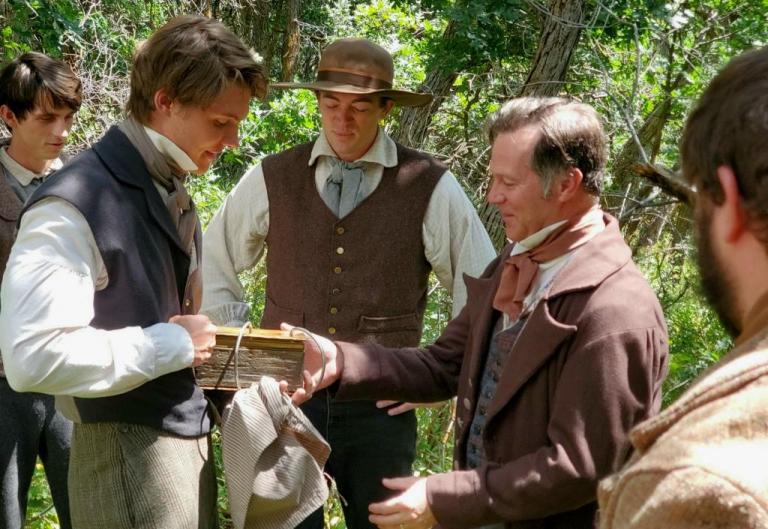
The experience of the Eight Witnesses as re-created for the forthcoming documentary portion of the Interpreter Foundation’s “Witnesses” film project, in a still photograph by James Jordan. I frankly confess that I was disappointed, at first, by the very mundane appearance of this scene. But then I realized that my reaction was irrational. That the experience of the Eight Witnesses with the plates of the Book of Mormon was mundane, prosaic, matter of fact, is precisely the POINT of their experience and what gives their account is remarkable evidentiary power.
***
Two new articles went up today in Interpreter: A Journal of Latter-day Saint Faith and Scholarship:
Abstract: This study compares personal relative pronoun usage in the earliest text of the Book of Mormon with 11 specimens of Joseph Smith’s early writings, 25 pseudo-archaic texts, the King James Bible, and more than 200,000 early modern (1473–1700) and late modern (1701–1800+) texts. The linguistic pattern of the Book of Mormon in this domain — a pattern difficult to consciously manipulate in a sustained manner — uniquely points to a less-common early modern pattern. Because there is no matching of the Book of Mormon’s pattern except with a small percentage of early modern texts, the indications are that Joseph Smith was neither the author nor the English-language translator of this pervasive element of the dictation language of the Book of Mormon. Cross-verification by means of large database comparisons and matching with one of the finest pseudo-archaic texts confirm these findings.
Brant A. Gardner, “A Sympathetic but Flawed Look at Book of Mormon Historicity”
Review of Terrence J. O’Leary, Book of Mormon: A History of Real People in Real Places (Pennsauken, NJ: BookBaby, 2020). 274 pages. Softcover, $20.
Abstract: Terrence O’Leary enters the field of books attempting to describe a geographical and cultural background to the Book of Mormon. Placing the action of the text in Mesoamerica, O’Leary explains the Book of Mormon against his understanding of the geography and therefore culture of the Book of Mormon peoples. He begins with the Jaredites, then moves to the Nephites and Mulekites. Along the way, he uses historical data to back up his ideas. While I agree with much of what he has written in principle, his lack of expertise in the cultures of Mesoamerica leads to times when he incorrectly uses some of his sources.
***
And, in case those aren’t enough to keep you busy over the weekend, here are links to five articles from a prior issue of Interpreter that you might have missed:
Gordon C. Thomasson, “Matthew Black and Mircea Eliade Meet Hugh Nibley”
Abstract: As a graduate student, Gordon Thomasson had the opportunity to introduce two internationally renowned scholars to the publications and scholarship of Hugh Nibley: Matthew Black, an eminent scholar of ancient Enoch writings; and Mircea Eliade, famed chair of the History of Religions program at the University of Chicago. Upon hearing of Nibley’s Enoch discoveries, Black made an immediate, impromptu visit to BYU to meet him. Upon reading one of Nibley’s studies, Eliade proposed hiring him on the spot, exclaiming, “He knows my field better than I do, and his translations are elegant!”
[Editor’s Note: Part of our book chapter reprint series, this article is reprinted here as a service to the Latter-day Saint community. Original pagination and page numbers have necessarily changed, otherwise the reprint has the same content as the original.
See Gordon C. Thomasson, “Matthew Black and Mircea Eliade Meet Hugh Nibley,” in Hugh Nibley Observed, ed. Jeffrey M. Bradshaw, Shirley S. Ricks, and Stephen T. Whitlock” (Orem, UT: The Interpreter Foundation; Salt Lake City: Eborn Books, 2021), 423–432. Further information at https://interpreterfoundation.org/books/hugh-nibley-observed/.]
A. Keith Thompson, “The Brass Plates: Can Modern Scholarship Help Identify Their Contents?”
Abstract: The Book of Mormon contains little information about what the Brass Plates contain. Nephi said it was a larger record than the Hebrew Bible brought to America by the Gentiles. But it could not have contained the records of Old Testament prophets who wrote after Lehi’s party left Jerusalem or the New Testament. We know it contained some writings from Zenos, Zenock, Neum, and Ezias, but what else could it have contained? Though the proposal from modern biblical source criticism that the Christian Bible is the product of redactors sometimes working with multiple sources is distasteful to many Christians, this article suggests this scholarship should not trouble Latter-day Saints, who celebrate Mormon’s scriptural abridgement of ancient American scripture. This article also revisits the insights of some Latter-day Saint scholars who have suggested the Brass Plates are a record of the tribe of Joseph, and this may explain its scriptural content. The eight verses from Micah 5, which Christ quoted three times during His visit to the Nephites and which did not previously appear in Mormon’s abridgment, receive close analysis.
Blake T. Ostler, “An Ingenious and Inspiring Literary Analysis of Alma 30–42”
Review of Mark A. Wrathall, Alma 30–63: A Brief Theological Introduction (Provo, UT: The Neal A. Maxwell Institute for Religious Scholarship, 2020). 176 pages. $9.95 (paperback).
Abstract: Mark A. Wrathall’s analytic treatment of Alma 30–42 is a sheer gift that inspires insight into the theological depth of Alma’s thought. His reading of Alma teases out insights not previously recognized and not easily discovered regarding belief and knowledge and their relation to faith and committed action. This extremely rewarding introduction provides a glimpse at the best any writer in the Latter-day Saint tradition has written on Alma’s thoughts and goals.
Mack C. Stirling, “Job: An LDS Reading”
Abstract: Mack C. Stirling examines the well-known story of Job, one of the literary books of the Bible and part of the Wisdom literature (which is heavy in temple mysticism and symbols), and proposes the story follows the temple endowment to the T. Following Hugh Nibley’s lead in The Message of the Joseph Smith Papyri, the temple endowment is not discussed. Stirling focuses only on Job’s story, drawing on analysis of literary genres and literary tools, like chiasms, focusing on the existential questions asked by the ancient author. Doing this, he concludes that Job’s is a story about a spiritual journey, in which two main questions are answered: “(1) Is it worthwhile to worship God for His own sake apart from material gain? (2) Can man, by coming to earth and worshipping God, enter into a process of becoming that allows him to participate in God’s life and being?” What follows is an easy to read exegesis of the Book of Job with these questions in mind, culminating with Job at the veil, speaking with God. Stirling then discusses Job’s journey in terms of Adam’s journey — beginning in a situation of security, going through tribulations, finding the way to God and being admitted into His presence — and shows how this journey is paralleled in Lehi’s dream in the Book of Mormon (which journey ends at a tree of life). This journey also is what each of us faces, from out premortal home with God, to the tribulations of this telestial world, and back to the eternal bliss of Celestial Kingdom, the presence of God, through Christ. In this way, the stories of Adam and Eve, of Job, and of Lehi’s dream provide a framework for every human’s existence.
[Editor’s Note: Part of our book chapter reprint series, this article is reprinted here as a service to the LDS community. Original pagination and page numbers have necessarily changed, otherwise the reprint has the same content as the original.
See Mack C. Stirling, “Job: An LDS Reading,” in Temple Insights: Proceedings of the Interpreter Matthew B. Brown Memorial Conference, “The Temple on Mount Zion,” 22 September 2012, ed. William J. Hamblin and David Rolph Seely (Orem, UT: The Interpreter Foundation; Salt Lake City: Eborn Books, 2014), 99–144. Further information at https://interpreterfoundation.org/books/temple-insights/.]
Duane Boyce, ““Beloved by All the People”: A Fresh Look at Captain Moroni”
Abstract: In his well-known volume about the Book of Mormon, Grant Hardy focuses primarily on the book’s main narrators. However, he also makes a number of observations about other figures in the book that are of particular interest, including some about Captain Moroni. In addition to those I address elsewhere, these observations range from the assertion that Captain Moroni slaughtered his political opponents in one instance, to his claim that Moroni is not depicted as “particularly religious,” to his claim that Moroni had a “quick temper.” The question is: Are such observations supported in the text? Carefully examining this question both shows the answer to be “no” and allows a deeper look into Captain Moroni.
***
Growing up, I was an ardent fan of the original Rod Serling Twilight Zone. (Yes, I’m that old.) Still, prior to this past week, I hadn’t watched an episode of it since it went off the air in 1964. This week, though, at the urging of a son, we’ve enjoyed four episodes. One of the two that we watched last night was Episode 73, “It’s a Good Life.” I strongly recommend it. It’s only about half an hour long and it first aired in 1961 but, because of it, I can now understand certain aspects of contemporary American politics far better than before.
***
Finally, in quick succession, one of my sons and then Cody Quirk called this important opportunity to my notice. Act quickly!
Brief Theological Introduction
Previous Post

November 12, 2021
Sex and the Church
Next Post
November 13, 2021 "The Toll of Unbelief"
Browse Our Archives
Select a Category Uncategorized
Select a Month October 2026 September 2026 August 2026 July 2026 June 2026 May 2026 April 2026 March 2026 February 2026 January 2026 December 2025 November 2025 October 2025 September 2025 August 2025 July 2025 June 2025 May 2025 April 2025 March 2025 February 2025 January 2025 December 2024 November 2024 October 2024 September 2024 August 2024 July 2024 June 2024 May 2024 April 2024 March 2024 February 2024 January 2024 December 2023 November 2023 October 2023 September 2023 August 2023 July 2023 June 2023 May 2023 April 2023 March 2023 February 2023 January 2023 December 2022 November 2022 October 2022 September 2022 August 2022 July 2022 June 2022 May 2022 April 2022 March 2022 February 2022 January 2022 December 2021 November 2021 October 2021 September 2021 August 2021 July 2021 June 2021 May 2021 April 2021 March 2021 February 2021 January 2021 December 2020 November 2020 October 2020 September 2020 August 2020 July 2020 June 2020 May 2020 April 2020 March 2020 February 2020 January 2020 December 2019 November 2019 October 2019 September 2019 August 2019 July 2019 June 2019 May 2019 April 2019 March 2019 February 2019 January 2019 December 2018 November 2018 October 2018 September 2018 August 2018 July 2018 June 2018 May 2018 April 2018 March 2018 February 2018 January 2018 December 2017 November 2017 October 2017 September 2017 August 2017 July 2017 June 2017 May 2017 April 2017 March 2017 February 2017 January 2017 December 2016 November 2016 October 2016 September 2016 August 2016 July 2016 June 2016 May 2016 April 2016 March 2016 February 2016 January 2016 December 2015 November 2015 October 2015 September 2015 August 2015 July 2015 June 2015 May 2015 April 2015 March 2015 February 2015 January 2015 December 2014 November 2014 March 2014 August 2013 February 2012
Follow Us!
TAKE THE
Religious Wisdom Quiz
I told my daughter-in-law to uncover a man's feet and lie down at the threshing floor. Who am I?
Select your answer to see how you score.
Rebekah Naomi Ruth Bathsheba
Related posts from Sic et Non


Some notes on the archaeology of the Bible


TRENDING AT PATHEOS Latter-day Saint

Pope Leo Celebrates Mass for Nurses & Docs...
I don't have any idea how he did it, but Pope Leo...

The Sermon on the Mount, Part I: Matthew...
The Sermon on the Mount, Part I (Matthew 4:12-5:12) St. Matthew moves...

What's up from Crossway: Reviewing some of their latest A few weeks...

Janie Learns the Way of the Cross: A...
Teaching children about Jesus' Passion can be challenging. Many parents and educators...

Looking For Good Catholic Writing - October 2026
He alone extends the heavens, and he walks upon the waves of...

In "Irreplaceable," our book on vocation and technology, Trevor Sutton and I...
view all Latter-day Saint blogs
Ad-Free & Subscriber Log-In Subscription Support
- About Us
- 2026 Calendar
- Videos
- Podcasts
- Library of World Religions
- Faith In Media Tracker
- Advertise With Us
- Write for Us
- Privacy Policy
- Terms of Service
- Do Not Sell My Data
- Contact Us
- Radiant Digital
- Manage Newsletter Subscriptions
- Unsubscribe From Notifications
- Sitemap
Copyright 2008-2026, Patheos. All rights reserved.
Subscription Support Ad-Free & Subscriber Log-In
Follow Patheos