
BuddhistCatholicContemplativeEvangelicalGeneral ChristianHinduJewishLatter-day SaintMuslimNew VisionsProgressive Christian
Beliefs
- Buddhist
- Catholic
- Contemplative
- Evangelical
- General Christian
- Hindu
- Jewish
- Latter-day Saint
- More Voices
- Muslim
- New Visions
- Pagan
- Progressive Christian
Topics
- Religion News
- Food and Religion
- Sports and Religion
- Religious Art
- Religious Music and Entertainment
- Religious Events
- History and Religion
- Style and Religion
- Politics and Religion
- Women in Religion
- Recreation Outdoors and Religion
- Business Finance and Religion
- Careers Workplace and Religion
- Education and Religion
- Family Parenting and Religion
- Health Fitness and Religion
- Home and Religion
- Relationships and Religion
- Technology and Religion
- Travel and Religion
Columnists
- Buddhist Columnists
- Business Finance and Religion Columnists
- Careers Workplace and Religion Columnists
- Catholic Columnists
- Contemplative Columnists
- Education and Religion Columnists
- Evangelists Columnists
- Family Parenting and Religion Columnists
- General Christian Columnists
- Health Fitness and Religion Columnists
- Hindu Columnists
- History and Religion Columnists
- Home and Religion Columnists
- Jewish Columnists
- More Voices Columnists
- Latter Day Columnists
- Muslim Columnists
- New Visions Columnists
- Nonreligious Columnists
- Pagan Columnists
- Politics and Religion Columnists
- Progressive Columnists
- Recreation Outdoors and Religion Columnists
- Relationships and Religion Columnists
- Religion News Columnists
- Religious Art Columnists
- Religious Events Columnists
- Religious Music and Entertainment Columnists
- Sports and Religion Columnists
- Style and Religion Columnists
- Technology and Religion Columnists
- Travel and Religion Columnists
- Women in Religion Columnists
Resource Library
- 2026 Calendar
- Library of World Religions
- The 100 Most Holy Places on Earth
- Patheos Answers
- Podcasts
- Videos
- Faith Leaders Database
- Anglican Episcopalian
- Bahai
- Baptist
- Buddhism
- Christianity
- Confucianism
- Eastern Orthodoxy
- Hinduism
- Holiness and Pentecostal
- ISKCON
- Islam
- Judaism
- Lutheran
- Methodist
- The Church of Jesus Christ of Latter-day Saints
- New Age
- Paganism
- Presbytarian and Reformed
- Protestantism
- Religion Behind the Scenes
- Roman Catholic
- Scientology
- Shia Islam
- Sikhism
- Sufism
- Sunni Islam
- Taoism
- Zen
- See all religions
Research Tools
 Ad-Free & Subscriber Log-In Subscription Support
Ad-Free & Subscriber Log-In Subscription Support
Follow Patheos 

- Trending:
- Forgiveness
- |
- Marriage
- |
- Consciousness
- |
- Death Penalty
- |
- Election
- |
- Halloween

- Home
- Latter-day Saint
- Some More on Spirituality, Religiosity, and Health
Some More on Spirituality, Religiosity, and Health
Last updated on: October 18, 2021 at 12:29 am by Dan Peterson
Some More on Spirituality, Religiosity, and Health 2021-10-18T00:29:32-06:00 Dan Peterson
Patheos Explore the world's faith through different perspectives on religion and spirituality! Patheos has the views of the prevalent religions and spiritualities of the world.
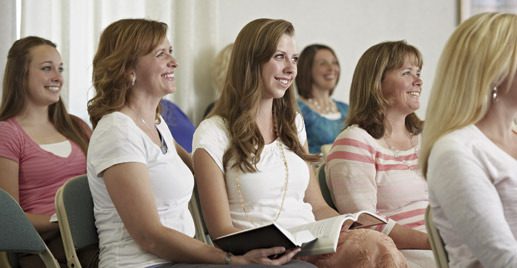
Is the seeming happiness of these women an example of “false consciousness”? Self-deception? A façade? A phony pretense? (LDS Media Library image)
***
I continue to go through the articles that Dr. Lynn Johnson has kindly called to my attention over the past several weeks. Here are some additional items, which, like those mentioned in my previous blog entry on this subject, plainly appear to have come from the Christopher Hitchens Memorial “How Religion Poisons Everything” File©. The references aren’t quite ideal yet, but those who are interested should have no problem in finding these articles:
Abstract Researchers have identified health implications of religiosity and spirituality but have rarely addressed differences between these dimensions. The associations of religiosity and spirituality with physical and mental health were examined in a national sample (N = 890) after the September 11, 2001 terrorist attacks (9/11). Health information was collected before 9/11 and health, religiosity, and spirituality were assessed longitudinally during six waves of data collection over the next 3 years. Religiosity (i.e., participation in religious social structures) predicted higher positive affect ([beta] = .12), fewer cognitive intrusions ([beta] = –.07), and lower odds of new onset mental (incidence rate ratio [IRR] = .88) and musculoskeletal (IRR = .94) ailments. Spirituality (i.e., subjective commitment to spiritual or religious beliefs) predicted higher positive affect ([beta] = .09), lower odds of new onset infectious ailments (IRR = 0.83), more intrusions ([beta] = .10)and a more rapid decline in intrusions over time ([beta] = –.10). Religiosity and spirituality independently predict health after a collective trauma, controlling for pre-event health status; they are not interchangeable indices of religion.
The present study sets out to examine the spirituality-coping-health link in a culturally and religiously diverse undergraduate sample (N
= 301) in Canada. Specifically, this investigation: (a) assessed intrinsic spirituality with a factorially derived measure, created based on a multidimensional measure of spirituality; (b) tested the mediating role of coping in the spirituality-psychological well-being relation with a validated cross-cultural measure of coping; and (c) examined this complex, multivariate web of relationships with a pathanalysis. The results showed that Intrinsic Spirituality reduced Psychological Distress, promoted the use of Collective Coping, and reduced the use of Avoidance Coping.Furthermore, Engagement Coping reduced Psychological Distress while Avoidance Coping increased the distress. The findings suggest that one way in which spiritual faith and belief can act to improve individuals’ psychological well-being is through promoting adaptive and culturally congruent/appropriate coping behaviours in the face of stressful situations. Implications and recommendations for future research are discussed.
Religiousness is reliably associated with lower substance use, but little research has examined whether self-control helps explain why religiousness predicts lower substance use. Building on prior theoretical work, our studies suggest that self-control mediates the relationship between religiousness and a variety of substance-use behaviors. Study 1 showed that daily prayer predicted lower alcohol use on subsequent days. In Study 2, religiousness related to lower alcohol use, which was mediated by self-control. Study 3 replicated this mediational pattern using a behavioral measure of self-control. Using a longitudinal design, Study 4 revealed that self-control mediated the relationship between religiousness and lower alcohol use 6 weeks later. Study 5 replicated this mediational pattern again and showed that it remained significant after controlling for trait mindfulness. Studies 6 and 7 replicated and extended these effects to both alcohol and various forms of drug use among community and cross-cultural adult samples. These findings offer novel evidence regarding the role of self-control in explaining why religiousness is associated with lower substance use.
Although prior studies have documented a positive association between religiosity and sense of meaning in life, the role of specific religious beliefs is currently unclear. Past research on images of God suggests that loving images of God will positively correlate with a sense of meaning and purpose. Mechanisms for this hypothesized relationship are drawn from prior work on attachment theory, religious coping, and symbolic interaction. We suggest that these mechanisms are complementary and that secure attachment styles, reliable coping strategies, and positive self-images work in tandem to facilitate a sense of meaning and purpose. Using a random, national sample from the second wave of the Baylor Religion Survey, we perform multivariate regression analysis that controls for key religious and demographic effects. In our full model, results indicate that the dependent variable is positively associated with student status, religious non-affiliation, congregational friendship networks, and frequency of prayer. Most important from the perspective of the present study, the connection between loving images of God and a sense of meaning and purpose is consistent and robust.
The present research tested a mediation model specifying that divine struggle (e.g., anger at God, feeling punished or abandoned by God) mediates the associations of beliefs about suffering with psychological distress and mental health. We tested this model using structural equation modeling in 2 large samples, an undergraduate sample (N = 3,083) and a web-based sample of U.S. adults (N = 1,047). In both samples, beliefs that suffering is part of God’s benevolent plan, as well as beliefs that a nonbenevolent God causes suffering, were associated with more divine struggle and in turn with lower levels of well-being and higher distress. Beliefs attributing a benevolent role to God in suffering were directly linked to higher well-being, along with beliefs about God’s limited knowledge of the future and ability to prevent suffering. These results attest to the nuanced nature of the associations between religious belief systems, adversity, and life outcomes.
Although a long tradition of theoretical and sociohistorical analysis has suggested that religious practices and values help African Americans in coping with the distressing sequelae of racism and discrimination, few studies have examined this issue with systematic, quantitative, empirical data. Our work contributes to the literature by: (a) outlining a series of arguments regarding the potential significance of multiple aspects of religious involvement— attendance at services, church-based social support, and religious guidance in daily life—in dealing with harmful psychosocial effects of recent experiences of discrimination; and (b) testing hypotheses derived from two alternative models of the racism-religion-distress relationship using longitudinal data from a nationwide survey. Results indicate that both religious guidance and religious attendance moderate the effects of racism on psychological distress, while congregational support has a direct (but not interactive) effect on distress, thereby partly offsetting (but not buffering) the negative effects of discrimination.
Christopher Hitchens Memorial "How Religion Poisons Everything" File
Previous Post

October 16, 2021
Two studies of LDS, LGBTQ Youth, and Suicide
Next Post
October 18, 2021 All of you can partake, freely.
Browse Our Archives
Select a Category Uncategorized
Select a Month October 2026 September 2026 August 2026 July 2026 June 2026 May 2026 April 2026 March 2026 February 2026 January 2026 December 2025 November 2025 October 2025 September 2025 August 2025 July 2025 June 2025 May 2025 April 2025 March 2025 February 2025 January 2025 December 2024 November 2024 October 2024 September 2024 August 2024 July 2024 June 2024 May 2024 April 2024 March 2024 February 2024 January 2024 December 2023 November 2023 October 2023 September 2023 August 2023 July 2023 June 2023 May 2023 April 2023 March 2023 February 2023 January 2023 December 2022 November 2022 October 2022 September 2022 August 2022 July 2022 June 2022 May 2022 April 2022 March 2022 February 2022 January 2022 December 2021 November 2021 October 2021 September 2021 August 2021 July 2021 June 2021 May 2021 April 2021 March 2021 February 2021 January 2021 December 2020 November 2020 October 2020 September 2020 August 2020 July 2020 June 2020 May 2020 April 2020 March 2020 February 2020 January 2020 December 2019 November 2019 October 2019 September 2019 August 2019 July 2019 June 2019 May 2019 April 2019 March 2019 February 2019 January 2019 December 2018 November 2018 October 2018 September 2018 August 2018 July 2018 June 2018 May 2018 April 2018 March 2018 February 2018 January 2018 December 2017 November 2017 October 2017 September 2017 August 2017 July 2017 June 2017 May 2017 April 2017 March 2017 February 2017 January 2017 December 2016 November 2016 October 2016 September 2016 August 2016 July 2016 June 2016 May 2016 April 2016 March 2016 February 2016 January 2016 December 2015 November 2015 October 2015 September 2015 August 2015 July 2015 June 2015 May 2015 April 2015 March 2015 February 2015 January 2015 December 2014 November 2014 March 2014 August 2013 February 2012
Follow Us!
TAKE THE
Religious Wisdom Quiz
Which book of the Bible records Paul’s shipwreck?
Select your answer to see how you score.
1 Corinthians Acts Romans 2 Timothy
Related posts from Sic et Non

Once more unto the breach, dear friends, once...


A monument to the transience of power (and...
"Was Joseph a Sexual Predator?" and other fun...
TRENDING AT PATHEOS Latter-day Saint

A new article, written by Jeff Lindsay and Gale L. Pooley,...

Swimfan: Forgotten Aughts Pleasures
This is a recovery effort. In 2002, My Big Fat Greek Wedding...

Top Three Anti-Catholic Lies About Catholicism
This is my initial transcript for the video, "THE 3 WORST...

Pope Leo Celebrates Mass for Nurses & Docs...
I don't have any idea how he did it, but Pope Leo...

The Sermon on the Mount, Part I: Matthew...
The Sermon on the Mount, Part I (Matthew 4:12-5:12) St. Matthew moves...

What's up from Crossway: Reviewing some of their latest A few weeks...
view all Latter-day Saint blogs
Ad-Free & Subscriber Log-In Subscription Support
- About Us
- 2026 Calendar
- Videos
- Podcasts
- Library of World Religions
- Faith In Media Tracker
- Advertise With Us
- Write for Us
- Privacy Policy
- Terms of Service
- Do Not Sell My Data
- Contact Us
- Radiant Digital
- Manage Newsletter Subscriptions
- Unsubscribe From Notifications
- Sitemap
Copyright 2008-2026, Patheos. All rights reserved.
Subscription Support Ad-Free & Subscriber Log-In
Follow Patheos