
BuddhistCatholicContemplativeEvangelicalGeneral ChristianHinduJewishLatter-day SaintMuslimNew VisionsProgressive Christian
Beliefs
- Buddhist
- Catholic
- Contemplative
- Evangelical
- General Christian
- Hindu
- Jewish
- Latter-day Saint
- More Voices
- Muslim
- New Visions
- Pagan
- Progressive Christian
Topics
- Religion News
- Food and Religion
- Sports and Religion
- Religious Art
- Religious Music and Entertainment
- Religious Events
- History and Religion
- Style and Religion
- Politics and Religion
- Women in Religion
- Recreation Outdoors and Religion
- Business Finance and Religion
- Careers Workplace and Religion
- Education and Religion
- Family Parenting and Religion
- Health Fitness and Religion
- Home and Religion
- Relationships and Religion
- Technology and Religion
- Travel and Religion
Columnists
- Buddhist Columnists
- Business Finance and Religion Columnists
- Careers Workplace and Religion Columnists
- Catholic Columnists
- Contemplative Columnists
- Education and Religion Columnists
- Evangelists Columnists
- Family Parenting and Religion Columnists
- General Christian Columnists
- Health Fitness and Religion Columnists
- Hindu Columnists
- History and Religion Columnists
- Home and Religion Columnists
- Jewish Columnists
- More Voices Columnists
- Latter Day Columnists
- Muslim Columnists
- New Visions Columnists
- Nonreligious Columnists
- Pagan Columnists
- Politics and Religion Columnists
- Progressive Columnists
- Recreation Outdoors and Religion Columnists
- Relationships and Religion Columnists
- Religion News Columnists
- Religious Art Columnists
- Religious Events Columnists
- Religious Music and Entertainment Columnists
- Sports and Religion Columnists
- Style and Religion Columnists
- Technology and Religion Columnists
- Travel and Religion Columnists
- Women in Religion Columnists
Resource Library
- 2026 Calendar
- Library of World Religions
- The 100 Most Holy Places on Earth
- Patheos Answers
- Podcasts
- Videos
- Faith Leaders Database
- Anglican Episcopalian
- Bahai
- Baptist
- Buddhism
- Christianity
- Confucianism
- Eastern Orthodoxy
- Hinduism
- Holiness and Pentecostal
- ISKCON
- Islam
- Judaism
- Lutheran
- Methodist
- The Church of Jesus Christ of Latter-day Saints
- New Age
- Paganism
- Presbytarian and Reformed
- Protestantism
- Religion Behind the Scenes
- Roman Catholic
- Scientology
- Shia Islam
- Sikhism
- Sufism
- Sunni Islam
- Taoism
- Zen
- See all religions
Research Tools
 Ad-Free & Subscriber Log-In Subscription Support
Ad-Free & Subscriber Log-In Subscription Support
Follow Patheos 

- Trending:
- Forgiveness
- |
- Marriage
- |
- Consciousness
- |
- Death Penalty
- |
- Election
- |
- Halloween

- Home
- Latter-day Saint
- “Quiet Revivalism: New Light on the Burned-Over District”
“Quiet Revivalism: New Light on the Burned-Over District”
Last updated on: October 15, 2021 at 9:48 pm by Dan Peterson
“Quiet Revivalism: New Light on the Burned-Over District” 2021-10-15T21:48:50-06:00 Dan Peterson
Patheos Explore the world's faith through different perspectives on religion and spirituality! Patheos has the views of the prevalent religions and spiritualities of the world.
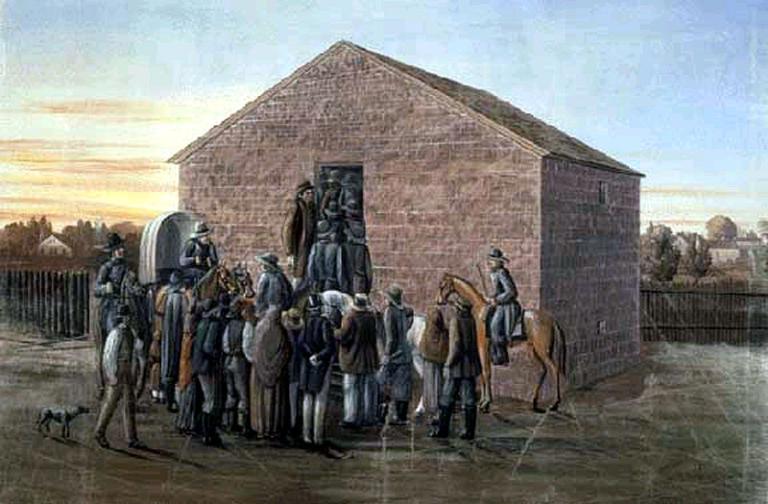
C. C. A. Christensen’s depiction of Joseph Smith being introduced to Liberty Jail, where he’ll spend nearly six months, through the winter of 1838-1839
(Wikimedia Commons public domain image)
***
The big Deseret Book and Excel Entertainment event for the Witnesses film is tomorrow (Thursday) night, 14 October 2021. Don’t miss it. We’ll be reading a list of persons from the lectern who have been called on missions to the new Antarctica McMurdo Station Mission. Your name may be on it.
For further information, see here. To RSVP, see here. For a brief recent television interview related to the film and the event, see here.
***
Since I last mentioned any such thing, these new items have appeared on the entirely moribund website of the Interpreter Foundation:
Estimating the Evidence Episode Episode 15: On Trajectories of Truth
This is the latest installment — the fifteenth of a projected twenty-three — in Kyler Rasmussen’s series of Bayesian explorations into the truth-claims of the Book of Mormon.
During 1978, 1979, and 1980, Hugh Nibley taught a Doctrine and Covenants Sunday School class. Cassette recordings were made of these classes and some have survived and were recently digitized by Steve Whitlock. Most of the tapes were in pretty bad condition. The original recordings usually don’t stop or start at the beginning of the class and there is some background noise. Volumes vary, probably depending upon where the recorder was placed in the room. Many are very low volume but in most cases it’s possible to understand the words. In a couple of cases the ends of one class were put on some space left over from a different class. Even with these flaws and missing classes, we believe these these will be interesting to listen to and valuable to your Come, Follow Me study program.
The Interpreter Radio Roundtable for Come, Follow Me Doctrine and Covenants Lesson 43, “O God, Where Art Thou?” on D&C 121-123, featured Terry Hutchinson, John Gee, and Kevin Christensen. This roundtable was extracted from the 12 September 2021 broadcast of the Interpreter Radio Show. The complete show is available at https://interpreterfoundation.org/interpreter-radio-show-September-12-2021/. The Interpreter Radio Show can be heard Sunday evenings from 7 to 9 PM (MDT), on K-TALK, AM 1640, or you can listen live on the Internet at ktalkmedia.com.
***
I can scarcely express how much I’m looking forward to this:
“The Most Reluctant Convert: The Untold Story of C. S. Lewis”
My wife and I already have our tickets.
***
I’m reading Alexander L. Baugh, Steven C. Harper, Brent M. Rogers, and Benjamin C. Pykles, eds., Joseph Smith and His First Vision: Context Place, and Meaning (Provo and Salt Lake City: Religious Studies Center, Brigham Young University, and Deseret Book, 2021). Here, I will share notes from one of the essays that I’ve read in it, Richard E. Bennett’s “Quiet Revivalism: New Light on the Burned-Over District,” 89-108:
Joseph Smith-History 1:5 reports Joseph’s experience of “an unusual excitement on the subject of religion” that surrounded him and led him into the woods for guidance. Many have jumped from an “unusual excitement” about religion to the idea of mass revivals and then on to boisterous camp meetings. Critics of the Restoration, seeking to discredit Joseph, have claimed that no such revivals were occurring there at that time, which would make him a liar. But it’s not clear that no such revivals occurred. And, anyway, it’s not at all obvious that they’re needed. After all, Joseph doesn’t mention revivals or camp meetings in his canonized account. And Professor Bennett seems to be entering into that fray with his suggestion that “revivals” needn’t involve mass camp meetings.
These “reviving and converting influences of the Holy Spirit,” this “season of refreshing from on high,” reached Palmyra not only via the sounds and and excitements of outdoor camp meetings. These influences also owed much, if not everything, to dedicated missionaries and ministers who called upon friends and family in the sanctity of their own cabin homes by the fire and the hearth to seek the Lord through mighty private prayer for forgiveness and salvation. Besides this, there was the personal outreach of female missionaries and visiting teachers — a very intimate, deeply personalized revival of faith and a face-to-face invitation to repent and come unto Christ, which I am terming quite revivalism. (90, italics in original).
It is important to understand what the term revival meant at that time to these men of the cloth. While it is true that later Presbyterian divines such as Charles Finney turned to outdoor camp meetings as the means of grace, most Old and New School Presbyterian pastors preferred a much different path to personal conversion, a form of quiet revivalism that extended into the parlor of most Palmyra homes. (95)
Thanks to the pioneering research efforts of the late Milton V. Backman, we know that these Presbyterian-flavored revivals bore particular fruit in 1819 and 1820, “more numerous, extensive and blessed” than in any previous years and greater than in any other state. Presbyterianism grew in New York State by 35% in 1820 with 1,513 of the 2,250 new converts coming from the burned-over district. (100-101)
The local Palmyra Register wrote in the spring of 1820 of his [Rev. Asahel Nettleton’s] recent successes and of the “religious excitement” of the times in the communities east of Palmyra. His style of Presbyterian preaching, his house-to-house visits, and his caring concern paint a very different picture from that of the loud Methodist-dominated camp meeting. The former was as still as the latter was boisterous and may beg a revision to what some readers assume was the dominant spirit of revivalism. (102)
And it was among the youth — both young men and young women — that revivals of all kinds bore the greatest fruit and where conversion most often occurred in private, in the stillness and quiet created by seeking for answers to probing, personal prayers. Indeed, as one scholar has concluded, “The most striking and consistent characteristic of the Second Great Awakening was the youthfulness of its participants.” One Baptist minister writing in January 1820 about mass conversions in Cornish, New York, told of “a number of young children: from “thirteen down to seven years of age” singing hosannas to the Son of David. (102)
It was common for ministers of all faiths to report from the field that “two thirds of [the] whole number of converts [were] under 20 years of age.” (103)
From this and scores of other similar descriptions, it is clear that while the answer to Joseph Smith Jr.’s teenage prayers would eventuate in the birth of a new world religion, his “determination to ask of God” on “the morning of a beautiful, clear day” and the way he went about approaching heaven that spring of 1820 were entirely consistent with the contemporary upstate New York culture of Presbyterian-led revivalism — a time known for its deeply personal, very quiet private pleadings to heaven, when young women and young men, with scriptures in hand or at least in mind, entered their own sacred groves to pray for the salvation of their souls (Joseph Smith–History 1:14). (104)
Previous Post

October 12, 2021
"The First Vision Within the Context of Revivalism"
Next Post
October 14, 2021 "The Better Angels of Our Nature"
Browse Our Archives
Select a Category Uncategorized
Select a Month October 2026 September 2026 August 2026 July 2026 June 2026 May 2026 April 2026 March 2026 February 2026 January 2026 December 2025 November 2025 October 2025 September 2025 August 2025 July 2025 June 2025 May 2025 April 2025 March 2025 February 2025 January 2025 December 2024 November 2024 October 2024 September 2024 August 2024 July 2024 June 2024 May 2024 April 2024 March 2024 February 2024 January 2024 December 2023 November 2023 October 2023 September 2023 August 2023 July 2023 June 2023 May 2023 April 2023 March 2023 February 2023 January 2023 December 2022 November 2022 October 2022 September 2022 August 2022 July 2022 June 2022 May 2022 April 2022 March 2022 February 2022 January 2022 December 2021 November 2021 October 2021 September 2021 August 2021 July 2021 June 2021 May 2021 April 2021 March 2021 February 2021 January 2021 December 2020 November 2020 October 2020 September 2020 August 2020 July 2020 June 2020 May 2020 April 2020 March 2020 February 2020 January 2020 December 2019 November 2019 October 2019 September 2019 August 2019 July 2019 June 2019 May 2019 April 2019 March 2019 February 2019 January 2019 December 2018 November 2018 October 2018 September 2018 August 2018 July 2018 June 2018 May 2018 April 2018 March 2018 February 2018 January 2018 December 2017 November 2017 October 2017 September 2017 August 2017 July 2017 June 2017 May 2017 April 2017 March 2017 February 2017 January 2017 December 2016 November 2016 October 2016 September 2016 August 2016 July 2016 June 2016 May 2016 April 2016 March 2016 February 2016 January 2016 December 2015 November 2015 October 2015 September 2015 August 2015 July 2015 June 2015 May 2015 April 2015 March 2015 February 2015 January 2015 December 2014 November 2014 March 2014 August 2013 February 2012
Follow Us!
TAKE THE
Religious Wisdom Quiz
True or False: Mark is the only Gospel that records Jesus asking 'Who touched my clothes?' after power went out from him.
Select your answer to see how you score.
FALSE TRUE
Related posts from Sic et Non
How many divine beings appeared in Joseph's First...


"The Physicality of the Small Plates"
TRENDING AT PATHEOS Latter-day Saint

Janie Learns the Way of the Cross: A...
Teaching children about Jesus' Passion can be challenging. Many parents and educators...

Looking For Good Catholic Writing - October 2026
He alone extends the heavens, and he walks upon the waves of...

In "Irreplaceable," our book on vocation and technology, Trevor Sutton and I...

I was strolling through the top floor of the brand new Parthenon...

What Does Gêvâh Mean For Kimberley Guifoyle &...
This week, a lot of the news is focused on Kimberly Guilfoyle....

INNER CIRCLE: Profound Mystery (Of Christ In All...
Ephesians 5:31-32 “For this reason, a man will leave his father and...
view all Latter-day Saint blogs
Ad-Free & Subscriber Log-In Subscription Support
- About Us
- 2026 Calendar
- Videos
- Podcasts
- Library of World Religions
- Faith In Media Tracker
- Advertise With Us
- Write for Us
- Privacy Policy
- Terms of Service
- Do Not Sell My Data
- Contact Us
- Radiant Digital
- Manage Newsletter Subscriptions
- Unsubscribe From Notifications
- Sitemap
Copyright 2008-2026, Patheos. All rights reserved.
Subscription Support Ad-Free & Subscriber Log-In
Follow Patheos