
BuddhistCatholicContemplativeEvangelicalGeneral ChristianHinduJewishLatter-day SaintMuslimNew VisionsProgressive Christian
Beliefs
- Buddhist
- Catholic
- Contemplative
- Evangelical
- General Christian
- Hindu
- Jewish
- Latter-day Saint
- More Voices
- Muslim
- New Visions
- Pagan
- Progressive Christian
Topics
- Religion News
- Food and Religion
- Sports and Religion
- Religious Art
- Religious Music and Entertainment
- Religious Events
- History and Religion
- Style and Religion
- Politics and Religion
- Women in Religion
- Recreation Outdoors and Religion
- Business Finance and Religion
- Careers Workplace and Religion
- Education and Religion
- Family Parenting and Religion
- Health Fitness and Religion
- Home and Religion
- Relationships and Religion
- Technology and Religion
- Travel and Religion
Columnists
- Buddhist Columnists
- Business Finance and Religion Columnists
- Careers Workplace and Religion Columnists
- Catholic Columnists
- Contemplative Columnists
- Education and Religion Columnists
- Evangelists Columnists
- Family Parenting and Religion Columnists
- General Christian Columnists
- Health Fitness and Religion Columnists
- Hindu Columnists
- History and Religion Columnists
- Home and Religion Columnists
- Jewish Columnists
- More Voices Columnists
- Latter Day Columnists
- Muslim Columnists
- New Visions Columnists
- Nonreligious Columnists
- Pagan Columnists
- Politics and Religion Columnists
- Progressive Columnists
- Recreation Outdoors and Religion Columnists
- Relationships and Religion Columnists
- Religion News Columnists
- Religious Art Columnists
- Religious Events Columnists
- Religious Music and Entertainment Columnists
- Sports and Religion Columnists
- Style and Religion Columnists
- Technology and Religion Columnists
- Travel and Religion Columnists
- Women in Religion Columnists
Resource Library
- 2026 Calendar
- Library of World Religions
- The 100 Most Holy Places on Earth
- Patheos Answers
- Podcasts
- Videos
- Faith Leaders Database
- Anglican Episcopalian
- Bahai
- Baptist
- Buddhism
- Christianity
- Confucianism
- Eastern Orthodoxy
- Hinduism
- Holiness and Pentecostal
- ISKCON
- Islam
- Judaism
- Lutheran
- Methodist
- The Church of Jesus Christ of Latter-day Saints
- New Age
- Paganism
- Presbytarian and Reformed
- Protestantism
- Religion Behind the Scenes
- Roman Catholic
- Scientology
- Shia Islam
- Sikhism
- Sufism
- Sunni Islam
- Taoism
- Zen
- See all religions
Research Tools
 Ad-Free & Subscriber Log-In Subscription Support
Ad-Free & Subscriber Log-In Subscription Support
Follow Patheos 

- Trending:
- Forgiveness
- |
- Marriage
- |
- Consciousness
- |
- Death Penalty
- |
- Election
- |
- Halloween

- Home
- Latter-day Saint
- Happy Halloween! (“Ways of Remembering the Dead”)
Happy Halloween! (“Ways of Remembering the Dead”)
Last updated on: November 3, 2021 at 11:57 pm by Dan Peterson
Happy Halloween! (“Ways of Remembering the Dead”) 2021-11-03T23:57:34-06:00 Dan Peterson
Patheos Explore the world's faith through different perspectives on religion and spirituality! Patheos has the views of the prevalent religions and spiritualities of the world.
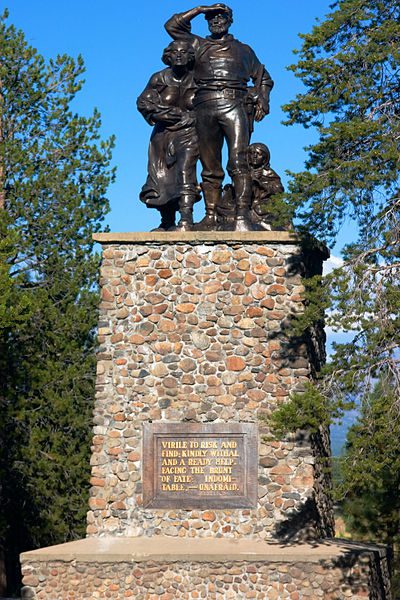
A 1918 statue in California’s Donner Memorial State Park
Wikimedia Commons public domain photo by Seano1
The pedestal of the statue is 22 feet high, indicating the depth of the snow in this region of the Sierra Nevada Mountains of California during the fatal winter of 1846-1847.
***
Here in the United States of America and in more than a few other places, the Halloween season is upon us. So here is my 2021 Halloween offering, in Meridian Magazine:
“Ways of Remembering the Dead”
With that in mind, I suppose it was appropriate that my wife and I devoted part of our time today to revisiting Donner Memorial State Park and working our way through the exhibits there. Tragic and sad as the story of the Donner Party is — 46 of the 91 members of the wagon train (slightly more than half) died, according to the official brochure that we were given — it’s also a cautionary tale of the consequences that can follow from rejecting sound counsel and relying, instead, upon untried and foolish advice from people who don’t know what they’re talking about.
I am, by the way, very late in calling this to your attention. But you still might be able to make some use of it:
“New Resources Help You Share Messages of Faith, Hope During Day of the Dead”
See also this:
“Celebrating Día de los Muertos”
And here’s a little piece that I wrote for the official Church website back in 2008:
Everyone Else Makes Such Lonely Heavens [1]
For these defects, and for no other evil,
we now are lost and punished just with this:
we have no hope and yet we live in longing.
Dante’s Inferno[2]
The New Testament states unequivocally that, besides Jesus Christ, “there is none other name under heaven given among men whereby we must be saved.”[3] And yet hundreds of millions of souls, probably the majority of all who have ever lived, were never taught about Christianity and perhaps never so much as heard the name of Jesus Christ. Are these millions of souls lost for the eternities? If so, can God be considered just, let alone merciful?
The poet Dante Alighieri, upon entering (fictionally) into the next world, was astonished by what he saw: “I should never have believed,” he wrote in his Inferno, “that death could have unmade so many souls.”[4] Strikingly, despite his obvious admiration for Socrates, Plato, Aristotle, the great Islamic philosophers Avicenna and Averroës, and the chivalrous Muslim military hero Saladin, Dante felt obliged to place them all in Hell.[5] Even his guide, companion and “kindly master,” the Roman poet Virgil, was eternally barred from heaven. Virgil explains the reason to Dante as follows:
I’d have you know, before you go ahead,
they did not sin; and yet, though they have merits,
that’s not enough, because they lacked baptism,
the portal of the faith that you embrace.
And if they lived before Christianity,
they did not worship God in fitting ways;
and of such spirits I myself am one.
For these defects, and for no other evil,
we now are lost and punished just with this:
we have no hope and yet we live in longing.[6]
The founding Mormon prophet, Joseph Smith, proclaimed a much more generous and expansive view of eternal possibilities. He pointed out that even the New Testament itself suggests a hopeful escape from this troubling prospect, citing the Apostle Paul’s reference to a practice long since forgotten or ignored by mainstream Christianity.[7]
Else what shall they do which are baptized for the dead,
if the dead rise not at all? Why are they then baptized for
the dead?[8]
Though vicarious or “proxy” baptism is but briefly mentioned in the Bible, a restoration of this ancient Christian practice became a foundational doctrine of the Latter-day Saint faith.
Today, members of The Church of Jesus Christ of Latter-day Saints labor to gather genealogical records and to construct temples[9] in which baptisms for the dead and related ordinances can be performed. In striking contrast to the horrific atrocities committed by men and governments in the course of history, this vicarious temple service extends the love of God, with full salvational access, to every human who ever lived.
Proxy temple work best reflects the foundational Latter-day Saint conviction that the power of the atonement of Christ extends even to those who did not hear: every person who has ever lived is to be individually remembered, labored for and valued, thus vindicating the justice of God and illustrating the breadth of his redemptive love. Any rite performed in a Latter-day Saint temple on behalf of a deceased person, who yet lives as a spirit being, is a rite of offering only, exacting no forced compliance nor acceptance of the rite. There is no imposed change of identity, heritage or religious belief, nor is the individual’s name added to the membership rolls of The Church of Jesus Christ of Latter-day Saints.
Editor’s Note: This commentary is one in a series of brief summaries written in 2005 for the 200-year commemoration of Joseph Smith’s birth. Drawing from Joseph Smith’s writings and teachings, these summaries explain the doctrinal foundation of The Church of Jesus Christ of Latter-day Saints. Though far from comprehensive, these summaries provide a brief overview of Joseph Smith’s ideas and beliefs relating to theological, religious and social topics.
Notes:
[1]Tom McHenry, “Mormons Offer Post-Mortem Baptism,” The Exponent Online, 8 Dec. 2003, http://archive.purdueexponent.org/interface/bebop/showstory.php?date=2003/12/08§ion=columns&storyid=ProxyBaptism.
[2] Allen Mandelbaum, trans., The Divine Comedy of Dante Alighieri: Inferno (Toronto and New York: Bantam Books, 1982), canto 4, lines 33-41.
[3]Acts 4:12.
[4] Inferno, canto 3, lines 56-57.
[5] Inferno, canto 4.
[6] Inferno, canto 4, lines 33-41.
[7]Some individual contemporary Christian thinkers have noticed it. See, for example, Stephen T. Davis, Risen Indeed: Making Sense of the Resurrection (Grand Rapids: Eerdmans, 1993), pp. 159-65, where the author, a philosopher affiliated with Claremont McKenna College in California, cautiously mentions the passage while expressing hope for the unevangelized. Historians have also begun to notice the practice (e.g., Jeffrey A. Trumbower, Rescue for the Dead: The Posthumous Salvation of Non-Christians in Early Christianity [New York: Oxford University Press, 2001]).
[8]1 Corinthians 15:29, quoted by Joseph Smith in a letter to the Church elders in Great Britain, 15 Dec. 1840, Nauvoo, Illinois; in Joseph Smith, Teachings of the Prophet Joseph Smith, sel. Joseph Fielding Smith (Salt Lake City: Deseret Book Co., 1976), p. 179.
[9] Latter-day Saint temples, of which there are 140 constructed or announced worldwide [now, as of the end of October 2021, there are a total of 265 announced, under construction, or dedicated], are distinct in purpose from meetinghouses or chapels, of which there are thousands.

On the shore of Donner Lake, in happier times than 1846-1847. (Photo by my wife)
Posted from Northstar, California
Church of Jesus Christ of Latter-day Saints
Previous Post

October 29, 2021
"Mine House is a House of Zion and not a House of Babylon!"
Next Post
October 31, 2021 From the city by the Bay
Browse Our Archives
Select a Category Uncategorized
Select a Month October 2026 September 2026 August 2026 July 2026 June 2026 May 2026 April 2026 March 2026 February 2026 January 2026 December 2025 November 2025 October 2025 September 2025 August 2025 July 2025 June 2025 May 2025 April 2025 March 2025 February 2025 January 2025 December 2024 November 2024 October 2024 September 2024 August 2024 July 2024 June 2024 May 2024 April 2024 March 2024 February 2024 January 2024 December 2023 November 2023 October 2023 September 2023 August 2023 July 2023 June 2023 May 2023 April 2023 March 2023 February 2023 January 2023 December 2022 November 2022 October 2022 September 2022 August 2022 July 2022 June 2022 May 2022 April 2022 March 2022 February 2022 January 2022 December 2021 November 2021 October 2021 September 2021 August 2021 July 2021 June 2021 May 2021 April 2021 March 2021 February 2021 January 2021 December 2020 November 2020 October 2020 September 2020 August 2020 July 2020 June 2020 May 2020 April 2020 March 2020 February 2020 January 2020 December 2019 November 2019 October 2019 September 2019 August 2019 July 2019 June 2019 May 2019 April 2019 March 2019 February 2019 January 2019 December 2018 November 2018 October 2018 September 2018 August 2018 July 2018 June 2018 May 2018 April 2018 March 2018 February 2018 January 2018 December 2017 November 2017 October 2017 September 2017 August 2017 July 2017 June 2017 May 2017 April 2017 March 2017 February 2017 January 2017 December 2016 November 2016 October 2016 September 2016 August 2016 July 2016 June 2016 May 2016 April 2016 March 2016 February 2016 January 2016 December 2015 November 2015 October 2015 September 2015 August 2015 July 2015 June 2015 May 2015 April 2015 March 2015 February 2015 January 2015 December 2014 November 2014 March 2014 August 2013 February 2012
Follow Us!
TAKE THE
Religious Wisdom Quiz
According to Hebrews, without what is it impossible to please God?
Select your answer to see how you score.
Faith Sacrifice Obedience Love
Related posts from Sic et Non


Notes on Women, Priesthood, and General Conference

"The Book of Moses as a Temple Text"

TRENDING AT PATHEOS Latter-day Saint

How to Make a Decision When You Can't...
Main point: It’s much more valuable to stay close to God so...

Archdiocese Hosts Military Marriage Retreat in Germany
RASTATT, Germany — The transient military lifestyle, with its frequent deployments and...

Nearly every morning, I make the drive to Detroit with my high-school-age...

The Real AI Story Is Adoption Without Trust
Artificial intelligence has crossed a political threshold. It is no longer a...

A new article, written by Jeff Lindsay and Gale L. Pooley,...

Swimfan: Forgotten Aughts Pleasures
This is a recovery effort. In 2002, My Big Fat Greek Wedding...
view all Latter-day Saint blogs
Ad-Free & Subscriber Log-In Subscription Support
- About Us
- 2026 Calendar
- Videos
- Podcasts
- Library of World Religions
- Faith In Media Tracker
- Advertise With Us
- Write for Us
- Privacy Policy
- Terms of Service
- Do Not Sell My Data
- Contact Us
- Radiant Digital
- Manage Newsletter Subscriptions
- Unsubscribe From Notifications
- Sitemap
Copyright 2008-2026, Patheos. All rights reserved.
Subscription Support Ad-Free & Subscriber Log-In
Follow Patheos