
BuddhistCatholicContemplativeEvangelicalGeneral ChristianHinduJewishLatter-day SaintMuslimNew VisionsProgressive Christian
Beliefs
- Buddhist
- Catholic
- Contemplative
- Evangelical
- General Christian
- Hindu
- Jewish
- Latter-day Saint
- More Voices
- Muslim
- New Visions
- Pagan
- Progressive Christian
Topics
- Religion News
- Food and Religion
- Sports and Religion
- Religious Art
- Religious Music and Entertainment
- Religious Events
- History and Religion
- Style and Religion
- Politics and Religion
- Women in Religion
- Recreation Outdoors and Religion
- Business Finance and Religion
- Careers Workplace and Religion
- Education and Religion
- Family Parenting and Religion
- Health Fitness and Religion
- Home and Religion
- Relationships and Religion
- Technology and Religion
- Travel and Religion
Columnists
- Buddhist Columnists
- Business Finance and Religion Columnists
- Careers Workplace and Religion Columnists
- Catholic Columnists
- Contemplative Columnists
- Education and Religion Columnists
- Evangelists Columnists
- Family Parenting and Religion Columnists
- General Christian Columnists
- Health Fitness and Religion Columnists
- Hindu Columnists
- History and Religion Columnists
- Home and Religion Columnists
- Jewish Columnists
- More Voices Columnists
- Latter Day Columnists
- Muslim Columnists
- New Visions Columnists
- Nonreligious Columnists
- Pagan Columnists
- Politics and Religion Columnists
- Progressive Columnists
- Recreation Outdoors and Religion Columnists
- Relationships and Religion Columnists
- Religion News Columnists
- Religious Art Columnists
- Religious Events Columnists
- Religious Music and Entertainment Columnists
- Sports and Religion Columnists
- Style and Religion Columnists
- Technology and Religion Columnists
- Travel and Religion Columnists
- Women in Religion Columnists
Resource Library
- 2026 Calendar
- Library of World Religions
- The 100 Most Holy Places on Earth
- Patheos Answers
- Podcasts
- Videos
- Faith Leaders Database
- Anglican Episcopalian
- Bahai
- Baptist
- Buddhism
- Christianity
- Confucianism
- Eastern Orthodoxy
- Hinduism
- Holiness and Pentecostal
- ISKCON
- Islam
- Judaism
- Lutheran
- Methodist
- The Church of Jesus Christ of Latter-day Saints
- New Age
- Paganism
- Presbytarian and Reformed
- Protestantism
- Religion Behind the Scenes
- Roman Catholic
- Scientology
- Shia Islam
- Sikhism
- Sufism
- Sunni Islam
- Taoism
- Zen
- See all religions
Research Tools
 Ad-Free & Subscriber Log-In Subscription Support
Ad-Free & Subscriber Log-In Subscription Support
Follow Patheos 

- Trending:
- Forgiveness
- |
- Marriage
- |
- Consciousness
- |
- Death Penalty
- |
- Election
- |
- Halloween

- Home
- Latter-day Saint
- “Be Ye Therefore Loyal, Even as Your Father Which is in Heaven is Loyal”
“Be Ye Therefore Loyal, Even as Your Father Which is in Heaven is Loyal”
Last updated on: October 8, 2021 at 10:30 pm by Dan Peterson
“Be Ye Therefore Loyal, Even as Your Father Which is in Heaven is Loyal” 2021-10-08T22:30:34-06:00 Dan Peterson
Patheos Explore the world's faith through different perspectives on religion and spirituality! Patheos has the views of the prevalent religions and spiritualities of the world.
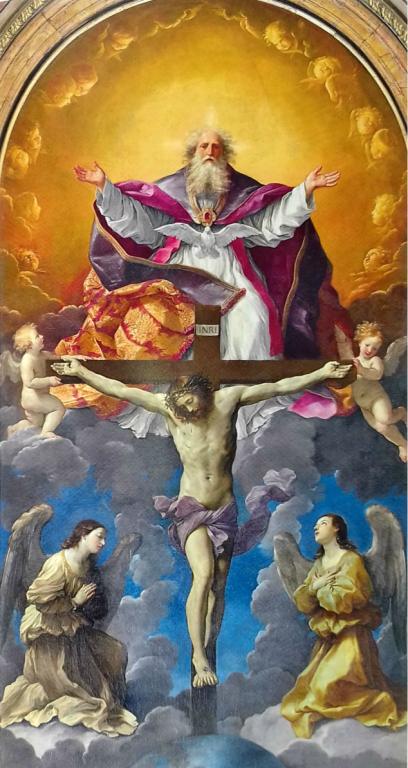
Guido Reni, “La Trinità” (ca. 1625-1626; Rome, Chiesa della Trinità dei Pellegrini)
Wikimedia Commons public domain image
***
A new article — this one by Taylor Halverson — went up today in Interpreter: A Journal of Latter-day Saint Faith and Scholarship:
“Be Ye Therefore Loyal, Even as Your Father Which is in Heaven is Loyal”
Abstract: The scriptures are saturated with covenantal words and terms. Any serious or close reading of the scriptures that misses or ignores the covenantal words, phrases, and literary structure of scripture runs the risk of missing the full purpose of why God preserved the scriptures for us. This is especially true for the Old Testament and the Book of Mormon, which emerged out of an Old Testament cultural context. Research during the past century on ancient Near Eastern covenants has brought clarity to the covenantal meaning and context of a variety of words and literary structures in the Old Testament and the Book of Mormon. This article builds on that revealing research to show that the English word “perfect” in a covenantal context in scripture can also be represented with the covenantal synonyms of “loyal, loyalty, faithful, and trustworthy.” God has revealed and preserved the scriptures as records of these covenants and of the consequences of covenantal loyalty or disloyalty. The Lord’s injunction to “be ye therefore perfect” (Matthew 5:48) is beautifully magnified when we realize that we are not simply asked to be without sin, but, rather, to “be ye therefore covenantally loyal” even as God has been eternally and covenantally loyal to us.
***
And here are links to five articles that were previously published in Interpreter:
Daniel C. Peterson, “Notes on Mormonism and the Trinity”
Abstract: With “awe, humility, and circumspection,” Daniel C. Peterson provides a useful summary and discussion of Latter-day Saint beliefs as they relate to traditional Christian conceptions of the Trinity. In particular, his discussions reveals the many nuances of the questions raised, including the precise nature of the unity of the three persons of the Godhead and how the overall conception relates to doctrines of salvation and practical discipleship, which continued to be a controversial issue in both the Eastern and Western Churches for centuries. Peterson argues that the Latter-day Saint doctrine affirms both biblical precedents and, to a degree, some modern theological trends such as social theories of the Trinity.
[Editor’s Note: Part of our book chapter reprint series, this article is reprinted here as a service to the LDS community. Original pagination and page numbers have necessarily changed, otherwise the reprint has the same content as the original.
See Daniel C. Peterson, “Notes on Mormonism and the Trinity,” in “To Seek the Law of the Lord”: Essays in Honor of John W. Welch, ed. Paul Y. Hoskisson and Daniel C. Peterson (Orem, UT: The Interpreter Foundation, 2017), 267–316. Further information at https://interpreterfoundation.org/books/to-seek-the-law-of-the-lord-essays-in-honor-of-john-w-welch-2/.]
Ralph C. Hancock, “Nephi’s Obsession, Or, How to Talk with Nephi about God”
Review of Joseph M. Spencer, 1 Nephi: A Brief Theological Introduction (Provo, UT: The Neal A. Maxwell Institute for Religious Scholarship, 2020). 146 pages. $9.99 (paperback).
Abstract: Joseph Spencer’s intimate familiarity with the Book of Mormon text, based upon years of close textual study and informed by a well- developed theological sensibility, is in full evidence in this lead-off volume in Neal A. Maxwell Institute’s new series of books on the various books of the Book of Mormon. Leaving to prophets and apostles the responsibility for “declaring official doctrine,” this new series approaches the book with the tools of the “scholarly practice” of theology. In Spencer’s case at least, his practice is understood to be (1) informed by an emphasis on grace that is skeptical of claims of personal righteousness and (2) very much engaged with contemporary moral and social issues grounded in a fundamental concern for “equality.” Accordingly, Spencer’s reading is much more interested in “what God is doing in history with what we call the Abrahamic covenant” than with the more popular (non-scholarly) concerns of “everyday faithful living;” it is also more interested in Nephi’s “realistic” and “mature” regret over his youthful over-boldness than in his confident statements of righteous faith. In the end, Spencer’s extremely careful but theologically tendentious reading alerts us very skillfully to certain features of Nephi’s imperfect humanity but reveals a consistent preoccupation with any possible faults in the prophet that might be extracted from an ingenious reading of the text. Finally, concerning women in the Book of Mormon, Spencer again expertly raises provocative questions about barely heard female voices but is too eager to frame these questions from the standpoint of the “modern sensibility” of “sexual egalitarianism.”
Jeff Lindsay, “An Intelligent, Thoughtful Work on One of the Richest Portions of the Book of Mormon”
Review of Terryl Givens, 2nd Nephi: A Brief Theological Introduction (Provo, UT: The Neal A. Maxwell Institute for Religious Scholarship, 2020). 124 pages. $9.95 (paperback).
Abstract: Terryl Givens’s well-written and enjoyable book does much to equip readers of the Book of Mormon with new tools to appreciate the riches of a text often viewed as the most difficult part of the Book of Mormon. Givens helps us recognize Nephi’s sorrow over Jerusalem and his passionate hope and joy centered in the Messiah, Jesus Christ. He helps us understand the weightier matters that Nephi focuses on to encourage us to accept the covenants of the Lord and to be part of Zion. Readers will better respect 2 Nephi as a vital part of the Restoration with content critically important for our day.
Dana M. Pike, “Formed in and Called from the Womb”
Abstract: Drawing on his deep knowledge of biblical Hebrew, Dana Pike gives us a close reading of Jeremiah 1:5, the most important Old Testament verse relating to the Latter-day Saint understanding of premortal existence of human spirits and the foreordination of prophets to their appointed callings. He shows that the plain sense of this verse cannot be easily dismissed: first, and consistent with Latter-day Saint understanding, God knew Jeremiah before he was conceived and that afterward, in a second phase that transpired in the womb, he was, “according to the Israelite perspective preserved in the Bible,” appointed to become a prophet.
[Editor’s Note: Part of our book chapter reprint series, this article is reprinted here as a service to the LDS community. Original pagination and page numbers have necessarily changed, otherwise the reprint has the same content as the original.
See Dana M. Pike, “Formed in and Called from the Womb,” in “To Seek the Law of the Lord”: Essays in Honor of John W. Welch, ed. Paul Y. Hoskisson and Daniel C. Peterson (Orem, UT: The Interpreter Foundation, 2017), 317–32. Further information at https://interpreterfoundation.org/books/to-seek-the-law-of-the-lord-essays-in-honor-of-john-w-welch-2/.]
Abstract: Genesis 30:23–24 offers a double etiology for Joseph in terms of “taking away”/“gathering” (ʾāsap) and “adding” (yāsap). In addition to its later narratological use of the foregoing, the Joseph cycle (Genesis 37–50) evidences a third dimension of onomastic wordplay involving Joseph’s kĕtōnet passîm*, an uncertain phrase traditionally translated “coat of many colours” (from LXX), but perhaps better translated, “coat of manifold pieces.” Moroni1, quoting from a longer version of the Joseph story from the brass plates, refers to “Joseph, whose coat was rent by his brethren into* many pieces*” (Alma 46:23). As a military and spiritual leader, Moroni1 twice uses Joseph’s torn coat and the remnant doctrine from Jacob’s prophecy regarding Joseph’s coat as a model for his covenant use of his own coat to “gather” (cf.* ʾāsap*) and rally faithful Nephites as “a remnant of the seed of Joseph” (Alma 46:12–28, 31; 62:4–6). In putting that coat on a “pole” or “standard” (Hebrew* nēs — i.e., “ensign”) to “gather” a “remnant of the seed of Joseph” appears to make use of the Isaianic nēs*-imagery of Isaiah 11:11–12 (and elsewhere), where the Joseph-connected verbs* yāsap and ʾāsap serve as key terms. Moroni’s written-upon “standard” or “ensign” for “gathering” the “remnant of the seed of Joseph” constituted an important prophetic antetype for how Mormon and his son, Moroni2, perceived the function of their written record in the latter-days (see, e.g., 3 Nephi 5:23–26; Ether 13:1–13).
Brief Theological Introduction
Church of Jesus Christ of Latter-day Saints
Interpreter Journal Latter-day Saint Faith Scholarship
Previous Post

October 8, 2021
Misrepresenting an apostle
Next Post
October 10, 2021 The lovely features of a naturalistic universe
Browse Our Archives
Select a Category Uncategorized
Select a Month October 2026 September 2026 August 2026 July 2026 June 2026 May 2026 April 2026 March 2026 February 2026 January 2026 December 2025 November 2025 October 2025 September 2025 August 2025 July 2025 June 2025 May 2025 April 2025 March 2025 February 2025 January 2025 December 2024 November 2024 October 2024 September 2024 August 2024 July 2024 June 2024 May 2024 April 2024 March 2024 February 2024 January 2024 December 2023 November 2023 October 2023 September 2023 August 2023 July 2023 June 2023 May 2023 April 2023 March 2023 February 2023 January 2023 December 2022 November 2022 October 2022 September 2022 August 2022 July 2022 June 2022 May 2022 April 2022 March 2022 February 2022 January 2022 December 2021 November 2021 October 2021 September 2021 August 2021 July 2021 June 2021 May 2021 April 2021 March 2021 February 2021 January 2021 December 2020 November 2020 October 2020 September 2020 August 2020 July 2020 June 2020 May 2020 April 2020 March 2020 February 2020 January 2020 December 2019 November 2019 October 2019 September 2019 August 2019 July 2019 June 2019 May 2019 April 2019 March 2019 February 2019 January 2019 December 2018 November 2018 October 2018 September 2018 August 2018 July 2018 June 2018 May 2018 April 2018 March 2018 February 2018 January 2018 December 2017 November 2017 October 2017 September 2017 August 2017 July 2017 June 2017 May 2017 April 2017 March 2017 February 2017 January 2017 December 2016 November 2016 October 2016 September 2016 August 2016 July 2016 June 2016 May 2016 April 2016 March 2016 February 2016 January 2016 December 2015 November 2015 October 2015 September 2015 August 2015 July 2015 June 2015 May 2015 April 2015 March 2015 February 2015 January 2015 December 2014 November 2014 March 2014 August 2013 February 2012
Follow Us!
TAKE THE
Religious Wisdom Quiz
What disaster did Joseph predict would happen to Egypt?
Select your answer to see how you score.
Flood Plague of locusts Seven-year famine Great fire
Related posts from Sic et Non


Notes on Women, Priesthood, and General Conference

"The Book of Moses as a Temple Text"

TRENDING AT PATHEOS Latter-day Saint

Swimfan: Forgotten Aughts Pleasures
This is a recovery effort. In 2002, My Big Fat Greek Wedding...

Top Three Anti-Catholic Lies About Catholicism
This is my initial transcript for the video, "THE 3 WORST...

Pope Leo Celebrates Mass for Nurses & Docs...
I don't have any idea how he did it, but Pope Leo...

The Sermon on the Mount, Part I: Matthew...
The Sermon on the Mount, Part I (Matthew 4:12-5:12) St. Matthew moves...

What's up from Crossway: Reviewing some of their latest A few weeks...

Janie Learns the Way of the Cross: A...
Teaching children about Jesus' Passion can be challenging. Many parents and educators...
view all Latter-day Saint blogs
Ad-Free & Subscriber Log-In Subscription Support
- About Us
- 2026 Calendar
- Videos
- Podcasts
- Library of World Religions
- Faith In Media Tracker
- Advertise With Us
- Write for Us
- Privacy Policy
- Terms of Service
- Do Not Sell My Data
- Contact Us
- Radiant Digital
- Manage Newsletter Subscriptions
- Unsubscribe From Notifications
- Sitemap
Copyright 2008-2026, Patheos. All rights reserved.
Subscription Support Ad-Free & Subscriber Log-In
Follow Patheos