
BuddhistCatholicContemplativeEvangelicalGeneral ChristianHinduJewishLatter-day SaintMuslimNew VisionsProgressive Christian
Beliefs
- Buddhist
- Catholic
- Contemplative
- Evangelical
- General Christian
- Hindu
- Jewish
- Latter-day Saint
- More Voices
- Muslim
- New Visions
- Pagan
- Progressive Christian
Topics
- Religion News
- Food and Religion
- Sports and Religion
- Religious Art
- Religious Music and Entertainment
- Religious Events
- History and Religion
- Style and Religion
- Politics and Religion
- Women in Religion
- Recreation Outdoors and Religion
- Business Finance and Religion
- Careers Workplace and Religion
- Education and Religion
- Family Parenting and Religion
- Health Fitness and Religion
- Home and Religion
- Relationships and Religion
- Technology and Religion
- Travel and Religion
Columnists
- Buddhist Columnists
- Business Finance and Religion Columnists
- Careers Workplace and Religion Columnists
- Catholic Columnists
- Contemplative Columnists
- Education and Religion Columnists
- Evangelists Columnists
- Family Parenting and Religion Columnists
- General Christian Columnists
- Health Fitness and Religion Columnists
- Hindu Columnists
- History and Religion Columnists
- Home and Religion Columnists
- Jewish Columnists
- More Voices Columnists
- Latter Day Columnists
- Muslim Columnists
- New Visions Columnists
- Nonreligious Columnists
- Pagan Columnists
- Politics and Religion Columnists
- Progressive Columnists
- Recreation Outdoors and Religion Columnists
- Relationships and Religion Columnists
- Religion News Columnists
- Religious Art Columnists
- Religious Events Columnists
- Religious Music and Entertainment Columnists
- Sports and Religion Columnists
- Style and Religion Columnists
- Technology and Religion Columnists
- Travel and Religion Columnists
- Women in Religion Columnists
Resource Library
- 2026 Calendar
- Library of World Religions
- The 100 Most Holy Places on Earth
- Patheos Answers
- Podcasts
- Videos
- Faith Leaders Database
- Anglican Episcopalian
- Bahai
- Baptist
- Buddhism
- Christianity
- Confucianism
- Eastern Orthodoxy
- Hinduism
- Holiness and Pentecostal
- ISKCON
- Islam
- Judaism
- Lutheran
- Methodist
- The Church of Jesus Christ of Latter-day Saints
- New Age
- Paganism
- Presbytarian and Reformed
- Protestantism
- Religion Behind the Scenes
- Roman Catholic
- Scientology
- Shia Islam
- Sikhism
- Sufism
- Sunni Islam
- Taoism
- Zen
- See all religions
Research Tools
 Ad-Free & Subscriber Log-In Subscription Support
Ad-Free & Subscriber Log-In Subscription Support
Follow Patheos 

- Trending:
- Forgiveness
- |
- Marriage
- |
- Consciousness
- |
- Death Penalty
- |
- Election
- |
- Halloween

- Home
- Latter-day Saint
- All of you can partake, freely.
All of you can partake, freely.
Last updated on: October 18, 2021 at 12:36 pm by Dan Peterson
All of you can partake, freely. 2021-10-18T12:36:46-06:00 Dan Peterson
Patheos Explore the world's faith through different perspectives on religion and spirituality! Patheos has the views of the prevalent religions and spiritualities of the world.
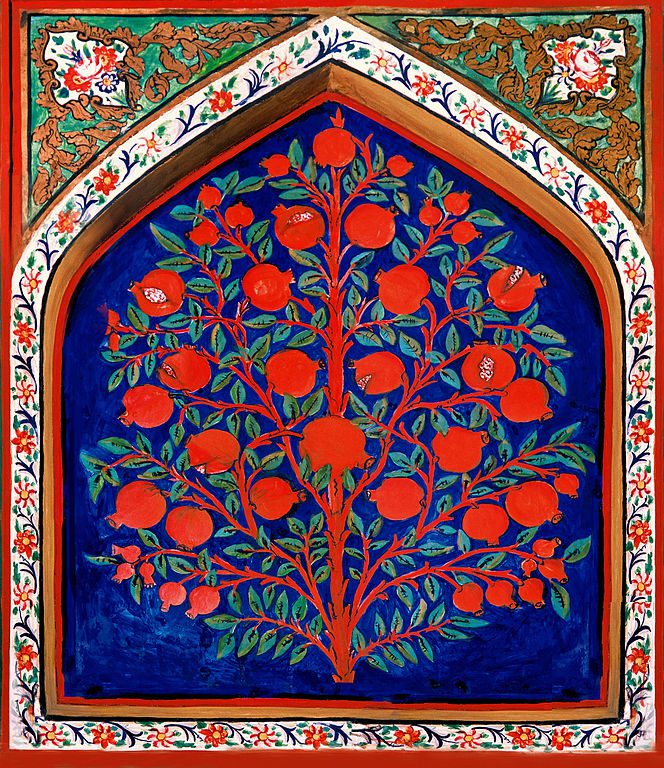
A seventeenth-century representation of the Tree of Life from the Shaki Khan Palace in Azerbaijan
(Wikimedia Commons public domain image)
***
I presented a lecture last week in connection with the Interpreter Foundation’s upcoming “Ultimate Egypt Tour,” under the title “What You Need to Know About Egypt’s Most Recent Two Thousand Years.” That lecture is now available online and at no charge for anybody who cares to watch it. You simply need to scroll down on the page to which I link immediately below. Of course, as you scroll down you’ll also notice many other lectures that may interest you more than mine. Enjoy!
“The Ultimate Egypt – Interpreter Foundation Tour: Lecture Series”
***
I don’t believe that I called attention to this relatively new little essay when it appeared:
Book of Moses Essays #77: Noah (Moses 8) Was Noah Drunk or in a Vision? (Genesis 9)
***
And here, while I’m at it, are a few links to articles in a prior issue of Interpreter: A Journal of Latter-day Saint Faith and Scholarship:
Daniel C. Peterson, ““All Can Partake, Freely””
Abstract: The Interpreter Foundation welcomes faithful ideas, insights, and manuscripts from people of all backgrounds. In this brief essay, I share some that were recently shared with me regarding Lehi’s vision of the tree of life, as recorded in 1 Nephi 8. Among other things, Lehi seems to have been shown that the divine offer of salvation extends far beyond a small elite. As Peter exclaims in the King James rendering of Acts 10:34, “God is no respecter of persons.” Other translations render the same words as saying that he doesn’t “play favorites” or “show partiality.” The passage in James 1:5 with which the Restoration commenced clearly announces that, if they will simply ask, God “giveth to all men liberally.”
Alan Goff, “Working out Salvation History in the Book of Mormon Politeia with Fear and Trembling”
Review of James E. Faulconer, Mosiah: A Brief Theological Introduction (Provo, UT: Neal A. Maxwell Institute for Religious Scholarship, 2020). 135 pages. $9.95 (paperback).
Abstract: The Maxwell Institute for the Study of Religion has released another book in its series The Book of Mormon: Brief Theological Introductions*. This book by James E. Faulconer more than ably engages five core elements of the book of Mosiah, exploring their theological implications. Faulconer puzzles through confusing passages and elements: why is the book rearranged so that it isn’t in chronological order? What might King Benjamin mean when he refers to the nothingness of humans? And what might Abinadi mean when he declares that Christ is both the Father and the Son? The most interesting parts of the introduction to Mosiah are those chapters that sort through the discussion of politics as both Alma1 and Mosiah2 sort out divine preferences in constitutional arrangements as the Nephites pass through a political revolution that shifts from rule by kings to rule by judges. Faulconer asserts that no particular political structure is preferred by God; in the chapter about economic arrangements, Faulconer (as in his analysis of political constitutions) asserts that deity doesn’t endorse any particular economic relationship.*
Royal Skousen, “The Pleading Bar of God”
Abstract: Royal Skousen’s essay shed light on enigmatic references in Jacob 6:13 and Moroni 10:34 to “the pleasing bar of God.” After establishing that the term “pleading bar” is an appropriate legal term, he cites both internal evidence and the likelihood of scribal errors as explanations for why “pleasing bar,” instead of the more likely “pleading bar,” appears in current editions of the Book of Mormon.
[Editor’s Note: Part of our book chapter reprint series, this article is reprinted here as a service to the LDS community. Original pagination and page numbers have necessarily changed, otherwise the reprint has the same content as the original.
See Royal Skousen, “The Pleading Bar of God,” in “To Seek the Law of the Lord”: Essays in Honor of John W. Welch, ed. Paul Y. Hoskisson and Daniel C. Peterson (Orem, UT: The Interpreter Foundation, 2017), 413–28. Further information at https://interpreterfoundation.org/books/to-seek-the-law-of-the-lord-essays-in-honor-of-john-w-welch-2/.]
Amanda Colleen Brown, “Subtle Hebraic Features in the Book of Mormon
Review of Donald W. Parry, Preserved in Translation: Hebrew and Other Ancient Literary Forms in the Book of Mormon (Salt Lake City: Deseret Book; Provo, UT: Religious Studies Center, Brigham Young University, 2020). 171 pages. Hardback, $19.99.
Abstract: Donald W. Parry combines a lifetime of insights about the Old Testament and Book of Mormon into one volume. Written for a non- academic audience, this book will provide a glimpse into some of the Book of Mormon’s literary complexities that originate from Hebrew grammar and style.
Robert F. Smith, “Poesy and Prosody in the Book of Mormon”
Abstract: Robert Smith makes the case that “poetic art in the Book of Mormon is highly developed” — you just need to have the eye to recognize it. Though many readers are aware of the stunning examples of chiasmus in the Book of Mormon, thanks to the pioneering work by John W. Welch, fewer are acquainted with the other important forms of parallelism that pervade the text, often placed strategically to highlight the importance of a particular passage. Smith also shows why apocalpytic texts, sometimes thought to originate at a later period, can be found, for example, in the first chapter of the Book of Mormon.
[Editor’s Note: Part of our book chapter reprint series, this article is reprinted here as a service to the LDS community. Original pagination and page numbers have necessarily changed, otherwise the reprint has the same content as the original.
See Robert F. Smith, “Poesy and Prosody in the Book of Mormon,” in “To Seek the Law of the Lord”: Essays in Honor of John W. Welch, ed. Paul Y. Hoskisson and Daniel C. Peterson (Orem, UT: The Interpreter Foundation, 2017), 429–67. Further information at https://interpreterfoundation.org/books/to-seek-the-law-of-the-lord-essays-in-honor-of-john-w-welch-2/.]
***
I’ve been thoroughly enjoying the Brigham Young University conference on Islam — “The Islamic World Today: Issues and Perspectives” — that got fully underway this morning and will continue through tomorrow. Thus far, it’s drawn a good in-person audience. Although I’m on campus for it right now, it’s also accessible at no charge online. I encourage any who might be interested to tune in. Scan through the conference schedule and decide what might particularly catch your attention!
Brief Theological Introduction
Previous Post

October 17, 2021
Some More on Spirituality, Religiosity, and Health
Next Post
October 18, 2021 Into the Woods, with Joseph
Browse Our Archives
Select a Category Uncategorized
Select a Month October 2026 September 2026 August 2026 July 2026 June 2026 May 2026 April 2026 March 2026 February 2026 January 2026 December 2025 November 2025 October 2025 September 2025 August 2025 July 2025 June 2025 May 2025 April 2025 March 2025 February 2025 January 2025 December 2024 November 2024 October 2024 September 2024 August 2024 July 2024 June 2024 May 2024 April 2024 March 2024 February 2024 January 2024 December 2023 November 2023 October 2023 September 2023 August 2023 July 2023 June 2023 May 2023 April 2023 March 2023 February 2023 January 2023 December 2022 November 2022 October 2022 September 2022 August 2022 July 2022 June 2022 May 2022 April 2022 March 2022 February 2022 January 2022 December 2021 November 2021 October 2021 September 2021 August 2021 July 2021 June 2021 May 2021 April 2021 March 2021 February 2021 January 2021 December 2020 November 2020 October 2020 September 2020 August 2020 July 2020 June 2020 May 2020 April 2020 March 2020 February 2020 January 2020 December 2019 November 2019 October 2019 September 2019 August 2019 July 2019 June 2019 May 2019 April 2019 March 2019 February 2019 January 2019 December 2018 November 2018 October 2018 September 2018 August 2018 July 2018 June 2018 May 2018 April 2018 March 2018 February 2018 January 2018 December 2017 November 2017 October 2017 September 2017 August 2017 July 2017 June 2017 May 2017 April 2017 March 2017 February 2017 January 2017 December 2016 November 2016 October 2016 September 2016 August 2016 July 2016 June 2016 May 2016 April 2016 March 2016 February 2016 January 2016 December 2015 November 2015 October 2015 September 2015 August 2015 July 2015 June 2015 May 2015 April 2015 March 2015 February 2015 January 2015 December 2014 November 2014 March 2014 August 2013 February 2012
Follow Us!
TAKE THE
Religious Wisdom Quiz
What Christian group believes in the doctrine of transubstantiation?
Select your answer to see how you score.
Catholics Pentecostals Baptists Protestants
Related posts from Sic et Non


Some notes on the archaeology of the Bible


TRENDING AT PATHEOS Latter-day Saint

Nearly every morning, I make the drive to Detroit with my high-school-age...

The Real AI Story Is Adoption Without Trust
Artificial intelligence has crossed a political threshold. It is no longer a...

A new article, written by Jeff Lindsay and Gale L. Pooley,...

Swimfan: Forgotten Aughts Pleasures
This is a recovery effort. In 2002, My Big Fat Greek Wedding...

Top Three Anti-Catholic Lies About Catholicism
This is my initial transcript for the video, "THE 3 WORST...

Pope Leo Celebrates Mass for Nurses & Docs...
I don't have any idea how he did it, but Pope Leo...
view all Latter-day Saint blogs
Ad-Free & Subscriber Log-In Subscription Support
- About Us
- 2026 Calendar
- Videos
- Podcasts
- Library of World Religions
- Faith In Media Tracker
- Advertise With Us
- Write for Us
- Privacy Policy
- Terms of Service
- Do Not Sell My Data
- Contact Us
- Radiant Digital
- Manage Newsletter Subscriptions
- Unsubscribe From Notifications
- Sitemap
Copyright 2008-2026, Patheos. All rights reserved.
Subscription Support Ad-Free & Subscriber Log-In
Follow Patheos