
BuddhistCatholicContemplativeEvangelicalGeneral ChristianHinduJewishLatter-day SaintMuslimNew VisionsProgressive Christian
Beliefs
- Buddhist
- Catholic
- Contemplative
- Evangelical
- General Christian
- Hindu
- Jewish
- Latter-day Saint
- More Voices
- Muslim
- New Visions
- Pagan
- Progressive Christian
Topics
- Religion News
- Food and Religion
- Sports and Religion
- Religious Art
- Religious Music and Entertainment
- Religious Events
- History and Religion
- Style and Religion
- Politics and Religion
- Women in Religion
- Recreation Outdoors and Religion
- Business Finance and Religion
- Careers Workplace and Religion
- Education and Religion
- Family Parenting and Religion
- Health Fitness and Religion
- Home and Religion
- Relationships and Religion
- Technology and Religion
- Travel and Religion
Columnists
- Buddhist Columnists
- Business Finance and Religion Columnists
- Careers Workplace and Religion Columnists
- Catholic Columnists
- Contemplative Columnists
- Education and Religion Columnists
- Evangelists Columnists
- Family Parenting and Religion Columnists
- General Christian Columnists
- Health Fitness and Religion Columnists
- Hindu Columnists
- History and Religion Columnists
- Home and Religion Columnists
- Jewish Columnists
- More Voices Columnists
- Latter Day Columnists
- Muslim Columnists
- New Visions Columnists
- Nonreligious Columnists
- Pagan Columnists
- Politics and Religion Columnists
- Progressive Columnists
- Recreation Outdoors and Religion Columnists
- Relationships and Religion Columnists
- Religion News Columnists
- Religious Art Columnists
- Religious Events Columnists
- Religious Music and Entertainment Columnists
- Sports and Religion Columnists
- Style and Religion Columnists
- Technology and Religion Columnists
- Travel and Religion Columnists
- Women in Religion Columnists
Resource Library
- 2026 Calendar
- Library of World Religions
- The 100 Most Holy Places on Earth
- Patheos Answers
- Podcasts
- Videos
- Faith Leaders Database
- Anglican Episcopalian
- Bahai
- Baptist
- Buddhism
- Christianity
- Confucianism
- Eastern Orthodoxy
- Hinduism
- Holiness and Pentecostal
- ISKCON
- Islam
- Judaism
- Lutheran
- Methodist
- The Church of Jesus Christ of Latter-day Saints
- New Age
- Paganism
- Presbytarian and Reformed
- Protestantism
- Religion Behind the Scenes
- Roman Catholic
- Scientology
- Shia Islam
- Sikhism
- Sufism
- Sunni Islam
- Taoism
- Zen
- See all religions
Research Tools
 Ad-Free & Subscriber Log-In Subscription Support
Ad-Free & Subscriber Log-In Subscription Support
Follow Patheos 

- Trending:
- Forgiveness
- |
- Marriage
- |
- Consciousness
- |
- Death Penalty
- |
- Election
- |
- Halloween

- Home
- Latter-day Saint
- Semites and/or Egyptians in the Pre-Columbian New World?
Semites and/or Egyptians in the Pre-Columbian New World?
Last updated on: September 3, 2021 at 11:23 pm by Dan Peterson
Semites and/or Egyptians in the Pre-Columbian New World? 2021-09-03T23:23:50-06:00 Dan Peterson
Patheos Explore the world's faith through different perspectives on religion and spirituality! Patheos has the views of the prevalent religions and spiritualities of the world.
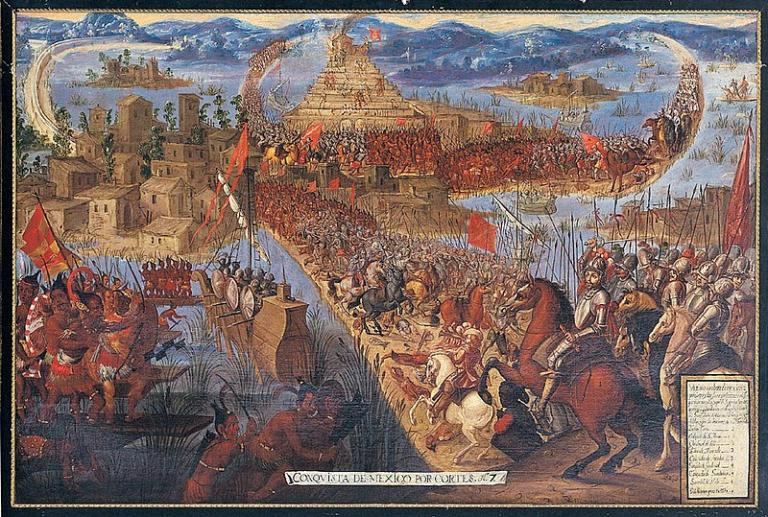
A late sixteenth century painting of the Spanish conquest of Tenochtitlan in 1521, by an unknown artist
(Wikimedia Commons public domain image)
***
Here are links to a few articles that might interest you from a prior volume of Interpreter: A Journal of Latter-day Saint Faith and Scholarship:
L. Michael Morales, “The Tabernacle: Mountain of God in the Cultus of Israel”
Abstract: In this article, Michael Morales considers how the building of the Tabernacle had been pre-figured from the earliest narratives of Genesis onward. It describes some of the parallels between the creation, deluge, and Sinai narratives and the tabernacle account; examines how the high priest’s office functions as something of a new Adam; and considers how the completed tabernacle resolves the storyline of Genesis and Exodus, via the biblical theme of “to dwell in the divine Presence.”
[Editor’s Note: Part of our book chapter reprint series, this article is reprinted here as a service to the LDS community. Original pagination and page numbers have necessarily changed, otherwise the reprint has the same content as the original.
See L. Michael Morales, “The Tabernacle: Mountain of God in the Cultus of Israel,” in Ancient Temple Worship: Proceedings of The Expound Symposium 14 May 2011, ed. Matthew B. Brown, Jeffrey M. Bradshaw, Stephen D. Ricks, and John S. Thompson (Orem, UT: The Interpreter Foundation; Salt Lake City: Eborn Books, 2014), 27–70. Further information at https://interpreterfoundation.org/books/ancient-temple-worship/.]
Ryan Atwood, “Lehi’s Dream and the Plan of Salvation”
Abstract: Lehi’s dream symbolically teaches us about many aspects of Heavenly Father’s plan of salvation. The central message of Lehi’s dream is that all must come unto Jesus Christ in order to be saved. Each of us has the choice to pursue the path that leads to eternal joy and salvation or to choose a different way and experience undesirable outcomes. In this paper, elements of Lehi’s dream and supporting scriptures are analyzed to see how they relate to key aspects of the plan of salvation and our journey through life.
Abstract: On the Mount of Olives, just prior to the culminating events of the Passion week, Jesus gave one of the most controversial prophecies of the New Testament, saying, among other things, that the “abomination of desolation” will “stand in the holy place.” In Joseph Smith-Matthew the Prophet renders this passage in a way that radically changes its meaning. Rather than describing how the “abomination of desolation” will “stand in the holy place,” the JST version enjoins the apostles to “stand in the holy place” when the “abomination of desolation” appears. Though several Latter-day Saint scholars have offered interpretations and personal applications of these words as given in modern scripture, it appears that no one has heretofore seriously explored how this change in meaning might be explained and defended. This article will show that other passages in the Bible, in connection with the light shed by Jewish midrash and contemporary scholarship, demonstrate that the idea behind Joseph Smith’s revision of the passage, far from being a modern invention, reverberates throughout the religious thought of earlier times. The article concludes with an appendix that tries to draw out a possibility for a specific interpretation of the prophecy about the “abomination of desolation” at the time of Christ and in the latter days.
[Editor’s Note: Part of our book chapter reprint series, this article is reprinted here as a service to the LDS community. Original pagination and page numbers have necessarily changed, otherwise the reprint has the same content as the original.
See Jeffrey M. Bradshaw, “Standing in the Holy Place: Ancient and Modern Reverberations of an Enigmatic New Testament Prophecy,” in [Page 164]Ancient Temple Worship: Proceedings of The Expound Symposium 14 May 2011, ed. Matthew B. Brown, Jeffrey M. Bradshaw, Stephen D. Ricks, and John S. Thompson (Orem, UT: The Interpreter Foundation; Salt Lake City: Eborn Books, 2014), 71–142. Further information at https://interpreterfoundation.org/books/ancient-temple-worship/.]
Brian D. Stubbs, “Answering the Critics in 44 Rebuttal Points”
Abstract: After publishing several articles in peer-reviewed journals, the author published Uto-Aztecan: A Comparative Vocabulary (2011), the new standard in comparative Uto-Aztecan, favorably reviewed and heartily welcomed by specialists in the field. Four years later, another large reference work, Exploring the Explanatory Power of Semitic and Egyptian in Uto-Aztecan (2015), was also favorably reviewed but not as joyfully welcomed among specialists as its predecessor. While some saw it as sound, more were silent. Some disliked the topic, but no one produced substantive refutations of it. In August 2019, Chris Rogers published a review, but John S. Robertson’s response to Rogers’s review and my response in the first 24 items rebutted below shed new light on his criticisms. Following on the heels of Rogers’s review, Magnus Pharao Hansen, specializing in Nahuatl, blogged objections to 14 Nahuatl items among the 1,528 sets. Rogers’s and Hansen’s articles gave rise to some critical commentary as well as to a few valid questions. What follows clarifies the misconceptions in Rogers’s review, responds to Hansen’s Nahuatl issues, and answers some reasonable questions raised by others.
Editor’s Note: Critics of the Book of Mormon often argue that no evidence exists for contact between the ancient Near East and the Americas. Accordingly, proof of such contact would demolish a principal objection to Joseph Smith’s prophetic claims. If the thesis of Brian Stubbs’s works is correct, he has furnished precisely that proof.
As might be expected, Stubbs’s efforts have drawn criticism from some, but not all, of his linguistic peers. This article represents a response by Stubbs to those criticisms. Stubbs’s works are admittedly complex and highly technical. They are, therefore, difficult, and it can take quite a bit of work for a reader to assimilate and understand the implications of his arguments. That very complexity and difficulty, though, precludes dismissal of Stubbs’s works out of hand.
Has Stubbs proved the Book of Mormon true? No, but his data suggest that speakers of both Egyptian and a Semitic language came into contact with Uto-Aztecan speakers at roughly the same time as Book of Mormon events purportedly occurred and that a distinct Semitic infusion occurred at a different point.
Stubbs’s work is important and it deserves careful, reasoned consideration by scholars and lay readers alike.
Previous Post

September 3, 2021
"Additional Janus Parallels in the Book of Mormon"
Next Post
September 4, 2021 Temples, Ancient and Modern
Browse Our Archives
Select a Category Uncategorized
Select a Month October 2026 September 2026 August 2026 July 2026 June 2026 May 2026 April 2026 March 2026 February 2026 January 2026 December 2025 November 2025 October 2025 September 2025 August 2025 July 2025 June 2025 May 2025 April 2025 March 2025 February 2025 January 2025 December 2024 November 2024 October 2024 September 2024 August 2024 July 2024 June 2024 May 2024 April 2024 March 2024 February 2024 January 2024 December 2023 November 2023 October 2023 September 2023 August 2023 July 2023 June 2023 May 2023 April 2023 March 2023 February 2023 January 2023 December 2022 November 2022 October 2022 September 2022 August 2022 July 2022 June 2022 May 2022 April 2022 March 2022 February 2022 January 2022 December 2021 November 2021 October 2021 September 2021 August 2021 July 2021 June 2021 May 2021 April 2021 March 2021 February 2021 January 2021 December 2020 November 2020 October 2020 September 2020 August 2020 July 2020 June 2020 May 2020 April 2020 March 2020 February 2020 January 2020 December 2019 November 2019 October 2019 September 2019 August 2019 July 2019 June 2019 May 2019 April 2019 March 2019 February 2019 January 2019 December 2018 November 2018 October 2018 September 2018 August 2018 July 2018 June 2018 May 2018 April 2018 March 2018 February 2018 January 2018 December 2017 November 2017 October 2017 September 2017 August 2017 July 2017 June 2017 May 2017 April 2017 March 2017 February 2017 January 2017 December 2016 November 2016 October 2016 September 2016 August 2016 July 2016 June 2016 May 2016 April 2016 March 2016 February 2016 January 2016 December 2015 November 2015 October 2015 September 2015 August 2015 July 2015 June 2015 May 2015 April 2015 March 2015 February 2015 January 2015 December 2014 November 2014 March 2014 August 2013 February 2012
Follow Us!
TAKE THE
Religious Wisdom Quiz
How many days was Jesus tempted in the wilderness?
Select your answer to see how you score.
50 days 40 days 60 days 30 days
Related posts from Sic et Non


Some notes on the archaeology of the Bible


TRENDING AT PATHEOS Latter-day Saint

The Sermon on the Mount, Part I: Matthew...
The Sermon on the Mount, Part I (Matthew 4:12-5:12) St. Matthew moves...

What's up from Crossway: Reviewing some of their latest A few weeks...

Janie Learns the Way of the Cross: A...
Teaching children about Jesus' Passion can be challenging. Many parents and educators...

Looking For Good Catholic Writing - October 2026
He alone extends the heavens, and he walks upon the waves of...

In "Irreplaceable," our book on vocation and technology, Trevor Sutton and I...

I was strolling through the top floor of the brand new Parthenon...
view all Latter-day Saint blogs
Ad-Free & Subscriber Log-In Subscription Support
- About Us
- 2026 Calendar
- Videos
- Podcasts
- Library of World Religions
- Faith In Media Tracker
- Advertise With Us
- Write for Us
- Privacy Policy
- Terms of Service
- Do Not Sell My Data
- Contact Us
- Radiant Digital
- Manage Newsletter Subscriptions
- Unsubscribe From Notifications
- Sitemap
Copyright 2008-2026, Patheos. All rights reserved.
Subscription Support Ad-Free & Subscriber Log-In
Follow Patheos