
BuddhistCatholicContemplativeEvangelicalGeneral ChristianHinduJewishLatter-day SaintMuslimNew VisionsProgressive Christian
Beliefs
- Buddhist
- Catholic
- Contemplative
- Evangelical
- General Christian
- Hindu
- Jewish
- Latter-day Saint
- More Voices
- Muslim
- New Visions
- Pagan
- Progressive Christian
Topics
- Religion News
- Food and Religion
- Sports and Religion
- Religious Art
- Religious Music and Entertainment
- Religious Events
- History and Religion
- Style and Religion
- Politics and Religion
- Women in Religion
- Recreation Outdoors and Religion
- Business Finance and Religion
- Careers Workplace and Religion
- Education and Religion
- Family Parenting and Religion
- Health Fitness and Religion
- Home and Religion
- Relationships and Religion
- Technology and Religion
- Travel and Religion
Columnists
- Buddhist Columnists
- Business Finance and Religion Columnists
- Careers Workplace and Religion Columnists
- Catholic Columnists
- Contemplative Columnists
- Education and Religion Columnists
- Evangelists Columnists
- Family Parenting and Religion Columnists
- General Christian Columnists
- Health Fitness and Religion Columnists
- Hindu Columnists
- History and Religion Columnists
- Home and Religion Columnists
- Jewish Columnists
- More Voices Columnists
- Latter Day Columnists
- Muslim Columnists
- New Visions Columnists
- Nonreligious Columnists
- Pagan Columnists
- Politics and Religion Columnists
- Progressive Columnists
- Recreation Outdoors and Religion Columnists
- Relationships and Religion Columnists
- Religion News Columnists
- Religious Art Columnists
- Religious Events Columnists
- Religious Music and Entertainment Columnists
- Sports and Religion Columnists
- Style and Religion Columnists
- Technology and Religion Columnists
- Travel and Religion Columnists
- Women in Religion Columnists
Resource Library
- 2026 Calendar
- Library of World Religions
- The 100 Most Holy Places on Earth
- Patheos Answers
- Podcasts
- Videos
- Faith Leaders Database
- Anglican Episcopalian
- Bahai
- Baptist
- Buddhism
- Christianity
- Confucianism
- Eastern Orthodoxy
- Hinduism
- Holiness and Pentecostal
- ISKCON
- Islam
- Judaism
- Lutheran
- Methodist
- The Church of Jesus Christ of Latter-day Saints
- New Age
- Paganism
- Presbytarian and Reformed
- Protestantism
- Religion Behind the Scenes
- Roman Catholic
- Scientology
- Shia Islam
- Sikhism
- Sufism
- Sunni Islam
- Taoism
- Zen
- See all religions
Research Tools
 Ad-Free & Subscriber Log-In Subscription Support
Ad-Free & Subscriber Log-In Subscription Support
Follow Patheos 

- Trending:
- Forgiveness
- |
- Marriage
- |
- Consciousness
- |
- Death Penalty
- |
- Election
- |
- Halloween

- Home
- Latter-day Saint
- Personal revelations following the murder of Joseph and Hyrum
Personal revelations following the murder of Joseph and Hyrum
Last updated on: September 8, 2021 at 11:54 pm by Dan Peterson
Personal revelations following the murder of Joseph and Hyrum 2021-09-08T23:54:37-06:00 Dan Peterson
Patheos Explore the world's faith through different perspectives on religion and spirituality! Patheos has the views of the prevalent religions and spiritualities of the world.
A rarely-treated subject in the history of the Church of Jesus Christ of Latter-day Saints
***
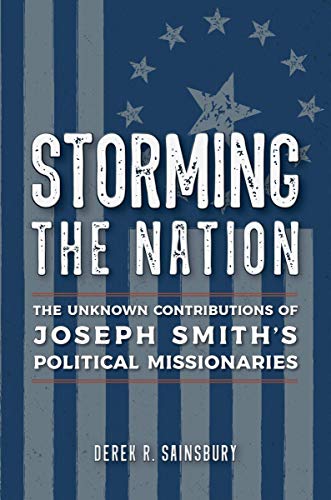
Here are a few additional passages that I marked during my reading of Derek R. Sainsbury’s Storming the Nation: The Unknown Contributions of Joseph Smith’s Political Missionaries (Provo: Religious Studies Center, Brigham Young University, 2020). Please note that such stories as these do not constitute the primary or even secondary focus of the book; they are tangential to its argument:
A small number of electioneers received comfort in what they described as revelatory visions or dreams. George Miller recorded a dream from the morning of June 28, just twelve hours after the assassination. He later remembered that as he lay in bed, “suddenly Joseph Smith appeared to me, saying, ‘God bless you, Brother Miller.'” Joseph told Miller that he and his brother Hyrum had been killed by a mob at Carthage after being “delivered up by the brethren as a lamb for the slaughter.” . . . The prophet . . . approach[ed] Miller as if to embrace him, [and] Joseph said, “God bless you forever and ever.” As the dream ended, Miller found himself standing in the middle of the room, arms extended as if returning an embrace. Miller’s companion, Thomas Edwards, now awakened, called out, “What is the matter?” Miller said nothing.
During their morning walk, Miller told Edwards of his vision, declaring he was sure it was true and he would be returning to Nauvoo. Edwards responded that Miller “preached too much and [his] mind was somewhat deranged” and that they should fulfill their appointments. Miller agreed, but after their last engagement they headed home. Passing a tavern, they read of the Smiths’ deaths. (157 )
John D. Lee in Kentucky learned of Joseph’s death from newspaper accounts on 5 July. A few days later he recorded a dream-vision. A heavenly messenger appeared to him and showed him “the martyrdom of the prophet and patriarch” and “bid [Lee’s] fears depart, “for his labors [were] accepted.” The angel explained that Christ’s original Twelve and Seventy had felt all was lost when he was “taken and crucified instead of being crown[ed] king (temporal) of that nation, as they fondly expected.” “Just so it is with you,” the messenger explained. “Instead of electing your leader the chief magistrate of this nation, they have martyred him in prison, which has hasten[ed] his exaltation to the executive chair over this generation.” The angel instructed Lee to “return home in peace and there [a]wait his endowment from on high, as did the disciples at Jerusalem.” (157-158)
Perhaps most amazing was the experience of James Holt [who was serving as a missionary near the town of Lebanon in his native county in Tennessee on 27 June 1844]. . . . They procured him the courthouse, rang the town bell, and soon the building was overflowing with people eager to hear the “Mormon” who had grown up nearby.
Holt began his sermon two hours before sunset, around 5:15 p.m. — the exact time of the attack on Carthage Jail, five hundred miles to the northwest. . . . He preached for two hours, much longer than he had anticipated. He recorded, “In the winding up of my sermon, I had the spirit of revelation come upon me, and I told them that the enemies of the church had taken the prophet of God this day and put him to death, as they had all the prophets of God in all dispensations of the world.” “Now,” he concluded, “you may have this as a testimony of the gospel, for that is true Mormonism.” Stunned at his own words, Holt looked out over the crowd: “No one had anything to say, but all seemed struck with amazement and their eyes filled with tears.”
Holt returned to his father’s house. He shared his experience with his companion Jackson Smith and also with his father. Neither believed him. Holt responded, “The Spirit of God [can] reveal anything to man that [is] going on in any part of the world,” adding, “I kn[o]w that God . . . revealed the truth to me and that I should start for home right away.” Skeptical, Smith refused to return to Nauvoo with him.
On his way home, Holt felt drawn to a man on a porch reading a newspaper. He approached and asked for water as an excuse to talk. After a few swallows, Holt said, “You seem to be quite interested in what you are reading. Is it anything very special?” The man said it “concern[ed] the death of the Mormon prophets.” Holt coyly asked where those prophets lived. The man replied, “Nauvoo, and [they] were taken to Carthage and killed.” He remarked that the article carried the signature of Governor Ford, so it must be true. Holt thanked the man for the water and continued his journey, the stranger never knowing he had entertained one of Joseph’s electioneers. Holt remembered, “This confirmed my impression of the expression I had by the Spirit at Lebanon, for I now had no cause to doubt if I had felt so inspired, but I had not doubted since it was first revealed to me. The series of events, “instead of . . . weakening my faith . . . strengthened it,” Holt penned, “for I knew that Joseph Smith was a prophet of God.” (159-160)
On 27 June, the day Joseph was assassinated, missionary and future apostle Erastus Snow failed to appear at a conference in Vermont over which he had been expected to preside. Why?
Snow had felt a “dreadful pressure of sorrow and grief and sense of mourning [worse] than I had ever before felt, but knew not why.” He left to rendezvous with members of the Twelve in Salem, Massachusetts. (172-173)
However, the next week they learned that Joseph had been killed. “At first I could not believe it,” [the young missionary Lorenzo H.] Hatch wrote, “but at last was convinced that it was a fact.” He “mourned and wept as the children of Israel did when Moses was taken from them. I was alone, a young man being but eighteen years old, 1,500 miles from home. The question in my mind was, Who would lead the church now that the Prophet Joseph was gone?” A possible answer arrived in the mail in August. The letter from Hatch’s uncle Jeremiah stated plainly that “the Lord had called Sidney Rigdon to lead the church.” Hatch recalled, “It was about noon. I stood in the middle of the sitting room reading the letter to my cousin when a voice plain and distinct said, “Brigham Young is the man God has chosen to fill the vacancy.” Hatch turned to his cousin and shared the truth with joy. (173)
Church of Jesus Christ of Latter-day Saints
Previous Post

September 4, 2021
From "Storming the Nation"
Next Post
September 6, 2021 Developments in Temple Design and Function
Browse Our Archives
Select a Category Uncategorized
Select a Month October 2026 September 2026 August 2026 July 2026 June 2026 May 2026 April 2026 March 2026 February 2026 January 2026 December 2025 November 2025 October 2025 September 2025 August 2025 July 2025 June 2025 May 2025 April 2025 March 2025 February 2025 January 2025 December 2024 November 2024 October 2024 September 2024 August 2024 July 2024 June 2024 May 2024 April 2024 March 2024 February 2024 January 2024 December 2023 November 2023 October 2023 September 2023 August 2023 July 2023 June 2023 May 2023 April 2023 March 2023 February 2023 January 2023 December 2022 November 2022 October 2022 September 2022 August 2022 July 2022 June 2022 May 2022 April 2022 March 2022 February 2022 January 2022 December 2021 November 2021 October 2021 September 2021 August 2021 July 2021 June 2021 May 2021 April 2021 March 2021 February 2021 January 2021 December 2020 November 2020 October 2020 September 2020 August 2020 July 2020 June 2020 May 2020 April 2020 March 2020 February 2020 January 2020 December 2019 November 2019 October 2019 September 2019 August 2019 July 2019 June 2019 May 2019 April 2019 March 2019 February 2019 January 2019 December 2018 November 2018 October 2018 September 2018 August 2018 July 2018 June 2018 May 2018 April 2018 March 2018 February 2018 January 2018 December 2017 November 2017 October 2017 September 2017 August 2017 July 2017 June 2017 May 2017 April 2017 March 2017 February 2017 January 2017 December 2016 November 2016 October 2016 September 2016 August 2016 July 2016 June 2016 May 2016 April 2016 March 2016 February 2016 January 2016 December 2015 November 2015 October 2015 September 2015 August 2015 July 2015 June 2015 May 2015 April 2015 March 2015 February 2015 January 2015 December 2014 November 2014 March 2014 August 2013 February 2012
Follow Us!
TAKE THE
Religious Wisdom Quiz
What sign marked the houses to be spared during Passover?
Select your answer to see how you score.
A lit candle A red ribbon A dove symbol Blood on doorposts
Related posts from Sic et Non


Notes on Women, Priesthood, and General Conference

"The Book of Moses as a Temple Text"

TRENDING AT PATHEOS Latter-day Saint

The Problem with False Prophets
Miller’s Station UMC| 10/18/26| Anchor Verse: Jeremiah 23: 1, 9-23 I...

Emotion in Early Christianity by Andrew Crislip
Andrew Crislip’s Emotion in Early Christianity examines an often overlooked dimension of...

16 Spiritual Touchstones for a More Grounded Life
After decades of spiritual study, here are 16 principles I try...

Catholic Evangelization: Sharing Your Faith Every Day
Welcome back to the Graceful Awakening mini-series called, “From Faith to Mission.” ...

The Pillar of the Boatmen: the Ancient Monument...
The Pillar of the Boatmen is a Romano-Gaulish sculpture that dates from...

In one sense walking into Westminster Abbey is like walking down the...
view all Latter-day Saint blogs
Ad-Free & Subscriber Log-In Subscription Support
- About Us
- 2026 Calendar
- Videos
- Podcasts
- Library of World Religions
- Faith In Media Tracker
- Advertise With Us
- Write for Us
- Privacy Policy
- Terms of Service
- Do Not Sell My Data
- Contact Us
- Radiant Digital
- Manage Newsletter Subscriptions
- Unsubscribe From Notifications
- Sitemap
Copyright 2008-2026, Patheos. All rights reserved.
Subscription Support Ad-Free & Subscriber Log-In
Follow Patheos