
BuddhistCatholicContemplativeEvangelicalGeneral ChristianHinduJewishLatter-day SaintMuslimNew VisionsProgressive Christian
Beliefs
- Buddhist
- Catholic
- Contemplative
- Evangelical
- General Christian
- Hindu
- Jewish
- Latter-day Saint
- More Voices
- Muslim
- New Visions
- Pagan
- Progressive Christian
Topics
- Religion News
- Food and Religion
- Sports and Religion
- Religious Art
- Religious Music and Entertainment
- Religious Events
- History and Religion
- Style and Religion
- Politics and Religion
- Women in Religion
- Recreation Outdoors and Religion
- Business Finance and Religion
- Careers Workplace and Religion
- Education and Religion
- Family Parenting and Religion
- Health Fitness and Religion
- Home and Religion
- Relationships and Religion
- Technology and Religion
- Travel and Religion
Columnists
- Buddhist Columnists
- Business Finance and Religion Columnists
- Careers Workplace and Religion Columnists
- Catholic Columnists
- Contemplative Columnists
- Education and Religion Columnists
- Evangelists Columnists
- Family Parenting and Religion Columnists
- General Christian Columnists
- Health Fitness and Religion Columnists
- Hindu Columnists
- History and Religion Columnists
- Home and Religion Columnists
- Jewish Columnists
- More Voices Columnists
- Latter Day Columnists
- Muslim Columnists
- New Visions Columnists
- Nonreligious Columnists
- Pagan Columnists
- Politics and Religion Columnists
- Progressive Columnists
- Recreation Outdoors and Religion Columnists
- Relationships and Religion Columnists
- Religion News Columnists
- Religious Art Columnists
- Religious Events Columnists
- Religious Music and Entertainment Columnists
- Sports and Religion Columnists
- Style and Religion Columnists
- Technology and Religion Columnists
- Travel and Religion Columnists
- Women in Religion Columnists
Resource Library
- 2026 Calendar
- Library of World Religions
- The 100 Most Holy Places on Earth
- Patheos Answers
- Podcasts
- Videos
- Faith Leaders Database
- Anglican Episcopalian
- Bahai
- Baptist
- Buddhism
- Christianity
- Confucianism
- Eastern Orthodoxy
- Hinduism
- Holiness and Pentecostal
- ISKCON
- Islam
- Judaism
- Lutheran
- Methodist
- The Church of Jesus Christ of Latter-day Saints
- New Age
- Paganism
- Presbytarian and Reformed
- Protestantism
- Religion Behind the Scenes
- Roman Catholic
- Scientology
- Shia Islam
- Sikhism
- Sufism
- Sunni Islam
- Taoism
- Zen
- See all religions
Research Tools
 Ad-Free & Subscriber Log-In Subscription Support
Ad-Free & Subscriber Log-In Subscription Support
Follow Patheos 

- Trending:
- Forgiveness
- |
- Marriage
- |
- Consciousness
- |
- Death Penalty
- |
- Election
- |
- Halloween

- Home
- Latter-day Saint
- Developments in Temple Design and Function
Developments in Temple Design and Function
Last updated on: September 9, 2021 at 12:09 am by Dan Peterson
Developments in Temple Design and Function 2021-09-09T00:09:33-06:00 Dan Peterson
Patheos Explore the world's faith through different perspectives on religion and spirituality! Patheos has the views of the prevalent religions and spiritualities of the world.
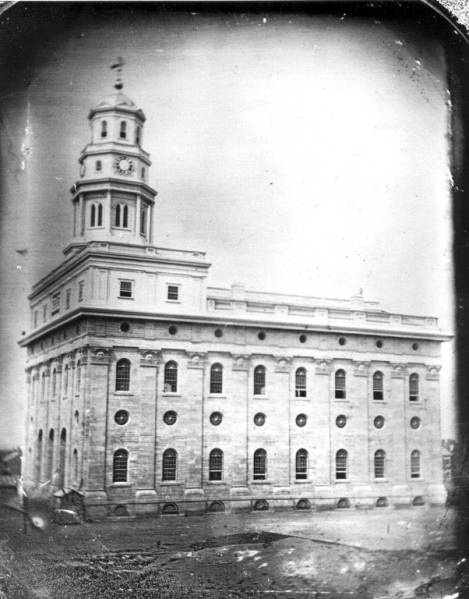
A daguerreotype of the original Nauvoo Illinois Temple as it looked in 1847. (Wikimedia Commons public domain image)
***
A new article by Richard O. Cowan appeared today in Interpreter: A Journal of Latter-day Saint Faith and Scholarship:
“Latter-day Houses of the Lord: Developments in Their Design and Function”
Abstract: This essay traces the modern-day usage and understanding of temples from the Kirtland Temple to Nauvoo and the Salt Lake Temple. Architecture was used to teach principles. While the Kirtland Temple was preparatory (think of the vision of Christ and the conference of keys by Abraham, Moses, Abraham, Elias, and finally Elijah), the Nauvoo Temple was dedicated to ritual usage. In 1879, the Church reduced temple usage to rituals, and thus assembly rooms are missing from later temples. Through his paper, Cowan shows how temples have changed according to revelation and how prophets have seen models in vision that then have been incorporated in the temples God’s people built.
[Editor’s Note: Part of our book chapter reprint series, this article is reprinted here as a service to the Latter-day Saint community. Original pagination and page numbers have necessarily changed, otherwise the reprint has the same content as the original.
See Richard O. Cowan, “Latter-day Houses of the Lord: Developments in Their Design and Function,” in Temple Insights: Proceedings of the Interpreter Matthew B. Brown Memorial Conference, “The Temple on Mount Zion,” 22 September 2012, ed. William J. Hamblin and David Rolph Seely (Orem, UT: The Interpreter Foundation; Salt Lake City: Eborn Books, 2014), 203–218. Further information at https://interpreterfoundation.org/books/temple-insights/.]
I simply must note that Professor Cowan chaired the Gospel Doctrine writing committee during the near-decade that I served as a member of it, and that he is one of the kindest and most pleasant people that I’ve ever known. But he is also one of the most remarkable people I’ve ever known: He has been blind since infancy, yet still managed, among many other things, to earn a doctorate in history from Stanford University, to teach for decades at the university level — he apparently ranks among the longest-serving BYU faculty ever and as the longest-serving member of the Church History Department — to chair our committee and coordinate its work, and even to lead tours. I’m in awe of him. (I must add, though, that his devoted wife, Dawn, has been a major contributor to his achievements. I hold her in awe, as well.)
***
And here are links to four articles that were published in a previous number of Interpreter:
Daniel C. Peterson, “The End from the Beginning”
Abstract: We are often at the dubious mercy of people, forces, and events that are beyond our control. But a trust in Providence — a word that is used relatively seldom these days for power that transcends even those people, forces, and events and that can, in the end, overrule them for our good — can nonetheless give us serene confidence. That such providential power exists, that it is personal and caring, is one of the fundamental messages of the scriptures and the prophets.
J. Ward Moody, “Times of Reckoning and Set Times in Abraham 3”
Abstract: The third chapter of Abraham considers two types of times regarding the moon, the earth, and the planets: “times of reckoning” and “set times.” A straightforward interpretation of these two times, if correct, sheds light on the cosmology known to Abraham. “Times of reckoning” may be understood as the times of celestial movements directly observed or reckoned by someone standing on the surface of the earth. These times would most likely be synodic, meaning the motion being considered is referenced to the sun, but they could also be sidereal, meaning referenced to the stars. Observed from the earth’s surface, times of reckoning would naturally have a geocentric perspective. “Set times,” on the other hand, may refer to times of motion established or set by God. These would be the orbital motions intrinsic to the bodies themselves. They would be sidereal and, with the exception of the moon — which would still be geocentric, would be from a heliocentric or even wider galactocentric point of view. With this interpretation, Abraham 3:5‒10 may be an account of God elevating Abraham’s knowledge of heavenly motions from that which is seen and measured by looking at the sky to that which actually exists in space. Such knowledge, likely possessed by the prophet Mormon as well, provided a natural means for Abraham to teach Pharaoh of the supremacy of God.
Abstract: In this article, the author attempts to shed light on practices alluded to in the Psalms that may have formed part of the ritual system and theology of Solomon’s original temple. He describes various aspects of the ritual system of pre-exilic Israel, including pilgrimage, questioning at the gates, epiphany, and royal rites. In the culmination of these rites, the king, who likely led the procession up to the temple, was enthorned on or beside the Lord’s own throne and transformed or “reborn” as a Son of God, appearing before the people in glorious fashion as the representative of Yahweh.
[Editor’s Note: Part of our book chapter reprint series, this article is reprinted here as a service to the LDS community. Original pagination and page numbers have necessarily changed, otherwise the reprint has the same content as the original.
See David J. Larsen, “Ascending into the Hill of the Lord: What the Psalms Can Tell Us About the Rituals of the First Temple,” in Ancient Temple Worship: Proceedings of The Expound Symposium 14 May 2011, ed. Matthew B. Brown, Jeffrey M. Bradshaw, Stephen D. Ricks, and John S. Thompson (Orem, UT: The Interpreter Foundation; Salt Lake City: Eborn Books, 2014), 171–88. Further information at https://interpreterfoundation.org/books/ancient-temple-worship/.]
Finally, here’s a review of a book that I read over this past weekend, and on which I’ve been drawing for my blog entries here over the past two days:
Craig L. Foster, “Offering Americans Religious and Political Salvation”
Review of Derek R. Sainsbury, Storming the Nation: The Unknown Contributions of Joseph Smith’s Political Missionaries (Provo, UT: Religious Studies Center, Brigham Young University, 2020). 400 pages. $27.99 (hardback).
Abstract: Derek Sainsbury’s book discusses Joseph Smith’s quest for the presidency of the United States of America and how more than six hundred missionaries were sent out across the United States not only to preach the gospel of Jesus Christ but also to electioneer for Joseph Smith and his political platform. The book offers a concise history of and fascinating information about the 1844 electioneering mission and the men and woman who offered fellow Americans both religious and political salvation.
Church of Jesus Christ of Latter-day Saints
Previous Post

September 5, 2021
Personal revelations following the murder of Joseph and Hyrum
Next Post
September 8, 2021 "Elder Holland: What They Heard is Not What He Said"
Browse Our Archives
Select a Category Uncategorized
Select a Month October 2026 September 2026 August 2026 July 2026 June 2026 May 2026 April 2026 March 2026 February 2026 January 2026 December 2025 November 2025 October 2025 September 2025 August 2025 July 2025 June 2025 May 2025 April 2025 March 2025 February 2025 January 2025 December 2024 November 2024 October 2024 September 2024 August 2024 July 2024 June 2024 May 2024 April 2024 March 2024 February 2024 January 2024 December 2023 November 2023 October 2023 September 2023 August 2023 July 2023 June 2023 May 2023 April 2023 March 2023 February 2023 January 2023 December 2022 November 2022 October 2022 September 2022 August 2022 July 2022 June 2022 May 2022 April 2022 March 2022 February 2022 January 2022 December 2021 November 2021 October 2021 September 2021 August 2021 July 2021 June 2021 May 2021 April 2021 March 2021 February 2021 January 2021 December 2020 November 2020 October 2020 September 2020 August 2020 July 2020 June 2020 May 2020 April 2020 March 2020 February 2020 January 2020 December 2019 November 2019 October 2019 September 2019 August 2019 July 2019 June 2019 May 2019 April 2019 March 2019 February 2019 January 2019 December 2018 November 2018 October 2018 September 2018 August 2018 July 2018 June 2018 May 2018 April 2018 March 2018 February 2018 January 2018 December 2017 November 2017 October 2017 September 2017 August 2017 July 2017 June 2017 May 2017 April 2017 March 2017 February 2017 January 2017 December 2016 November 2016 October 2016 September 2016 August 2016 July 2016 June 2016 May 2016 April 2016 March 2016 February 2016 January 2016 December 2015 November 2015 October 2015 September 2015 August 2015 July 2015 June 2015 May 2015 April 2015 March 2015 February 2015 January 2015 December 2014 November 2014 March 2014 August 2013 February 2012
Follow Us!
TAKE THE
Religious Wisdom Quiz
Cast your bread upon the waters and after many days you will find it again. What does this encourage?
Select your answer to see how you score.
Patience Fishing Generosity Sharing
Related posts from Sic et Non


Notes on Women, Priesthood, and General Conference

"The Book of Moses as a Temple Text"

TRENDING AT PATHEOS Latter-day Saint

57th Dove Awards Honor Dolly Parton, Crown New...
On gospel music’s biggest night, the 57th annual GMA Dove Awards honored...

The First Eucharistic Controversy: Christ’s Real Presence
For Catholics, the Eucharist is the source and summit of the Christian...

What a Stop Sign Can Teach Us About...
How to Make a Decision When You Can't Hear God Main point:...

Archdiocese Hosts Military Marriage Retreat in Germany
RASTATT, Germany — The transient military lifestyle, with its frequent deployments and...

Nearly every morning, I make the drive to Detroit with my high-school-age...

The Real AI Story Is Adoption Without Trust
Artificial intelligence has crossed a political threshold. It is no longer a...
view all Latter-day Saint blogs
Ad-Free & Subscriber Log-In Subscription Support
- About Us
- 2026 Calendar
- Videos
- Podcasts
- Library of World Religions
- Faith In Media Tracker
- Advertise With Us
- Write for Us
- Privacy Policy
- Terms of Service
- Do Not Sell My Data
- Contact Us
- Radiant Digital
- Manage Newsletter Subscriptions
- Unsubscribe From Notifications
- Sitemap
Copyright 2008-2026, Patheos. All rights reserved.
Subscription Support Ad-Free & Subscriber Log-In
Follow Patheos