
BuddhistCatholicContemplativeEvangelicalGeneral ChristianHinduJewishLatter-day SaintMuslimNew VisionsProgressive Christian
Beliefs
- Buddhist
- Catholic
- Contemplative
- Evangelical
- General Christian
- Hindu
- Jewish
- Latter-day Saint
- More Voices
- Muslim
- New Visions
- Pagan
- Progressive Christian
Topics
- Religion News
- Food and Religion
- Sports and Religion
- Religious Art
- Religious Music and Entertainment
- Religious Events
- History and Religion
- Style and Religion
- Politics and Religion
- Women in Religion
- Recreation Outdoors and Religion
- Business Finance and Religion
- Careers Workplace and Religion
- Education and Religion
- Family Parenting and Religion
- Health Fitness and Religion
- Home and Religion
- Relationships and Religion
- Technology and Religion
- Travel and Religion
Columnists
- Buddhist Columnists
- Business Finance and Religion Columnists
- Careers Workplace and Religion Columnists
- Catholic Columnists
- Contemplative Columnists
- Education and Religion Columnists
- Evangelists Columnists
- Family Parenting and Religion Columnists
- General Christian Columnists
- Health Fitness and Religion Columnists
- Hindu Columnists
- History and Religion Columnists
- Home and Religion Columnists
- Jewish Columnists
- More Voices Columnists
- Latter Day Columnists
- Muslim Columnists
- New Visions Columnists
- Nonreligious Columnists
- Pagan Columnists
- Politics and Religion Columnists
- Progressive Columnists
- Recreation Outdoors and Religion Columnists
- Relationships and Religion Columnists
- Religion News Columnists
- Religious Art Columnists
- Religious Events Columnists
- Religious Music and Entertainment Columnists
- Sports and Religion Columnists
- Style and Religion Columnists
- Technology and Religion Columnists
- Travel and Religion Columnists
- Women in Religion Columnists
Resource Library
- 2026 Calendar
- Library of World Religions
- The 100 Most Holy Places on Earth
- Patheos Answers
- Podcasts
- Videos
- Faith Leaders Database
- Anglican Episcopalian
- Bahai
- Baptist
- Buddhism
- Christianity
- Confucianism
- Eastern Orthodoxy
- Hinduism
- Holiness and Pentecostal
- ISKCON
- Islam
- Judaism
- Lutheran
- Methodist
- The Church of Jesus Christ of Latter-day Saints
- New Age
- Paganism
- Presbytarian and Reformed
- Protestantism
- Religion Behind the Scenes
- Roman Catholic
- Scientology
- Shia Islam
- Sikhism
- Sufism
- Sunni Islam
- Taoism
- Zen
- See all religions
Research Tools
 Ad-Free & Subscriber Log-In Subscription Support
Ad-Free & Subscriber Log-In Subscription Support
Follow Patheos 

- Trending:
- Forgiveness
- |
- Marriage
- |
- Consciousness
- |
- Death Penalty
- |
- Election
- |
- Halloween

- Home
- Latter-day Saint
- Choosing the Kingdom First
Choosing the Kingdom First
Last updated on: September 9, 2021 at 12:03 am by Dan Peterson
Choosing the Kingdom First 2021-09-09T00:03:36-06:00 Dan Peterson
Patheos Explore the world's faith through different perspectives on religion and spirituality! Patheos has the views of the prevalent religions and spiritualities of the world.
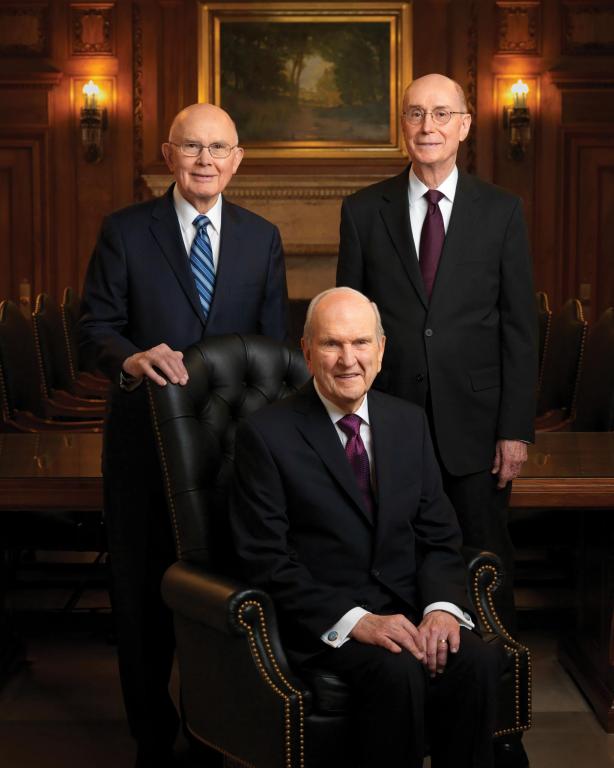
The First Presidency of the Church of Jesus Christ of Latter-day Saints: President Russell M. Nelson, center; first counselor, President Dallin H. Oaks, left; second counselor, President Henry B. Eyring, right. All three are sustained by faithful members of the Church as prophets, seers, and revelators.
***
I return to a subject that I raised in my immediately previous blog entry — namely, the seemingly increasing tendency for some members of the Church to put their political ideologies ahead of their loyalty to the prophets and apostles who lead the Church of Jesus Christ of Latter-day Saints. I spoke in the previous entry about the First Presidency statement on vaccination against COVID-19 and about Elder Holland’s exhortation to the faculty, staff, and administration to be loyal to the teachings, claims, and standards of the Church. But the question of Afghan refugees is beginning to bubble up, too.
Here, unchanged, is a blog entry that I posted back in March 2017:
“If you have not chosen the Kingdom of God first, it will in the end make no difference what you have chosen instead.”
William Law (1686-1761)
I posted something earlier today about the Church’s efforts to aid refugees. I’ve been saddened (though not surprised) to see some members of the Church, responding to that post (but also on previous occasions and in earlier conversations), come out in frank opposition to those efforts, and to the First Presidency itself.
I’ve been struck, of late, by the number of religiously-conservative Latter-day Saints — people who often deride politically liberal Latter-day Saints for being insufficiently Mormon — who have been openly critical of the men they’ve sustained as apostles and prophets because those Church leaders have gone against, or seem to have gone against, the political ideology favored by these members. I’ll be straightforward: Some Latter-day Saints who bristle at even the slightest criticism of Mr. Donald J. Trump are witheringly critical of Church leadership when it seems to contradict Trumpism.
I’m reminded of a very hardcore Latter-day Saint — a young-earth creationist and scriptural literalist who considered hot chocolate a violation of the Word of Wisdom — who was my senior home teaching companion for a time when I was a very young holder of the Aaronic Priesthood in southern California. One night, following a visit to a semi-active family, he confided to me that President Hugh B. Brown, who was at the time serving as first counselor to President David O. McKay, was a Communist agent determined to destroy the Church. I can still remember where I was standing when he told me this. I was shocked. Stunned. Not at what I had learned about President Brown, but at what I had just discovered about my home teaching companion.
For a period of about a year or so, I occasionally received phone calls from an elderly self-identified high priest in the Church who would rail against me in the strongest terms for my sympathetic attitude toward Muhammad and Islam. He told me that, in contrast to my support for “that mass-murdering pedophile and false prophet,” he stood with the apostles and prophets of the Church of Jesus Christ of Latter-day Saints. One evening, I called his attention to the First Presidency’s 1978 statement on, among others, Muhammad. He listened as I summarized what they had said, and then informed me that President Spencer W. Kimball and his counselors had been deceived by Satan. I found that, honestly, a rather odd way of standing with the apostles and prophets of the Church. I, whom he had branded as favoring Muhammad over the leaders of Mormonism, would never have said such a thing about them. Ever. Worlds without end. Never.
I can’t help thinking, today, of a passage in President Ezra Taft Benson’s famous 1981 speech “Fourteen Fundamentals in Following the Prophet”:
Seventh: The prophet tells us what we need to know, not always what we want to know.
“Thou hast declared unto us hard things, more than we are able to bear,” complained Nephi’s brethren. But Nephi answered by saying, “The guilty taketh the truth to be hard, for it cutteth them to the very center” (1 Nephi 16:1, 3). Or, to put it in another prophet’s words, “Hit pigeons flutter.”
Said President Harold B. Lee:
“You may not like what comes from the authority of the Church. It may contradict your political views. It may contradict your social views. It may interfere with some of your social life. … Your safety and ours depends upon whether or not we follow. … Let’s keep our eye on the President of the Church.” [In Conference Report, October 1970, p. 152–153]
But it is the living prophet who really upsets the world. “Even in the Church,” said President Kimball, “many are prone to garnish the sepulchres of yesterday’s prophets and mentally stone the living ones” (Instructor, 95:257).
Why? Because the living prophet gets at what we need to know now, and the world prefers that prophets either be dead or mind their own business. Some so-called experts of political science want the prophet to keep still on politics. Some would-be authorities on evolution want the prophet to keep still on evolution. And so the list goes on and on.
How we respond to the words of a living prophet when he tells us what we need to know, but would rather not hear, is a test of our faithfulness.
Said President Marion G. Romney, “It is an easy thing to believe in the dead prophets.” And then he gives this illustration:
“One day when President Grant was living, I sat in my office across the street following a general conference. A man came over to see me, an elderly man. He was very upset about what had been said in this conference by some of the Brethren, including myself. I could tell from his speech that he came from a foreign land. After I had quieted him enough so he would listen, I said, ‘Why did you come to America?’ ‘I am here because a prophet of God told me to come.’ ‘Who was the prophet,’ I continued. ‘Wilford Woodruff.’ ‘Do you believe Wilford Woodruff was a prophet of God?’ ‘Yes, I do.’ ‘Do you believe that President Joseph F. Smith was a prophet of God?’ ‘Yes, sir.’
“Then came the sixty-four dollar question. ‘Do you believe that Heber J. Grant is a prophet of God?’ His answer, ‘I think he ought to keep his mouth shut about old age assistance.’
“Now I tell you that a man in his position is on the way to apostasy. He is forfeiting his chances for eternal life. So is everyone who cannot follow the living Prophet of God.” [In Conference Report, April 1953, p. 125]
I’m not accusing any particular person of apostasy. But I do think that President Benson’s warning is worth keeping very much in mind. I’m convinced that we all — myself included — need to reflect continually on where we stand with respect to those whom we claim to revere as prophets and apostles.
Are we free to disagree with Church leaders? Yes. Of course. I have my own opinions, myself. But there’s abundant scriptural precedent for dissenting from the Lord’s prophets. The Book of Mormon, for example, is chock full of examples of such rejection. Scripturally, though, it doesn’t often end well.
And my concern is especially strong in this particular matter, where some Church members actually seem to be angry at being reminded of the Savior’s teaching at Matthew 25:31-46. In such matters, I should think that those who are angered by that teaching really, desperately, need to do some serious introspection.
Church of Jesus Christ of Latter-day Saints
Previous Post

September 8, 2021
"Elder Holland: What They Heard is Not What He Said"
Next Post
September 9, 2021 Temples, all the way down
Browse Our Archives
Select a Category Uncategorized
Select a Month October 2026 September 2026 August 2026 July 2026 June 2026 May 2026 April 2026 March 2026 February 2026 January 2026 December 2025 November 2025 October 2025 September 2025 August 2025 July 2025 June 2025 May 2025 April 2025 March 2025 February 2025 January 2025 December 2024 November 2024 October 2024 September 2024 August 2024 July 2024 June 2024 May 2024 April 2024 March 2024 February 2024 January 2024 December 2023 November 2023 October 2023 September 2023 August 2023 July 2023 June 2023 May 2023 April 2023 March 2023 February 2023 January 2023 December 2022 November 2022 October 2022 September 2022 August 2022 July 2022 June 2022 May 2022 April 2022 March 2022 February 2022 January 2022 December 2021 November 2021 October 2021 September 2021 August 2021 July 2021 June 2021 May 2021 April 2021 March 2021 February 2021 January 2021 December 2020 November 2020 October 2020 September 2020 August 2020 July 2020 June 2020 May 2020 April 2020 March 2020 February 2020 January 2020 December 2019 November 2019 October 2019 September 2019 August 2019 July 2019 June 2019 May 2019 April 2019 March 2019 February 2019 January 2019 December 2018 November 2018 October 2018 September 2018 August 2018 July 2018 June 2018 May 2018 April 2018 March 2018 February 2018 January 2018 December 2017 November 2017 October 2017 September 2017 August 2017 July 2017 June 2017 May 2017 April 2017 March 2017 February 2017 January 2017 December 2016 November 2016 October 2016 September 2016 August 2016 July 2016 June 2016 May 2016 April 2016 March 2016 February 2016 January 2016 December 2015 November 2015 October 2015 September 2015 August 2015 July 2015 June 2015 May 2015 April 2015 March 2015 February 2015 January 2015 December 2014 November 2014 March 2014 August 2013 February 2012
Follow Us!
TAKE THE
Religious Wisdom Quiz
I stood on a wooden platform and read the Law from daybreak till noon, and the people wept. Who am I?
Select your answer to see how you score.
Ezra Joshua Nehemiah Moses
Related posts from Sic et Non


Notes on Women, Priesthood, and General Conference

"The Book of Moses as a Temple Text"

TRENDING AT PATHEOS Latter-day Saint

Top Three Anti-Catholic Lies About Catholicism
This is my initial transcript for the video, "THE 3 WORST...

Pope Leo Celebrates Mass for Nurses & Docs...
I don't have any idea how he did it, but Pope Leo...

The Sermon on the Mount, Part I: Matthew...
The Sermon on the Mount, Part I (Matthew 4:12-5:12) St. Matthew moves...

What's up from Crossway: Reviewing some of their latest A few weeks...

Janie Learns the Way of the Cross: A...
Teaching children about Jesus' Passion can be challenging. Many parents and educators...

Looking For Good Catholic Writing - October 2026
He alone extends the heavens, and he walks upon the waves of...
view all Latter-day Saint blogs
Ad-Free & Subscriber Log-In Subscription Support
- About Us
- 2026 Calendar
- Videos
- Podcasts
- Library of World Religions
- Faith In Media Tracker
- Advertise With Us
- Write for Us
- Privacy Policy
- Terms of Service
- Do Not Sell My Data
- Contact Us
- Radiant Digital
- Manage Newsletter Subscriptions
- Unsubscribe From Notifications
- Sitemap
Copyright 2008-2026, Patheos. All rights reserved.
Subscription Support Ad-Free & Subscriber Log-In
Follow Patheos