
BuddhistCatholicContemplativeEvangelicalGeneral ChristianHinduJewishLatter-day SaintMuslimNew VisionsProgressive Christian
Beliefs
- Buddhist
- Catholic
- Contemplative
- Evangelical
- General Christian
- Hindu
- Jewish
- Latter-day Saint
- More Voices
- Muslim
- New Visions
- Pagan
- Progressive Christian
Topics
- Religion News
- Food and Religion
- Sports and Religion
- Religious Art
- Religious Music and Entertainment
- Religious Events
- History and Religion
- Style and Religion
- Politics and Religion
- Women in Religion
- Recreation Outdoors and Religion
- Business Finance and Religion
- Careers Workplace and Religion
- Education and Religion
- Family Parenting and Religion
- Health Fitness and Religion
- Home and Religion
- Relationships and Religion
- Technology and Religion
- Travel and Religion
Columnists
- Buddhist Columnists
- Business Finance and Religion Columnists
- Careers Workplace and Religion Columnists
- Catholic Columnists
- Contemplative Columnists
- Education and Religion Columnists
- Evangelists Columnists
- Family Parenting and Religion Columnists
- General Christian Columnists
- Health Fitness and Religion Columnists
- Hindu Columnists
- History and Religion Columnists
- Home and Religion Columnists
- Jewish Columnists
- More Voices Columnists
- Latter Day Columnists
- Muslim Columnists
- New Visions Columnists
- Nonreligious Columnists
- Pagan Columnists
- Politics and Religion Columnists
- Progressive Columnists
- Recreation Outdoors and Religion Columnists
- Relationships and Religion Columnists
- Religion News Columnists
- Religious Art Columnists
- Religious Events Columnists
- Religious Music and Entertainment Columnists
- Sports and Religion Columnists
- Style and Religion Columnists
- Technology and Religion Columnists
- Travel and Religion Columnists
- Women in Religion Columnists
Resource Library
- 2026 Calendar
- Library of World Religions
- The 100 Most Holy Places on Earth
- Patheos Answers
- Podcasts
- Videos
- Faith Leaders Database
- Anglican Episcopalian
- Bahai
- Baptist
- Buddhism
- Christianity
- Confucianism
- Eastern Orthodoxy
- Hinduism
- Holiness and Pentecostal
- ISKCON
- Islam
- Judaism
- Lutheran
- Methodist
- The Church of Jesus Christ of Latter-day Saints
- New Age
- Paganism
- Presbytarian and Reformed
- Protestantism
- Religion Behind the Scenes
- Roman Catholic
- Scientology
- Shia Islam
- Sikhism
- Sufism
- Sunni Islam
- Taoism
- Zen
- See all religions
Research Tools
 Ad-Free & Subscriber Log-In Subscription Support
Ad-Free & Subscriber Log-In Subscription Support
Follow Patheos 

- Trending:
- Forgiveness
- |
- Marriage
- |
- Consciousness
- |
- Death Penalty
- |
- Election
- |
- Halloween

- Home
- Latter-day Saint
- “Could a Loving God Allow Such Suffering?”
“Could a Loving God Allow Such Suffering?”
Last updated on: August 21, 2021 at 4:17 pm by Dan Peterson
“Could a Loving God Allow Such Suffering?” 2021-08-21T16:17:14-06:00 Dan Peterson
Patheos Explore the world's faith through different perspectives on religion and spirituality! Patheos has the views of the prevalent religions and spiritualities of the world.
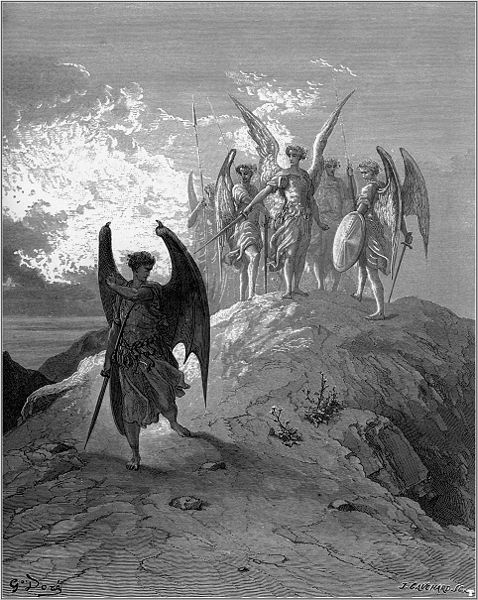
Gustave Doré, “The Expulsion of Lucifer”
An illustration for Milton’s “Paradise Lost”
(Wikimedia Commons public domain image)
This article of mine was published yesterday, I believe, in Meridian Magazine. It was actually inspired by certain responses to a blog post here.
“Could a Loving God Allow Such Suffering?”
And this little essay, not by me, went up on the website of the Interpreter Foundation earlier today:
***
And here, as has lately been my habit, are some links to articles that were published in a prior issue of Interpreter: A Journal of Latter-day Saint Faith and Scholarship:
Abstract: The toponym Onidah*, attested as the name of a hill in Alma 32:4, most plausibly derives from Hebrew* ʿŏnî /ʿōnî/ʿônî (ʿonyî, “my affliction”) + yādaʿ/yēdaʿ (“he knew,” “he knows”) — i.e., “he has acknowledged my affliction” or “he knows my affliction.” This etymology finds support in the context of the Zoramite narrative in which it occurs. In view of the pejorative lexical associations of the Rameumptom, the “high” and “holy stand,” with Hebrew rām (< rwm*, “high”) and haughtiness, arrogance, and pride, we see Mormon using the Rameumptom, the “high” platform for Zoramite self-exalting worship, with Onidah, the hill from which Alma and Amulek taught the Zoramite poor and humble. The latter name and Alma’s teaching from that location constituted a sign that the Lord “knew” their “affliction.” Alma devotes a significant part of his message not only extolling the spiritual value of their state of “affliction” and humiliation or compelled “humility” (*ʿŏnî Exodus 3:7, 17), but teaching them how to “plant” the “word” (even Jesus Christ himself) in their hearts through prayer — the word that would grow up into a “perfect knowledge” of God — experientially “knowing” God (Alma 32:16‒36) and being known by him (cf. Alma 7:12).
Clifford P. Jones, “The Prophets Who Wrote the Book of Omni”
Abstract: The brief accounts written by Omni, Amaron, Chemish, Abinadom, and Amaleki, taken alone, don’t always inspire confidence in their righteousness. Nevertheless, when the specific words used by these men and all relevant context are taken into consideration, it’s reasonable to conclude that each of these authors of the book of Omni was a prophet of God.
Donald W. Parry, “An Approach to Isaiah Studies”
Review of Joseph M. Spencer, The Vision of All: Twenty-Five Lectures on Isaiah in Nephi’s Record (Salt Lake City: Greg Kofford Books, 2016). 318 pages. $59.95 (hardback); $29.95 paperback.
Abstract: This review makes a case, briefly, for the unmistakable presence of Jesus Christ in Isaiah’s text, which case is based on a corpus linguistic-based description of the Hebrew Bible, equivalent designations of deific names, self-identification declarations by the Lord, and more. And, importantly, one can never set aside the multiple teachings and testimonies of our modern prophets and apostles regarding Isaiah’s prophecies of Jesus Christ. Moreover, in my view, a knowledge of biblical Hebrew helps us to penetrate the very depths and heights of Isaiah’s text.
Jim Bennett, ““Somebody Wrote It:” The Book of Mormon’s Missionary Message to a 21st-Century World”
Abstract: Nathan Oman’s “Welding Another Link in Wonder’s Chain: The Task of Latter-day Saint Intellectuals in the Church’s Third Century” wisely called for “new language in which to celebrate the Restoration.” That new language can be found in understanding the power of the Book of Mormon, which is the tangible miracle at the heart of the Restoration that defies the critics. My father, Senator Robert F. Bennett, devoted his final years to arguing that the Book of Mormon’s existence is a stumbling block to those who try to dismiss it as an obvious fraud. Those who scoff at the Book of Mormon have yet to come up with a plausible secular account of its existence, and this allows the Book of Mormon to endure as the centerpiece of our missionary efforts. But rather than simply use the Book of Mormon to attempt to answer questions people are no longer asking, we need to create a missionary message that uses this sacred scripture to connect people, directly and personally, to Jesus Christ.
Noel B. Reynolds, “Rethinking Alma 36”
Abstract: While Alma 36 has long been one of the most admired examples of classical Hebrew chiasmus in the Book of Mormon, critiques in the last two decades have questioned whether, in fact, it really meets the requirements of classical biblical chiasms. The principal objections have pointed to the large sections of the chapter that are not easily included in the chiasm as outlined by John W. Welch and other proponents. Until now, this debate has not taken note of dramatic new developments in the analysis of Hebrew rhetoric over the last fifty years. The following essay turns to the discoveries made in this new approach to Hebrew rhetoric and shows that when the new “levels analysis” is incorporated into a study of Alma 36, the entire text does have a role to play in the extended chiastic structure of the chapter.
[Editor’s Note: An abbreviated version of this paper was presented at the 2019 Sperry Symposium and was included in that shortened form in the symposium volume. See Give Ear to My Words: Text and Context of Alma 36–42, edited by Kerry M. Hull, Nicholas J. Frederick, and Hank R. Smith, Religious Studies Center, 2019, 451–72. This complete and updated version is herein published by Interpreter with permission of the RSC.]
***
I’m doing a virtual fireside this evening for an online group that is based on Bainbridge Island, Washington, but that also includes members scattered across multiple other states. It’s amazing what technology has enabled us to do within just the past few years that we wouldn’t have imagined a decade or two back. It reminds me, in fact, of the article that I published in Meridian Magazine back on 6 July of this year:
“Preaching the Gospel Where We Cannot Go”
Perhaps you missed it, or you’ve forgotten it, or your conscious mind has repressed it
Church of Jesus Christ of Latter-day Saints
Previous Post

August 21, 2021
"Are Afghan refugees fleeing the Taliban regime headed to Utah?"
Next Post
August 23, 2021 Two sketches toward an autobiography
Browse Our Archives
Select a Category Uncategorized
Select a Month October 2026 September 2026 August 2026 July 2026 June 2026 May 2026 April 2026 March 2026 February 2026 January 2026 December 2025 November 2025 October 2025 September 2025 August 2025 July 2025 June 2025 May 2025 April 2025 March 2025 February 2025 January 2025 December 2024 November 2024 October 2024 September 2024 August 2024 July 2024 June 2024 May 2024 April 2024 March 2024 February 2024 January 2024 December 2023 November 2023 October 2023 September 2023 August 2023 July 2023 June 2023 May 2023 April 2023 March 2023 February 2023 January 2023 December 2022 November 2022 October 2022 September 2022 August 2022 July 2022 June 2022 May 2022 April 2022 March 2022 February 2022 January 2022 December 2021 November 2021 October 2021 September 2021 August 2021 July 2021 June 2021 May 2021 April 2021 March 2021 February 2021 January 2021 December 2020 November 2020 October 2020 September 2020 August 2020 July 2020 June 2020 May 2020 April 2020 March 2020 February 2020 January 2020 December 2019 November 2019 October 2019 September 2019 August 2019 July 2019 June 2019 May 2019 April 2019 March 2019 February 2019 January 2019 December 2018 November 2018 October 2018 September 2018 August 2018 July 2018 June 2018 May 2018 April 2018 March 2018 February 2018 January 2018 December 2017 November 2017 October 2017 September 2017 August 2017 July 2017 June 2017 May 2017 April 2017 March 2017 February 2017 January 2017 December 2016 November 2016 October 2016 September 2016 August 2016 July 2016 June 2016 May 2016 April 2016 March 2016 February 2016 January 2016 December 2015 November 2015 October 2015 September 2015 August 2015 July 2015 June 2015 May 2015 April 2015 March 2015 February 2015 January 2015 December 2014 November 2014 March 2014 August 2013 February 2012
Follow Us!
TAKE THE
Religious Wisdom Quiz
According to Romans 3:23, who has sinned?
Select your answer to see how you score.
Only those who break the Ten Commandments Everyone Those who do not accept Christ The Gentiles
Related posts from Sic et Non


Notes on Women, Priesthood, and General Conference

"The Book of Moses as a Temple Text"

TRENDING AT PATHEOS Latter-day Saint

The Sermon on the Mount, Part I: Matthew...
The Sermon on the Mount, Part I (Matthew 4:12-5:12) St. Matthew moves...

What's up from Crossway: Reviewing some of their latest A few weeks...

Janie Learns the Way of the Cross: A...
Teaching children about Jesus' Passion can be challenging. Many parents and educators...

Looking For Good Catholic Writing - October 2026
He alone extends the heavens, and he walks upon the waves of...

In "Irreplaceable," our book on vocation and technology, Trevor Sutton and I...

I was strolling through the top floor of the brand new Parthenon...
view all Latter-day Saint blogs
Ad-Free & Subscriber Log-In Subscription Support
- About Us
- 2026 Calendar
- Videos
- Podcasts
- Library of World Religions
- Faith In Media Tracker
- Advertise With Us
- Write for Us
- Privacy Policy
- Terms of Service
- Do Not Sell My Data
- Contact Us
- Radiant Digital
- Manage Newsletter Subscriptions
- Unsubscribe From Notifications
- Sitemap
Copyright 2008-2026, Patheos. All rights reserved.
Subscription Support Ad-Free & Subscriber Log-In
Follow Patheos