
BuddhistCatholicContemplativeEvangelicalGeneral ChristianHinduJewishLatter-day SaintMuslimNew VisionsProgressive Christian
Beliefs
- Buddhist
- Catholic
- Contemplative
- Evangelical
- General Christian
- Hindu
- Jewish
- Latter-day Saint
- More Voices
- Muslim
- New Visions
- Pagan
- Progressive Christian
Topics
- Religion News
- Food and Religion
- Sports and Religion
- Religious Art
- Religious Music and Entertainment
- Religious Events
- History and Religion
- Style and Religion
- Politics and Religion
- Women in Religion
- Recreation Outdoors and Religion
- Business Finance and Religion
- Careers Workplace and Religion
- Education and Religion
- Family Parenting and Religion
- Health Fitness and Religion
- Home and Religion
- Relationships and Religion
- Technology and Religion
- Travel and Religion
Columnists
- Buddhist Columnists
- Business Finance and Religion Columnists
- Careers Workplace and Religion Columnists
- Catholic Columnists
- Contemplative Columnists
- Education and Religion Columnists
- Evangelists Columnists
- Family Parenting and Religion Columnists
- General Christian Columnists
- Health Fitness and Religion Columnists
- Hindu Columnists
- History and Religion Columnists
- Home and Religion Columnists
- Jewish Columnists
- More Voices Columnists
- Latter Day Columnists
- Muslim Columnists
- New Visions Columnists
- Nonreligious Columnists
- Pagan Columnists
- Politics and Religion Columnists
- Progressive Columnists
- Recreation Outdoors and Religion Columnists
- Relationships and Religion Columnists
- Religion News Columnists
- Religious Art Columnists
- Religious Events Columnists
- Religious Music and Entertainment Columnists
- Sports and Religion Columnists
- Style and Religion Columnists
- Technology and Religion Columnists
- Travel and Religion Columnists
- Women in Religion Columnists
Resource Library
- 2026 Calendar
- Library of World Religions
- The 100 Most Holy Places on Earth
- Patheos Answers
- Podcasts
- Videos
- Faith Leaders Database
- Anglican Episcopalian
- Bahai
- Baptist
- Buddhism
- Christianity
- Confucianism
- Eastern Orthodoxy
- Hinduism
- Holiness and Pentecostal
- ISKCON
- Islam
- Judaism
- Lutheran
- Methodist
- The Church of Jesus Christ of Latter-day Saints
- New Age
- Paganism
- Presbytarian and Reformed
- Protestantism
- Religion Behind the Scenes
- Roman Catholic
- Scientology
- Shia Islam
- Sikhism
- Sufism
- Sunni Islam
- Taoism
- Zen
- See all religions
Research Tools
 Ad-Free & Subscriber Log-In Subscription Support
Ad-Free & Subscriber Log-In Subscription Support
Follow Patheos 

- Trending:
- Forgiveness
- |
- Marriage
- |
- Consciousness
- |
- Death Penalty
- |
- Election
- |
- Halloween

- Home
- Latter-day Saint
- Abraham, Sodom, the Māori, and Other Topics for a Weekend
Abraham, Sodom, the Māori, and Other Topics for a Weekend
Last updated on: August 17, 2021 at 9:02 pm by Dan Peterson
Abraham, Sodom, the Māori, and Other Topics for a Weekend 2021-08-17T21:02:14-06:00 Dan Peterson
Patheos Explore the world's faith through different perspectives on religion and spirituality! Patheos has the views of the prevalent religions and spiritualities of the world.
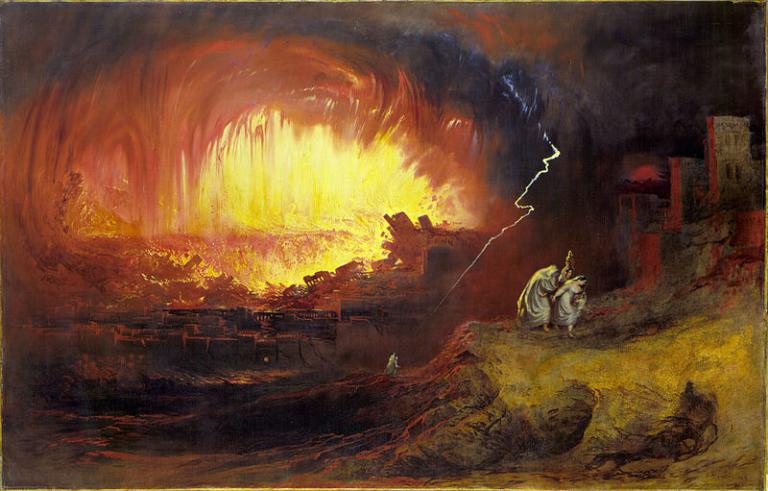
“The Destruction of Sodom and Gomorrah,” by John Martin (1852)
Wikimedia Commons public domain image
***
A version of the text of Stephen Smoot’s Thursday presentation at the 2021 FAIR Conference has already been published online in Public Square Magazine:
***
Carl R. Trueman, “Dogma Drives the Christian Life”
Carl Trueman, an ordained Presbyterian minister and a noted academic, delivered a very good address at the just-concluded 2021 FAIR Conference.
***
Here, to help you survive the inevitable letdown after the FAIR Conference, are a few links to articles that have been previously published in Interpreter: A Journal of Latter-day Saint Faith and Scholarship:
Louis C. Midgley, “The Māori Latter-day Saint Historical Narrative:Additions and Amendments”
Abstract: Selwyn Kātene has again assembled twelve essays written by the descendants of famous Māori Latter-day Saints. This volume flows from a revival of interest in the ground and content of the faith of early Māori Saints that began in the late 1990s. In various ways the essays in this volume add to and amend what has previously been known about what began unexpectedly on Christmas Day in 1882, when the first group of Māori joined the Church of Jesus Christ. Not only did the Māori have Seers who opened the way, some of those elite Māori men, who had been initiated into Māori esoteric knowledge of divine things, also found that their temple endowment fit rather snugly with their previous initiation ceremonies. Unlike other Christian missionaries, Latter-day Saint missionaries did not see the Māori as primitive heathens, and Māori saw in the restored gospel crucial elements of their own deeper understanding of divine things. Latter-day Saint missionaries were seeking to liberate Māori from the soul-destroying vices brought to them or enhanced by British colonization, while relishing the most noble elements in the Māori world.
Review of Selwyn Kātene, ed., By Their Fruits You Will Know Them: Early Maori Leaders in the Mormon Church, vol. 2 (Wellington, New Zealand: Steele Roberts Publishers, 2017). 295 pp. N.Z. $39.99 (hardback).
Abstract. When discussions arise about the relationship between Church members and the prophets who lead them, certain episodes in Church history often appear. These include the Lord’s words about “all patience and faith” in Doctrine and Covenants 21:4–5, as well as incidents involving George Albert Smith and Hugh B. Brown. On the surface, such episodes might seem to raise doubts about the reliability of the presiding Brethren in representing the Lord or to minimize the importance of Church orthodoxy itself. A closer look shows such interpretations to be a mistake, however. When we clarify the record, we see that these episodes do not support the conclusions that are sometimes drawn from them. Examining these incidents also permits making a point about so-called “blind obedience.”
Taylor Halverson, “The Lives of Abraham: Seeing Abraham through the Eyes of Second-Temple Jews”
Abstract: During the Second-Temple Period, Jews remembered and reimagined the story of Abraham to address their own immediate historical and cultural concerns. By exploring these reimaginations, we learn more about the faith and interests of later Jews who looked to their forefather for inspiration and guidance on how to live in a world of change, opportunity, and challenge. Second Temple Jewish writers included in this article are Artapanus, the author of Jubilees; Pseudo-Eupolemus, the author of Genesis Apocryphon*; Philo, and Josephus. Abraham was resurrected in these texts, but with the body and soul of the later author, Josephus; these authors live on in the guise of Abraham.*
Abstract: Elaine Cannon, who was general president of the Young Women some four decades ago, had an interesting conversation with President Spencer W. Kimball in 1978. According to Sister Cannon’s firsthand account, President Kimball revealed important insight into how he thought about himself as the prophet as well as how he thought leaders should talk to the general membership about that topic. Sister Cannon’s report is thus a valuable part of the historical record regarding both Spencer W. Kimball and prophets generally.
Abstract: A careful examination of the Abrahamic covenant, as contained in Leviticus 26, and the covenant established with the Lehites during their exodus to the New World, found in 1 Nephi 2, shows deliberate similarities. These similarities are important to understand, as the role of covenant is central in both ancient Israelite practice and current Latter-day Saint theology.
Abstract: Moses 1:41 echoes or plays on the etymological meaning of the name Joseph — “may he [Yahweh] add,” as the Lord foretells to Moses the raising up of a future figure through whom the Lord’s words, after having been “taken” (away) from the book that Moses would write, “shall be had again among the children of men.” Moses 1:41 anticipates and employs language reminiscent of the so-called biblical canon formulas, possible additions to biblical texts meant to ensure the texts’ stability by warning against “adding” or “diminishing” (i.e., “taking away”) from them (e.g., Deuteronomy 4:2; 5:22 [MT 5:18]; 12:32 [MT 13:1]; cf. Revelation 22:18– 19). This article presupposes that the vision of Moses presents restored text that was at some point recorded in Hebrew.
Morgan Deane, “A Nourishing and Accessible Read”
Review of Michaela Stephens, To Defend Them By Stratagem: Fortify Yourself with Book of Mormon War Tactics (Gilbert, AZ: Lion’s Whelp Publications, 2018). 246 pp. $12.99 (paperback).
Abstract: Sometimes it is easy to overlook, disregard, or discount the “war chapters” in the Book of Mormon. Michaela Stephens’ new book about these chapters deserves wider attention, as it is an excellent study resource that provides valuable devotional and academic insights while remaining accessible to lay readers.
***
“Thou shalt not kill,” says the Lord at Exodus 20:13.
So get your anti-COVID vaccination!
Church of Jesus Christ of Latter-day Saints
Previous Post

August 6, 2021
"Alma's Reality"
Next Post
August 8, 2021 Seething Rage and Quiet Satisfaction
Browse Our Archives
Select a Category Uncategorized
Select a Month October 2026 September 2026 August 2026 July 2026 June 2026 May 2026 April 2026 March 2026 February 2026 January 2026 December 2025 November 2025 October 2025 September 2025 August 2025 July 2025 June 2025 May 2025 April 2025 March 2025 February 2025 January 2025 December 2024 November 2024 October 2024 September 2024 August 2024 July 2024 June 2024 May 2024 April 2024 March 2024 February 2024 January 2024 December 2023 November 2023 October 2023 September 2023 August 2023 July 2023 June 2023 May 2023 April 2023 March 2023 February 2023 January 2023 December 2022 November 2022 October 2022 September 2022 August 2022 July 2022 June 2022 May 2022 April 2022 March 2022 February 2022 January 2022 December 2021 November 2021 October 2021 September 2021 August 2021 July 2021 June 2021 May 2021 April 2021 March 2021 February 2021 January 2021 December 2020 November 2020 October 2020 September 2020 August 2020 July 2020 June 2020 May 2020 April 2020 March 2020 February 2020 January 2020 December 2019 November 2019 October 2019 September 2019 August 2019 July 2019 June 2019 May 2019 April 2019 March 2019 February 2019 January 2019 December 2018 November 2018 October 2018 September 2018 August 2018 July 2018 June 2018 May 2018 April 2018 March 2018 February 2018 January 2018 December 2017 November 2017 October 2017 September 2017 August 2017 July 2017 June 2017 May 2017 April 2017 March 2017 February 2017 January 2017 December 2016 November 2016 October 2016 September 2016 August 2016 July 2016 June 2016 May 2016 April 2016 March 2016 February 2016 January 2016 December 2015 November 2015 October 2015 September 2015 August 2015 July 2015 June 2015 May 2015 April 2015 March 2015 February 2015 January 2015 December 2014 November 2014 March 2014 August 2013 February 2012
Follow Us!
TAKE THE
Religious Wisdom Quiz
Which prophet raised a dead boy to life for the Shunammite woman?
Select your answer to see how you score.
Elisha Elijah Isaiah Samuel
Related posts from Sic et Non



"The Book of Moses as a Temple Text"

TRENDING AT PATHEOS Latter-day Saint

Methodist Central Hall and Westminster Abbey
Situated on the same square is Methodist Central Hall and Westminster Abbey. ...

57th Dove Awards Honor Dolly Parton, Crown New...
On gospel music’s biggest night, the 57th annual GMA Dove Awards honored...

The First Eucharistic Controversy: Christ’s Real Presence
For Catholics, the Eucharist is the source and summit of the Christian...

What a Stop Sign Can Teach Us About...
How to Make a Decision When You Can't Hear God Main point:...

Archdiocese Hosts Military Marriage Retreat in Germany
RASTATT, Germany — The transient military lifestyle, with its frequent deployments and...

Nearly every morning, I make the drive to Detroit with my high-school-age...
view all Latter-day Saint blogs
Ad-Free & Subscriber Log-In Subscription Support
- About Us
- 2026 Calendar
- Videos
- Podcasts
- Library of World Religions
- Faith In Media Tracker
- Advertise With Us
- Write for Us
- Privacy Policy
- Terms of Service
- Do Not Sell My Data
- Contact Us
- Radiant Digital
- Manage Newsletter Subscriptions
- Unsubscribe From Notifications
- Sitemap
Copyright 2008-2026, Patheos. All rights reserved.
Subscription Support Ad-Free & Subscriber Log-In
Follow Patheos